UEG's content platform for gastroenterology education bringing recordings, courses, guidelines, and more together in one place.
Trending on Gutflix
Rate for better recommendations!
Your feedback helps us show you more of what you like and less of what you dislike!
Log in to continue.
This content is part of Gutflix. Log in with your myUEG account, or create one free, to watch it.
Not sure what you can access? Learn more about account types.
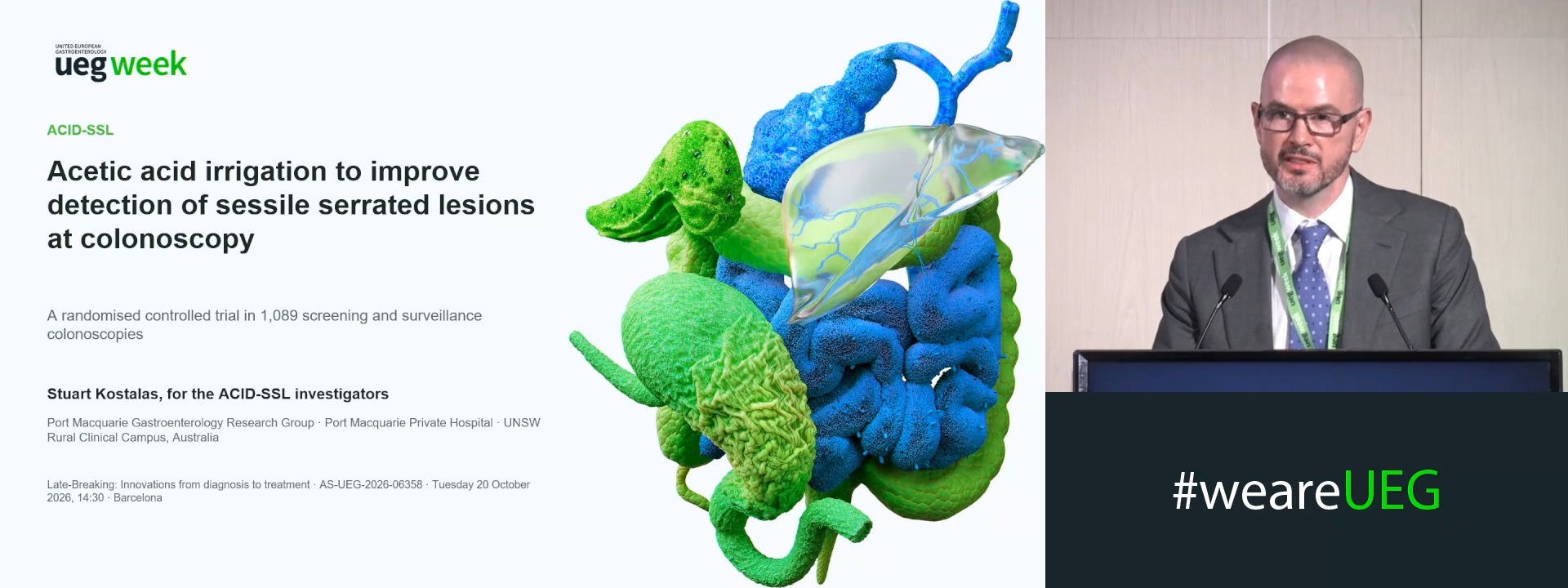
ACETIC ACID IRRIGATION VERSUS CONTROL IRRIGATION TO IMPROVE DETECTION OF SESSILE SERRATED LESIONS DURING COLONOSCOPY IN AN AVERAGE-RISK POPULATION: A PROSPECTIVE RANDOMISED CONTROLLED TRIAL (ACID-SSL)
Natalie Dierick 1, Kirsten McIntosh 2, Sue Myers 2, Christina Lee 1, Michael Wu 1, Joshua McCarthy 1,2, Praka Sundaralingam 1, Stuart Kostalas 1,3,2
Affiliations
1 Port Macquarie Gastroenterology Research Group, Thrumster, Australia
2 Port Macquarie Private Hospital, Port Macquarie, Australia
3 University of NSW, Port Macquarie, Australia
Log in to continue.
This content is part of Gutflix. Log in with your myUEG account, or create one free, to watch it.
Not sure what you can access? Learn more about account types.
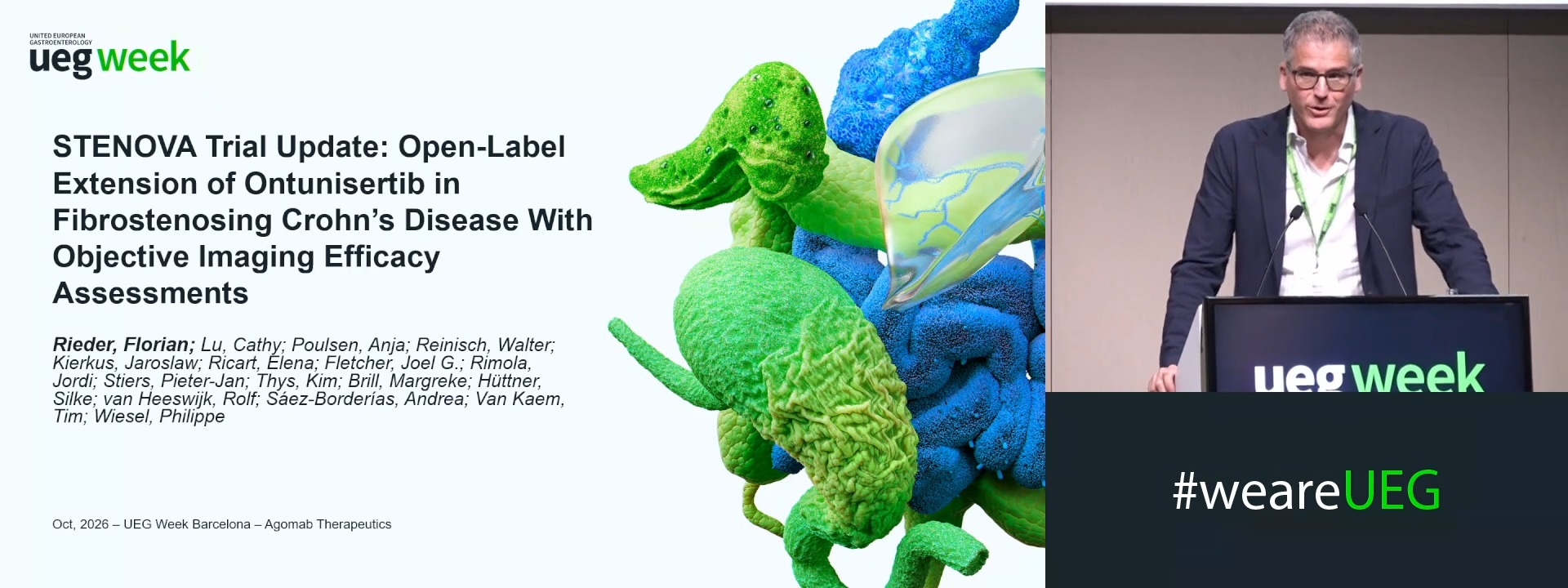
STENOVA TRIAL UPDATE: OPEN-LABEL EXTENSION OF ONTUNISERTIB IN FIBROSTENOSING CROHN’S DISEASE WITH OBJECTIVE IMAGING EFFICACY ASSESSMENTS
Florian Rieder 1, Cathy Lu 2, Anja Poulsen 3, Walter Reinisch 4, Jaroslaw Kierkus 5, Elena Ricart 6, Joel Flechter 7, Jordi Rimola 8, Pieter-Jan Stiers 9, Kim Thys 9, Margreke Brill 9, Silke Hüttner 9, Rolf Van Heeswijk 9, Andrea Saez 10, Tim Van Kaem 9, Philippe Wiesel 11
Affiliations
1 Cleveland Clinic Foundation, Cleveland Heights, United States
2 University Of Calgary, Calgary, Canada
3 Rigshospitalet, Copenhagen Ø, Denmark
4 Medical University of Vienna, Wien, Austria
5 Children’s Memorial Health Institute, Warsaw, Poland
6 Hospital Clinic, Barcelona, Spain
7 Mayo Clinic, Rochester, United States
8 Hospital Clínic Barcelona, Barcelona, Spain
9 Agomab Therapeutics NV, Berchem, Belgium
10 Agomab Spain S.L.U., A Coruña, Spain
11 Agomab US, Cambridge, United States