Introduction
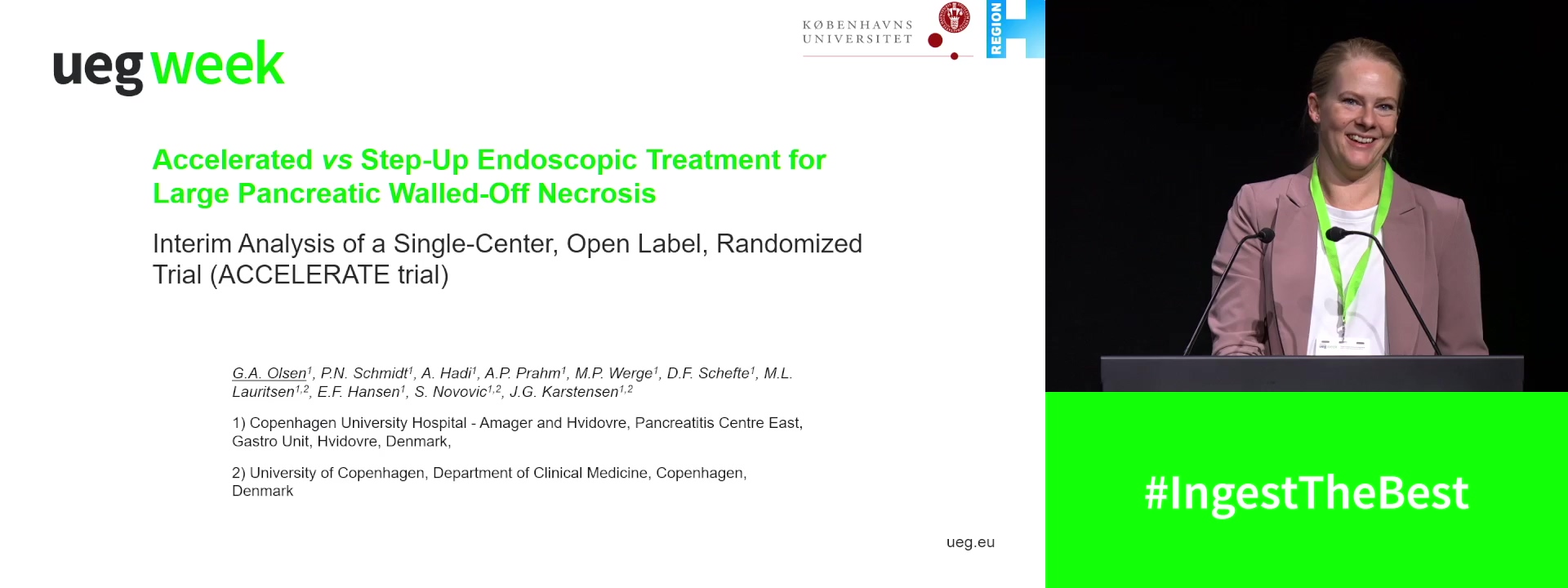
Pancreatic walled-off necrosis (WON) is a complication of acute necrotizing pancreatitis often resulting in prolonged hospitalization1. While the endoscopic step-up approach with endoscopic ultrasound guided transmural drainage followed by, if necessary, endoscopic necrosectomy, has become gold standard for treating WON, a recent study suggests that performing necrosectomy immediately after drainage yields favorable outcomes2. However, the necrotic collections in that study were of limited size, raising questions as to whether these findings can be generalized to patients with more complicated WON. We hypothesize that an accelerated treatment algorithm for patients with large WON could reduce hospital length of stay (LOS) and decrease the incidence of major complications.
Aims & Methods
This single-center, open-label, randomized controlled superiority trial enrolled patients with WON with a diameter > 15 cm, who were assigned to either an accelerated or conventional step-up treatment algorithm. Both groups underwent transgastric drainage with a 20 mm lumen-apposing metal stent. In the accelerated group, necrosectomy was performed during the index procedure and continued as needed until the WON cavity was cleared of necrotic tissue. In the step-up group, subsequent endoscopic necrosectomy or additional drainage was only performed if clinical improvement was not observed. The primary endpoint was a composite of death during treatment, major complications (as defined by the TENSION protocol3), and LOS exceeding 58 days from the index procedure. The endpoint of LOS exceeding 58 days was chosen based on a recent trial performed at our center, which found a median LOS in comparable patients to be 58 days4. Secondary outcomes included mortality, major complications, and LOS. To ensure the safety of the accelerated approach, an interim analysis was performed after treatment of 25 patients according to protocol (ClinicalTrials.gov NCT05601687).
Results
A total of 25 patients were included in this interim analysis: 12 in the accelerated group and 13 in the step-up group. The groups were comparable in terms of gender distribution, age, Charlson Comorbidity score, etiology of acute pancreatitis, indication for treatment, and WON size, with an overall median diameter of 21.7 cm [interquartile range (IQR) 18.0-25.0], defined as the largest measured diameter of the WON on cross-sectional imaging. The primary composite outcome occurred in 2 of 12 patients (16.6%) in the accelerated group and in 9 of 13 patients (69.3%) in the step-up group (odds ratio (OR) 0.089; p = 0.015). One patient in the step-up group died because of hemorrhage 14 days after index procedure. Major complications were significantly lower in the accelerated group (8.3% vs. 53.8%; OR 0.078; p = 0.030). In the step-up group, the first encountered major complication occurred a median of 38 days [IQR 24-42] after initial drainage. The median LOS was significantly shorter in the accelerated group (32.5 days [IQR 17.5-38.2] vs. 68.5 days [IQR 35.5-97.8], p = 0.039).
Conclusion
An accelerated treatment algorithm seems to reduce both the rate of major complications and the LOS compared to a conventional step-up approach, suggesting that a more aggressive treatment approach is preferable in patients with large symptomatic WON.
References
1. Ebrahim M, Werge MP, Hadi A, et al. Clinical outcomes following endoscopic or video-assisted retroperitoneal management of acute pancreatitis with large (>15 cm) walled-off pancreatic necrosis: Retrospective, single tertiary center cohort study. Digestive Endoscopy. 2022;34(6):1245-1252. doi:10.1111/den.14295
2. Bang JY, Lakhtakia S, Thakkar S, et al. Upfront endoscopic necrosectomy or step-up endoscopic approach for infected necrotising pancreatitis (DESTIN): a single-blinded, multicentre, randomised trial. Lancet Gastroenterol Hepatol. 2024;9(1):22-33. doi:10.1016/S2468-1253(23)00331-X
3. van Brunschot S, van Grinsven J, van Santvoort HC, et al. Endoscopic or surgical step-up approach for infected necrotising pancreatitis: a multicentre randomised trial. The Lancet. 2018;391(10115):51-58. doi:10.1016/S0140-6736(17)32404-2
4. Karstensen JG, Novovic S, Hansen EF, et al. EUS-guided drainage of large walled-off pancreatic necroses using plastic versus lumen-apposing metal stents: a single-centre randomised controlled trial. Gut. 2023;72(6):1167-1173. doi:10.1136/gutjnl-2022-328225