UEG's content platform for gastroenterology education bringing recordings, courses, guidelines, and more together in one place.
Trending on Gutflix
Rate for better recommendations!
Your feedback helps us show you more of what you like and less of what you dislike!
Log in to continue.
This content is part of Gutflix. Log in with your myUEG account, or create one free, to watch it.
Not sure what you can access? Learn more about account types.
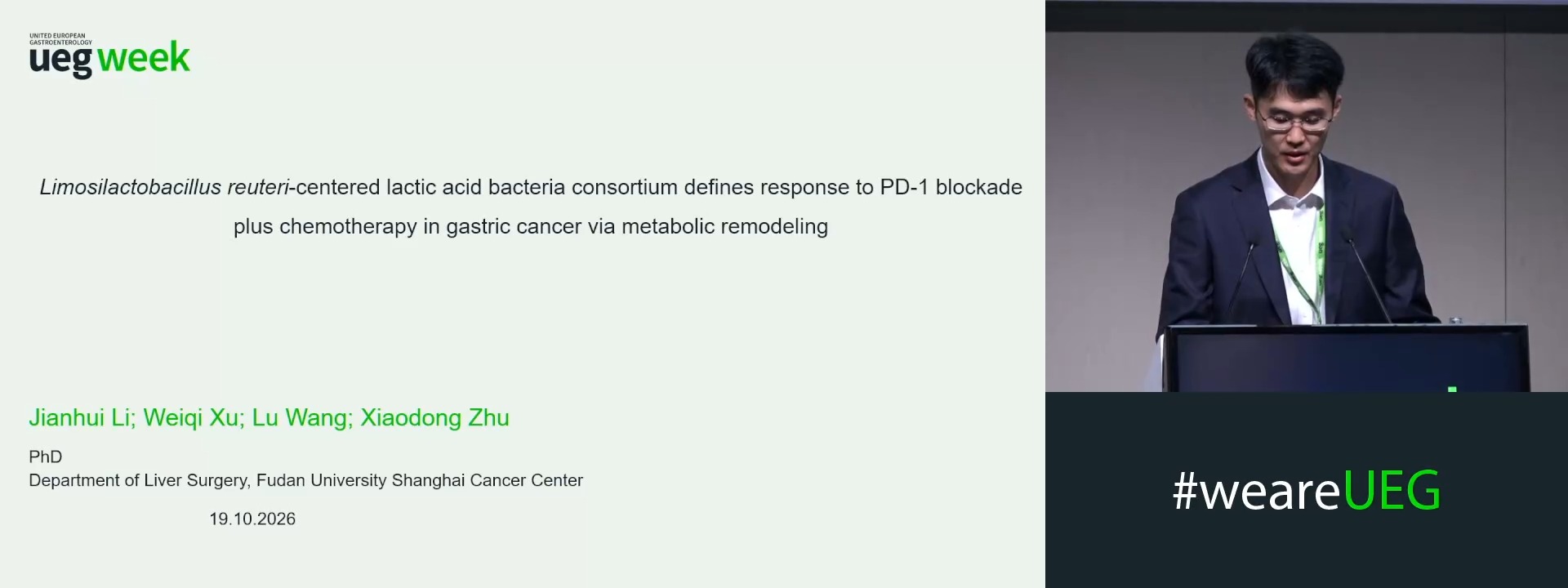
A LIMOSILACTOBACILLUS REUTERI-CENTERED LACTIC ACID BACTERIA CONSORTIUM DEFINES RESPONSE TO PD-1 BLOCKADE PLUS CHEMOTHERAPY IN GASTRIC CANCER VIA METABOLIC REMODELING
Affiliations
1 Fudan University Shanghai Cancer Center, Shanghai, China
2 Shanghai Medical College, Fudan University, Shanghai, China
Log in to continue.
This content is part of Gutflix. Log in with your myUEG account, or create one free, to watch it.
Not sure what you can access? Learn more about account types.
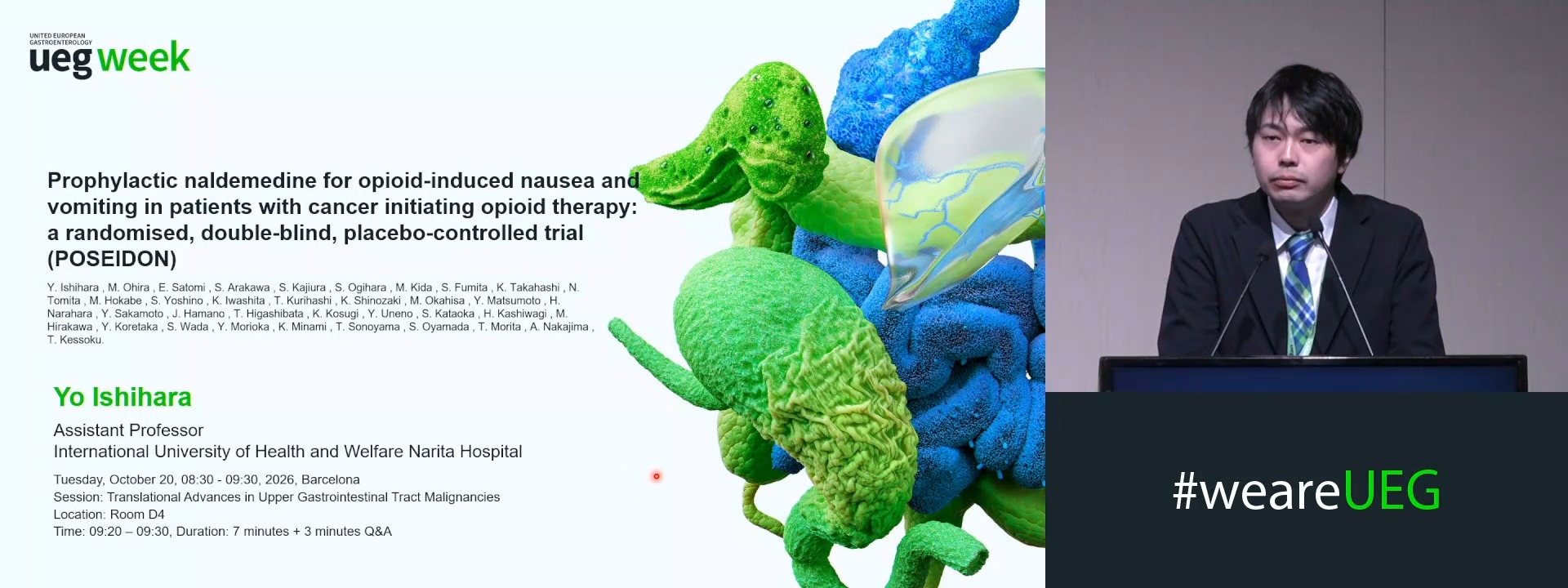
PROPHYLACTIC NALDEMEDINE FOR OPIOID-INDUCED NAUSEA AND VOMITING IN PATIENTS WITH CANCER INITIATING OPIOID THERAPY: A RANDOMIZED, DOUBLE-BLIND, PLACEBO-CONTROLLED TRIAL (POSEIDON)
Yo Ishihara 1,2, Mayumi Ohira 1, Eriko Satomi 3, Sayaka Arakawa 3, Shinya Kajiura 4, Suguru Ogihara 5, Masaki Kida 5, Soichi Fumita 6, Kota Takahashi 1,2, Naoki Tomita 1,2, Mitsuki Hokabe 1, Sadaaki Yoshino 1, Kohei Iwashita 1, Takeo Kurihashi 7, Katsunori Shinozaki 8, Masanobu Okahisa 9, Yoshihisa Matsumoto 9, Hiroyuki Narahara 10, Yasuhiro Sakamoto 11, Jun Hamano 12, Takahiro Higashibata 12, Kazuhiro Kosugi 12, Yu Uneno 13, Shigeki Kataoka 14, Hideyuki Kashiwagi 15, Mami Hirakawa 16, Yuichi Koretaka 17, Shihomi Wada 17, Yasuhide Morioka 17, Kazuhisa Minami 17, Takuhiro Sonoyama 17, Shunsuke Oyamada 18, Tatsuya Morita 19, Atsushi Nakajima 20, Takaomi Kessoku 21,2
Affiliations
1 International University of Health and Welfare Narita Hospital, Narita, Japan
2 IUHW School of Medicine, Narita, Japan
3 National Cancer Center Hospital, Tokyo, Japan
4 Toyama University Hospital, Toyama, Japan
5 Showa University Koto Toyosu Hospital, Tokyo, Japan
6 Kindai University Nara Hospital, Nara, Japan
7 Kanagawa Dental University Yokohama Clinic, Kanagawa, Japan
8 Hiroshima Prefectural Hospital, Hiroshima, Japan
9 Cancer Institute Hospital of Japanese Foundation for Cancer Research, Tokyo, Japan
10 Hyogo Prefectural Nishinomiya Hospital, Nishinomiya, Japan
11 Osaki Citizen Hospital, Ozaki, Japan
12 Institute of Medicine, University of Tsukuba, Tsukuba, Japan
13 Kyoto University Hospital, Kyoto, Japan
14 Graduate School of Medicine, Kyoto University, Kyoto, Japan
15 Iizuka Hospital, Iizuka, Japan
16 St. Marianna University School of Medicine, Kanagawa, Japan
17 Shionogi & Co., Ltd., Osaka, Japan
18 JORTC Data Centre, Tokyo, Japan
19 Seirei Mikatahara General Hospital, Shizuoka, Japan
20 International University of Health and Welfare Atami Hospital, Atami, Japan
21 International University Of Health And Welfare Narita Hospital, Narita, Japan