UEG Week Recordings UEG Week Posters Online courses Guidelines Mistakes in... Podcasts Webinars
new
Gut Guide online
Visit ueg.eu Create myUEG account Log In

Filters:

UEG Presentation
Share via Email Share on Facebook Share on X Share on LinkedIn Share on Bluesky
UEG Journal Best Paper Award

Log in to continue.

This content is part of Gutflix. Log in with your myUEG account, or create one free, to watch it.

Log In Create a free account

Not sure what you can access? Learn more about account types.

UEG Journal Best Paper Award

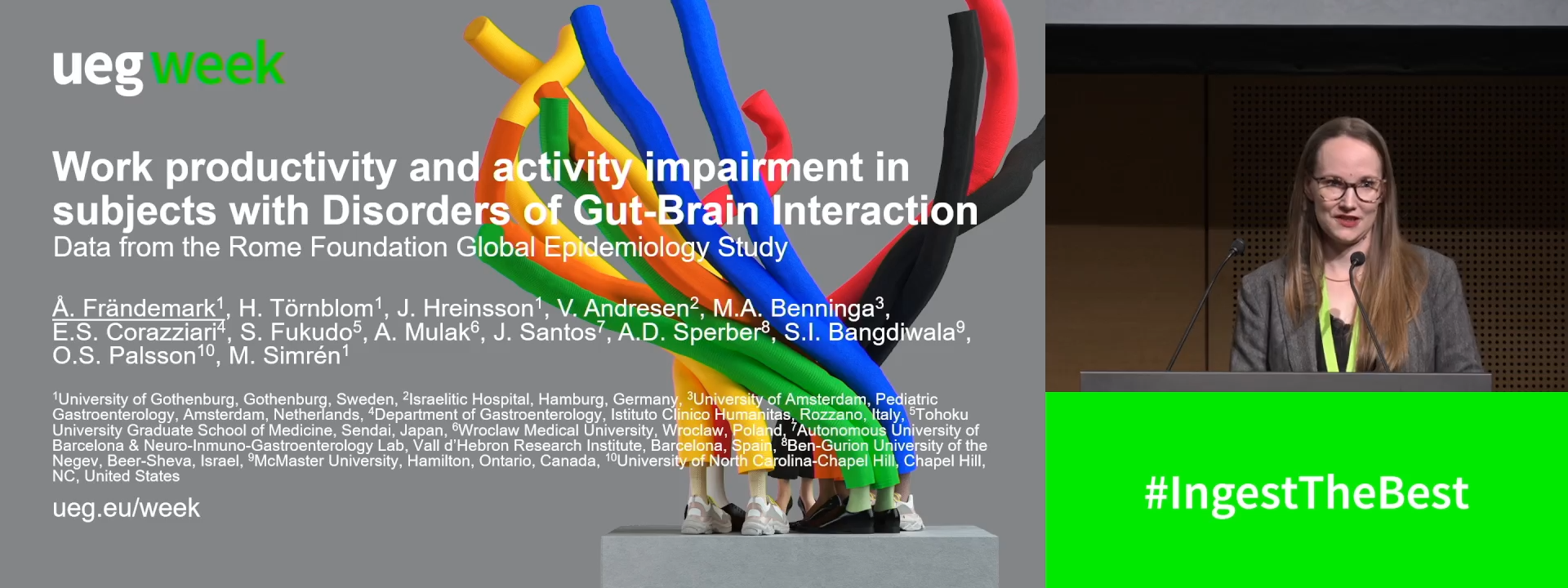
Joost Drenth 1, Åsa Frändemark 2

Affiliations

1 Radboudumc University Nijmegen Medical Centre, Nijmegen, Netherlands

2 Department of Molecular and Clinical Medicine, Gothenburg, Sweden
Summary

AI Generated

A multinational population-based study of 16,820 respondents found that persons with disorders of gut-brain interaction experience substantial work productivity and daily activity impairments compared to those without these disorders.

  • The speaker reported that 7,111 of 16,820 respondents had disorders of gut-brain interaction (formerly functional GI disorders), and these individuals showed higher impairment on all four work productivity measures: absenteeism, presenteeism, overall work impairment, and activity impairment outside work.
  • Participants with disorders affecting multiple anatomical regions of the GI tract had progressively higher work impairments for each additional region affected, and those with painful disorders had higher impairment than those with non-painful disorders.
  • Regression analysis identified fatigue, somatic symptom severity, psychological distress, number of affected anatomical regions, and male sex as independent factors associated with overall work impairment in persons with these disorders.
  • The study used data from eight countries (Germany, Israel, Italy, Japan, the Netherlands, Poland, Spain, and Sweden) collected via internet surveys with the Rome IV Diagnostic Questionnaire and Work Productivity and Activity Impairment questionnaire.
  • Participants with disorders of gut-brain interaction were younger, more often female, and had higher levels of psychological distress and somatic symptom severity than those without these disorders.
Download PDF

Was this helpful?

Thanks for your feedback.

This summary was generated by an AI large language model based on the content transcript. It is for informational purposes only and should not be considered a substitute for clinical judgment. Always rely on your professional expertise and the full clinical context when making clinical decisions.

Abstract

Event

UEG Week Vienna 2024

Topics

Digestive Oncology Endoscopy Pancreas

Session

UEG Journal Session

Citation

United European Gastroenterology Journal 2024; 12 (Supplement 8)

Published

2024

More Like This:

A road to a multidisciplinary management of MASLD: The new EASL/EASD/EASO CPG

A road to a multidisciplinary management of MASLD: The new EASL/EASD/EASO CPG

Frank Tacke Frank Tacke

Bowel ischaemia: Strategies to avoid disaster

Bowel ischaemia: Strategies to avoid disaster

Yves Panis Yves Panis

Panel Discussion: Diabetes in GI disorders

Panel Discussion: Diabetes in GI disorders

Predictors of treatment response in hepatorenal syndrome

Predictors of treatment response in hepatorenal syndrome

Heiner Wedemeyer Heiner Wedemeyer

How to prevent MAFLD and MASH

How to prevent MAFLD and MASH

Shira Zelber-Sagi Shira Zelber-Sagi

COMPARISON OF NORMAL VS INTENSIFIED VACCINE REGIMENS AGAINST PNEUMOCOCCUS IN CD PATIENTS UNDER BIOTHERAPY: A PROSPECTIVE, MULTICENTER, RANDOMIZED, OPEN-LABEL PNEUMOMICI STUDY

COMPARISON OF NORMAL VS INTENSIFIED VACCINE REGIMENS AGAINST PNEUMOCOCCUS IN CD PATIENTS UNDER BIOTHERAPY: A PROSPECTIVE, MULTICENTER, RANDOMIZED, OPEN-LABEL PNEUMOMICI STUDY

Stéphane Paul Stéphane Paul, Mathilde BARRAU, Anne-Emmanuelle Berger, Mathurin Fumery, Guillaume Bouguen, Stéphanie Viennot, Guillaume Savoye, Nadia Arab, Xavier Hebuterne, Stephane NANCEY, Xavier Roblin

UEG Presentation
Share via Email Share on Facebook Share on X Share on LinkedIn Share on Bluesky
A road to a multidisciplinary management of MASLD: The new EASL/EASD/EASO CPG

Log in to continue.

This content is part of Gutflix. Log in with your myUEG account, or create one free, to watch it.

Log In Create a free account

Not sure what you can access? Learn more about account types.

A road to a multidisciplinary management of MASLD: The new EASL/EASD/EASO CPG

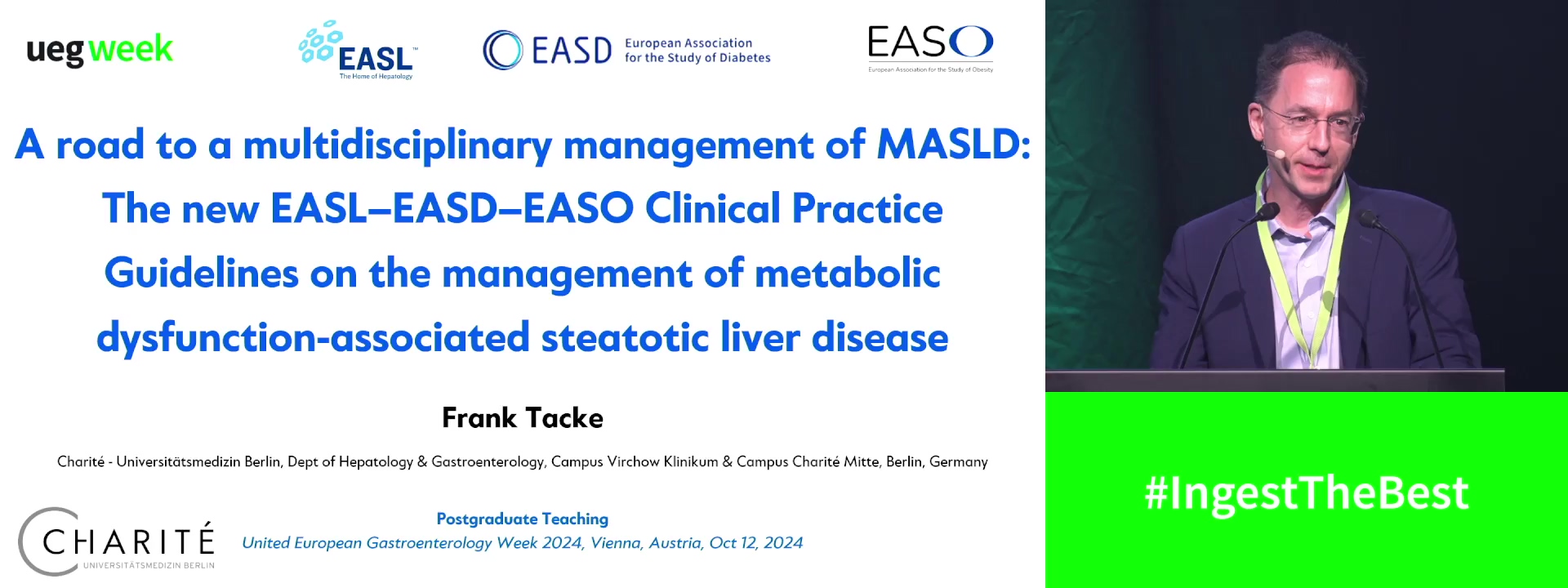
Frank Tacke 1

Affiliations

1 Charité Universitaetsmedizin Berlin, Dept of Hepatology & Gastroenterology, Berlin, Germany
Summary

AI Generated

Summary is not available for this content yet.

Download PDF

Was this helpful?

Thanks for your feedback.

This summary was generated by an AI large language model based on the content transcript. It is for informational purposes only and should not be considered a substitute for clinical judgment. Always rely on your professional expertise and the full clinical context when making clinical decisions.

Abstract

Event

UEG Postgraduate Teaching Programme Vienna 2024

Topics

Education & Training Hepatobiliary Primary Care

Session

Metabolic dysfunction: Associated steatotic liver disease

Citation

United European Gastroenterology Journal 2024; 12 (Supplement 8)

Published

2024

More Like This:

A road to a multidisciplinary management of MASLD: The new EASL/EASD/EASO CPG

A road to a multidisciplinary management of MASLD: The new EASL/EASD/EASO CPG

Frank Tacke Frank Tacke

Bowel ischaemia: Strategies to avoid disaster

Bowel ischaemia: Strategies to avoid disaster

Yves Panis Yves Panis

Panel Discussion: Diabetes in GI disorders

Panel Discussion: Diabetes in GI disorders

Predictors of treatment response in hepatorenal syndrome

Predictors of treatment response in hepatorenal syndrome

Heiner Wedemeyer Heiner Wedemeyer

How to prevent MAFLD and MASH

How to prevent MAFLD and MASH

Shira Zelber-Sagi Shira Zelber-Sagi

COMPARISON OF NORMAL VS INTENSIFIED VACCINE REGIMENS AGAINST PNEUMOCOCCUS IN CD PATIENTS UNDER BIOTHERAPY: A PROSPECTIVE, MULTICENTER, RANDOMIZED, OPEN-LABEL PNEUMOMICI STUDY

COMPARISON OF NORMAL VS INTENSIFIED VACCINE REGIMENS AGAINST PNEUMOCOCCUS IN CD PATIENTS UNDER BIOTHERAPY: A PROSPECTIVE, MULTICENTER, RANDOMIZED, OPEN-LABEL PNEUMOMICI STUDY

Stéphane Paul Stéphane Paul, Mathilde BARRAU, Anne-Emmanuelle Berger, Mathurin Fumery, Guillaume Bouguen, Stéphanie Viennot, Guillaume Savoye, Nadia Arab, Xavier Hebuterne, Stephane NANCEY, Xavier Roblin

UEG Presentation
Share via Email Share on Facebook Share on X Share on LinkedIn Share on Bluesky
Bowel ischaemia: Strategies to avoid disaster

Log in to continue.

This content is part of Gutflix. Log in with your myUEG account, or create one free, to watch it.

Log In Create a free account

Not sure what you can access? Learn more about account types.

Bowel ischaemia: Strategies to avoid disaster

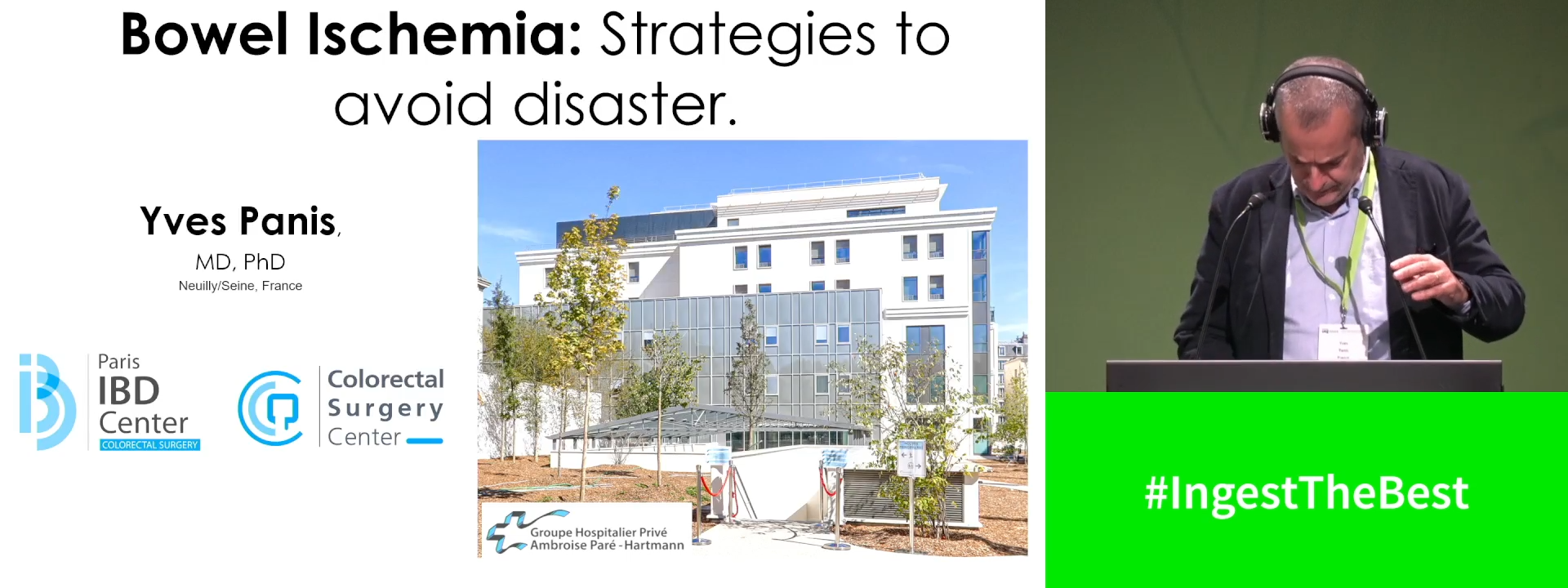
Yves Panis 1

Affiliations

1 Beaujon Hospital - Beaujon Hospital; Clichy/FR, Clichy, France

Summary

AI Generated

Summary is not available for this content yet.

Download PDF

Was this helpful?

Thanks for your feedback.

This summary was generated by an AI large language model based on the content transcript. It is for informational purposes only and should not be considered a substitute for clinical judgment. Always rely on your professional expertise and the full clinical context when making clinical decisions.

Abstract

Event

UEG Week Vienna 2024

Topics

Endoscopy Hepatobiliary Standards & Guidelines Surgery

Session

Therapy update: Abdominal emergencies in gastroenterology

Citation

United European Gastroenterology Journal 2024; 12 (Supplement 8)

Published

2024

More Like This:

A road to a multidisciplinary management of MASLD: The new EASL/EASD/EASO CPG

A road to a multidisciplinary management of MASLD: The new EASL/EASD/EASO CPG

Frank Tacke Frank Tacke

Bowel ischaemia: Strategies to avoid disaster

Bowel ischaemia: Strategies to avoid disaster

Yves Panis Yves Panis

Panel Discussion: Diabetes in GI disorders

Panel Discussion: Diabetes in GI disorders

Predictors of treatment response in hepatorenal syndrome

Predictors of treatment response in hepatorenal syndrome

Heiner Wedemeyer Heiner Wedemeyer

How to prevent MAFLD and MASH

How to prevent MAFLD and MASH

Shira Zelber-Sagi Shira Zelber-Sagi

COMPARISON OF NORMAL VS INTENSIFIED VACCINE REGIMENS AGAINST PNEUMOCOCCUS IN CD PATIENTS UNDER BIOTHERAPY: A PROSPECTIVE, MULTICENTER, RANDOMIZED, OPEN-LABEL PNEUMOMICI STUDY

COMPARISON OF NORMAL VS INTENSIFIED VACCINE REGIMENS AGAINST PNEUMOCOCCUS IN CD PATIENTS UNDER BIOTHERAPY: A PROSPECTIVE, MULTICENTER, RANDOMIZED, OPEN-LABEL PNEUMOMICI STUDY

Stéphane Paul Stéphane Paul, Mathilde BARRAU, Anne-Emmanuelle Berger, Mathurin Fumery, Guillaume Bouguen, Stéphanie Viennot, Guillaume Savoye, Nadia Arab, Xavier Hebuterne, Stephane NANCEY, Xavier Roblin

UEG Presentation
Share via Email Share on Facebook Share on X Share on LinkedIn Share on Bluesky
Panel Discussion: Diabetes in GI disorders

Log in to continue.

This content is part of Gutflix. Log in with your myUEG account, or create one free, to watch it.

Log In Create a free account

Not sure what you can access? Learn more about account types.

Panel Discussion: Diabetes in GI disorders
Summary

AI Generated

Summary is not available for this content yet.

Download PDF

Was this helpful?

Thanks for your feedback.

This summary was generated by an AI large language model based on the content transcript. It is for informational purposes only and should not be considered a substitute for clinical judgment. Always rely on your professional expertise and the full clinical context when making clinical decisions.

Abstract

Event

UEG Postgraduate Teaching Programme Berlin 2025

Topics

Gut Microbiota Hepatobiliary Mechanisms & Personalised Medicine

Session

Diabetes in GI disorders

Citation

United European Gastroenterology Journal 2025; 13 (Supplement 8)

Published

2025

More Like This:

A road to a multidisciplinary management of MASLD: The new EASL/EASD/EASO CPG

A road to a multidisciplinary management of MASLD: The new EASL/EASD/EASO CPG

Frank Tacke Frank Tacke

Bowel ischaemia: Strategies to avoid disaster

Bowel ischaemia: Strategies to avoid disaster

Yves Panis Yves Panis

Panel Discussion: Diabetes in GI disorders

Panel Discussion: Diabetes in GI disorders

Predictors of treatment response in hepatorenal syndrome

Predictors of treatment response in hepatorenal syndrome

Heiner Wedemeyer Heiner Wedemeyer

How to prevent MAFLD and MASH

How to prevent MAFLD and MASH

Shira Zelber-Sagi Shira Zelber-Sagi

COMPARISON OF NORMAL VS INTENSIFIED VACCINE REGIMENS AGAINST PNEUMOCOCCUS IN CD PATIENTS UNDER BIOTHERAPY: A PROSPECTIVE, MULTICENTER, RANDOMIZED, OPEN-LABEL PNEUMOMICI STUDY

COMPARISON OF NORMAL VS INTENSIFIED VACCINE REGIMENS AGAINST PNEUMOCOCCUS IN CD PATIENTS UNDER BIOTHERAPY: A PROSPECTIVE, MULTICENTER, RANDOMIZED, OPEN-LABEL PNEUMOMICI STUDY

Stéphane Paul Stéphane Paul, Mathilde BARRAU, Anne-Emmanuelle Berger, Mathurin Fumery, Guillaume Bouguen, Stéphanie Viennot, Guillaume Savoye, Nadia Arab, Xavier Hebuterne, Stephane NANCEY, Xavier Roblin

UEG Presentation
Share via Email Share on Facebook Share on X Share on LinkedIn Share on Bluesky
Predictors of treatment response in hepatorenal syndrome

Log in to continue.

This content is part of Gutflix. Log in with your myUEG account, or create one free, to watch it.

Log In Create a free account

Not sure what you can access? Learn more about account types.

Predictors of treatment response in hepatorenal syndrome

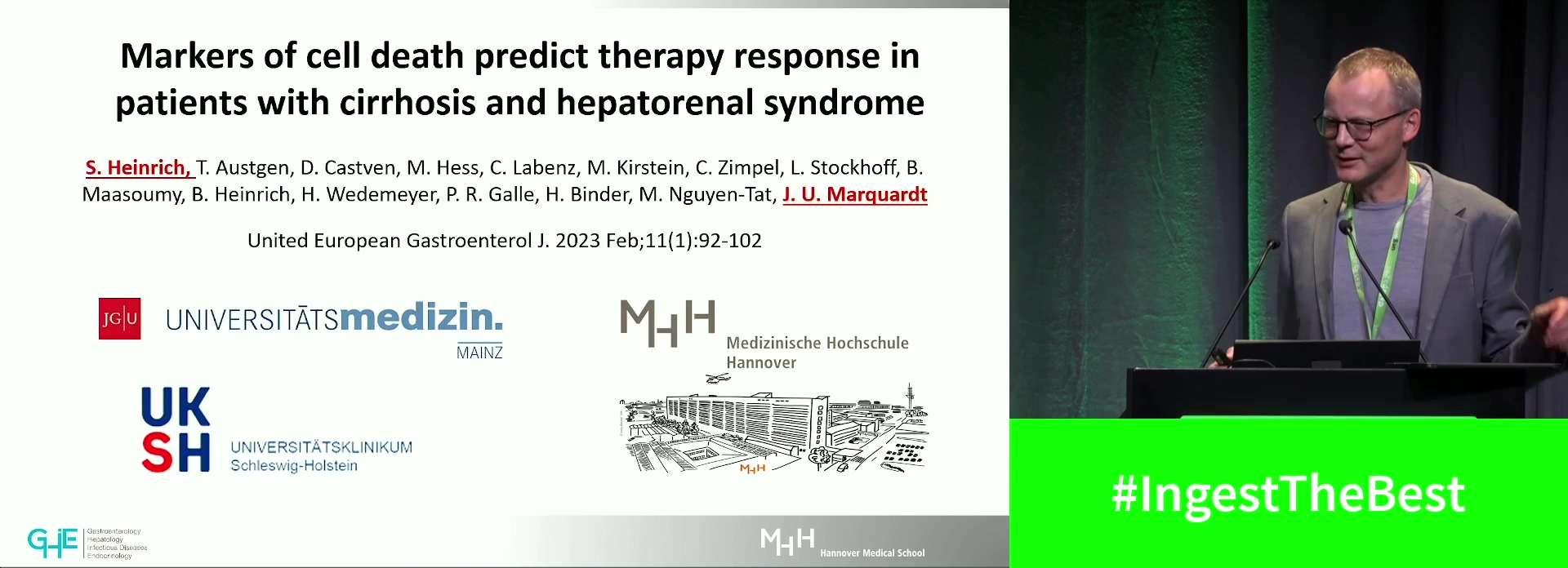
Heiner Wedemeyer 1

Affiliations

1 Hannover Medical School, Hannover, Germany
Summary

AI Generated

Summary is not available for this content yet.

Download PDF

Was this helpful?

Thanks for your feedback.

This summary was generated by an AI large language model based on the content transcript. It is for informational purposes only and should not be considered a substitute for clinical judgment. Always rely on your professional expertise and the full clinical context when making clinical decisions.

Abstract

Event

UEG Week Copenhagen 2023

Topics

Hepatobiliary

Session

Best of hepatology in UEG Journal

Published

2023

More Like This:

A road to a multidisciplinary management of MASLD: The new EASL/EASD/EASO CPG

A road to a multidisciplinary management of MASLD: The new EASL/EASD/EASO CPG

Frank Tacke Frank Tacke

Bowel ischaemia: Strategies to avoid disaster

Bowel ischaemia: Strategies to avoid disaster

Yves Panis Yves Panis

Panel Discussion: Diabetes in GI disorders

Panel Discussion: Diabetes in GI disorders

Predictors of treatment response in hepatorenal syndrome

Predictors of treatment response in hepatorenal syndrome

Heiner Wedemeyer Heiner Wedemeyer

How to prevent MAFLD and MASH

How to prevent MAFLD and MASH

Shira Zelber-Sagi Shira Zelber-Sagi

COMPARISON OF NORMAL VS INTENSIFIED VACCINE REGIMENS AGAINST PNEUMOCOCCUS IN CD PATIENTS UNDER BIOTHERAPY: A PROSPECTIVE, MULTICENTER, RANDOMIZED, OPEN-LABEL PNEUMOMICI STUDY

COMPARISON OF NORMAL VS INTENSIFIED VACCINE REGIMENS AGAINST PNEUMOCOCCUS IN CD PATIENTS UNDER BIOTHERAPY: A PROSPECTIVE, MULTICENTER, RANDOMIZED, OPEN-LABEL PNEUMOMICI STUDY

Stéphane Paul Stéphane Paul, Mathilde BARRAU, Anne-Emmanuelle Berger, Mathurin Fumery, Guillaume Bouguen, Stéphanie Viennot, Guillaume Savoye, Nadia Arab, Xavier Hebuterne, Stephane NANCEY, Xavier Roblin

UEG Presentation
Share via Email Share on Facebook Share on X Share on LinkedIn Share on Bluesky
How to prevent MAFLD and MASH

Log in to continue.

This content is part of Gutflix. Log in with your myUEG account, or create one free, to watch it.

Log In Create a free account

Not sure what you can access? Learn more about account types.

How to prevent MAFLD and MASH

Shira Zelber-Sagi 1

Affiliations

1 University of Haifa, Tel Aviv, Israel
Summary

AI Generated

Summary is not available for this content yet.

Download PDF

Was this helpful?

Thanks for your feedback.

This summary was generated by an AI large language model based on the content transcript. It is for informational purposes only and should not be considered a substitute for clinical judgment. Always rely on your professional expertise and the full clinical context when making clinical decisions.

Abstract

Event

UEG Week Vienna 2024

Topics

Hepatobiliary Surgery

Session

Advances in metabolic disorders: Liver injury - prevent or rescue

Citation

United European Gastroenterology Journal 2024; 12 (Supplement 8)

Published

2024

More Like This:

A road to a multidisciplinary management of MASLD: The new EASL/EASD/EASO CPG

A road to a multidisciplinary management of MASLD: The new EASL/EASD/EASO CPG

Frank Tacke Frank Tacke

Bowel ischaemia: Strategies to avoid disaster

Bowel ischaemia: Strategies to avoid disaster

Yves Panis Yves Panis

Panel Discussion: Diabetes in GI disorders

Panel Discussion: Diabetes in GI disorders

Predictors of treatment response in hepatorenal syndrome

Predictors of treatment response in hepatorenal syndrome

Heiner Wedemeyer Heiner Wedemeyer

How to prevent MAFLD and MASH

How to prevent MAFLD and MASH

Shira Zelber-Sagi Shira Zelber-Sagi

COMPARISON OF NORMAL VS INTENSIFIED VACCINE REGIMENS AGAINST PNEUMOCOCCUS IN CD PATIENTS UNDER BIOTHERAPY: A PROSPECTIVE, MULTICENTER, RANDOMIZED, OPEN-LABEL PNEUMOMICI STUDY

COMPARISON OF NORMAL VS INTENSIFIED VACCINE REGIMENS AGAINST PNEUMOCOCCUS IN CD PATIENTS UNDER BIOTHERAPY: A PROSPECTIVE, MULTICENTER, RANDOMIZED, OPEN-LABEL PNEUMOMICI STUDY

Stéphane Paul Stéphane Paul, Mathilde BARRAU, Anne-Emmanuelle Berger, Mathurin Fumery, Guillaume Bouguen, Stéphanie Viennot, Guillaume Savoye, Nadia Arab, Xavier Hebuterne, Stephane NANCEY, Xavier Roblin

UEG Presentation
Share via Email Share on Facebook Share on X Share on LinkedIn Share on Bluesky
COMPARISON OF NORMAL VS INTENSIFIED VACCINE REGIMENS AGAINST PNEUMOCOCCUS IN CD PATIENTS UNDER BIOTHERAPY: A PROSPECTIVE, MULTICENTER, RANDOMIZED, OPEN-LABEL PNEUMOMICI STUDY

Log in to continue.

This content is part of Gutflix. Log in with your myUEG account, or create one free, to watch it.

Log In Create a free account

Not sure what you can access? Learn more about account types.

COMPARISON OF NORMAL VS INTENSIFIED VACCINE REGIMENS AGAINST PNEUMOCOCCUS IN CD PATIENTS UNDER BIOTHERAPY: A PROSPECTIVE, MULTICENTER, RANDOMIZED, OPEN-LABEL PNEUMOMICI STUDY

Xavier Roblin 1, Stephane NANCEY 2, Xavier Hebuterne 3, Nadia Arab 3, Guillaume Savoye 4, Stéphanie Viennot 5, Guillaume Bouguen 6, Mathurin Fumery 7, Anne-Emmanuelle Berger 8, Mathilde BARRAU 9, Stéphane Paul 10

Affiliations

1 University of St. Etienne Dept. de Gastroenterologie, Saint Etienne, France

2 University Hospital, Pierre Benite, France

3 Hospital Archet 2, Nice, Nice, France

4 Hopiaux de Rouen, Rouen, France

5 CHRU de Caen HGE 19è étage, Caen Cedex, France

6 CHU Pontchaillou, Rennes, France

7 Amiens University Hospital, Amiens, France

8 University Hospital Of Saint Etienne, Saint Etienne, France

9 Centre Hospitalo-universitaire De Saint Etienne, Saint Etienne, France

10 Hôpital Nord, Saint Etienne, France

Summary

AI Generated

Summary is not available for this content yet.

Download PDF

Was this helpful?

Thanks for your feedback.

This summary was generated by an AI large language model based on the content transcript. It is for informational purposes only and should not be considered a substitute for clinical judgment. Always rely on your professional expertise and the full clinical context when making clinical decisions.

Abstract

Introduction

Pneumococcal vaccination is essential in IBD patients. However, its efficacy in patients on immunosuppressive or anti-TNF therapy is much lower than in the normal population (45% vs 80%). Vaccine regimen recommendations vary according to the degree of immunodepression. The aim of our study was to identify an optimal vaccination strategy for immunocompromised IBD patients treated with anti-TNF, vedolizumab and/or IS.

Aims & Methods

This is a prospective, multicenter, randomized study comparing two vaccine regimens: intensified vaccine strategy (Prevenar13®/Prevenar13®/PSV-23® (or Pneumovax as a replacement for PSV-23) vs. normal strategy (Prevenar13®/PSV-23® (or Pneumovax as a replacement for PSV-23), (randomization 1: 1) on vaccine immunogenicity measured by antibody titer against at least 9 of the 13 pneumococcal serotypes contained in Prevenar13®. Any patient with confirmed IBD under biotherapy (anti TNF with or without immunosuppressive drugs or Vedolizumab) and in clinical remission (HBI <4 for CD and partial Mayo Score <3 for UC) was included. Vaccination and vaccine monitoring were carried out by the vaccination center of each center, with adverse events reported at each visit (8 for 36 months of follow-up), and ELISA and OPA serotype assays systematically collected and clinical activity was reported by the gastroenterologist at the same time. Correlate of protection in adults using serology testing was classically defined as at least 9 out of 13. Serotypes > 1µg/mL. For functional testing of antibodies using the Opsonophagocytic assays, we apply the well-defined 4 times increase of titer between pre and post-vaccination against at least 70% of serotypes. ClinicalTrials.gov Identifier: NCT02255227

Results

51 patients in the normal vaccination arm and 53 in the intensified vaccination arm were included (mean age: 42.9 years, male: 63%, CD: 68%, active smoking: 21%, duration of IBD: 10.2 years, 98% IBD inactive). Around 88% of patients were under anti-TNF monotherapy (28% on combotherapy) and 12% under vedolizumab. Serology criteria for good responders at M5 were 57.5% for the intensified regimen vs 25.6% for the standard regimen (RR: 2.25 (1.26;4.00), p = 0.003). For OPA correlate of protection, vaccine response was significantly greater in the intensified arm at all-time points: M5 (96% vs. 89%), M12 (76 vs. 58%) and M36 (68% vs. 36.8%). In multivariate analysis, two factors reduced vaccine response: anti-TNF use (RR: 6.84; CI95: 1.01-46.1; p=0.048) and CD type (RR: 9.48; CI95: 2.74-32.8; p:0.0004). The tolerability of the vaccine regimens was comparable throughout follow-up. In terms of IBD activity, percentage of clinical relapse was similar during follow-up (16.8% under the intensified regimen versus 25% under the normal regimen (p:NS).

Conclusion

In IBD on biotherapy and/or IS, the intensified pneumococcal vaccine regimen (2 injections of Prevenar followed by one of Pneumo 23) is significantly more immunogenic than a standard regimen, especially when using functional correlate of protection. The duration of the response is also greater in this intensified arm.

Event

UEG Week Vienna 2024

Topics

Digestive Oncology Histopathology IBD

Submission format

Abstract

Session

Finetuning treatment in IBD

Citation

United European Gastroenterology Journal 2024; 12 (Supplement 8)

Published

2024

More Like This:

A road to a multidisciplinary management of MASLD: The new EASL/EASD/EASO CPG

A road to a multidisciplinary management of MASLD: The new EASL/EASD/EASO CPG

Frank Tacke Frank Tacke

Bowel ischaemia: Strategies to avoid disaster

Bowel ischaemia: Strategies to avoid disaster

Yves Panis Yves Panis

Panel Discussion: Diabetes in GI disorders

Panel Discussion: Diabetes in GI disorders

Predictors of treatment response in hepatorenal syndrome

Predictors of treatment response in hepatorenal syndrome

Heiner Wedemeyer Heiner Wedemeyer

How to prevent MAFLD and MASH

How to prevent MAFLD and MASH

Shira Zelber-Sagi Shira Zelber-Sagi

COMPARISON OF NORMAL VS INTENSIFIED VACCINE REGIMENS AGAINST PNEUMOCOCCUS IN CD PATIENTS UNDER BIOTHERAPY: A PROSPECTIVE, MULTICENTER, RANDOMIZED, OPEN-LABEL PNEUMOMICI STUDY

COMPARISON OF NORMAL VS INTENSIFIED VACCINE REGIMENS AGAINST PNEUMOCOCCUS IN CD PATIENTS UNDER BIOTHERAPY: A PROSPECTIVE, MULTICENTER, RANDOMIZED, OPEN-LABEL PNEUMOMICI STUDY

Stéphane Paul Stéphane Paul, Mathilde BARRAU, Anne-Emmanuelle Berger, Mathurin Fumery, Guillaume Bouguen, Stéphanie Viennot, Guillaume Savoye, Nadia Arab, Xavier Hebuterne, Stephane NANCEY, Xavier Roblin

The global reference point for the digestive health community

Platform Publisher

United European Gastroenterology

Wickenburggasse 1 1080 Vienna, Austria

Contact us

support@ueg.eu

ueg.eu

T: +43 1 997 1639

Legal

Terms & Conditions

Imprint

Privacy Policy

Explore

My Bookmarks

My recommendations

My fields of interest

© 2026 United European Gastroenterology

Change fields of interest

These fields are selected based on the interests in your myUEG profile.
Click the item to unselect it. You can select multiple items.