UEG's content platform for gastroenterology education bringing recordings, courses, guidelines, and more together in one place.
Trending on Gutflix
Rate for better recommendations!
Your feedback helps us show you more of what you like and less of what you dislike!
Log in to continue.
This content is part of Gutflix. Log in with your myUEG account, or create one free, to watch it.
Not sure what you can access? Learn more about account types.
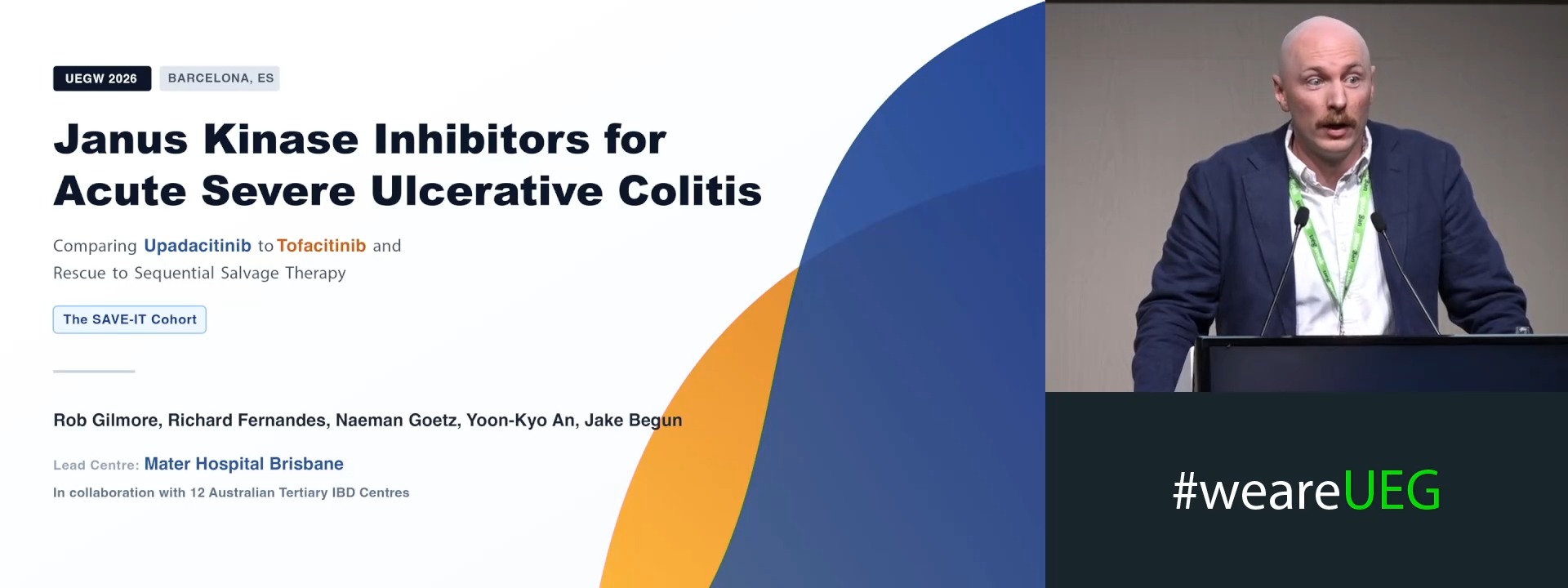
LONG-TERM OUTCOMES OF UPADACITINIB VERSUS TOFACITINIB FOR THE MANAGEMENT OF ACUTE SEVERE ULCERATIVE COLITIS: A MULTICENTRE REAL-WORLD STUDY COMPARING RESCUE AND SEQUENTIAL SALVAGE THERAPY
Robert Gilmore 1,2, Richard Fernandes 1,2, Naeman Goetz 1, Simone Chin 3, Daniel Con 3, Peter de Cruz 3, Kathryn Demase 4, Unknown Unknown 4, Sarah Lucas 5, Mayur Garg 5, Zachary Tuttle 6, Nichloas Clark 6, Daniel Tassone 6, Nik Ding 6, Moshe Loebenstein 7, Andrew Nguyen 7, Gregory Moore 7,8, Lena Thin 9, Kirsty Macfarlane 10, Kate D Lynch 10, Delo Subhaharan 11, Waled Mohsen 11, Adam Haig 12, Melissa Day 12, Lauren White 12, Justin Baker 13, Kannan Venugopal 13, Bhuwan Tandon 14, Robert Bryant 14, Amirah Etchegaray 15, George Tambakis 15, Gareth Walker 15, Anita Pelecanos 16, Jakob Begun 2,1, Yoon-Kyo An 2,1
Affiliations
1 Mater Hospital Brisbane, Brisbane, Australia
2 University of Queensland, Brisbane, Australia
3 Austin Health, Heidelberg, Australia
4 Alfred Health, Melbourne, Australia
5 Northern Health, Epping, Australia
6 St Vincent's Hospital Melbourne, Melbourne, Australia
7 Monash Health, Clayton, Australia
8 Monash University, Victoria, Australia
9 Fiona Stanley Hospital, Perth, Australia
10 Royal Adelaide Hospital, Adelaide, Australia
11 Gold Coast University Hospital, Gold Coast, Australia
12 Sunshine Coast University Hospital, Birtinya, Australia
13 Royal Perth Hospital, Perth, Australia
14 The Queen Elizabeth Hospital, Australia, Australia
15 Royal Brisbane and Women's Hospital, Brisbane, Australia
16 QIMR Berghofer, Brisbane, Australia
Log in to continue.
This content is part of Gutflix. Log in with your myUEG account, or create one free, to watch it.
Not sure what you can access? Learn more about account types.
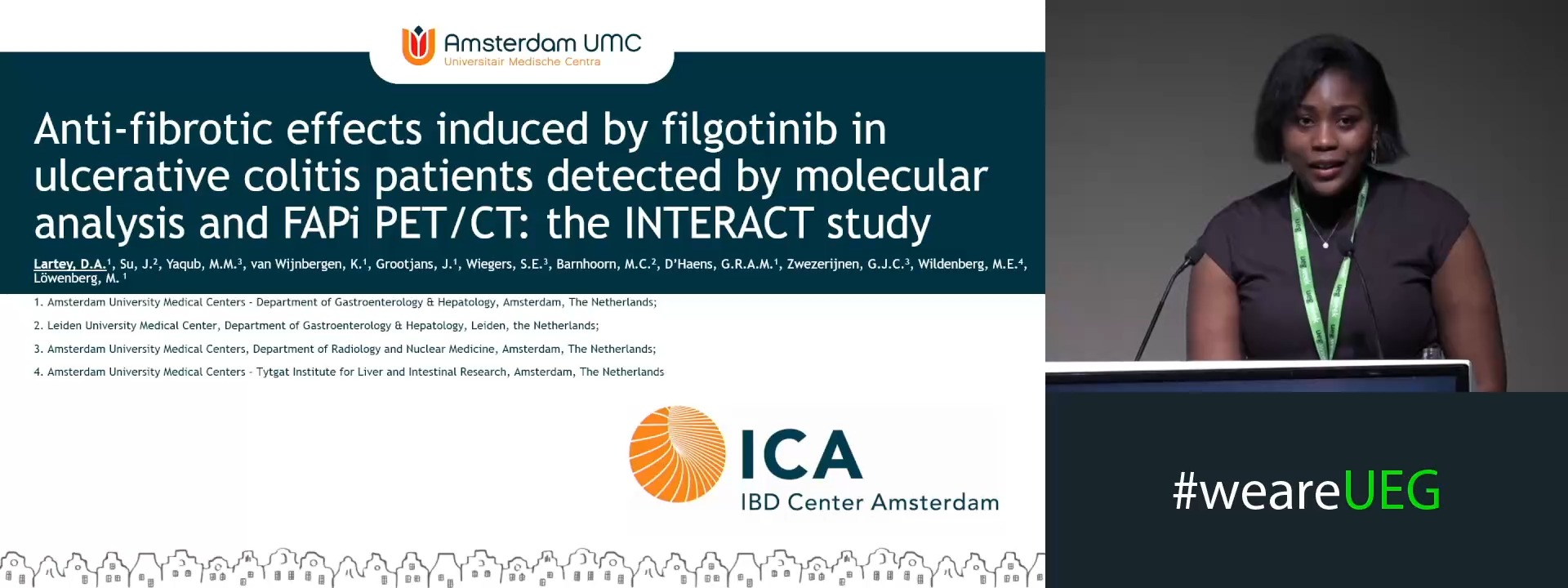
ANTI-FIBROTIC EFFECTS INDUCED BY FILGOTINIB IN ULCERATIVE COLITIS PATIENTS DETECTED BY MOLECULAR ANALYSIS AND FAPI PET/CT: THE INTERACT TRIAL
Dalia Alexia Lartey 1, Jie Su 2, Maqsood M. Yaqub 1, Kelly van Wijnbergen 1, Joep Grootjans 1, Sanne E. Wiegers 1, Marieke Barnhoorn 2, Geert R. D'Haens 1, Gerben J. C. Zwezerijnen 1, Manon E. Wildenberg 1, Mark Löwenberg 1
Affiliations
1 Amsterdam UMC, Amsterdam, Netherlands
2 Leiden University Medical Center, Leiden, Netherlands
Log in to continue.
This content is part of Gutflix. Log in with your myUEG account, or create one free, to watch it.
Not sure what you can access? Learn more about account types.
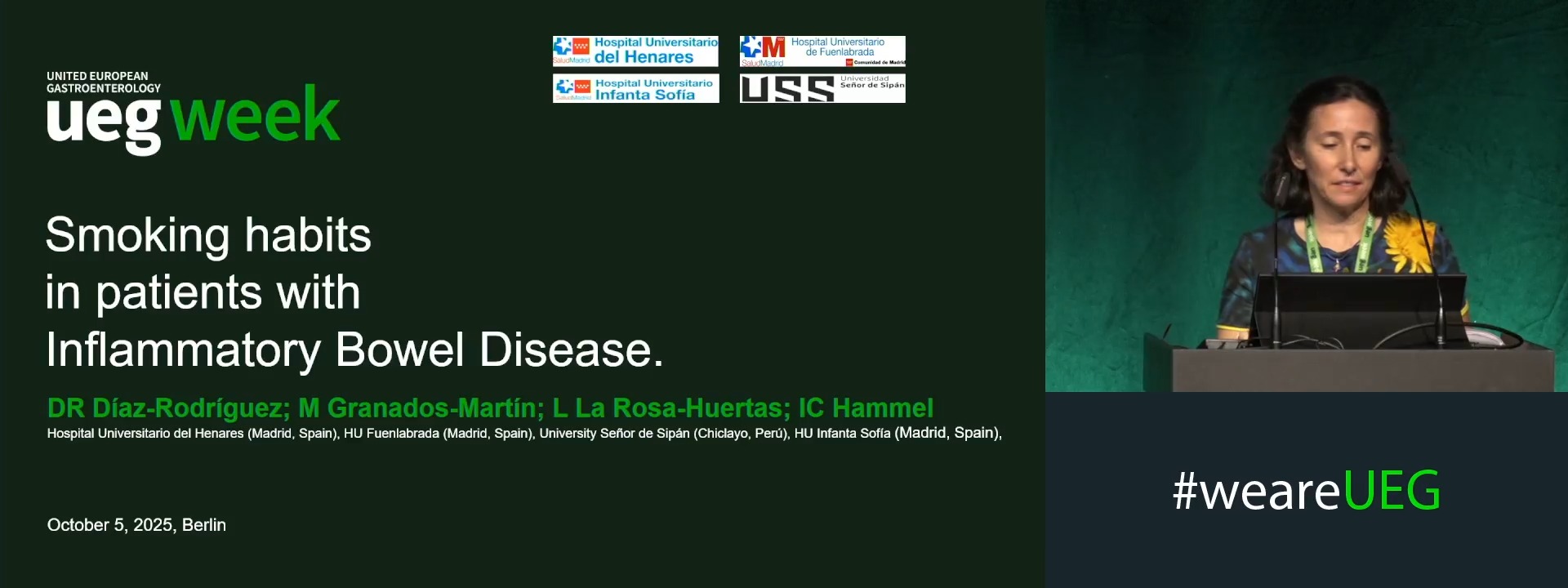
SMOKING HABITS IN PATIENTS WITH INFLAMMATORY BOWEL DISEASE
Dania Rocio Diaz-Rodriguez 1, Monica Granados Martin 2, Liliana La Rosa-Huertas 3, Inés Constanze Hammel 4
Affiliations
1 Hospital Universitario del Henares, Madrid, Spain
2 Hospital de Fuenlabrada, Fuenlabrada, Spain
3 Universidad Señor de Sipán, Lims, Peru
4 Hospital Universitario Infanta Sofía, San Sebastián de los Reyes, Spain
Log in to continue.
This content is part of Gutflix. Log in with your myUEG account, or create one free, to watch it.
Not sure what you can access? Learn more about account types.
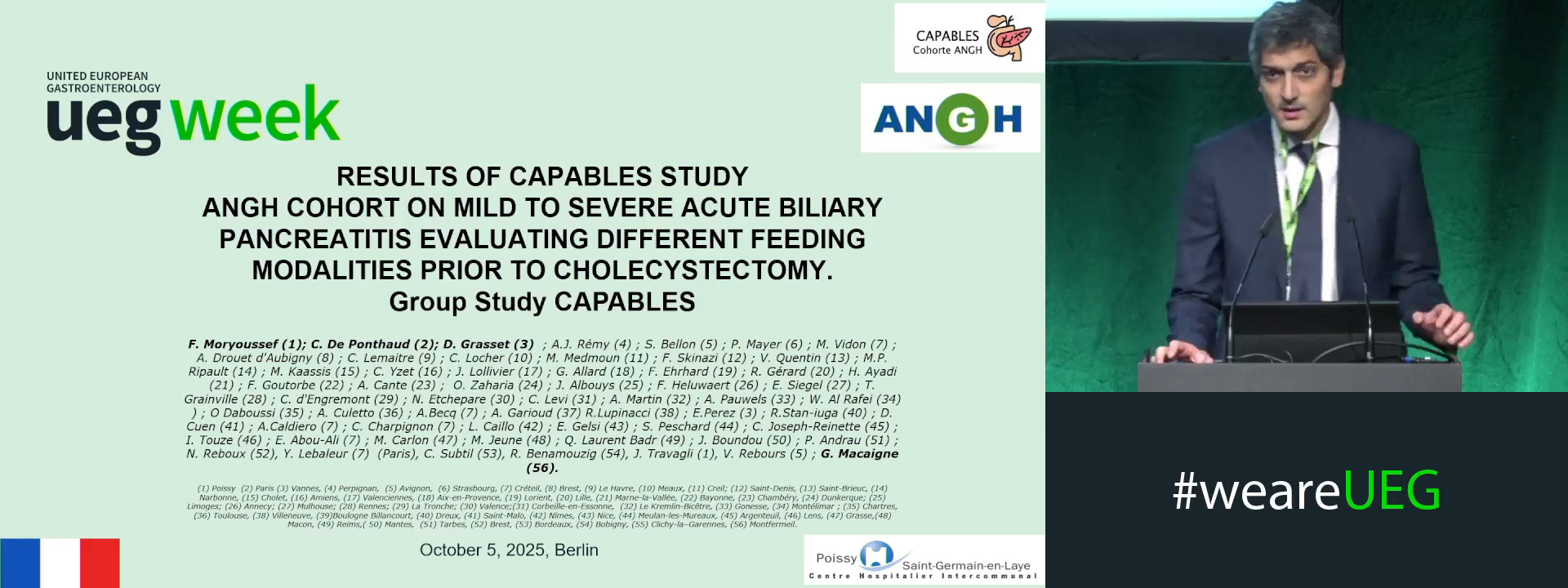
RESULTS OF THE ANGH COHORT ON MILD TO SEVERE ACUTE BILIARY PANCREATITIS (CAPABLES): EVALUATING DIFFERENT FEEDING MODALITIES PRIOR TO CHOLECYSTECTOMY
Frederick Moryoussef 1, Charles De Ponthaud 2, Denis Grasset 3, ANDRE JEAN REMY 4, Serge Bellon 5, Pierre Mayer 6, Mathias Vidon 7, Augustin Drouet D'Aubigny 8, Caroline Lemaitre 9, christophe locher 10, Mourad MEDMOUN 11, Florence Skinazi 12, vincent quentin 13, Marie-Pierre Ripault 14, Mehdi Kaassis 15, Clara Yzet 16, Julien Lollivier 17, Guillaume Allard 18, Florent Ehrard 19, Romain Gerard 20, Hend Ayadi 21, Félix Goutorbe 22, Gaelle Boudoux d'Hautefeuille 23, Oana Maria Zaharia 24, Jeremie Albouys 25, Frédéric HELUWAERT 26, Emily Siegel 27, Thomas Grainville 28, Christelle d'Engremont 29, Nicolas Etchepare 30, Cristina Levi 31, Antoine Martin 32, Gabriela Chitic 33, Wasim Al Rafei 34, Oussama Daboussi 35, Adrian Culetto 36, Aymeric Becq 37, Armand Garioud 38, Renato Micelli Lupinacci 39, Enrique Perez 40, Roxana Stan Iuga 41, David Cuen 42, Anthony Caldiero 43, Claire Charpignon 44, Ludovic Caillo 45, Eve Gelsi 46, Sylvie Peschard 47, Julia Travagli 1, Vinciane Rebours 48, gilles macaigne 49
Affiliations
1 CH Poissy-Saint-Germain-En-Laye, Poissy, France
2 Pitie Salpétrière University Hospital, Paris, France
3 CHBA Service de Gastroentérologie, Vannes, France
4 CH Perpignan, Perpignan, France
5 Centre Hospitalier d'Avignon Henri Duffaut, Perpignan, France
6 Hepato-gastroenterology, Strasbourg, France
7 Centre Hospitalier Intercommunal de Creteil, Creteil, France
8 CH Cornouaille, Quimper, France
9 CH Le havre, Le Havre, France
10 CH Meaux, Meaux, France
11 CH Creil, Creil, France
12 CH Delafontaine, Saint Denis, France
13 Y Le Foll, Saint Brieuc, France
14 CH Narbonne, Narbonne, France
15 CH DE CHOLET, Cholet Cedex, France
16 Amiens univerisity hospital, Amiens, France
17 CH Valenciennes, Valenciennes, France
18 CH Aix-en-provence, Aix-en-provence, France
19 CH Lorient, Lorient, France
20 Inserm, Lille, France
21 CH Marne-la-vallée, Marne-la-vallée, France
22 CH Cote basque, Bayonne, France
23 CH Mteropole Savoie, Aix-les-bains, France
24 CH Dunkerque, Dunkerque, France
25 CHU Limoges / University of Limoges, Limoges, France
26 CH Annecy, Annecy, France
27 CH Mulhouse, Mulhouse, France
28 CHU Rennes, Rennes, France
29 Grenoble University Hospital, Grenoble, France
30 CH Valence, Valence, France
31 CH sud-francilien, Corbeilles-en-Essone, France
32 Kremlin Bicetre University Hospital, Kremlin Bicetre, France
33 CH Gonesse, Gonesse, France
34 CH Portes de Provencd, Montelimar, France
35 CH Chartres, Chartes, France
36 University Hospital Le Rangueuil, Toulouse, France
37 Mondor University Hospital, Creteil, France
38 CH Villeneuve-saint-georges, Villeneuve, France
39 Ambroise Paré University Hospital, Boulogne Billancourt, France
40 University Hospital Georges Pompidou, Paris, France
41 CH Dreux, Dreux, France
42 CH Saint-malo, Saint-malo, France
43 Tenon University Hospital, Paris, France
44 Montsouris Institute, Paris, France
45 CHU DE NIMES, Nîmes, France
46 Nice University Hospital, Nice, France
47 CH Meulan, Meulan-les-mureaux, France
48 Hopital Beaujon, Clichy, France
49 CH Montfermeil, Montfermeil, France

Log in to continue.
This content is part of Gutflix. Log in with your myUEG account, or create one free, to watch it.
Not sure what you can access? Learn more about account types.
EARLY PHASE MICROBIOME IS ASSOCIATED WITH POST DISCHARGE DIABETES, RECURRENT ACUTE PANCREATITIS AND MORTALITY- RESULTS FROM THE MULTICENTER PROSPECTIVE MAMBA-TRIAL
Christoph Ammer-Herrmenau 1, Richard Meier 1, Kai Antweiler 1, Thomas Asendorf 1, Georg Beyer 2, Silke Cameron 1, Gabriele Capurso 3, Marko Damm 4, Linh Dang 1, Fabian Frost 5, Jacob Hamm 1, Albrecht Hoffmeister 6, Robert Jaster 7, Christian Meinhardt 8, Lukasz Nawacki 9, Arpad Panyko 10, Veit Phillip 11, Aldis Pukitis 12, Diana Riekstina 12, Ecaterina Rinja 13, Lourdes Ruiz-Rebollo 14, Arlett Patricia Gloria Schäfer 2, Rahel Scholz 1, Julian Seelig 6, Simon Sirtl 2, Vasile Sandru 13, Volker Ellenrieder 1, Albrecht Neesse 1
Affiliations
1 University Medical Centre Goettingen, Goettingen, Germany
2 University Hospital LMU Munich, München, Germany
3 San Raffaele Scientific Institute Irccs, Rome, Italy
4 University Hospital Halle, Halle, Germany
5 Universität Greifswald, Greifswald, Germany
6 University Hospital of Leipzig, Leipzig, Germany
7 Rostock University Medical Center, Rostock, Germany
8 Klinikum Oldenburg AöR, Oldenburg, Germany
9 The Jan Kochanowski University in Kielce, Kielce, Poland
10 University Hospital Bratislava, Bratislava, Slovakia
11 Technische Universität München, München, Germany
12 Pauls Stradins Clininic University Hopital Gastroenterology Center, Riga, Latvia
13 Bucharest Clinical Emergency Hospital, Bucharest, Romania
14 Hospital Clínico Universitario de Valladolid, Valladolid, Spain

Log in to continue.
This content is part of Gutflix. Log in with your myUEG account, or create one free, to watch it.
Not sure what you can access? Learn more about account types.
RANDOMISED CONTROLLED TRIAL OF A CLOUD-BASED ARTIFICIAL INTELLIGENCE POLYP DETECTION SYSTEM (CADDIE)
Rawen Kader 1,2, Paul Bassett 3, Yusuf Kabir 1, Sharon Cheung 1, Lester Macabodbod 1, Archana Jayanthi 1, Manish Chand 2, Laurence B. Lovat 1,2
Affiliations
1 Wellcome/EPSRC Centre for Interventional and Surgical Sciences (WEISS), University College London (UCL), London, United Kingdom
2 University College London Hospital, London, United Kingdom
3 Statsconsultancy Ltd, London, United Kingdom