Introduction
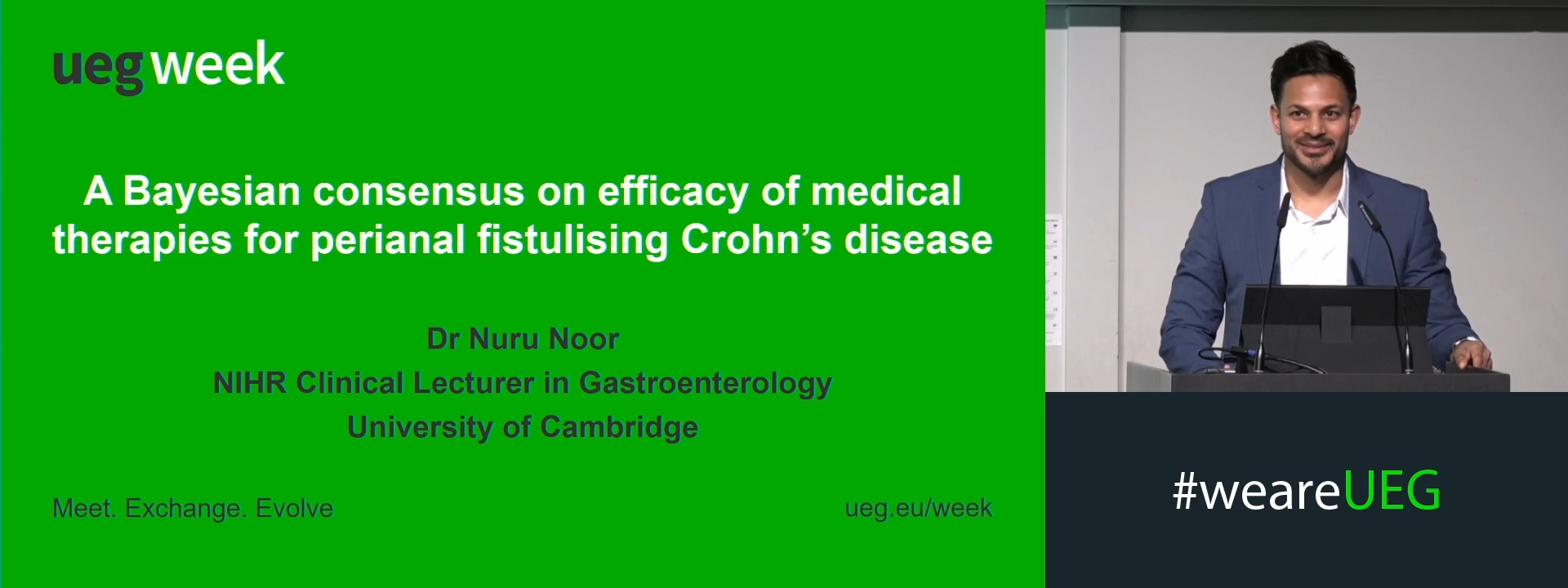
Fistulating peri-anal Crohn’s disease can affect approximately 20% of patients and have a major impact on quality of life. Despite being an important area of unmet clinical need, there is a paucity of evidence for most medical treatments and a lack of dedicated clinical trials for perianal Crohn’s disease. Current studies also report a high level of heterogeneity for outcomes with both treatments and placebo - making interpretation of the available data challenging for both clinical practice and design of clinical trials. Use of Bayesian methodology offers an attractive solution to help address some of these challenges. We sought to conduct a Bayesian prior elicitation exercise to determine the efficacy of licensed medical therapies for fistulating perianal Crohn’s disease.
Aims & Methods
A formal Bayesian prior elicitation meeting was convened. This was composed of a group of 11 gastroenterologists and 5 statisticians. Consensus priors were developed leveraging both published data and expertise of the gastroenterologists, to determine one-year fistula remission rates for seven options of licensed medical treatments based on five different mechanisms of action (anti-TNF, anti-integrin, anti-IL12/23, anti-IL-23, and JAK inhibitor). Consensus priors on the efficacy of each of seven treatment options was determined relative to an elicited consensus prior for placebo control. The log-odds ratio for efficacy for each of the seven therapy options versus placebo control was also established.
Results
Consensus priors were obtained for seven medical treatments for likelihood of fistula remission at one year. The prior mean, together with a 90% prior credible interval, of the one-year fistula remission rate was 0.22 (0.05, 0.46) for placebo, 0.58 (0.09, 0.96) for intravenous infliximab, 0.39 (0.06, 0.82) for adalimumab, 0.53 (0.09, 0.93) for subcutaneous infliximab, 0.24 (0.03, 0.60) for intravenous vedolizumab, 0.44 (0.05, 0.90) for upadacitinib, 0.34 (0.04, 0.77) for ustekinumab, and 0.36 (0.04, 0.82) for risankizumab. When assessing treatment effect on the log-odds ratio scale, oral upadacitinib and subcutaneous infliximab had the strongest “priors”, with the highest probability for likely efficacy, alongside intravenous infliximab.
Conclusion
We have conducted, to the best of our knowledge, the first formal Bayesian prior elicitation exercise for efficacy of medical therapies in perianal Crohn’s disease. These priors developed for the efficacy of licensed medical therapies can be internationally validated and potentially taken forward for planning of dedicated clinical trials. Importantly, these results could be used to enhance the design and analysis of clinical trials for fistulating perianal Crohn’s disease. Notable potential benefits from these findings include: improved estimation of treatment efficacy, reduction in the required sample sizes, and with minimisation or even avoidance of placebo control arms for future dedicated fistulating perianal Crohn’s disease clinical trials.
Disclosure
NMN declares educational/travel grants and/or speaker fees from AbbVie, Bristol Myers Squibb, Celltrion, Dr Falk Pharma, Ferring, Galapagos, J&J, Lilly, Pfizer, Pharmacosmos, Takeda and Tillotts Pharma AG. RC reports personal fees from AbbVie, Galapagos, Lilly outside the submitted work, and grants from Celltrion, Ferring, Tillotts Pharma outside the submitted work; and fees from advisory board membership of AbbVie, Bristol Myers Squibb outside the submitted work. SD reports personal fees from AbbVie, Ferring, Janssen, Takeda outside the submitted work; and grants from AbbVie, Dr Falk, Janssen, outside the submitted work; and fees from advisory board membership of AbbVie outside the submitted work. HG has received speaker fees from: Janssen, Ferring, Takeda, and AbbVie, and consultancy fees from. AbbVie, Galapagos. KBK reports serving as a speaker, a consultant, and/or an advisory board member for Abbvie, Falk, Galapagos, Janssen, and Takeda. JOL reports personal fees from AbbVie, Atlantic Healthcare, Bristol Meyer Squibb, Celgene, Celltrion, Engytix, Eli Lilly, Ferring, Galapagos, Gilead, GSK, Janssen, MSD, Norgine, Pfizer, Shire, and Takeda outside the submitted work; and grants from AbbVie, Ferring, Gilead, Takeda, and Shire outside the submitted work. GWM declares consultancy fees/grant funding from AbbVie, AstraZeneca and Janssen; all outside the submitted work. KVP reports personal fees from AbbVie, DrFalk, Galapagos, Janssen, PredictImmune, Pfizer, Takeda outside the submitted work; and grants from AbbVie, Celltrion, Dr Falk, Ferring, Janssen, Takeda, Tillotts Pharma outside the submitted work; and fees from advisory board membership of AbbVie, Galapagos, Janssen, Pfizer outside the submitted work. SS reports consulting fees from Takeda, AbbVie, Merck, Ferring, Pharmacosmos, Warner Chilcott, J&J Innovative Medicine, Dr Falk Pharma, Biohit, TriGenix, Celgene, and Tillots Pharma outside the submitted work; payment or honoraria from AbbVie, Takeda, Celltrion, Pfizer, Biogen, AbbVie, J&J Innovative Medicine, Merck, Warner Chilcott, Dr Falk Pharma, outside the submitted work; and is co-director of research for the South Asian IBD Alliance. TR has received research/educational grants and/or speaker/consultation fees from Abbvie, Arena, Aslan, AstraZeneca, Boehringer-Ingelheim, BMS, Celgene, Eli Lilly, Ferring, Galapagos, Gilead, GSK, Heptares, LabGenius, Janssen, MonteRosa, Mylan, MSD, Novartis, Numab, Pfizer, Roche, Sandoz, Takeda, UCB, and XAP Therapeutics. SS reports person fees from Abbvie, Celltrion, Dr. Falk, Ipsen, Janssen, Takeda outside the submitted work. ALH has received consultancy fees from AbbVie, Bristol Myers Squibb, Celltrion, Galapagos, Johnson & Johnson, Takeda, Pfizer, and Lilly; has received honoraria from AbbVie, Bristol Myers Squibb, Celltrion, Galapogos, Johnson & Johnson, Takeda, Pfizer, Lilly; and has received support for attending meetings or travel from AbbVie, Bristol Myers Squibb, Celltrion, Galapagos, Johnson & Johnson, Takeda, Pfizer, and Lilly; all outside of the submitted work. MP reports personal fees from Janssen and Takeda outside the submitted work; and grants from AstraZeneca, Galapagos, Gilead, Pfizer outside the submitted work. All other authors declare no conflicts of interest.