UEG's educational platform for gastroenterology education bringing recordings, courses, guidelines, and more together in one place.
Most popular content
Rate for better recommendations!
Your feedback helps us show you more of what you like and less of what you dislike!
Log in to access this content.
Free for all myUEG account holders. Your access level is set automatically based on your occupation. Medical professionals get full access to all content. If you are a non-medical user, you can only access UEG Week content from congresses you attended.
Not sure what you can access? Learn more about account types.

ENRICHMENT OF POLYSTYRENE-DEGRADING MICROBES IN THE UPPER GASTROINTESTINAL TRACT OF FUNCTIONAL DYSPEPSIA PATIENTS
Emily Hoedt 1, Jennifer Pryor 1, Ayesha Shah 2, Gerald J. Holtmann 2, Nicholas J. Talley 1, Simon Keely 1
1 University of Newcastle, Newcastle, Australia|||Hunter Medical Research Institute, Newcastle, Australia
2 Princess Alexandra Hospital, Brisbane, Australia|||University of Queensland, Brisbane, Australia
Conference
Topics
Submission format
Session
Citation
Published
Log in to access this content.
Free for all myUEG account holders. Your access level is set automatically based on your occupation. Medical professionals get full access to all content. If you are a non-medical user, you can only access UEG Week content from congresses you attended.
Not sure what you can access? Learn more about account types.
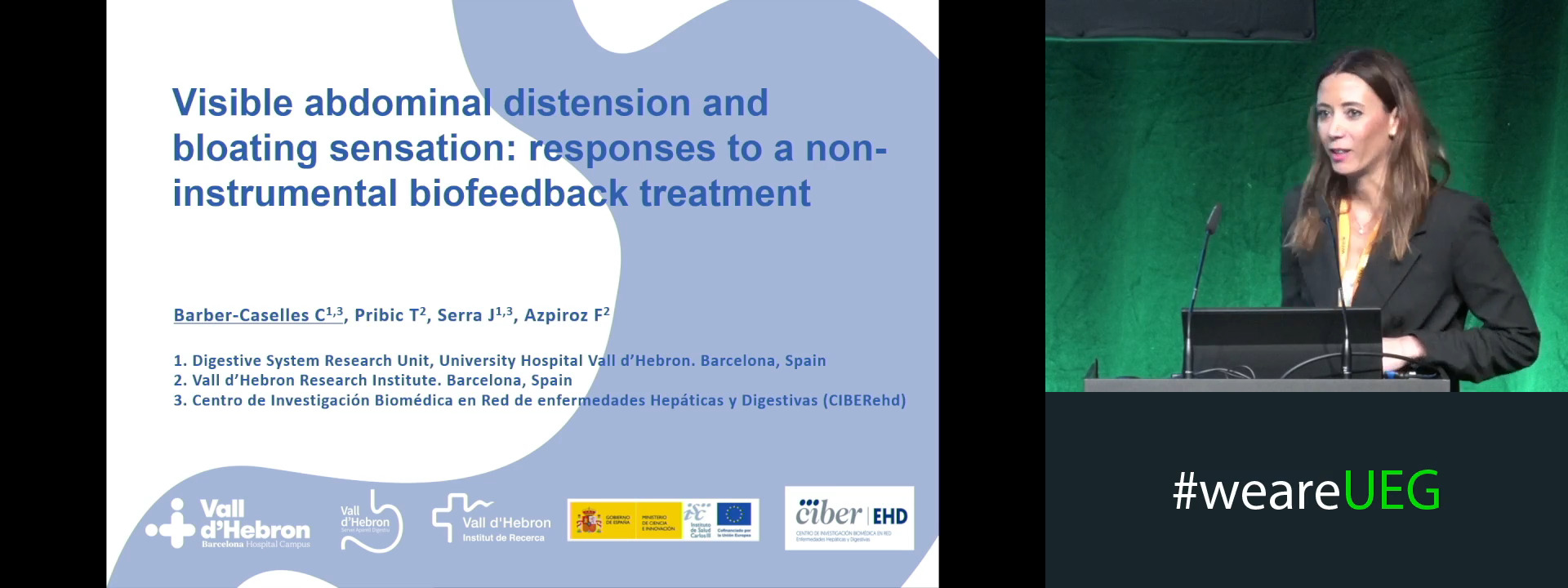
VISIBLE ABDOMINAL DISTENSION AND BLOATING SENSATION: RESPONSES TO A NON-INSTRUMENTAL BIOFEEDBACK TREATMENT.
1 University Hospital Vall d'Hebron, Barcelona, Spain
2 Vall D'Hebron Research Institute, Barcelona, Spain
Event
Submission format
Session
Citation
Published
Log in to access this content.
Free for all myUEG account holders. Your access level is set automatically based on your occupation. Medical professionals get full access to all content. If you are a non-medical user, you can only access UEG Week content from congresses you attended.
Not sure what you can access? Learn more about account types.
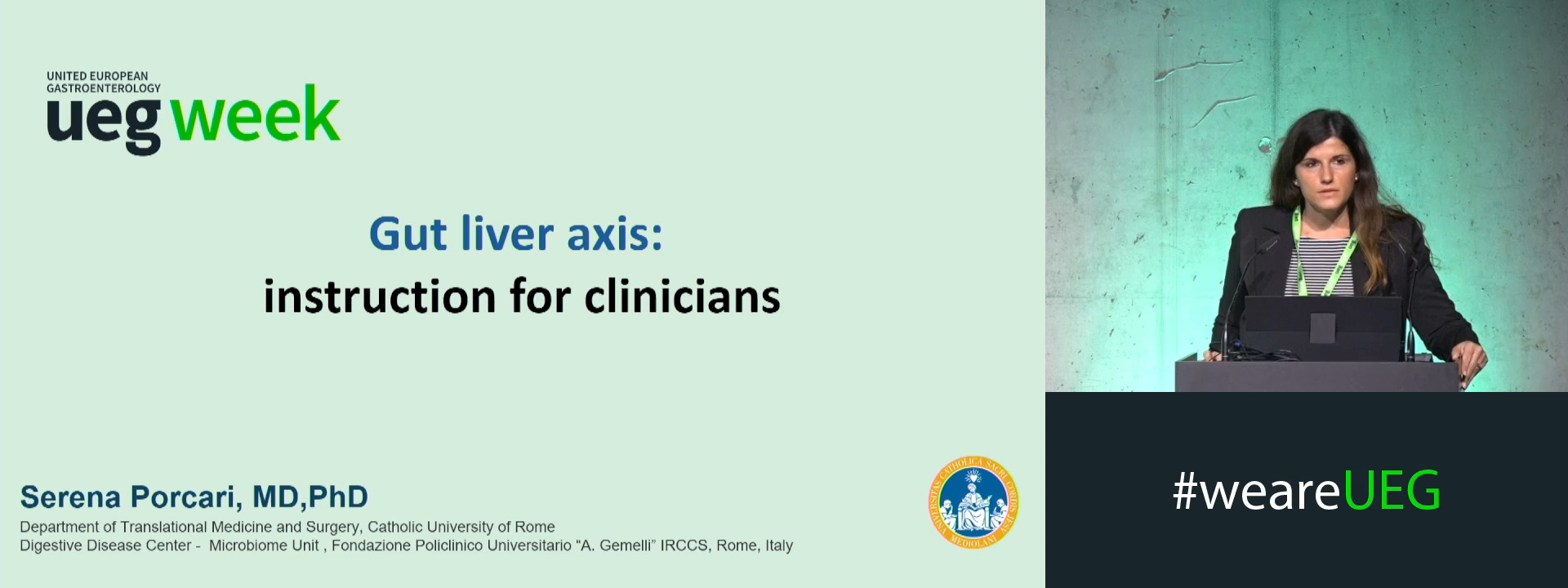
Microbiome: Implications for clinicians - gut-liver and gut-pancreas axis
1 Universitätsklinikum Göttingen, Hamburg, Germany
2 Fondazione Policlinico Universitario 'A.Gemelli' - IRCCS, MONTEROTONDO - ROME, Italy
Event
Citation
Published
Log in to access this content.
Free for all myUEG account holders. Your access level is set automatically based on your occupation. Medical professionals get full access to all content. If you are a non-medical user, you can only access UEG Week content from congresses you attended.
Not sure what you can access? Learn more about account types.
LONG-TERM PROTON PUMP INHIBITOR USE AND RISK OF GASTRIC NEUROENDOCRINE NEOPLASMS IN A POPULATION-BASED STUDY FROM THE FIVE NORDIC COUNTRIES
Eivind Ness-Jensen 1, Giola Santoni 2, Cecilia Radkiewicz 2, My von Euler-Chelpin 3, Joonas H. Kauppila 4, Helgi Birgisson 5, Reidar Fossmark 6, Jesper Lagergren 7
1 NTNU, Norwegian University of Science and Technology, Levanger, Norway|||Nord-Trøndelag Hospital Trust, Levanger Hospital, Levanger, Norway
2 Karolinska Institutet & Karolinska University Hospital, Stockholm, Sweden
3 University of Copenhagen, Copenhagen, Denmark
4 University of Oulu and Oulu University Hospital, Oulu, Finland|||Karolinska Institutet & Karolinska University Hospital, Stockholm, Sweden
5 Icelandic Cancer Registry, Reykjavík, Iceland
6 NTNU, Norwegian University of Science and Technology, Trondheim, Norway|||Oslo University Hospital, Oslo, Norway
7 King's College London and Guy’s and St Thomas Foundation Trust, London, United Kingdom|||Karolinska Institutet & Karolinska University Hospital, Stockholm, Sweden
Event
Submission format
Citation
Published
Log in to access this content.
Free for all myUEG account holders. Your access level is set automatically based on your occupation. Medical professionals get full access to all content. If you are a non-medical user, you can only access UEG Week content from congresses you attended.
Not sure what you can access? Learn more about account types.
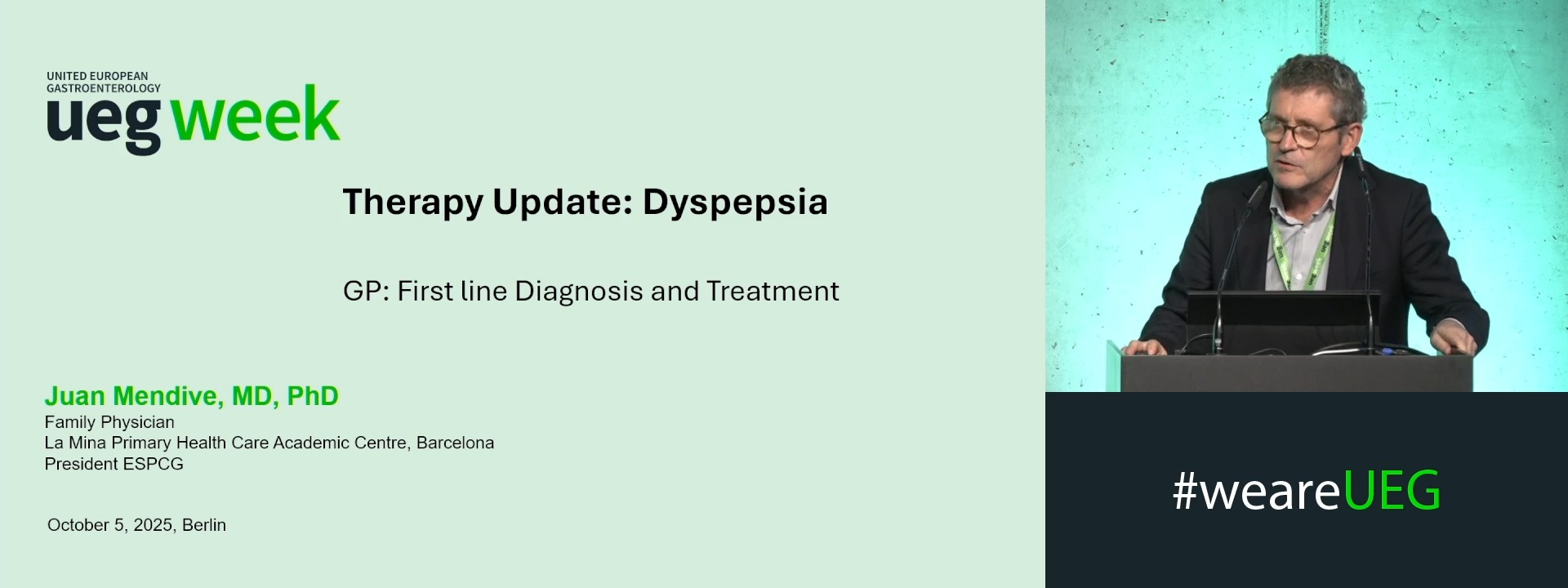
GP: First line diagnosis and treatment
1 European Society for Primary Care Gastroenterology (ESPCG), Sant Adrià de Besòs ( Barcelona), Spain
Event
Session
Citation
Published
Log in to access this content.
Free for all myUEG account holders. Your access level is set automatically based on your occupation. Medical professionals get full access to all content. If you are a non-medical user, you can only access UEG Week content from congresses you attended.
Not sure what you can access? Learn more about account types.
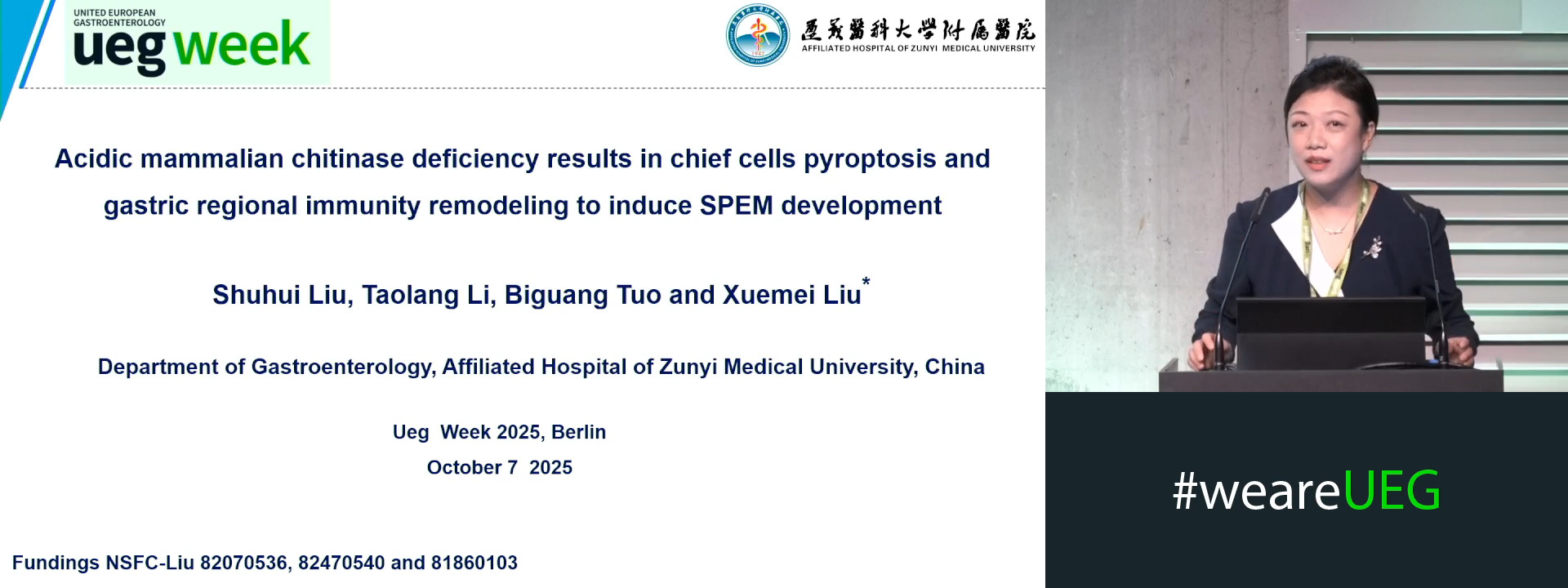
ACIDIC MAMMALIAN CHITINASE DEFICIENCY RESULTS IN CHIEF CELLS PYROPTOSIS AND GASTRIC REGIONAL IMMUNITY REMODELING IS THE NEW CELLULAR ORIGIN OF SPEM
1 Affiliated Hospital of Zunyi Medical University, Zunyi, China
Event
Topics
Submission format
Citation
Published

Log in to access this content.
Free for all myUEG account holders. Your access level is set automatically based on your occupation. Medical professionals get full access to all content. If you are a non-medical user, you can only access UEG Week content from congresses you attended.
Not sure what you can access? Learn more about account types.
Chronic constipation (Complete Session)
Event
Topics
Session