UEG's content platform for gastroenterology education bringing recordings, courses, guidelines, and more together in one place.
Trending on Gutflix
Rate for better recommendations!
Your feedback helps us show you more of what you like and less of what you dislike!

Log in to continue.
This content is part of Gutflix. Log in with your myUEG account, or create one free, to watch it.
Not sure what you can access? Learn more about account types.
COMBINATION THERAPY FOR THE TREATMENT OF KRAS-MUTANT PANCREATIC CANCER: PRE-CLINICAL INVESTIGATION OF THE NOVEL INHIBITORS RMC-4550 (SHP2I) AND LY3214996 (ERKI)
Katrin Jana Frank 1, Antonio Mulero-Sánchez 2, Alexandra Berninger 1, Laura Ruiz-Cañas 3,4, Astrid Bosma 2, Kivanc Görgülü 1, Nan Wu 1, Nina Diakopoulos 1, Ezgi Kaya-Aksoy 1, Dietrich Alexander Ruess 5, Derya Kabacaoglu 1, Fränze Schmidt 1, Larissa Kohlmann 1, Olaf van Tellingen 2, Bram Thijssen 2, Marieke van de Ven 2, Natalie Proost 2, Susanne Kossatz 1, Wolfgang A. Weber 1, Bruno Sainz, Jr 3,4, René Bernards 2, Hana Algül 1, Marina Lesina 1, Sara Mainardi 2
Affiliations
1 Technische Universität München, München, Germany
2 The Netherlands Cancer Institute, Amsterdam, Netherlands
3 Universidad Autónoma de Madrid (UAM) and Instituto de Investigaciones Biomédicas "Alberto Sols" (IIBM), Madrid, Spain
4 Instituto Ramón y Cajal de Investigación Sanitaria (IRYCIS), Madrid, Spain
5 Medical Center University of Freiburg, Freiburg, Germany

Log in to continue.
This content is part of Gutflix. Log in with your myUEG account, or create one free, to watch it.
Not sure what you can access? Learn more about account types.
Local scar excision or completion surgery for R1/RX resected T1?
Affiliations
1 AMC Amsterdam Maag- Darm- Leverziekten, Amsterdam, Netherlands
Log in to continue.
This content is part of Gutflix. Log in with your myUEG account, or create one free, to watch it.
Not sure what you can access? Learn more about account types.
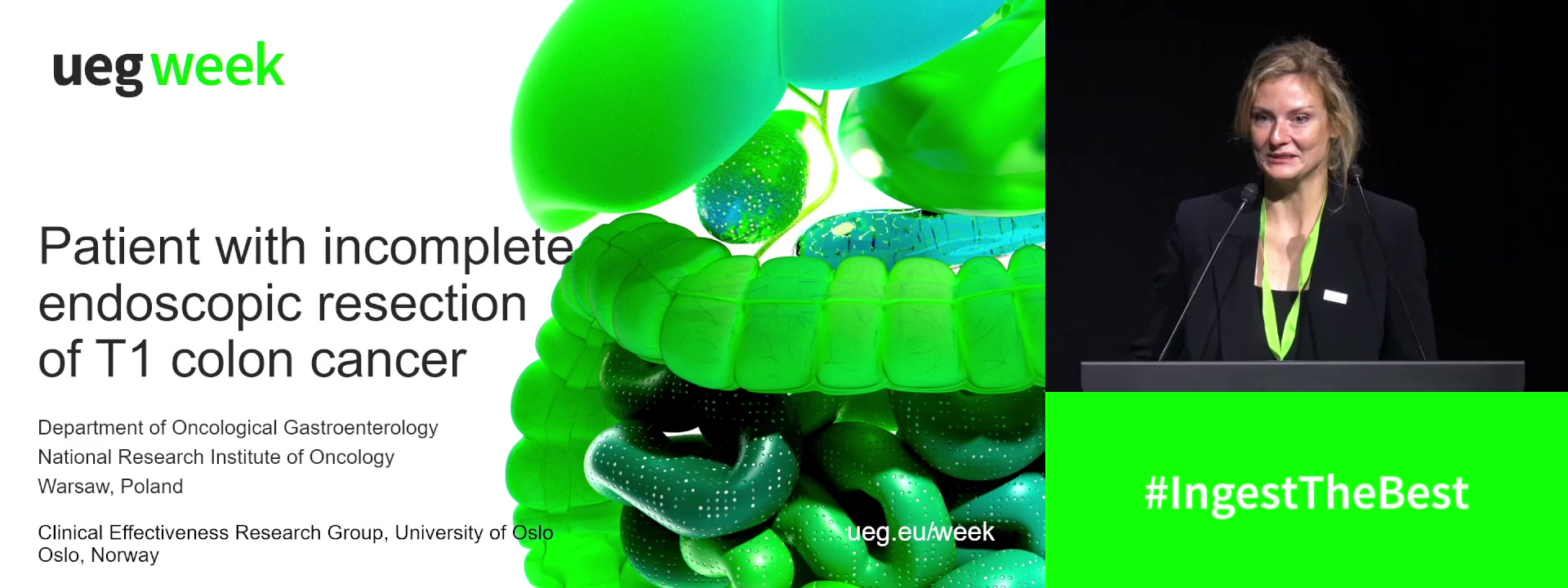
Patient with incomplete endoscopic resection of T1 colon cancer
Affiliations
1 The Maria Sklodowska-Curie Institute - Oncology Institute Warsaw, Poland, Warsaw, Poland

Log in to continue.
This content is part of Gutflix. Log in with your myUEG account, or create one free, to watch it.
Not sure what you can access? Learn more about account types.
EFFICACY AND SAFETY OF GUSELKUMAB FOR CROHN’S DISEASE THROUGH 3 YEARS: GALAXI-1 LONG-TERM EXTENSION
Anita Afzali 1, Silvio Danese 2, Remo Panaccione 3, Brian G. Feagan 4, David T. Rubin 5, Bruce E. Sands 6, Walter Reinisch 7, Julian Panés 8, Aparna Sahoo 9, Natalie Terry 9, Leonardo Salese 9, Christopher Corbett 10, Tadakazu Hisamatsu 11, Jane Andrews 12, Geert R. D'Haens 13
Affiliations
1 University of Cincinnati, Cincinnati, United States
2 Vita-Salute San Raffaele University - IRCCS San Raffaele Scientific Institute, Milan, Netherlands
3 University of Calgary, Calgary, Canada
4 The University of Western Ontario, London, Canada
5 University of Chicago Medicine, Chicago, United States
6 Icahn School of Medicine at Mount Sinai, New York, United States
7 Medical University of Vienna, Wien, Austria
8 Hospital Clínic Barcelona, Barcelona, Spain
9 Janssen, Spring House, United States
10 Janssen UK, Wycombe, United Kingdom
11 Kyorin University, Tokyo, Japan
12 Royal Adelaide Hospital, Adelaide, Australia
13 AMC Amsterdam Inflammatory Bowel Disease Centre - Academic Medical Center, AMC Amsterdam Inflammator, Amsterdam, Netherlands
Log in to continue.
This content is part of Gutflix. Log in with your myUEG account, or create one free, to watch it.
Not sure what you can access? Learn more about account types.
Panel discussion: Immunotherapy in digestive cancers - Where are we heading?