UEG's educational platform for gastroenterology education bringing recordings, courses, guidelines, and more together in one place.
Most popular content
Rate for better recommendations!
Your feedback helps us show you more of what you like and less of what you dislike!
Log in to access this content.
Free for all myUEG account holders. Your access level is set automatically based on your occupation. Medical professionals get full access to all content. If you are a non-medical user, you can only access UEG Week content from congresses you attended.
Not sure what you can access? Learn more about account types.
Choosing the right drug
1 University of Nottingham, Nottingham, United Kingdom
Event
Topics
Citation
Published
Log in to access this content.
Free for all myUEG account holders. Your access level is set automatically based on your occupation. Medical professionals get full access to all content. If you are a non-medical user, you can only access UEG Week content from congresses you attended.
Not sure what you can access? Learn more about account types.
SCREENING FOR ARFID IN PATIENTS WITH GASTROINTESTINAL DISORDERS: A CALL FOR INTEGRATED CARE
Karen Routhiaux 1, Karen Van den Houte 1, Lukas Balsiger 2, Michael P. Jones 3, Karlien Raymenants 1, Cedric Van de Bruaene 1, Bert Broeders 1, Annelies Verheyden 1, Helen Burton Murray 4, Tim Vanuytsel 5, Jan Tack 5
1 KU Leuven, Leuven, Belgium
2 KU Leuven, Leuven, Belgium|||University of Bern, Bern, Switzerland
3 Macquarie University, North Ryde, Australia
4 Massachusetts General Hospital/Harvard Medical School, Boston, United States
5 KU Leuven, Leuven, Belgium|||UZ Leuven, Leuven, Belgium
Event
Topics
Submission format
Citation
Published

Log in to access this content.
Free for all myUEG account holders. Your access level is set automatically based on your occupation. Medical professionals get full access to all content. If you are a non-medical user, you can only access UEG Week content from congresses you attended.
Not sure what you can access? Learn more about account types.
Chronic constipation (Complete Session)
Event
Topics
Session
Citation
Published
Log in to access this content.
Free for all myUEG account holders. Your access level is set automatically based on your occupation. Medical professionals get full access to all content. If you are a non-medical user, you can only access UEG Week content from congresses you attended.
Not sure what you can access? Learn more about account types.
Therapeutic approach to DGBI: Drugs or diet?
1 Sahlgrenska University Hospital - Dept of Internal Medicine, Sahlgrenska University Hospital ; Gothe, Gothenburg, Sweden
Event
Citation
Published
Log in to access this content.
Free for all myUEG account holders. Your access level is set automatically based on your occupation. Medical professionals get full access to all content. If you are a non-medical user, you can only access UEG Week content from congresses you attended.
Not sure what you can access? Learn more about account types.
BLOATING AND VISIBLE ABDOMINAL DISTENSION IN IRRITABLE BOWEL SYNDROME AND FUNCTIONAL DYSPEPSIA: OVERLAPPING OR DISTINCT SYMPTOMS?
Tom van Gils 1, Ryo Katsumata 1, Jóhann Hreinsson 1, Douglas Drossman 2, Jan Tack 3, Hans Törnblom 1, Boris Le Nevé 4, Laurent Quinquis 4, Rim Hassouna 4, Max Julio Schmulson Wasserman 5, Shrikant I. Bangdiwala 6, Olafur S. Palsson 7, Magnus Simrén 8
1 University of Gothenburg, Gothenburg, Sweden
2 University of North Carolina/Chapel Hill, Chapel Hill, United States|||The Rome Foundation, Raleigh, United States
3 University of Gothenburg, Gothenburg, Sweden|||University of Leuven, University Hospital Gasthuisberg, Leuven, Belgium
4 Danone Global Research & Innovation, Gif-sur-Yvette, France
5 Universidad Nacional Autónoma de México, Mexico City, Mexico
6 McMaster University, Hamilton, Canada
7 University of North Carolina/Chapel Hill, Chapel Hill, United States
8 University of Gothenburg, Gothenburg, Sweden|||University of North Carolina/Chapel Hill, Chapel Hill, United States
Event
Submission format
Session
Citation
Published
Log in to access this content.
Free for all myUEG account holders. Your access level is set automatically based on your occupation. Medical professionals get full access to all content. If you are a non-medical user, you can only access UEG Week content from congresses you attended.
Not sure what you can access? Learn more about account types.
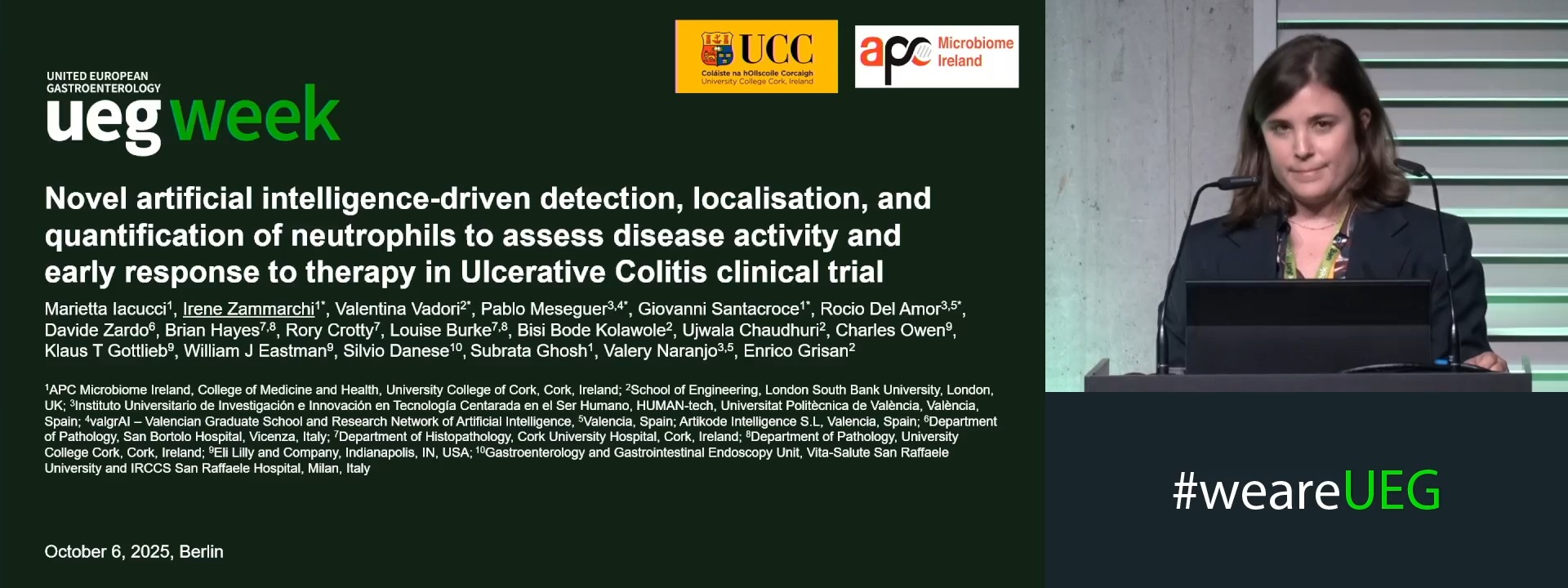
NOVEL ARTIFICIAL INTELLIGENCE-DRIVEN DETECTION LOCALISATION AND QUANTIFICATION OF NEUTROPHILS TO ASSESS DISEASE ACTIVITY AND EARLY RESPONSE TO THERAPY IN ULCERATIVE COLITIS CLINICAL TRIAL
Marietta Iacucci 1, Irene Zammarchi 1, Valentina Vadori 2, Pablo Meseguer 3, Giovanni Santacroce 1, Rocio Del Amor 4, Davide Zardo 5, Brian Hayes 6, Rory Crotty 7, Louise Burke 6, Bisi Bode Kolawole 2, Ujwala Chaudhari 2, Charles Owen 8, Klaus Gottlieb 8, William J. Eastman 8, Silvio Danese 9, Subrata Ghosh 1, Valery Naranjo 4, Enrico Grisan 2
1 University College Cork, Cork, Ireland
2 London South Bank University, London, United Kingdom
3 Universitat Politècnica de València, Valencia, Spain|||valgrAI – Valencian Graduate School and Research Network of Artificial Intelligence, Valencia, Spain
4 Universitat Politècnica de València, Valencia, Spain|||Artikode Intelligence S.L, Valencia, Spain
5 San Bortolo Hospital, Vicenza, Italy
6 Cork University Hospital, Cork, Ireland|||University College Cork, Cork, Ireland
7 Cork University Hospital, Cork, Ireland
8 Eli Lilly And Company, Indianapolis, United States
9 Vita-Salute San Raffaele University - IRCCS San Raffaele Scientific Institute, Milan, Italy
Event
Submission format
Citation
Published
Log in to access this content.
Free for all myUEG account holders. Your access level is set automatically based on your occupation. Medical professionals get full access to all content. If you are a non-medical user, you can only access UEG Week content from congresses you attended.
Not sure what you can access? Learn more about account types.
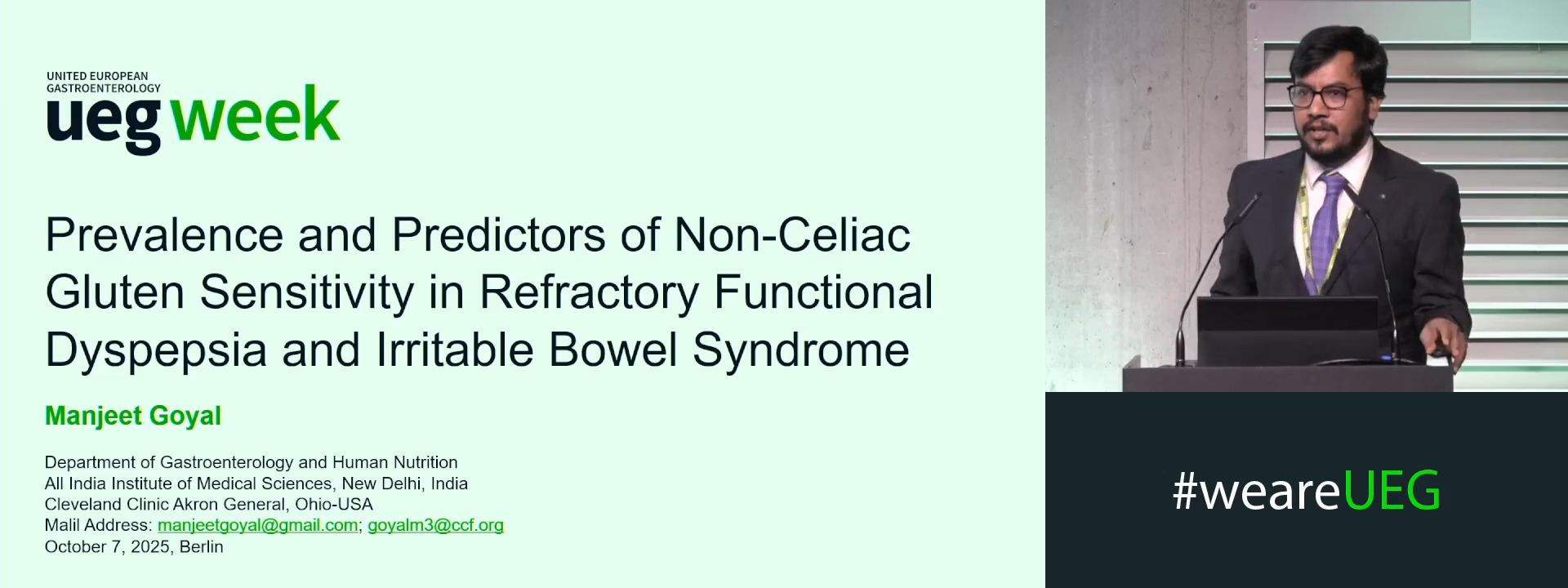
NON-CELIAC WHEAT SENSITIVITY IN REFRACTORY FUNCTIONAL DYSPEPSIA AND IRRITABLE BOWEL SYNDROME: A PROSPECTIVE, RANDOMIZED STUDY
1 Dayanand Medical College and Hospital, Ludhiana, India
2 All India Institute of Medical Sciences, New Delhi, New Delhi, India
3 R.G. stone and superspeciality Hospital, Ludhiana, India
4 Maharishi Markandeshwar Institute of Medical Sciences and Research, Ambala, India
Event
Topics