UEG's content platform for gastroenterology education bringing recordings, courses, guidelines, and more together in one place.
Trending on Gutflix
Rate for better recommendations!
Your feedback helps us show you more of what you like and less of what you dislike!
Log in to continue.
This content is part of Gutflix. Log in with your myUEG account, or create one free, to watch it.
Not sure what you can access? Learn more about account types.
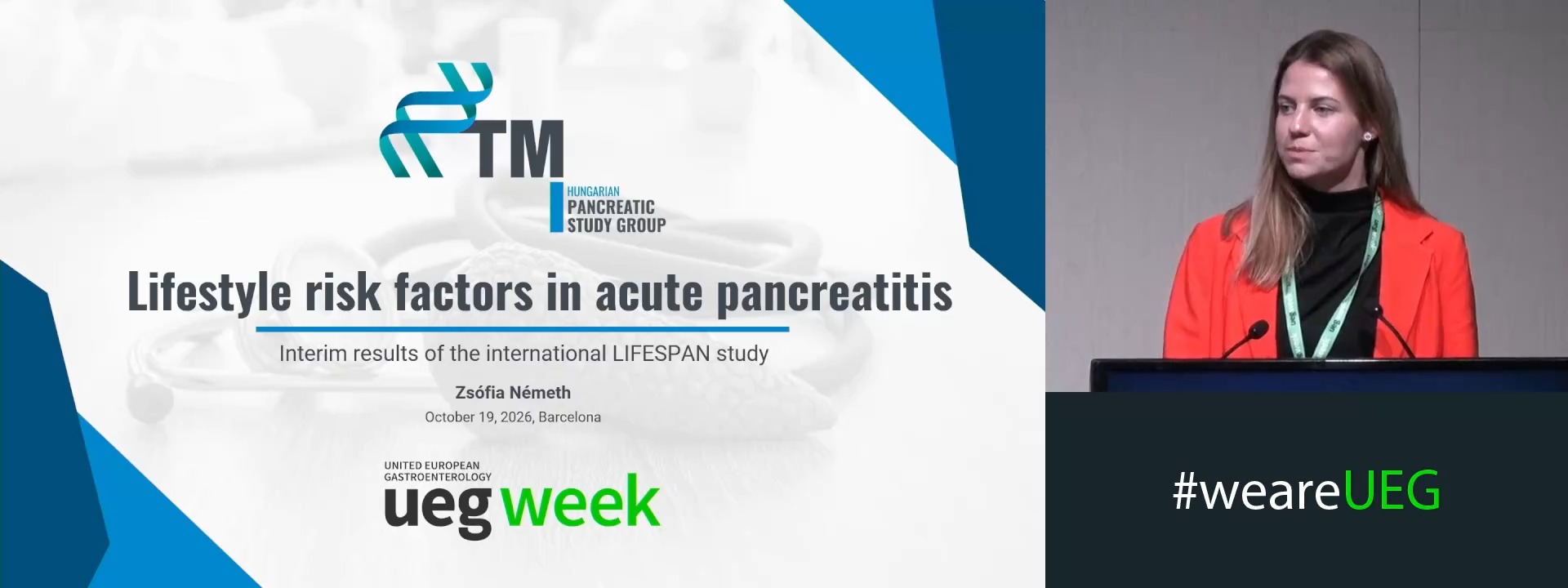
INTERIM RESULTS OF THE INTERNATIONAL LIFESPAN CASE–CONTROL STUDY: LIFESTYLE RISK FACTORS IN ACUTE PANCREATITIS
Dalma Dobszai 1,2, Zsofia Nemeth 2, Zsanett Macht-Szalai 3, Áron Vincze 3, László Czakó 4, Balint Eross 2, Peter Jeno Hegyi 2, Zoltán Hajnády 2, Ferenc Izbéki 5, László Gajdán 6, Imola Török 7, Andrey Litvin 8, elmas biberci keskin 9, Yaroslav Susak 10, Viktoriia Teterina 10, Peter Hegyi 2,3, Andrea Szentesi 2,3
Affiliations
1 University of Pécs Medical School, Pécs, Hungary
2 Semmelweis University, Budapest, Hungary
3 University of Pécs, Pécs, Hungary
4 University of Szeged, Szeged, Hungary
5 Szent György University Teaching Hospital, Szekesfehervar, Hungary
6 Szent György University Teaching Hospital, Székesfehérvár, Hungary
7 George Emil Palade University of Medicine, Targu Mures, Romania
8 Gomel State Medical University, Gomel, Belarus
9 9. Şişli Hamidiye Etfal Training and Research Hospital, Istanbul, Türkiye
10 Bogomolets National Medical University, Kyiv, Ukraine

Log in to continue.
This content is part of Gutflix. Log in with your myUEG account, or create one free, to watch it.
Not sure what you can access? Learn more about account types.
Pancreatic pain: From symptoms to treatment
Affiliations
1 Aalborg University Hospital, Aalborg, Denmark
Log in to continue.
This content is part of Gutflix. Log in with your myUEG account, or create one free, to watch it.
Not sure what you can access? Learn more about account types.
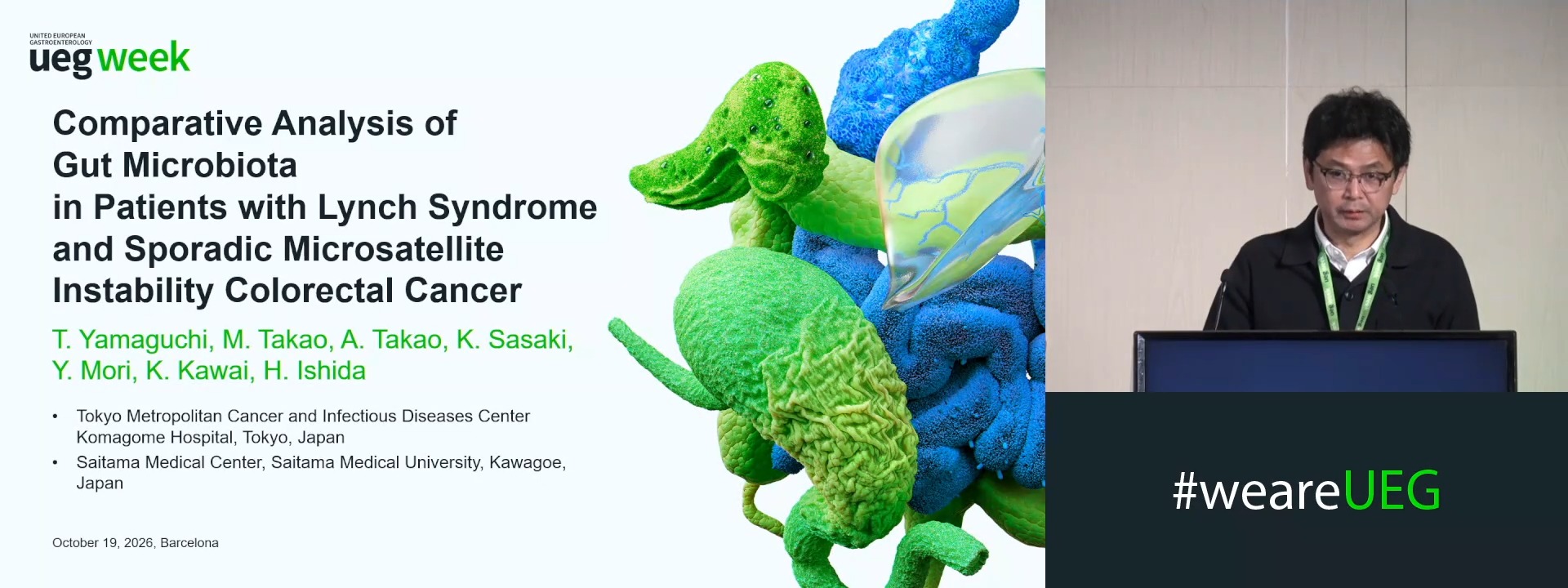
COMPARATIVE ANALYSIS OF GUT MICROBIOTA IN PATIENTS WITH LYNCH SYNDROME AND SPORADIC MICROSATELLITE INSTABILITY COLORECTAL CANCER
Tatsuro Yamaguchi 1, Misato Takao 1, Akinari Takao 1, Kazuhito Sasaki 1, Yoshiko Mori 2, Kazushige Kawai 1, Hideyuki Ishida 2
Affiliations
1 Tokyo Metropolitan Cancer and Infectious Diseases Center Komagome Hospital, Tokyo, Japan
2 Saitama Medical Center, Saitama Medical University, Kawagoe, Japan