UEG's content platform for gastroenterology education bringing recordings, courses, guidelines, and more together in one place.
Trending on Gutflix
Rate for better recommendations!
Your feedback helps us show you more of what you like and less of what you dislike!
Log in to continue.
This content is part of Gutflix. Log in with your myUEG account, or create one free, to watch it.
Not sure what you can access? Learn more about account types.
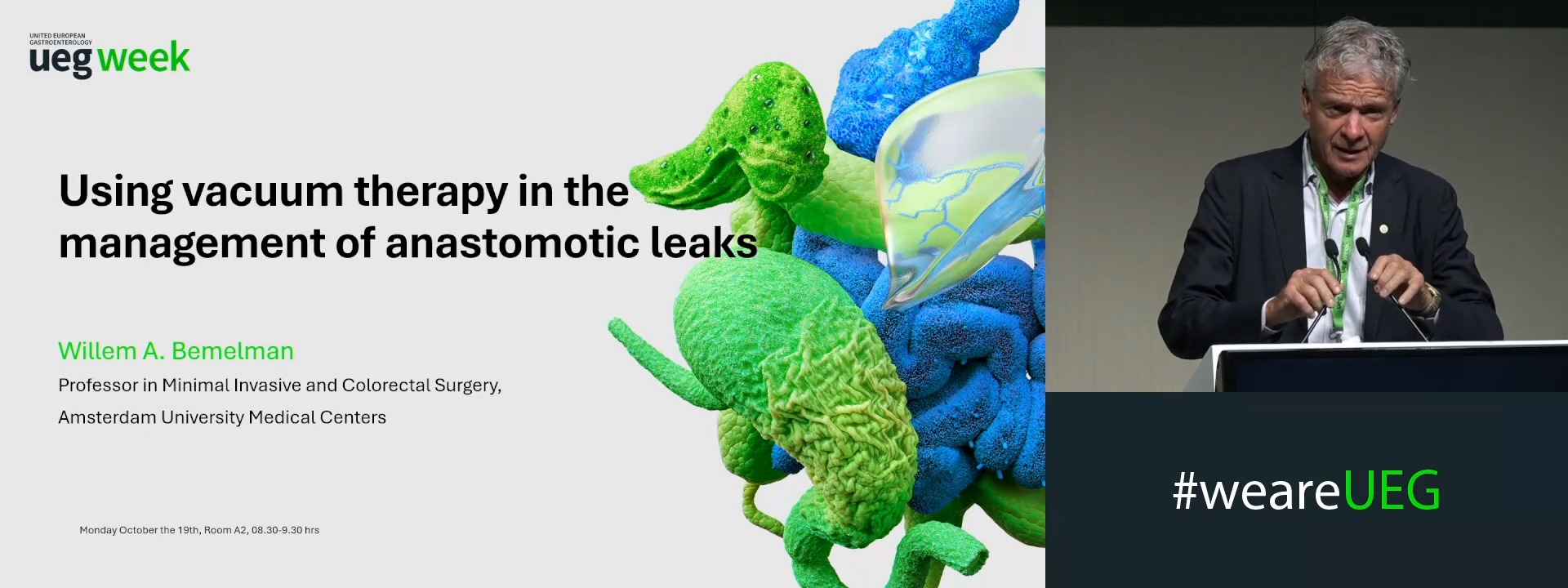
Using vacuum therapy in the management of anastomotic leaks
Affiliations
1 Amsterdam UMC, Amsterdam, Netherlands
Log in to continue.
This content is part of Gutflix. Log in with your myUEG account, or create one free, to watch it.
Not sure what you can access? Learn more about account types.
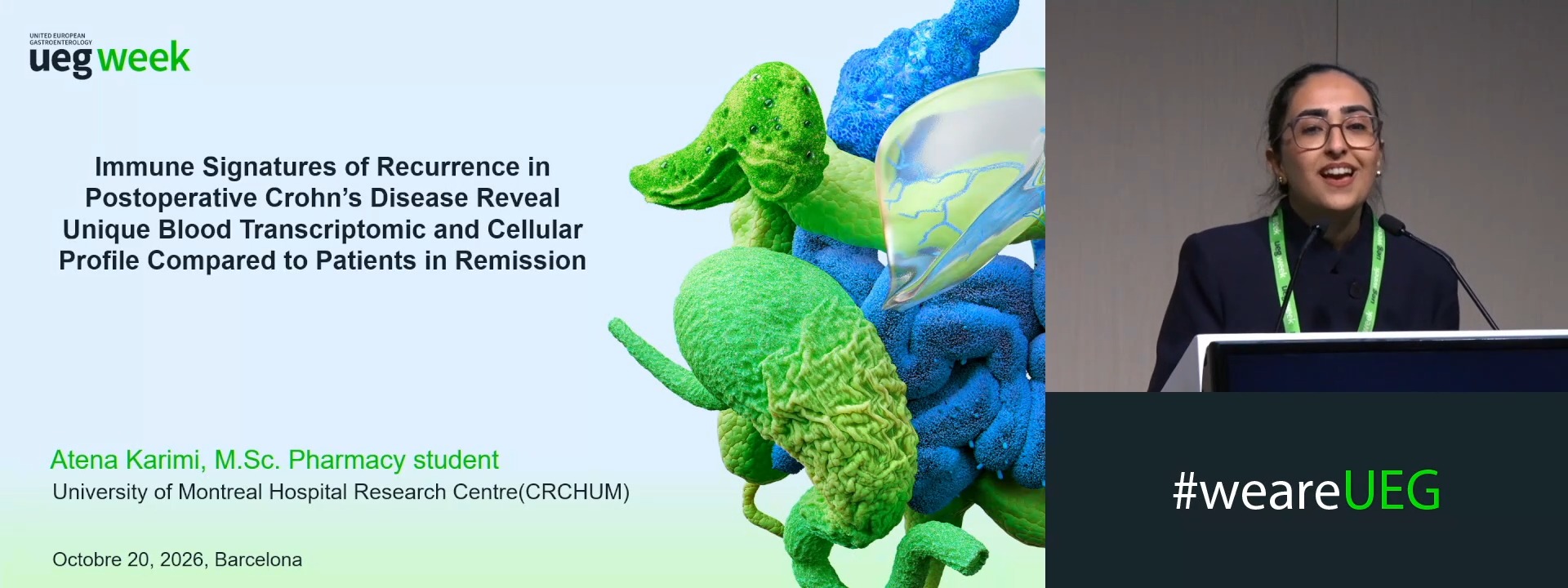
IMMUNE SIGNATURES OF RECURRENCE IN POSTOPERATIVE CROHN’S DISEASE REVEAL UNIQUE BLOOD TRANSCRIPTOMIC AND CELLULAR PROFILE COMPARED TO PATIENTS IN REMISSION
Atena Karimi 1, Alessandro David 1, Katarzyna Orlicka 1, Edmond Jean Bernard 1, Jeremy Liu Chen Kiow 1, Raymond Leduc 1, William Lanteigne-Lamoureux 1, Nathalie Nashen 1, Alice Dufresne 1, Andraanne Morin 1, Robert Battat 1
Affiliations
1 Centre de Recherche de Centre Hospitalier de l'Université de Montréal (CRCHUM), Montreal, Canada
Log in to continue.
This content is part of Gutflix. Log in with your myUEG account, or create one free, to watch it.
Not sure what you can access? Learn more about account types.
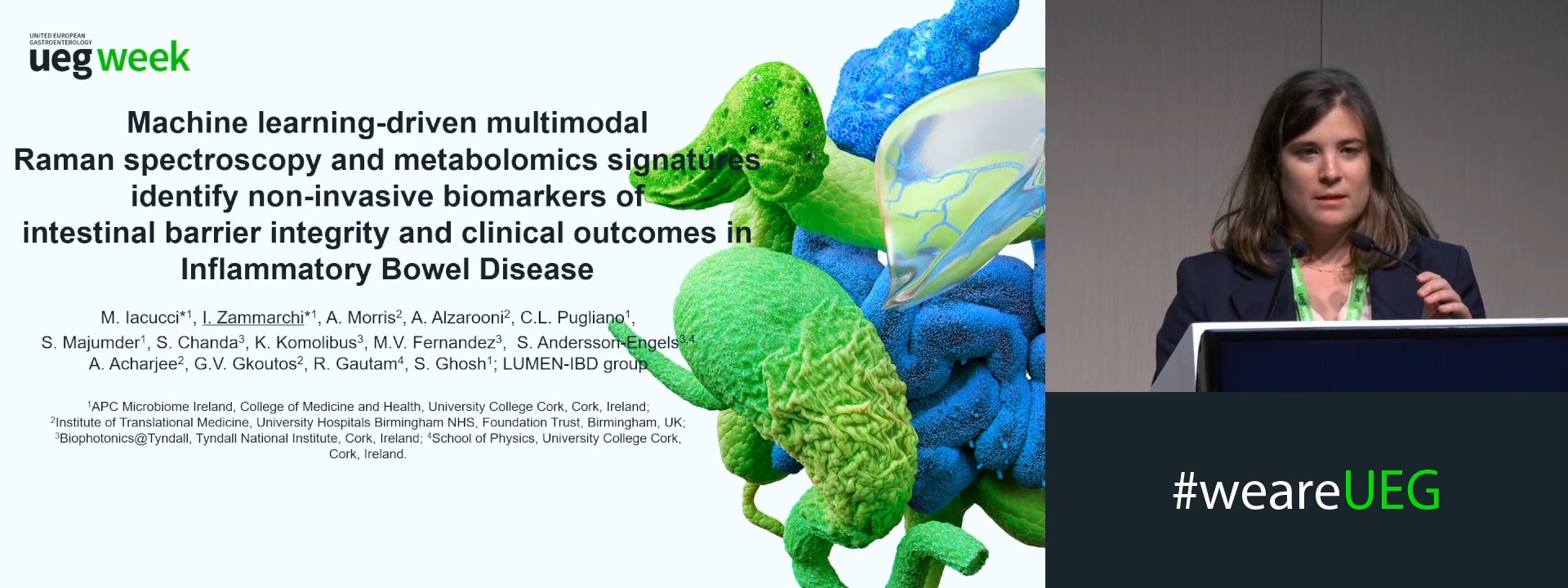
MACHINE LEARNING-DRIVEN MULTIMODAL RAMAN SPECTROSCOPY AND METABOLOMICS SIGNATURES IDENTIFY NON-INVASIVE BIOMARKERS OF INTESTINAL BARRIER INTEGRITY AND CLINICAL OUTCOMES IN INFLAMMATORY BOWEL DISEASE
Marietta Iacucci 1, Irene Zammarchi 1, Amy Morris 2, Abdulrahman Alzarooni 2, Cecilia Lina Pugliano 1, Snehali Majumder 1, Sumedha Chanda 3, Katarzyna Komolibus 3, Maria Victoria Fernandez 3, Stefan Andersson-Engels 3,1, Animesh Acharjee 2, Georgios V. Gkoutos 2, Rekha Gautam 3, Subrata Ghosh 1
Affiliations
1 University College Cork, Cork, Ireland
2 University Hospitals Birmingham NHS, Birmingham, United Kingdom
3 Tyndall National Institute, Cork, Ireland
Log in to continue.
This content is part of Gutflix. Log in with your myUEG account, or create one free, to watch it.
Not sure what you can access? Learn more about account types.
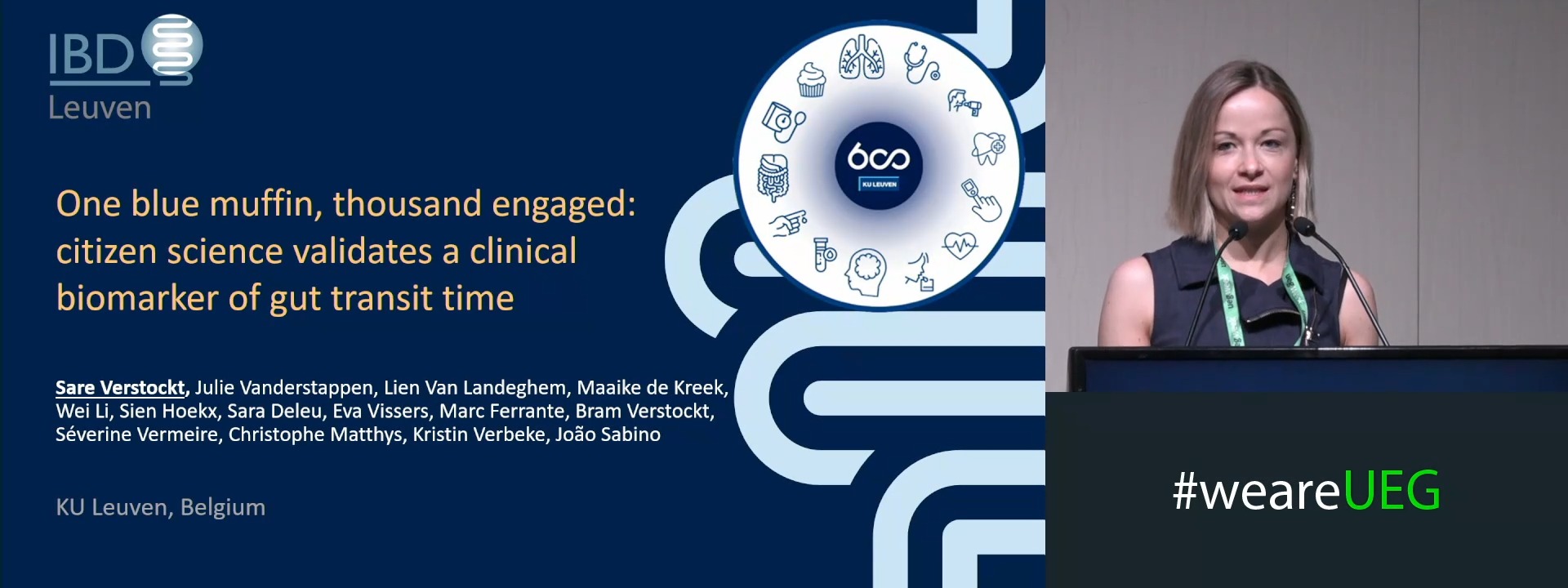
ONE BLUE MUFFIN, THOUSAND ENGAGED: CITIZEN SCIENCE VALIDATES A CLINICAL BIOMARKER OF GUT TRANSIT TIME
Sare Verstockt 1, Julie Vanderstappen 2, Lien Van Landeghem 1, Maaike De Kreek 1, Wei Li 1, Sien Hoekx 2, Sara Deleu 1, Eva Vissers 1, Marc Ferrante 2, Bram Verstockt 2, Séverine Vermeire 1, Christophe Matthys 1, Kristin Verbeke 1, João Sabino 2
Affiliations
1 KU Leuven, Leuven, Belgium
2 University Hospitals Leuven, Leuven, Belgium
Log in to continue.
This content is part of Gutflix. Log in with your myUEG account, or create one free, to watch it.
Not sure what you can access? Learn more about account types.
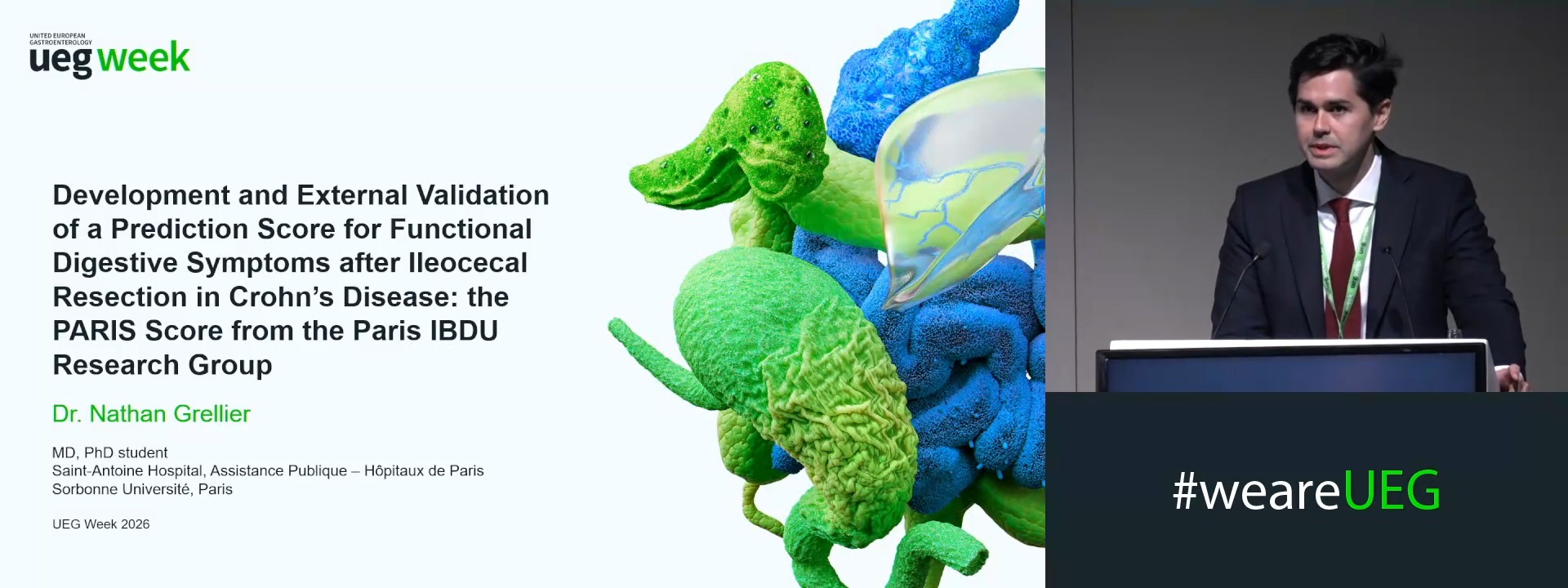
DEVELOPMENT AND EXTERNAL VALIDATION OF A PREDICTION SCORE FOR FUNCTIONAL DIGESTIVE SYMPTOMS AFTER ILEOCECAL RESECTION IN CROHN'S DISEASE: THE PARIS SCORE FROM THE PARIS IBDU RESEARCH GROUP
Nathan Grellier 1, Julien Kirchgesner 1, Heithem Soliman 2, Alexandre Nuzzo 3, Yves Panis 4, Franck Carbonnel 5, Antoine Brouquet 6, Aurelien Amiot 5, Matthieu Uzzan 7, Francesco Brunetti 7, Matthieu Allez 8, Leon Maggiori 9, Anne Laure Pelletier 10, Ahmad Tarhini 10, Bénédicte PIGNEUR 11, Harry Sokol 1, Laurent Beaugerie 1, Jeremie Lefevre 1, Philippe Seksik 1
Affiliations
1 Saint-Antoine Hospital, Paris, Paris, France
2 Hôpital Louis Mourier - AP-HP, Colombes, France
3 Beaujon Hospital, Paris, France
4 Institut des MICI, Neuilly-sur-Seine, France
5 CHU Bicetre - Dept. de Hepato-Gastroenterologie, CHU Bicetre; Le Kremlin Bicetre/FR - Dept. de Hepat, Le Kremlin Bicetre, France
6 Hôpital Kremlin Bicêtre, AP-HP, Kremlin Bicêtre, France
7 Hôpital Henri Mondor, AP-HP, Créteil, France
8 Hopital Saint-Louis APHP, Université Denis Diderot Paris 7, Paris, France
9 Hôpital Saint-Louis, Paris, France
10 Hôpital Bichat Claude Bernard, AP-HP, Paris, France
11 Hôpital Necker Enfants - Malades, Paris, France
Log in to continue.
This content is part of Gutflix. Log in with your myUEG account, or create one free, to watch it.
Not sure what you can access? Learn more about account types.
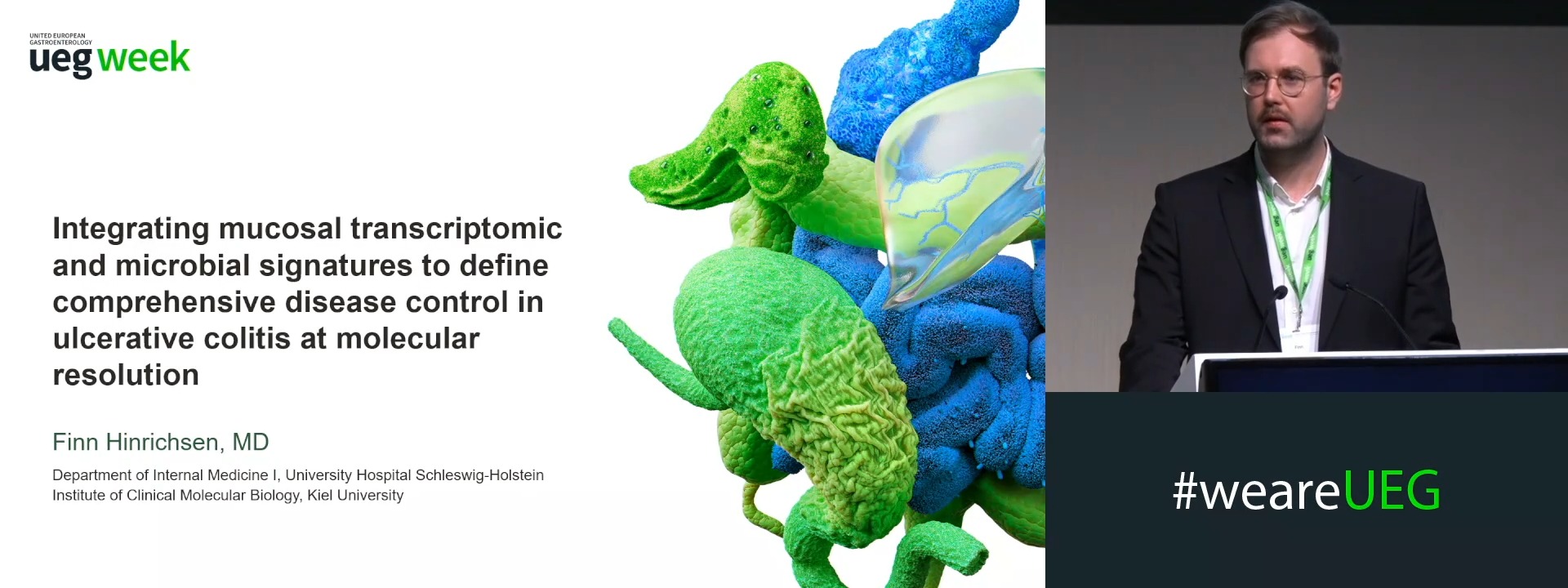
INTEGRATING MUCOSAL TRANSCRIPTOMIC AND MICROBIAL SIGNATURES TO DEFINE COMPREHENSIVE DISEASE CONTROL IN ULCERATIVE COLITIS AT MOLECULAR RESOLUTION
Finn Hinrichsen 1,2, Joana P. Bernardes 1, Víctor A. López-Agudelo 1, Neha Mishra 1, Lina Wehkamp 1,2, Florian Tran 1,2, Konrad Aden 1,2, Stefan Schreiber 1,2, Philip Rosenstiel 1,2
Affiliations
1 University Hospital Schleswig-Holstein UKSH, Kiel, Kiel, Germany
2 University Hospital Schleswig-Holstein UKSH, Campus Kiel, Kiel, Germany