Introduction
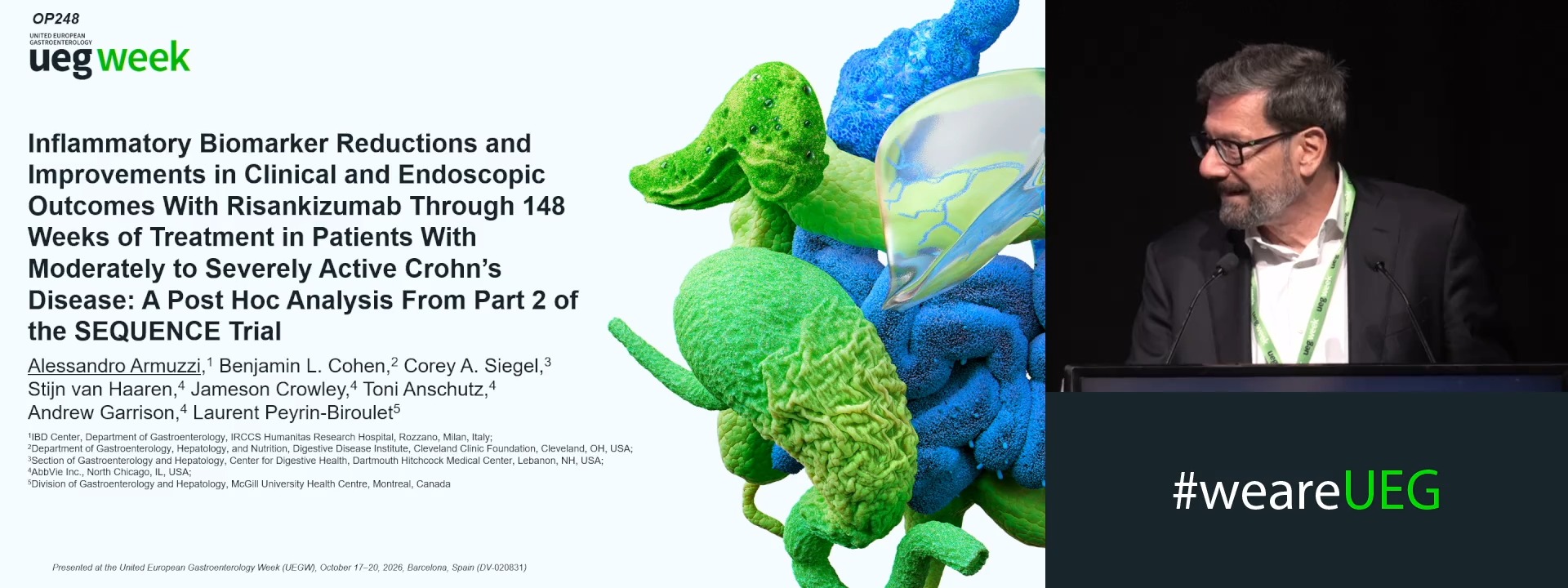
The STRIDE-II consensus recommendations for Crohn’s disease (CD) emphasise the importance of simultaneously achieving long-term treatment targets, including clinical remission, endoscopic healing, and normalisation of inflammatory biomarkers as a therapeutic strategy for improving long-term patient outcomes.1,2 This post hoc analysis of the SEQUENCE open-label extension (OLE; Part 2) evaluated the simultaneous achievement of clinical, endoscopic, and inflammatory biomarker improvements in patients with moderately to severely active CD treated long-term with risankizumab (RZB), an interleukin-23 p19 inhibitor.
Aims & Methods
SEQUENCE Part 2 (NCT04524611) included patients treated with RZB who completed the week 48 visit of Part 1 and were eligible to continue open-label subcutaneous RZB 360 mg maintenance therapy every 8 weeks.3 This analysis included patients who completed week 148 of RZB treatment or who discontinued treatment prior to week 148 in Part 2 (cutoff date: 02 July 2025). Patients were assessed for achievement of clinical remission according to the CD activity index (CDAI) or stool frequency/abdominal pain score (SF/APS), in combination with endoscopic response. Patients with elevated high-sensitivity C-reactive protein (hs-CRP; > 5 mg/L) or fecal calprotectin (FCP; > 250 mg/kg) at induction baseline were assessed for achievement of normalised hs-CRP or FCP in combination with the clinical remission endpoints or endoscopic response. All composite endpoints are defined in the Table footnote and were assessed at weeks 52 (OLE baseline), 76, 100, 124, and 148. Composite endpoints that included endoscopic response were assessed at weeks 52 and 148, as endoscopy is performed every 2 years in the OLE. Data were assessed as observed (AO), and using modified nonresponder imputation (mNRI) for all intent-to-treat patients. Safety was not assessed in this post hoc analysis but has been previously reported.4
Results
Of the 224 patients enrolled in SEQUENCE Part 2, nearly half (45.9%) achieved CDAI clinical remission and endoscopic response at week 52 per AO data (Table). The proportion of patients achieving this composite endpoint was maintained at week 148 (49.3%). A similar trend was observed for patients who achieved SF/APS clinical remission and endoscopic response. Among the 184 patients with elevated hs-CRP or FCP levels at baseline, the proportion who simultaneously achieved both normalised hs-CRP or FCP and clinical remission consistently increased from week 52 to weeks 76, 100, 124, and 148 per CDAI (AO data: 61.5%, 67.7%, 73.0%, 75.9%, and 81.1%, respectively) and per SF/APS (AO data: 55.8%, 61.4%, 64.2%, 65.5%, and 70.8%, respectively). Similarly, most patients also achieved normalisation of hs-CRP or FCP and endoscopic response at weeks 52 and 148 (AO data; week 52: 51.4%, week 148: 60.2%). mNRI data for all endpoints are summarised in the Table.
Endpoint, n/N (%) [95% CI]a
| AOb
| NRIc |
Achievement of CDAI clinical remissiond and endoscopic responsee
Week 52
Week 148
Achievement of SF/APS clinical remissionf and endoscopic responsee
Week 52
Week 148
Normalisation of hs-CRPg or FCPh and CDAI clinical remissiond
Week 52
Week 76
Week 100
Week 124
Week 148
Normalisation of hs-CRPg or FCPh and SF/APS clinical remissionf
Week 52
Week 76
Week 100
Week 124
Week 148
Normalisation of hs-CRPg or FCPh and endoscopic responsee
Week 52
Week 148
|
100/218 (45.9) [39.3, 52.5]
71/144 (49.3) [41.1, 57.5]
98/217 (45.2) [38.5, 51.8]
65/143 (45.5) [37.3, 53.6]
112/182 (61.5) [54.5, 68.6]
86/127 (67.7) [59.6, 75.8]
89/122 (73.0) [65.1, 80.8]
85/112 (75.9) [68.0, 83.8]
86/106 (81.1) [73.7, 88.6]
101/181 (55.8) [48.6, 63.0]
78/127 (61.4) [53.0, 69.9]
79/123 (64.2) [55.8, 72.7]
74/113 (65.5) [56.7, 74.3]
75/106 (70.8) [62.1, 79.4]
94/183 (51.4) [44.1, 58.6]
80/133 (60.2) [51.8, 68.5]
|
100/224 (44.6) [38.1, 51.2]
105/224 (46.8) [40.0, 53.7]
98/224 (43.8) [37.3, 50.2]
91/224 (40.5) [33.6, 47.5]
112/184 (60.9) [53.8, 67.9]
115/184 (62.5) [55.1, 69.9]
115/184 (62.4) [54.9, 70.0]
112/184 (60.7) [52.8, 68.5]
113/184 (61.3) [53.9, 68.7]
101/184 (54.9) [47.7, 62.1]
100/184 (54.4) [46.5, 62.2]
97/184 (52.6) [45.0, 60.1]
93/184 (50.4) [42.8, 58.0]
95/184 (51.4) [43.6, 59.1]
94/184 (51.1) [43.9, 58.3]
90/184 (48.7) [41.1, 56.3]
|
Table. Achievement of improvements in combinations of clinical, endoscopic, and inflammatory biomarker endpoints
Abbreviations: AE, adverse event; AO, as observed; CD, Crohn’s disease; CDAI, Crohn’s Disease Activity Index; FCP, fecal calprotectin; hs-CRP; high-sensitivity C-reactive protein; mNRI, modified nonresponder imputation;
RZB, Risankizumab; SF/APS, stool frequency/abdominal pain score.
The study population includes all intent-to-treat patients who received at least one dose of study drug in the SEQUENCE OLE.
aConstruction of CIs for response rate is based on the normal approximation to the binomial distribution.
bMissing data were addressed using multiple imputations for missed assessments, including missing value following premature study treatment discontinuation for reasons other than "lack of efficacy" or "AE limited only to CD". Visits after discontinuation from treatment caused by "lack of efficacy" or "AE limited only to CD", as well as visits on or after the initiation of RZB rescue therapy, were categorised as nonresponders.
cCDAI clinical remission: CDAI < 150.
dEndoscopic response: Decrease in SES-CD > 50% from baseline (or for patients with isolated ileal disease and a baseline SES-CD of 4, ≥ 2 point reduction from baseline), as scored by central reviewer.
eSF/APS clinical remission: Average daily SF ≤ 2.8 and not worse than baseline value and average daily APS ≤ 1 and not worse than baseline value.
fC-reactive protein (hs-CRP) ≤ 5 mg/L.
gFCP ≤ 250 mg/kg.
|
Conclusion
In this post hoc analysis of patients with moderately to severely active CD, long-term treatment with RZB led to simultaneous improvements in clinical, endoscopic, and inflammatory biomarker outcomes that were sustained through week 148. These results highlight the potential of RZB to provide long-term, comprehensive disease control in the management of CD.
References
- Turner D, et al. Gastroenterology. 2021;160:1570–83.
- Jairath V, et al. J Crohns Colitis. 2025;19:jjaf040.
- Peyrin-Biroulet L, et al. N Engl J Med. 2024;391:213–23.
- Peyrin-Biroulet L, et al. J Crohns Colitis. 2025;19:jjaf213.
Disclosure
Alessandro Armuzzi has received consulting/advisory board fees from AbbVie, Abivax, Alfa Sigma, AstraZeneca, Biogen, Bristol Myers Squibb, Celltrion, Eli Lilly, Enthera, Ferring, Galapagos, Gilead, Giuliani, Janssen, Lionhealth, MSD, Nestlé, Pfizer, Protagonist Therapeutics, Roche, Samsung Bioepis, Sandoz, Sanofi, Takeda, Teva Pharmaceuticals, Tillots Pharma; speaker’s fees from AbbVie, Abivax, Alfa Sigma, Biogen, Bristol Myers Squibb, Celltrion, Eli Lilly, Ferring, Fresenius Kabi, Galapagos, Gilead, Janssen, Lionhealth, MSD, Novartis, Pfizer, Roche, Samsung Bioepis, Sandoz, Takeda, and Teva Pharmaceuticals; and research support from AbbVie, Biogen, MSD, Takeda, and Pfizer.
Benjamin L. Cohen has received advisory board and consultancy fees from AbbVie, ALPCO, Celgene-Bristol Myers Squibb, Johnson & Johnson Innovative Medicine, Eli Lilly, Pfizer, Sublimity Therapeutics, Takeda, TARGET RWE; DSMB: Emmes Biopharma Services LLC; speakers’ fees from AbbVie and Takeda.
Corey A. Siegel has received consulting fees from AbbVie, Boomerang, Celltrion, Johnson & Johnson, Eli Lilly, Pfizer, Sanofi, Takeda; speaker fees for CME activities for AbbVie, Johnson & Johnson, Pfizer, Takeda; grant support from AbbVie, Celltrion, Johnson & Johnson, Eli Lilly, Pfizer, Takeda; and licensing fees from Takeda.
Stijn van Haaren, Jameson Crowley, Toni Anschutz, and Andrew Garrison, are full-time employees of AbbVie and may own AbbVie stock or stock options.
Laurent Peyrin-Biroulet has received consulting fees from AbbVie, Abivax, Adacyte, Alimentiv, Alfasigma, Amgen, Apini, Banook, BMS, Celltrion, Enthera, Ferring, Fresenius Kabi, Galapagos, Genentech, Gilead, GSK, Hemay, Iterative Health, Janssen, Eli Lilly, LifeMine, Medac, Mirador, Morphic, MSD, Nordic Pharma, Novartis, Oddifact, Oncodesign Precision Medicine, Onco3R, ONO Pharma, OSE Immunotherapeuthics, Palisade Bio, Par' Immune, Pfizer, Prometheus, Roche, Roivant, Samsung, Sandoz, Sanofi, Sorriso, Spyre, Takeda, Teva, ThirtyfiveBio, Tillots, Vectivbio, Vedanta, Ventyx; stock options from Iterative Health, Oragen, Pharmanest, Thetis; and lecture fees from AbbVie, Alfasigma, Amgen, Biogen, Celltrion, Ferring, Fresenius Kabi, Galapagos, Genentech, Gilead, Iterative Health, Janssen, Eli Lilly, Medac, MSD, Nordic Pharma, Novartis, Pfizer, Roche, Sandoz, Takeda, and Tillots.
Funding: AbbVie Inc. funded this trial and participated in the trial design, research, analysis, data collection, interpretation of data, and the review and approval of the publication. All authors had access to relevant data and participated in the drafting, review, and approval of this publication. No honoraria or payments were made for authorship.
Acknowledgments: AbbVie and the authors thank the patients, study sites, and investigators who participated in this clinical trial. Medical writing support was provided by Mahesh Chemudupati, PhD, of AbbVie. Editorial support was provided by S. Michael Austin of AbbVie.