UEG's content platform for gastroenterology education bringing recordings, courses, guidelines, and more together in one place.
Trending on Gutflix
Rate for better recommendations!
Your feedback helps us show you more of what you like and less of what you dislike!
Log in to continue.
This content is part of Gutflix. Log in with your myUEG account, or create one free, to watch it.
Not sure what you can access? Learn more about account types.
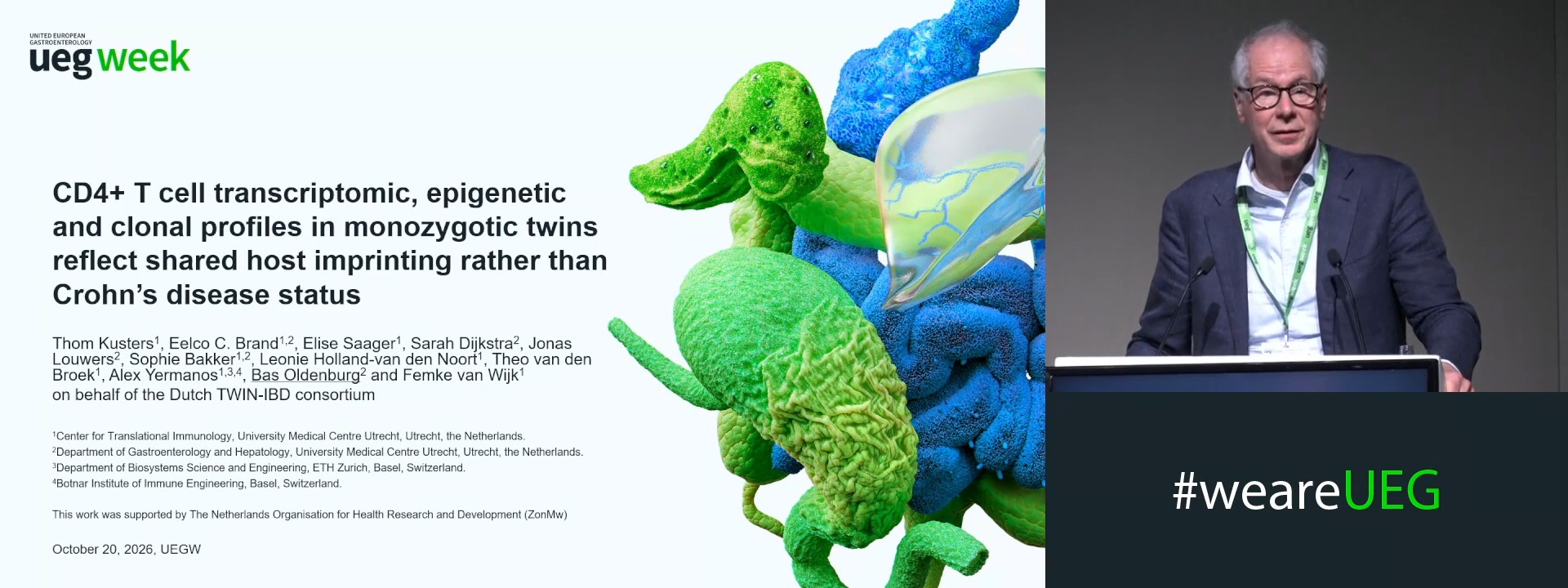
CD4+ T CELL TRANSCRIPTOMIC, EPIGENETIC AND CLONAL PROFILES IN MONOZYGOTIC TWINS REFLECT SHARED HOST IMPRINTING RATHER THAN CROHN’S DISEASE STATUS
Thom Kusters 1, Eelco C. Brand 1, Elise Saager 1, Sarah Dijkstra 1, Jonas Louwers 1, Sophie Bakker 1, Leonie Holland-van den Noort 1, Theo van den Broek 1, Alex Yermanos 1,2, Bas Oldenburg 1, Femke van Wijk 1
Affiliations
1 University Medical Centre Utrecht, Utrecht, Netherlands
2 Botnar Institute of Immune Engineering, Basel, Switzerland
Log in to continue.
This content is part of Gutflix. Log in with your myUEG account, or create one free, to watch it.
Not sure what you can access? Learn more about account types.
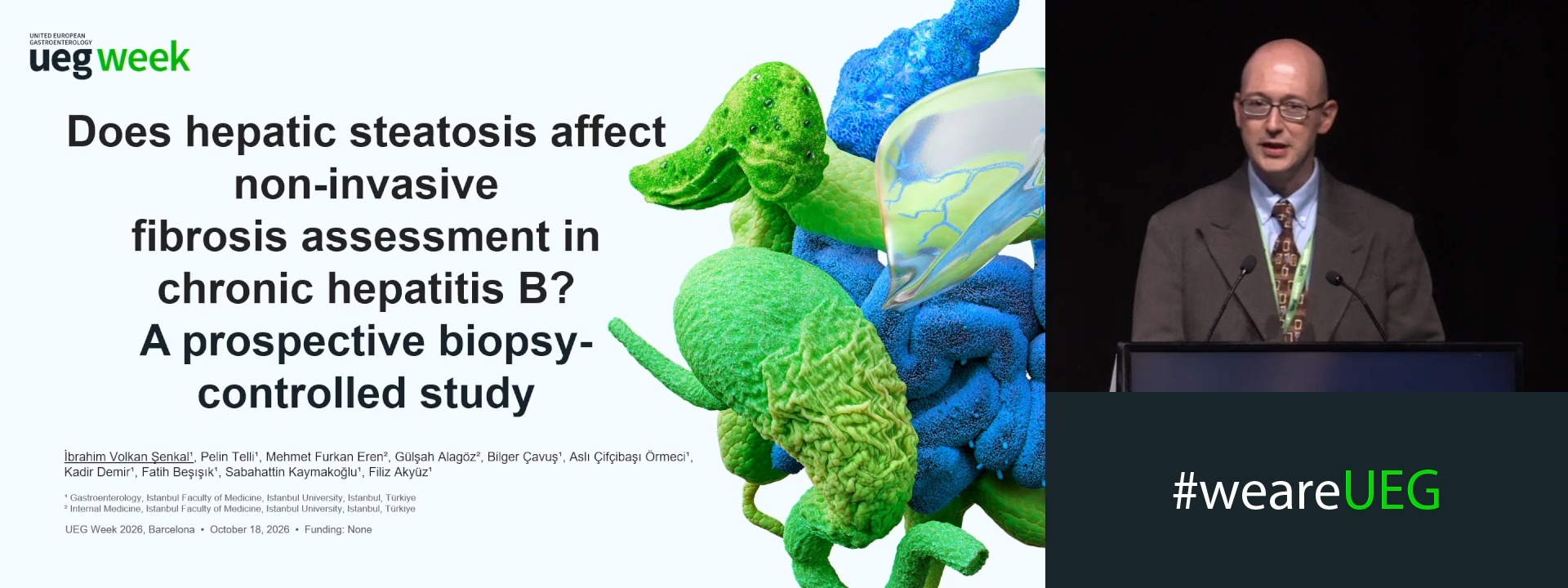
DOES HEPATIC STEATOSIS AFFECT NON-INVASIVE FIBROSIS ASSESSMENT IN CHRONIC HEPATITIS B? A PROSPECTIVE BIOPSY-CONTROLLED STUDY
Ibrahım Volkan Senkal 1, Pelin Telli 1, Mehmet Furkan EREN 1, Gülşah Alagöz 1, Bilger Cavus 1, Asli Cifcibasi Ormeci 1, Kadir Demir 1, Fatih Besisik 1, Sabahattin Kaymakoglu 1, Filiz Akyüz 1
Affiliations
1 Istanbul University Istanbul Medical Faculty, Istanbul, Türkiye
Log in to continue.
This content is part of Gutflix. Log in with your myUEG account, or create one free, to watch it.
Not sure what you can access? Learn more about account types.
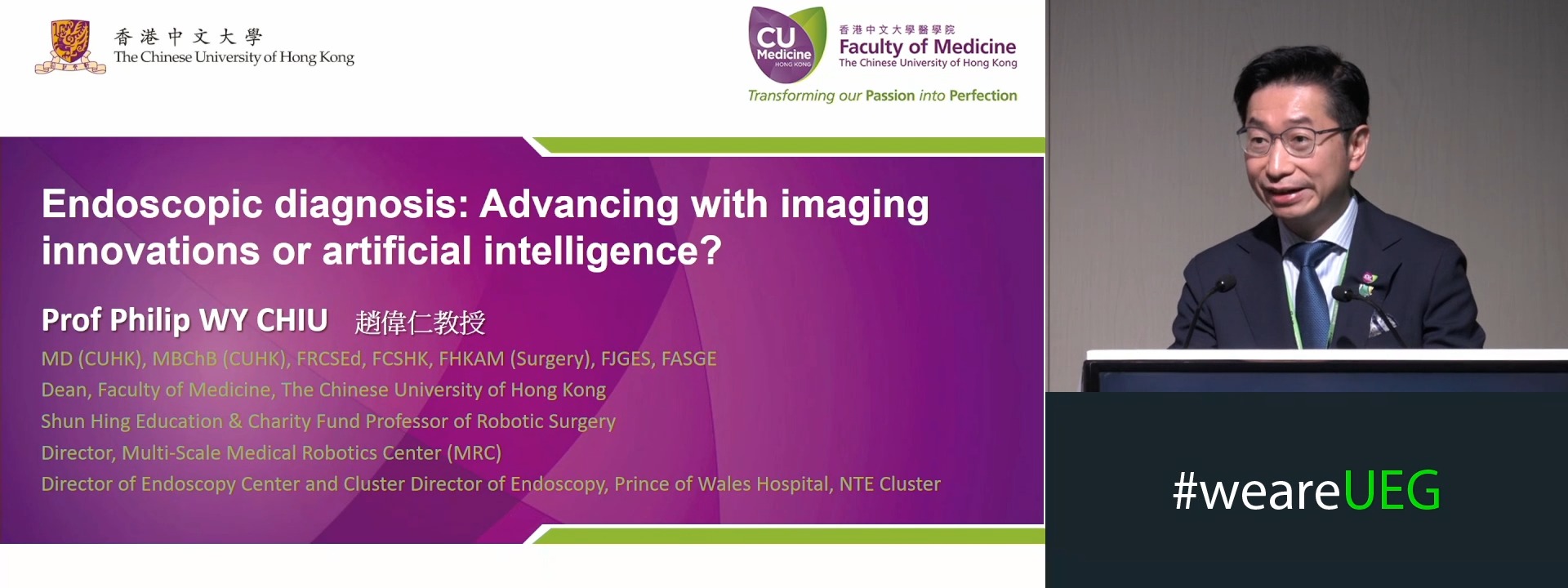
Endoscopic diagnosis: Advancing with imaging innovations or artificial intelligence?
Affiliations
1 Chinese University of Hong Kong, Hong Kong, Hong Kong
Log in to continue.
This content is part of Gutflix. Log in with your myUEG account, or create one free, to watch it.
Not sure what you can access? Learn more about account types.
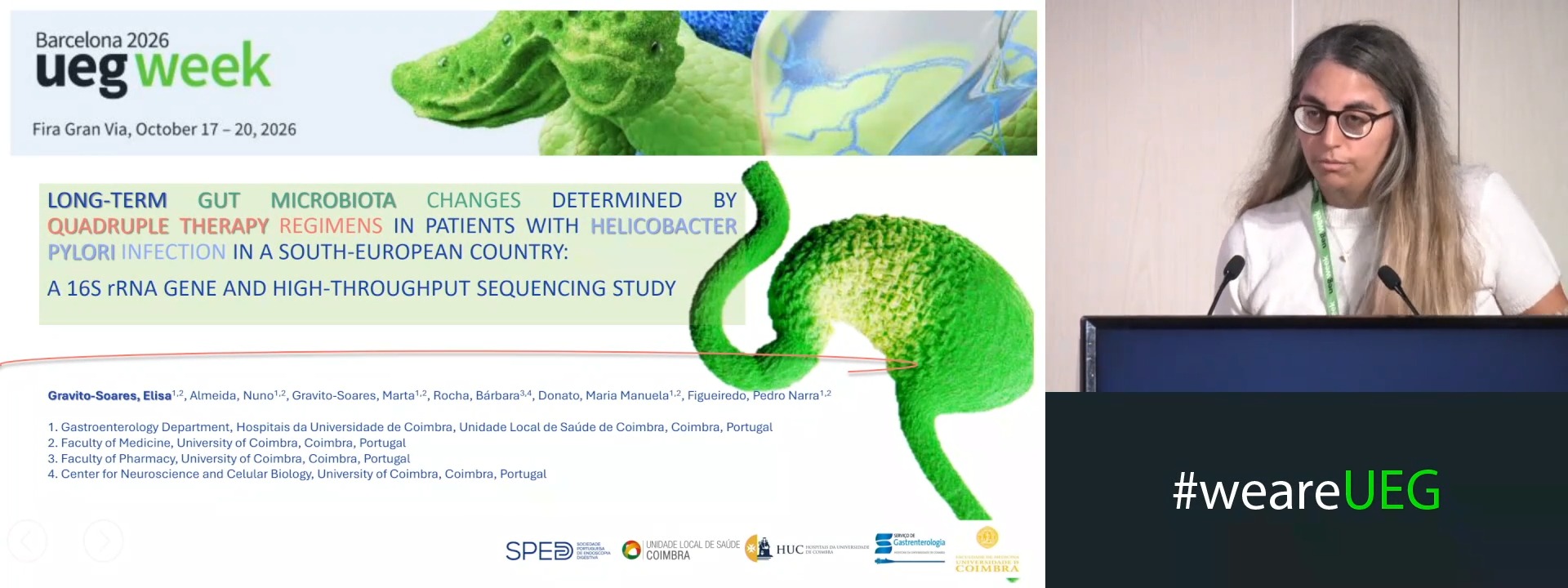
LONG-TERM GUT MICROBIOTA CHANGES DETERMINED BY QUADRUPLE THERAPY REGIMENS IN PATIENTS WITH HELICOBACTER PYLORI INFECTION IN A SOUTH-EUROPEAN COUNTRY: A 16S RRNA GENE SEQUENCING AND HIGH-THROUGHPUT SEQUENCING STUDY
Elisa Gravito-Soares 1,2, Nuno Peres Almeida 1,2, Marta Gravito-Soares 1,2, Barbara Rocha 3,4, Maria Manuela Donato 1,2, Pedro Narra Figueiredo 1,2
Affiliations
1 Hospitais da Universidade de Coimbra, Unidade Local de Saúde de Coimbra, Coimbra, Portugal
2 Faculty of Medicine, University of Coimbra, Coimbra, Portugal
3 Center for Neuroscience and Celular Biology, University of Coimbra, Coimbra, Portugal
4 Faculty of Pharmacy, University of Coimbra, Coimbra, Portugal