UEG's content platform for gastroenterology education bringing recordings, courses, guidelines, and more together in one place.
Trending on Gutflix
Rate for better recommendations!
Your feedback helps us show you more of what you like and less of what you dislike!
Log in to continue.
This content is part of Gutflix. Log in with your myUEG account, or create one free, to watch it.
Not sure what you can access? Learn more about account types.
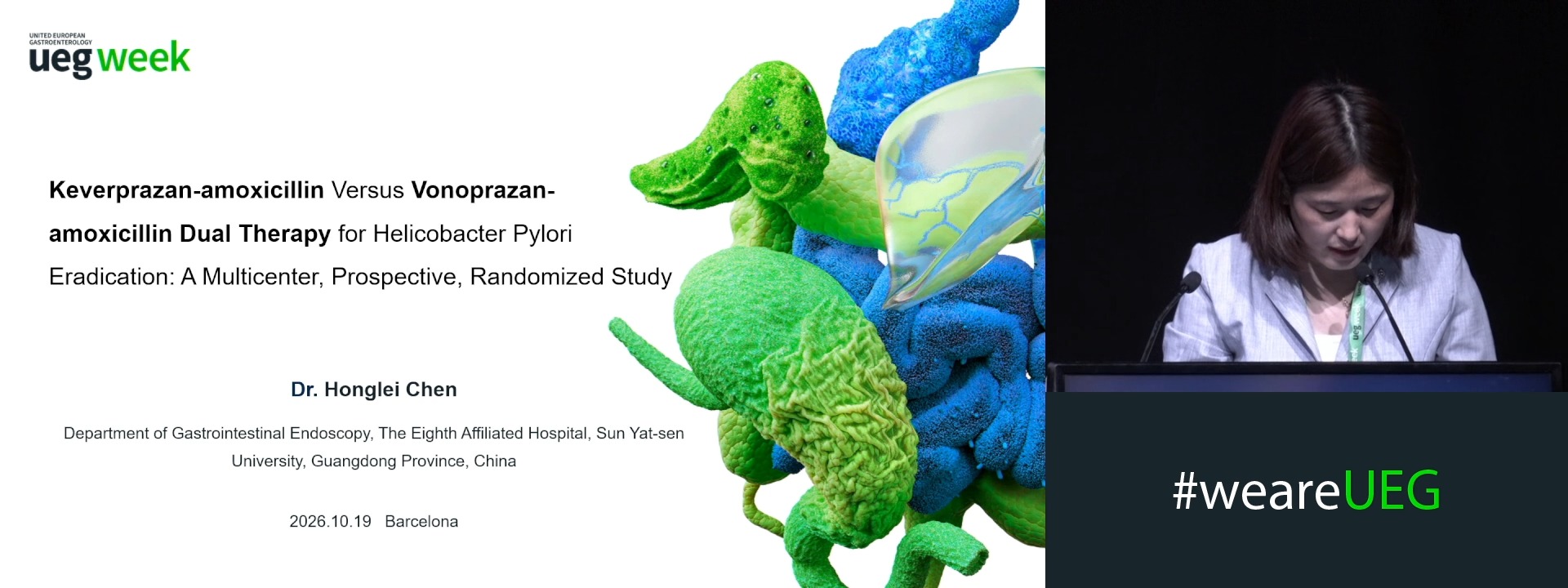
KEVERPRAZAN-AMOXICILLIN VERSUS VONOPRAZAN-AMOXICILLIN DUAL THERAPY FOR HELICOBACTER PYLORI ERADICATION: A MULTICENTER, PROSPECTIVE, RANDOMIZED STUDY
Ting Zhou 1, Ying Liu 2, Wei Liu 1, Yongsheng Huang 2, Fang Liu 1, Huizhen Xiong 1, Zhihao Huang 3, Meifang Ye 1,4, Chao Wu 1, Xiang Peng 5,6,7, Honglei Chen 1,4
Affiliations
1 The Eighth Affiliated Hospital, Sun Yat-sen University, Shenzhen, China
2 Xingguo Hospital Affiliated to Gannan Medical University, Xingguo, China
3 Puning Overseas Chinese Hospital, Puning, China
4 The Eighth Affiliated Hospital of Sun Yat-sen University, Shenzhen, China
5 The Sixth Affiliated Hospital, Sun Yat-sen University, Guangzhou, China
6 Guangdong Provincial Clinical Research Center for Digestive Diseases, Guangzhou, China
7 The Sixth Affiliated Hospital, Sun Yat- Sen University, Guangzhou, China
Log in to continue.
This content is part of Gutflix. Log in with your myUEG account, or create one free, to watch it.
Not sure what you can access? Learn more about account types.
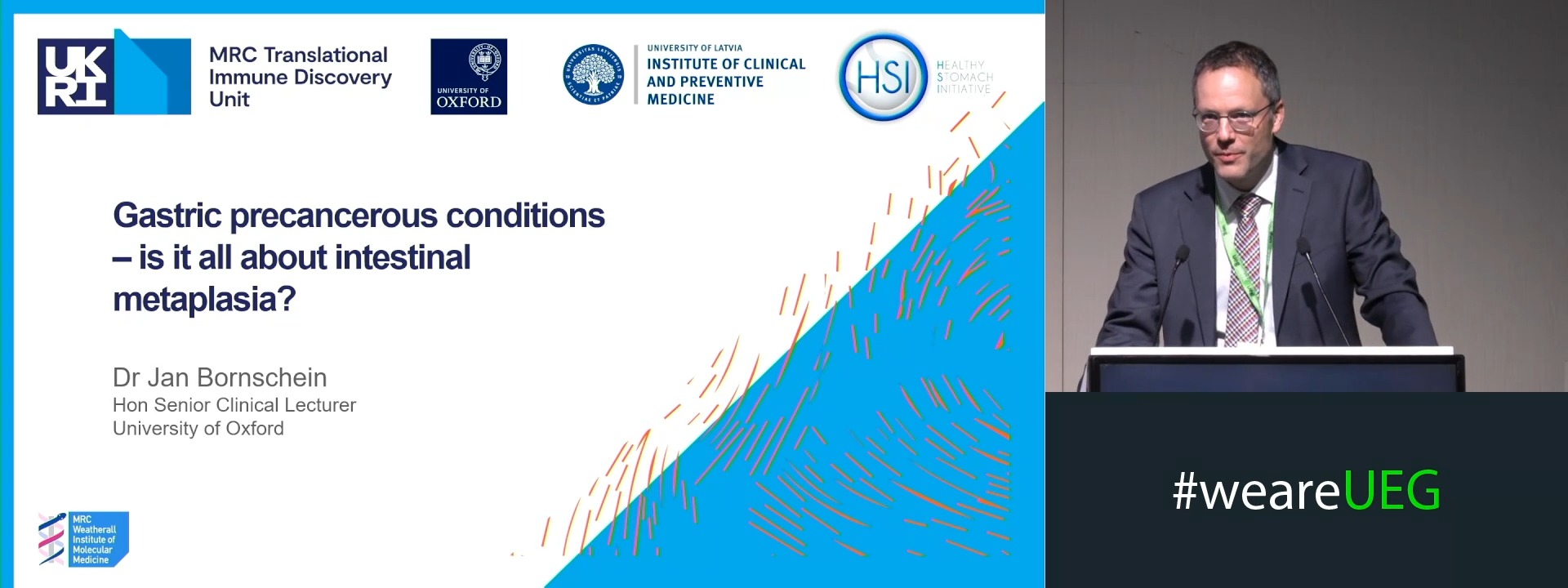
Is it all about intestinal metaplasia?
Affiliations
1 Oxford University Hospitals NHS Foundation Trust, Oxford, United Kingdom
Log in to continue.
This content is part of Gutflix. Log in with your myUEG account, or create one free, to watch it.
Not sure what you can access? Learn more about account types.
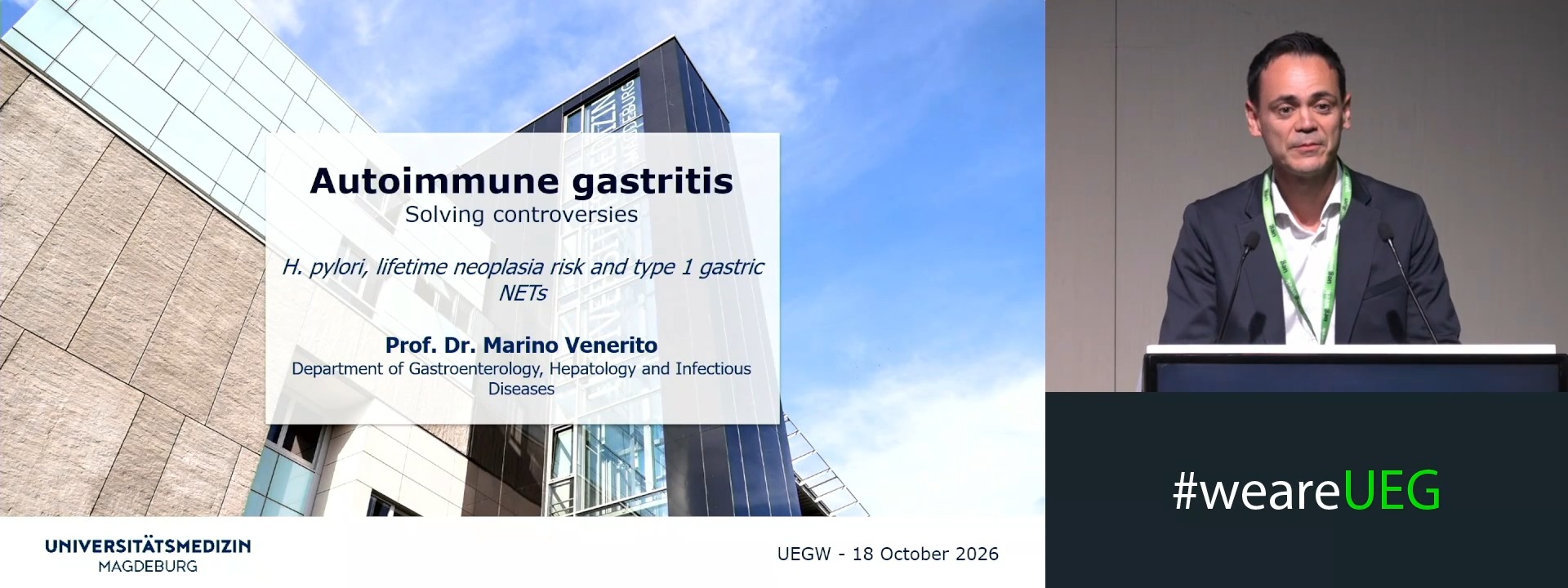
Autoimmune gastritis: Solving controversies
Affiliations
1 Otto-von-Guericke University, Magdeburg, Germany
Log in to continue.
This content is part of Gutflix. Log in with your myUEG account, or create one free, to watch it.
Not sure what you can access? Learn more about account types.
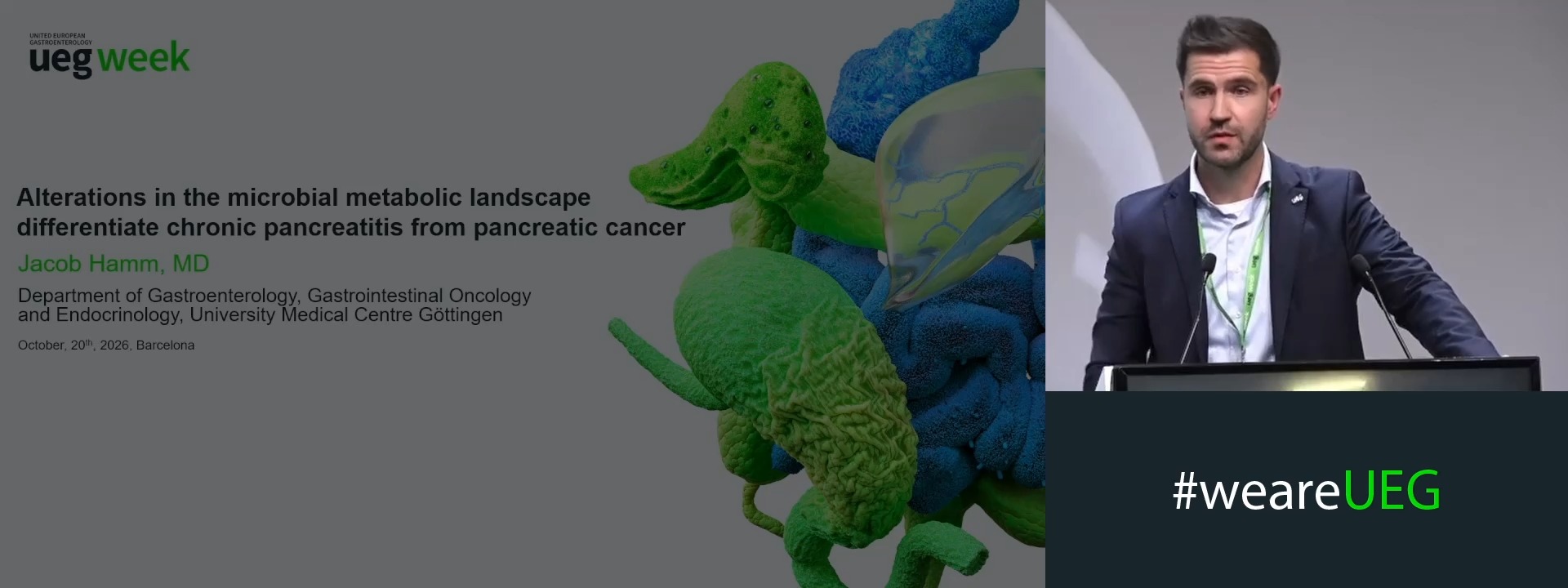
ALTERATIONS IN THE MICROBIAL METABOLIC LANDSCAPE DIFFERENTIATE CHRONIC PANCREATITIS FROM PANCREATIC CANCER
Jacob Hamm 1, Areej Shahbaz 1, Johannes Zimmermann 2, Linh Dang 1, Cathleen Heuer 1, Catharina Lingens 1, Charlotte Ratei 1, Isabel Toussaint 1, Helena Lescow 1, Louisa Eskelson 1, Tim Beißbarth 1, Angelika Hafke 1, Ralph Kraetzner 1, Christoph Gerdes 3, Georg Beyer 4, Simon Sirtl 5, Marko Damm 6, Veit Phillip 7, Sebastian Rasch 8, Robert Henker 9, Albrecht Hoffmeister 9, Maria Lourdes Ruiz Rebollo 10, Diana Riekstina 11, Aldis Pukitis 11, Juergen Brockmoeller 1, Volker Ellenrieder 1, Christoph Ammer-Herrmenau 1, Albrecht Neesse 1
Affiliations
1 University Medical Center Goettingen, Goettingen, Germany
2 Friedrich Schiller University Jena, Jena, Germany
3 Medical School Hanover, Hannover, Germany
4 University Hospital LMU Munich, München, Germany
5 LMU University Hospital Munich, Munich, Germany
6 University Hospital Halle, Halle, Germany
7 Technische Universität München, München, Germany
8 Klinikum rechts der Isar der TU München, München, Germany
9 University Hospital Leipzig, Leipzig, Germany
10 Hosptal Clinico Universitario Servicio De Aparato Digestivo, Valladolid, Spain
11 Pauls Stradins Clinical University Hospital Riga, Tukums, Latvia
Log in to continue.
This content is part of Gutflix. Log in with your myUEG account, or create one free, to watch it.
Not sure what you can access? Learn more about account types.
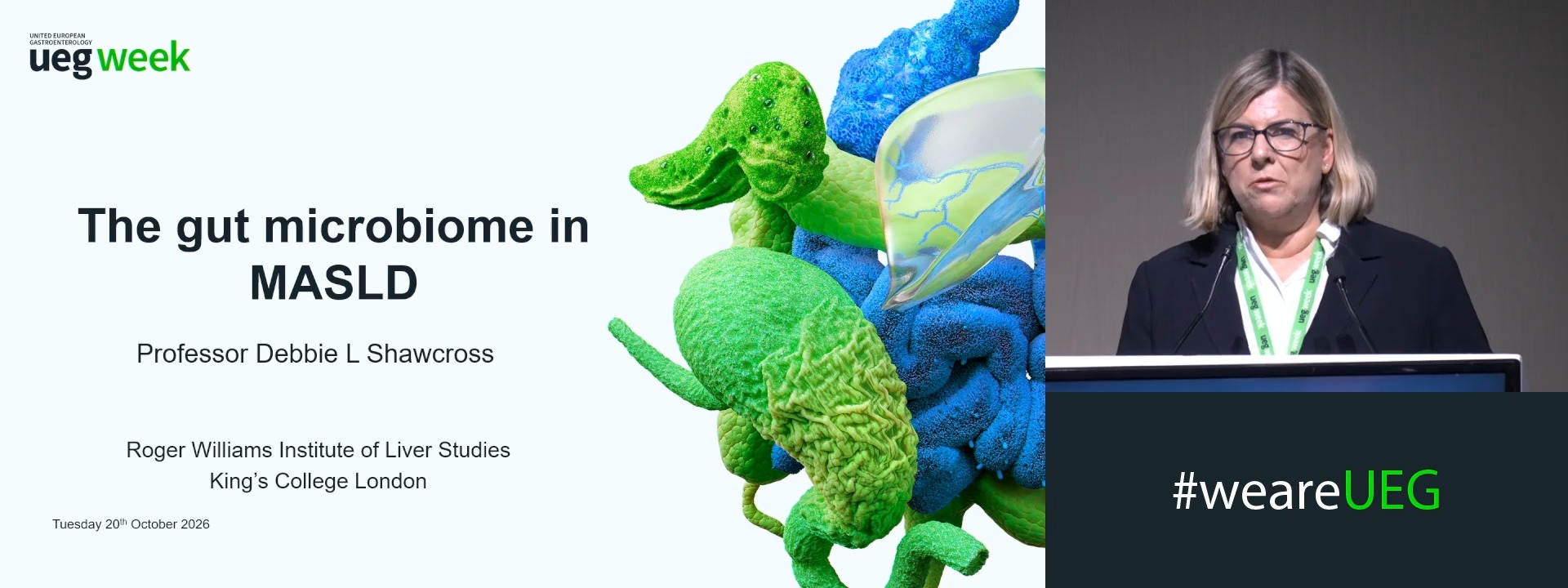
The gut microbiome in MASLD
Affiliations
1 Kings College London, NHS Foundation Trust, London, United Kingdom