UEG's educational platform for gastroenterology education bringing recordings, courses, guidelines, and more together in one place.
Most popular content
Rate for better recommendations!
Your feedback helps us show you more of what you like and less of what you dislike!
Log in to access this content.
Free for all myUEG account holders. Your access level is set automatically based on your occupation. Medical professionals get full access to all content. If you are a non-medical user, you can only access UEG Week content from congresses you attended.
Not sure what you can access? Learn more about account types.

PREDICTORS OF RECURRENCE AFTER ENDOSCOPIC RETROGRADE APPENDICITIS THERAPY FOR ACUTE APPENDICITIS: A MULTI-CENTER COHORT STUDY WITH LONG-TERM FOLLOW-UP IN CHINA
1 The First Affilaited Hospital of Zhengzhou University, Zhengzhou, China
Conference
Topics
Submission format
Citation
Published
Log in to access this content.
Free for all myUEG account holders. Your access level is set automatically based on your occupation. Medical professionals get full access to all content. If you are a non-medical user, you can only access UEG Week content from congresses you attended.
Not sure what you can access? Learn more about account types.
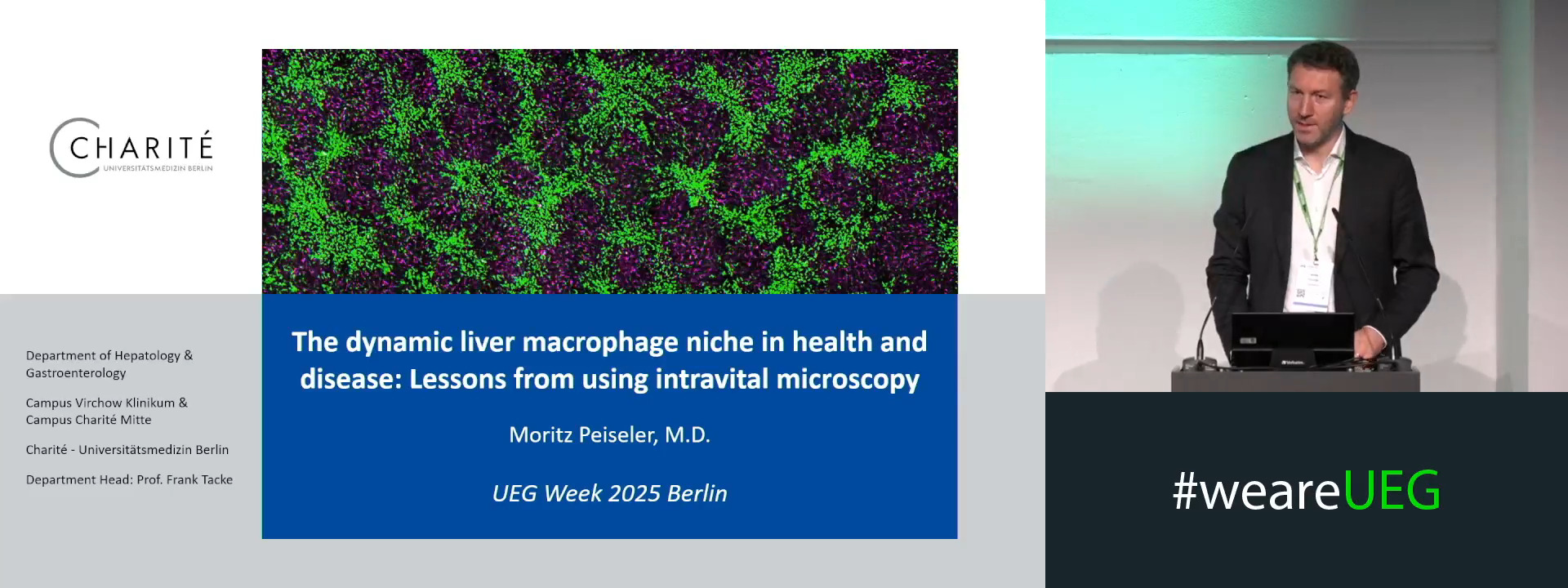
The dynamic liver macrophage niche in health and disease: Lessons from using intravital microscopy
1 Charité University Medicine Berlin, Berlin, Germany
Event
Citation
Published
Log in to access this content.
Free for all myUEG account holders. Your access level is set automatically based on your occupation. Medical professionals get full access to all content. If you are a non-medical user, you can only access UEG Week content from congresses you attended.
Not sure what you can access? Learn more about account types.
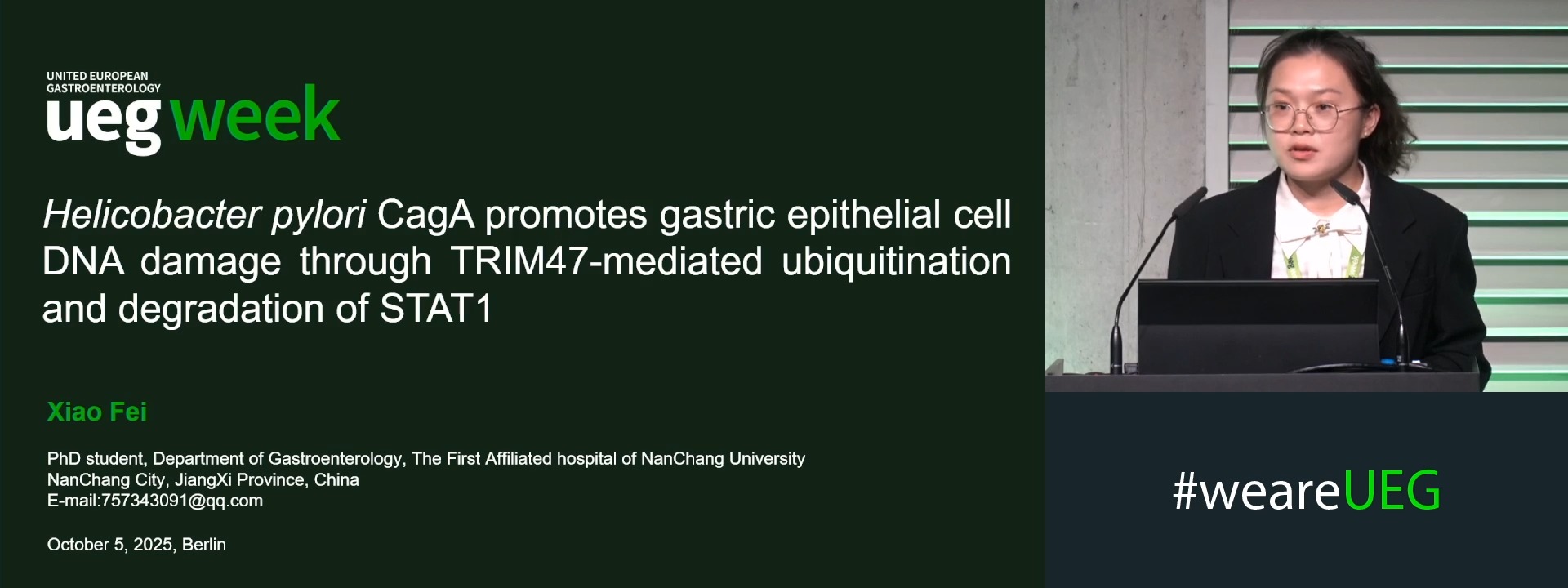
HELICOBACTER PYLORI CAGA PROMOTES GASTRIC EPITHELIAL CELL DNA DAMAGE THROUGH TRIM47-MEDIATED UBIQUITINATION AND DEGRADATION OF STAT1
1 The First Affiliated Hospital, Jiangxi Medical College, Nanchang University, Nanchang, China
Event
Submission format
Citation
Published

Log in to access this content.
Free for all myUEG account holders. Your access level is set automatically based on your occupation. Medical professionals get full access to all content. If you are a non-medical user, you can only access UEG Week content from congresses you attended.
Not sure what you can access? Learn more about account types.
GUT MICROBIOTA COMPOSITION AND ARTERIAL HYPERTENSION IN METABOLIC SYNDROME: THE ROLE OF ENTEROCLOSTER AND MICROBIALLY CONJUGATED BILE ACIDS
Raffaella Gadaleta 1, LUCILLA CRUDELE 1, Marica Cariello 1, Carlo De Matteis 1, Marilidia Piglionica 1, Maria Arconzo 1, Silvia Cultrera 1, Marilina Florio 1, Angela Fulvia Tricase 1, Antonio Moschetta 2
1 University Of Bari "Aldo Moro", Bari, Italy
2 University of Bari "Aldo Moro", Bari, Italy
Event
Topics
Submission format
Citation
Published
Log in to access this content.
Free for all myUEG account holders. Your access level is set automatically based on your occupation. Medical professionals get full access to all content. If you are a non-medical user, you can only access UEG Week content from congresses you attended.
Not sure what you can access? Learn more about account types.
NOT ALWAYS MECKEL’S: THE ROLE OF GASTRIC HETEROTOPIA IN GASTROINTESTINAL BLEEDING
Joana Camões Neves 1, José Damasceno 2, Andreia Guimarães 3, Patrícia Vaz Conde 4, Bruno Arroja 4, Raquel Gonçalves 4, Dalila Costa 5
1 Braga Hospital, Porto, Portugal
2 Braga Hospital, Vila Nova de Gaia, Portugal
3 Hospital Braga, Guimarães, Portugal
4 Braga Hospital, Braga, Portugal
5 Hospital de Braga, Braga, Portugal
Conference
Topics
Submission format
Session
Published
Log in to access this content.
Free for all myUEG account holders. Your access level is set automatically based on your occupation. Medical professionals get full access to all content. If you are a non-medical user, you can only access UEG Week content from congresses you attended.
Not sure what you can access? Learn more about account types.
ASSESSMENT OF HISTOLOGIC ENDPOINTS AND PERFORMANCE IN THE TAK-062 PHASE 2 TRIAL
Joseph R. Maxwell 1, Jorma Isola 2, Anna Välimäki 3, Marie Robert 4, Jie Cheng 1, Mahsa Zarei 1, Daniel A. Leffler 1
1 Takeda Development Center Americas, Inc., Cambridge, United States
2 University of Tampere, Tampere, Finland|||Jilab, Inc, Tampere, Finland
3 Jilab, Inc, Tampere, Finland
4 Yale University School Of Medicine, New Haven, United States
Conference
Topics
Submission format
Citation
Published
Log in to access this content.
Free for all myUEG account holders. Your access level is set automatically based on your occupation. Medical professionals get full access to all content. If you are a non-medical user, you can only access UEG Week content from congresses you attended.
Not sure what you can access? Learn more about account types.
A RARE CASE OF PSEUDOHEMATURIA INDUCED BY MESALAZINE
Isabel Caetano 1, Plácido Gomes 1, Diogo Simas 1, Catarina Atalaia-Martins 1, Maria Silva 1, Sandra Barbeiro 1, Helena Vasconcelos 1
1 Unidade Local de Saúde da Região de Leiria, Leiria, Portugal
Conference
Topics
Submission format
Session