Introduction
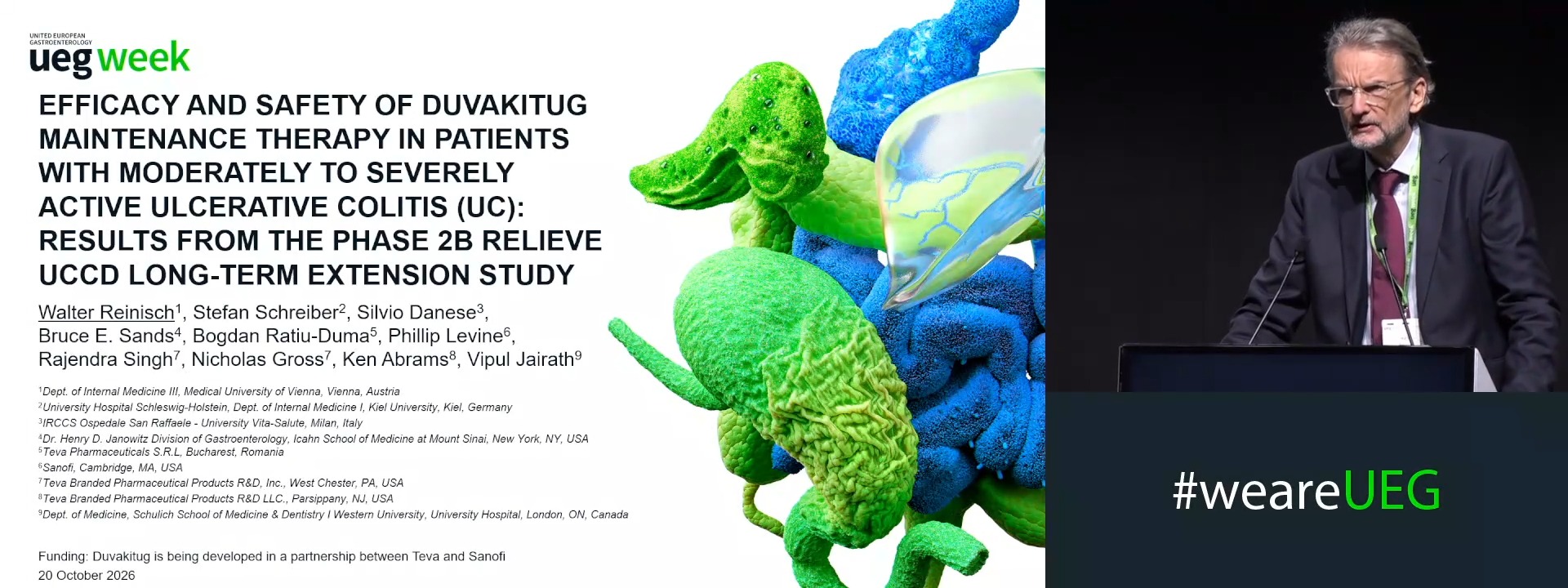
Duvakitug is an anti-TL1A monoclonal antibody selected for its preferential inhibition of TL1A-DR3 signaling over DcR3 binding.1 In the RELIEVE UCCD phase 2b induction study, duvakitug demonstrated significant evidence for clinical remission vs placebo in patients with moderately to severely active UC at week 14.2 Efficacy, safety and tolerability of duvakitug in patients who continued into the 44-week maintenance phase of the RELIEVE UCCD long-term extension (LTE) study are presented here.
Aims & Methods
This was a phase 2b, randomized, double-blind study without control. Patients were eligible to enter the maintenance phase if they achieved clinical response and/or remission (mMS) after 14 weeks of induction treatment, at which point they were re-randomized 1:1 to receive subcutaneous duvakitug 450 mg or 900 mg every 4 weeks. Efficacy analysis focused on duvakitug-treated patients who entered directly into the maintenance phase (total exposure of 58 weeks); safety analysis included all patients who received ≥1 dose of duvakitug during the maintenance phase. Maintenance outcomes were assessed at week 44. Primary efficacy endpoint was clinical remission (mMS). Secondary efficacy endpoints included clinical response (mMS) and endoscopic improvement (Mayo Endoscopic Score). Safety and tolerability were assessed by adverse event (AE) reporting and laboratory monitoring.
Results
The UC efficacy analysis set included 72 patients (34 [450 mg]; 38 [900 mg]); safety analysis included 113 patients (56 [450 mg]; 57 [900 mg]). Demographics and baseline characteristics were generally similar between dose groups. At week 44, clinical remission was achieved by 47% [450 mg] and 58% [900 mg] of patients receiving duvakitug (Table). High rates of clinical response and endoscopic improvement were achieved (Table). Treatment-emergent AEs occurred in 59% (450 mg; n=33) and 67% (900 mg; n=38) of patients and were mostly mild to moderate in severity. The most common AE was upper respiratory tract infection. Incidences of AEs leading to discontinuation were 4% (450 mg; n=2) and 2% (900 mg; n=1).
Conclusion
Duvakitug maintenance therapy demonstrated high rates of clinical remission, clinical response and endoscopic improvement at week 44 (total exposure of 58 weeks) in patients with moderately to severely active UC who responded to duvakitug induction therapy. Duvakitug appeared to demonstrate a dose response. No new safety concerns were identified. These findings support the development of duvakitug maintenance therapy as a potentially effective and durable treatment for UC, which is being further evaluated in phase 3.
| Table: Endoscopic and clinical outcomes following duvakitug treatment (week 14 of induction and week 44 of maintenance phase) |
| Week 14 induction1 | Week 44 maintenance
(58 weeks’ exposure) |
Duvakitug 450mg
q2w
N=47 | Duvakitug 900mg
q2w
N=46 | Duvakitug 450mg
q4w
N=34 | Duvakitug 900mg
q4w
N=38 |
Primary endpoint:
Clinical remission (mMS), n (%) | 17 (36) | 22 (48) | 16 (47)
[95% CI: 30, 65] | 22 (58)
[95% CI: 42, 73] |
| Secondary endpoints: |
| Clinical response (mMS), n (%) | 38 (81) | 32 (70) | 28 (82)
[95% CI: 61, 91] | 33 (87)
[95% CI: 71, 94] |
| Endoscopic improvement, n (%) | 21 (45) | 23 (50) | 20 (59)
[95% CI: 42, 76] | 24 (63)
[95% CI: 47, 78] |
Clinical remission defined as mMS score of ≤2 points, with a stool frequency subscore of 0 or 1, rectal bleeding subscore of 0, and an endoscopic subscore of 0 or 1 where a score of 1 does not include “friability”. Clinical response defined as ≥2 points decrease from baseline in mMS score with ≥30% reduction from baseline and either a decrease in rectal bleeding subscore of ≥1 or an absolute rectal bleeding subscore ≤1. Endoscopic improvement defined as Mayo endoscopic subscore of 0 or 1 with no friability.
CI, confidence interval.
1. Reinisch et al. J Crohn's Colitis 2025;19:i79–80; doi: 10.1093/ecco-jcc/jjae190.0039B. |
References
- Clarke et al. MAbs 2018;10:664–77; doi: 10.1080/19420862.2018.1440164.
- Reinisch et al. J Crohn's Colitis 2025;19:i79–80; doi: 10.1093/ecco-jcc/jjae190.0039B.
Disclosure
Duvakitug is being developed in partnership by Teva and Sanofi.
WR: served as speaker for AbbVie, Celltrion, Ferring, Galapagos, Janssen, Merck Sharp & Dohme, Pfizer, Roche, Sobi, Takeda; as a consultant for AbbVie, Amgen, AOP Orphan, Boehringer Ingelheim, Bristol Myers Squibb, Calyx, Celltrion, Eli Lilly, Galapagos, Gilead, Index Pharma, Janssen, Medahead, Microbiotica, Pfizer, Takeda, Teva; served as an advisory board member for AbbVie, Amgen, Boehringer Ingelheim, Bristol Myers Squibb, Celltrion, Galapagos, Janssen, Pfizer, Teva; and has received research funding from AbbVie, Janssen, Sandoz, Sanofi, Takeda.
SS: advisory board fees from AbbVie, Alfasigma, Arena, Biogen, Bristol Myers Squibb, Celltrion, Eli Lilly, Fresenius, Gilead, I-Mab, Janssen, Pfizer, Protagonist Therapeutics, ProventionBio, Takeda, Ventyx. Speaker fees from AbbVie, Alfasigma, Bristol Myers Squibb, Celltrion, Falk, Ferring, Galapagos, Janssen, Eli Lilly, Pfizer, Takeda.
SD: consultancy fees from AbbVie, Alimentiv, Allergan, Amgen, Applied Molecular Transport, AstraZeneca, Athos Therapeutics, Biogen, Boehringer Ingelheim, Bristol Myers Squibb, Celgene, Celltrion, Dr Falk Pharma, Eli Lilly, Enthera, Ferring Pharmaceuticals Inc., Gilead, Hospira, Inotrem, Janssen, Johnson & Johnson, Morphic, MSD, Mundipharma, Mylan, Pfizer, Roche, Sandoz, Sublimity Therapeutics, Takeda, Teladoc Health, TiGenix, UCB Inc., Vial, Vifor; and lecture fees from AbbVie, Amgen, Ferring Pharmaceuticals Inc., Gilead, Janssen, Mylan, Pfizer, Takeda.
BES: reports consulting fees from AbbVie, Adiso Therapeutics, Agomab, Alimentiv, Amgen, AnaptysBio, AstraZeneca, Biolojic Design, Biora Therapeutics, Boehringer Ingelheim, Celltrion, Ensho Therapeutics, Enthera, Enveda Biosciences, Equillium, Evommune, Ferring, Fzata, Galapagos, Genentech (Roche), Gilead Sciences, GlaxoSmithKline, Gossamer Bio, Imhotex, Immunyx Therapeutics, Index Pharmaceuticals, Innovation Pharmaceuticals, Kaleido, Kallyope, Merck & Co., Microba, Microbiotica, Mitsubishi Tanabe Pharma, Mobius Care, Morphic Therapeutics, MRM Health, Nexus Therapeutics, Nimbus Discovery, Odyssey Therapeutics, Palisade Bio, Prometheus Biosciences, Prometheus Laboratories, Protagonist Therapeutics, Q32 Bio, Rasayana Therapeutics, Recludix Therapeutics, Reistone Biotherapeutics, Sanofi, Sorriso Pharmaceuticals, Surrozen, Target RWE, Teva, TLL Pharmaceutical, TR1X, Union Therapeutics; consulting and speaking fees from Abivax; consulting and speaking fees and other support from Lilly; research grants, consulting and speaking fees, and other support from Bristol Myers Squibb, Janssen/J & J Innovative Medicine, Pfizer, Takeda; research grants and consulting fees from Theravance Biopharma; and consulting fees, stock, and stock options from Ventyx Biopharma.
BR-D, RS, NG: Teva employees.
PL: employee of Sanofi – may hold stock and/or stock options in the company.
VJ: consulting/advisory board fees from Abbvie, Alimentiv, Amgen, Anaptys Bio, Asahi Kasei, Asieris, AstraZeneca, Attovia, Blackbird Labs, BMS, Boehringer Ingleheim, Biomebank, Cabaletta, Caldera, Calluna, Catalytic Health, Celltrion, Ensho, Enthera, Equillium Exeliome Biosciences, Ferring, Fresenius Kabi, Gilead, Granite Bio, GSK, Janssen, Lilly, Merck, Mountainfield, MRM Health, Nxera, Organon, OSE Immunotherapeutics, Palisade Bio, Pendopharm, Pioneering Medicine, Pfizer, Prometheus, Roche/Genentech, Sanofi, SCOPE, Shattuck Labs, Sorriso, Spyre, Synedgen, Takeda, Teva, Throne Scientific, Tillotts, Union Therapeutics, Ventus, Ventyx, Vividion, Xencor, Zealand Pharma; payment for lectures, presentations, speakers bureaus, manuscript writing or educational events from AbbVie, Eli Lilly, Ferring, Fresenius Kabi, Janssen, Pfizer, Takeda, Tillotts; and participation on Data Safety Monitoring Board or Advisory Board for Abbvie, Takeda, Janssen, Fresenius Kabi, Gilead, Roche.