Introduction
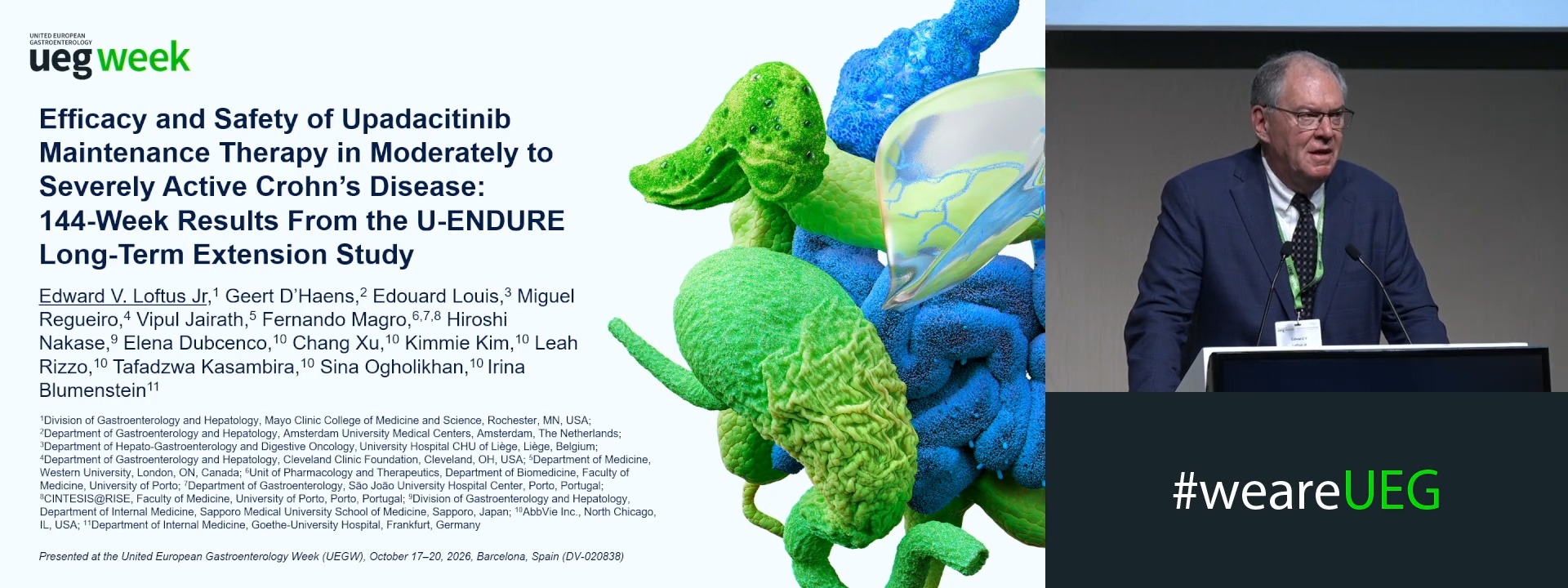
Upadacitinib (UPA), an oral Janus kinase inhibitor, is approved for treatment of moderately to severely active Crohn’s disease (CD).1-3 In the phase 3 U-ENDURE maintenance study and its long-term extension (LTE), UPA demonstrated sustained efficacy with a safety profile consistent with previous reports.4-6 Here, we evaluated long-term efficacy and safety outcomes at 144 weeks (wks; 4 years) in patients who continued UPA maintenance therapy in the ongoing U-ENDURE LTE.
Aims & Methods
Patients (pts) who completed the U-ENDURE 52-wk maintenance trial were eligible to enroll in the LTE study and continued open-label (OL) treatment with their originally assigned regimen of UPA 15 mg (UPA15) or 30 mg (UPA30) once daily. The present analysis included pts who entered the LTE after completing maintenance treatment period. Patients with inadequate response could receive rescue therapy (OL UPA30 or/and protocol-specified CD medications); efficacy data after initiation of rescue therapy were analysed separately. Clinical and endoscopic endpoints were evaluated using both as observed (AO) (in text and Table) and nonresponder imputation (NRI) methods (Table). Changes from induction baseline in inflammatory biomarkers, including high-sensitivity C-reactive protein (hs-CRP) and faecal calprotectin (FCP), were evaluated using AO analyses (in text). Safety was assessed from maintenance wk 0, with up to 292 wks of cumulative maintenance and LTE treatment exposure (data cutoff 13 Nov 2025).
Results
The UPA15 and UPA30 groups, respectively, included 221 and 229 randomised responders; 107 and 173 pts in the LTE population; and 107 and 137 pts in the efficacy population. Baseline demographics and clinical characteristics in the UPA15 and UPA30 groups were generally well balanced in the LTE population.4 At LTE wk 0 and wk 144, AO efficacy rates remained stable in each treatment group for clinical remission per stool frequency (SF)/abdominal pain score (APS) (UPA15: 78.3% to 78.9%; UPA30: 84.7% to 86.6%) or Crohn’s Disease Activity Index (CDAI) (UPA15: 81.3% to 86.0%; UPA30: 86.1% to 84.1%) (Table); similar results were observed for corticosteroid-free clinical remission. At wk 144, rates of endoscopic response (UPA15: 59.6% to 70.6%; UPA30: 71.2% to 72.8%) and endoscopic remission (UPA15: 42.4% to 47.1%; UPA30: 53.0% to 64.2%) (AO) were maintained. Improvements in inflammatory biomarkers were observed at LTE wk 144 and were measured as mean change from baseline for hs-CRP in mg/L (UPA15: -12.4, -11.4; UPA30: -12.7, -9.4) and FCP in µg/g (UPA15: -2752, -3344; UPA30: -1850, -1865) (AO). Across efficacy endpoints, similar results were found per NRI. The safety profile was consistent with the known safety profile of UPA in CD.1
Efficacy endpoints in LTE Population,a
(n/N) % [95% CI] | AO analysisb | NRI analysisc |
|
| UPA 15 mg QD | UPA 30 mg QD | UPA 15 mg QD | UPA 30 mg QD |
|
SF/APS clinical remissiond
Week 0
Week 144
CDAI clinical remissione
Week 0
Week 144
Maintenance of SF/APS clinical remissionf
Week 144
Maintenance of CDAI clinical remissionf
Week 144
Corticosteroid-free SF/APS clinical remissiong
Week 0
Week 144
Corticosteroid-free CDAI clinical remissiong
Week 0
Week 144
Endoscopic responseh
Week 0
Week 144
Endoscopic remissioni
Week 0
Week 144
Maintenance of endoscopic remissionj
Week 144 |
(83/106) 78.3
[70.5, 86.1]
(45/57) 78.9
[68.4, 89.5]
(87/107) 81.3
[73.9, 88.7]
(49/57) 86.0
[76.9, 95.0]
(41/46) 89.1
[80.1, 98.1]
(42/45) 93.3
[86.0, 100.0]
(76/106) 71.7
[63.1, 80.3]
(43/57) 75.4
[64.3, 86.6]
(80/107) 74.8
[66.5, 83.0]
(46/57) 80.7
[70.5, 90.9]
(59/99) 59.6
[49.9, 69.3]
(36/51) 70.6
[58.1, 83.1]
(42/99) 42.4
[32.7, 52.2]
(24/51) 47.1
[33.4, 60.8]
(14/22) 63.6
[43.5, 83.7] |
(116/137) 84.7
[78.6, 90.7]
(71/82) 86.6
[79.2, 94.0]
(118/137) 86.1
[80.3, 91.9]
(69/82) 84.1
[76.2, 92.1]
(68/72) 94.4
[89.2, 99.7]
(63/70) 90.0
[83.0, 97.0]
(114/137) 83.2
[77.0, 89.5]
(71/82) 86.6
[79.2, 94.0]
(116/137) 84.7
[78.6, 90.7]
(69/82) 84.1
[76.2, 92.1]
(94/132) 71.2
[63.5, 78.9]
(59/81) 72.8
[63.2, 82.5]
(70/132) 53.0
[44.5, 61.5]
(52/81) 64.2
[53.8, 74.6]
(42/50) 84.0
[73.8, 94.2] |
(83/106) 78.3
[70.5, 86.1]
(44/107) 41.1
[31.8, 50.4]
(87/107) 81.3
[73.9, 88.7]
(48/107) 44.9
[35.4, 54.3]
(40/83) 48.2
[37.4, 58.9]
(41/87) 47.1
[36.6, 57.6]
(76/106) 71.7
[63.1, 80.3]
(42/107) 39.3
[30.0, 48.5]
(80/107) 74.8
[66.5, 83.0]
(45/107) 42.1
[32.7, 51.4]
(59/99) 59.6
[49.9, 69.3]
(35/107) 32.7
[23.8, 41.6]
(42/99) 42.4
[32.7, 52.2]
(24/107) 22.4
[14.5, 30.3]
(14/42) 33.3
[19.1, 47.6] |
(116/137) 84.7
[78.6, 90.7]
(70/137) 51.1
[42.7, 59.5]
(118/137) 86.1
[80.3, 91.9]
(68/137) 49.6
[41.3, 58.0]
(67/116) 57.8
[48.8, 66.7]
(62/118) 52.5
[43.5, 61.6]
(114/137) 83.2
[77.0, 89.5]
(70/137) 51.1
[42.7, 59.5]
(116/137) 84.7
[78.6, 90.7]
(68/137) 49.6
[41.3, 58.0]
(94/132) 71.2
[63.5, 78.9]
(58/137) 42.3
[34.1, 50.6]
(70/132) 53.0
[44.5, 61.5]
(52/137) 38.0
[29.8, 46.1]
(42/70) 60.0
[48.5, 71.5] |
|
| TEAE in Cumulative Maintenance Population (Randomised Responders),k E (E/100PY) | UPA 15 mg QD
N = 221; PYs = 438.0; Median exposure = 51.6 weeks | UPA 30 mg QD
N = 229; PYs = 573.8; Median exposure = 103.1 weeks |
|
Overview of TEAE
Any TEAE
Any TEAE leading to the discontinuation of the study drug
Any TEAE with a reasonable possibility of being related
to the study drugl
COVID-19 infection
Severe TEAE
Serious TEAE
TEAE leading to death |
1158 (264.4)
35 (8.0)
307 (70.1)
40 (9.1)
57 (13.0)
60 (13.7)
1 (0.2)m |
1444 (251.7)
28 (4.9)
381 (66.4)
80 (13.9)
63 (11.0)
73 (12.7)
0 |
|
TEAE of Special Interest
Serious infections
Opportunistic infection excluding tuberculosis
and herpes zostern
Active tuberculosis
Herpes zoster
Adjudicated gastrointestinal perforations |
13 (3.0)
3 (0.7)
0
9 (2.1)
6 (1.4) |
22 (3.8)
1 (0.2)
0
27 (4.7)
3 (0.5) |
|
Anaemia
Neutropenia
Lymphopenia
CPK elevation | 23 (5.3)
18 (4.1)
24 (5.5)
23 (5.3) | 28 (4.9)
19 (3.3)
51 (8.9)
33 (5.8) |
|
Hepatic disorder
Transaminase increased events
All other events
|
25 (5.7)
7 (1.6) |
35 (6.1)
8 (1.4) |
|
Renal dysfunction
Malignancies excluding NMSCo
NMSC
Lymphoma
Adjudicated MACE
Adjudicated VTE
Serious hypersensitivity reactions
Fractures | 0
3 (0.7)
0
0
0
0
0
6 (1.4) | 1 (0.2)
5 (0.9)
3 (0.5)
0
1 (0.2)p
2 (0.3)q
0
12 (2.1) |
|
Table. Efficacy and Safety in Patients Treated With Upadacitinib at LTE Week 144 of the U-ENDURE LTE Study.
AE, adverse event; AO, as observed; APS, abdominal pain score; CDAI, Crohn’s disease activity index; CI, confidence interval; COVID-19, coronavirus disease 2019; CPK, creatine phosphokinase elevation; E, events; LTE, long-term extension; MACE, major adverse cardiovascular event; NMSC, nonmelanoma skin cancer; NRI, nonresponder imputation; PY, patient-years; QD, once-daily; SES-CD, Simplified Endoscopic Score for Patients with Crohn’s Disease; SF, stool frequency; wk, week; TEAE, treatment-emergent adverse event; UPA, upadacitinib; VTE, venous thromboembolism.
Patients were blinded until the last patient completed maintenance by wk 52.
aEfficacy was assessed from LTE wk 0 to wk 144. 95% CI for the response rate was based on the normal approximation to the binomial distribution.
bUsed all available data up to the initiation of open-label UPA 30 mg rescue therapy and did not impute values for missing data.
cPatients were categorised as nonresponders after initiation of any protocol rescue medications or missing data.
dAverage daily very soft or liquid SF ≤2.8 and average daily APS ≤1.0 and both not greater than induction baseline.
eCDAI < 150.
fClinical remission at LTE wk 144 in patients who were in clinical remission at LTE wk 0.
gWithout corticosteroid use for ≥ 90 days before evaluation of endpoint.
hDecrease in SES-CD > 50% from baseline of the induction study (or for patients with an SES-CD of 4 at baseline of induction, at least a 2-point reduction from baseline), as scored by a central reviewer. Endoscopies were performed annually.
iSES-CD ≤ 4 and at least a 2-point reduction from baseline and no subscore > 1 in any individual variable, as scored by a central reviewer.
jEndoscopic remission at LTE wk 144 in patients who were in endoscopic remission at LTE wk 0.
kTEAEs were defined as any AE with an onset date on or after the first dose of the study drug in the maintenance period and up to 30 days past the last dose of the study drug in the maintenance or LTE period or until 1 day prior to the rescue in the maintenance or LTE period; cut-off date: 13 Nov 2025.
lAs assessed by the study investigator.
mOne event of suicide with no reasonable possibility of being related to the study drug as assessed by the investigator.
nFour events of opportunistic infections, excluding tuberculosis and herpes zoster, were reported: oesophageal candidiasis, oral fungal infection, and Pneumocystis jirovecii pneumonia in the UPA 15 mg group, and oesophageal candidiasis in the UPA 30 mg group. The event of Pneumocystis jirovecii pneumonia was serious and led to the discontinuation of the study drug.
oMalignancies excluding NMSC: ovarian cancer metastatic (n = 1), malignant melanoma (n = 1), bladder transitional cell carcinoma (n =1) in the UPA 15 mg group; adenocarcinoma of colon (n = 2), glioblastoma (n = 1), invasive lobular breast carcinoma (n = 1), and malignant fibrous histiocytoma (n = 1) in the UPA 30 mg group.
pIn the UPA 30 mg group, there was 1 patient with a non-fatal myocardial infarction.
qIn the UPA 30 mg group, there was 1 patient with a deep vein thrombosis and 1 patient with a pulmonary embolism. |
Conclusion
Clinical and endoscopic outcomes and improvements in inflammatory biomarkers were observed at 144 wks of follow-up in the U-ENDURE LTE, with no new safety signals identified. Interpretation of UPA15 outcomes is limited by small pt numbers.
References
- Loftus EV, Jr. and Panés J et al. N Engl J Med. 2023;88:1966-80.
- AbbVie Inc. RINVOQ (Upadacitinib) [package insert] U.S. Food and Drug Administration website. https://www.rxabbvie.com/pdf/rinvoq_pi.pdf. Revised Oct 2025.
- AbbVie DG& CoK. RINVOQ. (Upadacitinib) [package insert] Summary of Product Characteristics. European Medicine Agency website. https://www.ema.europa.eu/en/documents/product-information/rinvoq-epar-product-information_en.pdf. Revised Nov 2025.
- Loftus EV, Jr. et al. J Crohn's Colitis. 2025;19:jjaf138.
- Panaccione R et al. Clin Gastroenterol Hepatol. 2026;24:772-83.
- Loftus EV, Jr. et al. (Abstract). UEG Journal. 2025;13(S8):273-4.
Disclosure
Financial arrangements of the authors with companies whose products may be related to the present publication are listed, as declared by the authors.
Edward V. Loftus Jr. has served as a consultant for AbbVie, Abivax, Astellas, Avalo, Biocon, Bristol Myers Squibb, Celltrion, Eli Lilly, Fresenius Kabi, Genentech, Gilead, Hanall Biopharma, Iota Biosciences, Iterative Health, Janssen, Merck, Morphic Therapeutics, Ono Pharma, Shattuck Labs, Spyre Therapeutic, Takeda, and TR1X Bio; has received research grants from AbbVie, Gilead, Janssen, Merck, and TR1X Bio; and is a shareowner of Exact Sciences and Moderna.
Geert D’Haens has served as advisor and/or speaker for AbbVie, Abivax, Agomab, Akros, Alimentiv, Anaptys Bio, Bristol Meiers Squibb, Boehringer Ingelheim, Celltrion, Eli Lilly, Galapagos, Glaxo Smith Kline, Index Pharmaceuticals, Johnson and Johnson, Merck, Polpharm, Prometheus Biosciences, Sanofi, Spyre, Takeda, and Tillotts.
Edouard Louis has received Education and Research Grants for his department: Abbvie, Takeda, Janssen, Pfizer, Fresenius-Kabi, Celltrion, EG Pharma, Sandoz, Falk; Personal Fees for conferences, advisory boards and consultancy: Abbvie, Takeda, Ferring, Pfizer, Janssen, Lilly, Galapagos, Celltrion, Arena, BMS, Falk, Biokuris, Fresenius-Kabi, Thabor.
Miguel Regueiro has served as a consultant, speaker, and is an advisory board member for AbbVie.
Vipul Jairath has received consulting/advisory board fees from AbbVie, Alimentiv, Arena, Asahi Kasei Pharma, Asieris, Astra Zeneca, Avoro Capital, Bristol Myers Squibb, Celltrion, Eli Lilly, Endpoint Health, Enthera, Ferring, Flagship Pioneering, Fresenius Kabi, Galapagos, Gilde Healthcare, GlaxoSmithKline, Genentech, Gilead, Innomar, JAMP, Janssen, Merck, Metacrine, Mylan, Pandion, Pendopharm, Pfizer, Protagonist, Prometheus Biosciences, Reistone Biopharma, Roche, Roivant, Sandoz, Scope Eyecare, Second Genome, Sorriso, Takeda, TD Securities, Teva, TopiVert, Ventyx, Vividion; received speaker’s fees from AbbVie, Ferring, Bristol Myers Squibb, Galapagos, Janssen, Pfizer, Takeda, and Fresenius Kabi.
Fernando Magro has been a speaker and has received honoraria for services from AbbVie, Biogen, Falk, Ferring, Hospira, Laboratorios Vitoria, Merck, and Vifor.
Hiroshi Nakase reports receiving personal fees from Abbvie Inc., KYORIN Pharmaceutical Co., Ltd, Janssen Pharmaceutical K.K, Takeda Pharmaceutical Co., Ltd., Pfizer Japan Inc., EA Pharma Co., Ltd., Mochida Pharmaceutical Co., Ltd., Gilead Sciences Inc., JIMRO Co., Ltd., Bristol Myers Squibb company and grants for commissioned/joint research from Hoya Group Pentax Medical; and being endowed chair by Miyarisan Pharmaceutical Co., Mochida Pharmaceutical Co., Ltd. JIMRO Co., Ltd., and KYORIN Pharmaceutical Co., Ltd..
Elena Dubcenco, Chang Xu, Kimmie Kim, Leah Rizzo, Tafadzwa Kasambira, and Sina Ogholikhan are employees of AbbVie and may own stocks/stock options.
Irina Blumenstein has received consultant honoraria from AbbVie Deutschland, Amgen GmbH, Bristol Myers Squibb, Janssen-Cilag GmbH, Fresenius Kabi Deutschland, Pharmacosmos GmbH, Pfizer GmbH, Shire Deutschland GmbH, Takeda Pharma GmbH; honoraria from AbbVie Deutschland, Biogen GmbH, DGVS, Dr. Falk Pharma GmbH, EndoAkademie, Ferring Arzneimittel, Fraunhofer, Fresenius Kabi Deutschland, Kompetenznetz Darmerkrankungen, MSD Sharp Dohme, Mylan GmbH, Pfizer GmbH, Janssen-Cilag GmbH, Shire Deutschland GmbH, Takeda Pharma GmbH.
Funding: AbbVie funded this study (U-ENDURE; NCT03345823) and participated in the study design, research, analysis, data collection, interpretation of data, reviewing, and approval of the publication. All authors had access to relevant data and participated in the drafting, review, and approval of this publication. No honoraria or payments were made for authorship.
Acknowledgements: AbbVie and the authors thank the participants, study sites, and investigators who participated in this clinical trial. Kathleen Richter, MS, of AbbVie, provided medical writing support, and Catherine Barone, PhD, of AbbVie, provided editorial support.