UEG's content platform for gastroenterology education bringing recordings, courses, guidelines, and more together in one place.
Trending on Gutflix
Rate for better recommendations!
Your feedback helps us show you more of what you like and less of what you dislike!
Log in to continue.
This content is part of Gutflix. Log in with your myUEG account, or create one free, to watch it.
Not sure what you can access? Learn more about account types.
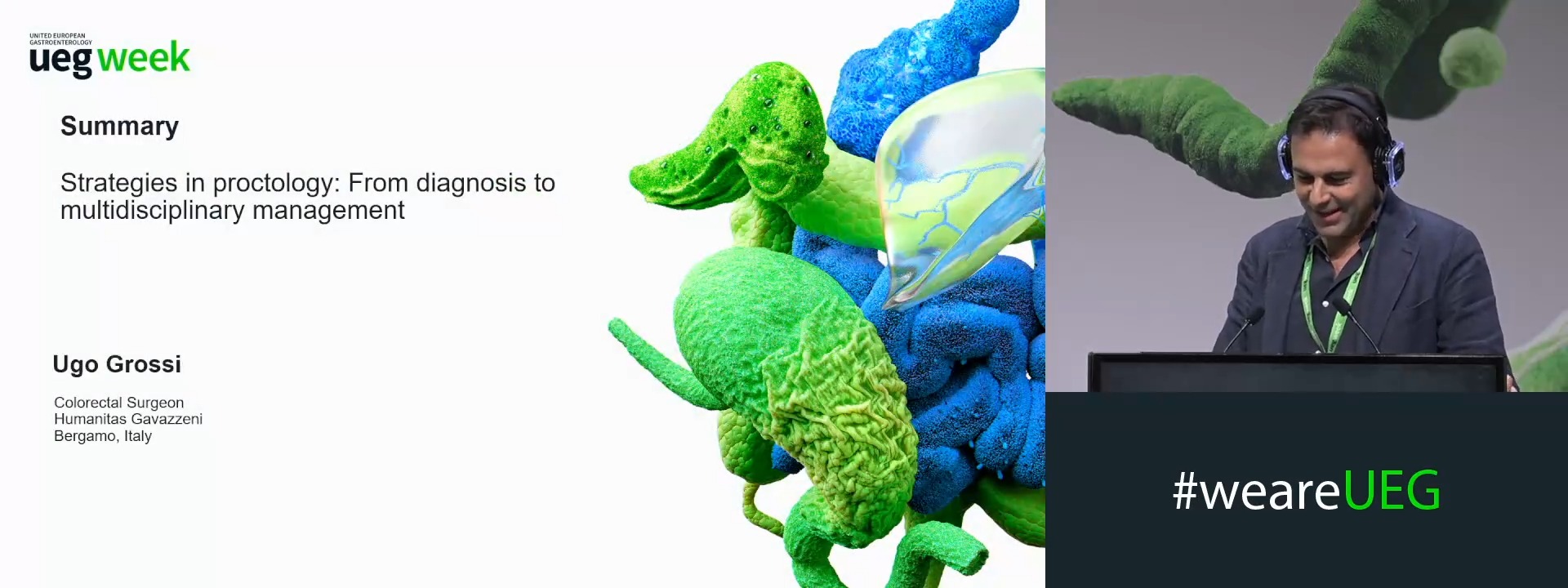
Summary: Strategies in proctology: From diagnosis to multidisciplinary management
Affiliations
1 Humanitas Gavazzeni, Bergamo, Italy
Log in to continue.
This content is part of Gutflix. Log in with your myUEG account, or create one free, to watch it.
Not sure what you can access? Learn more about account types.
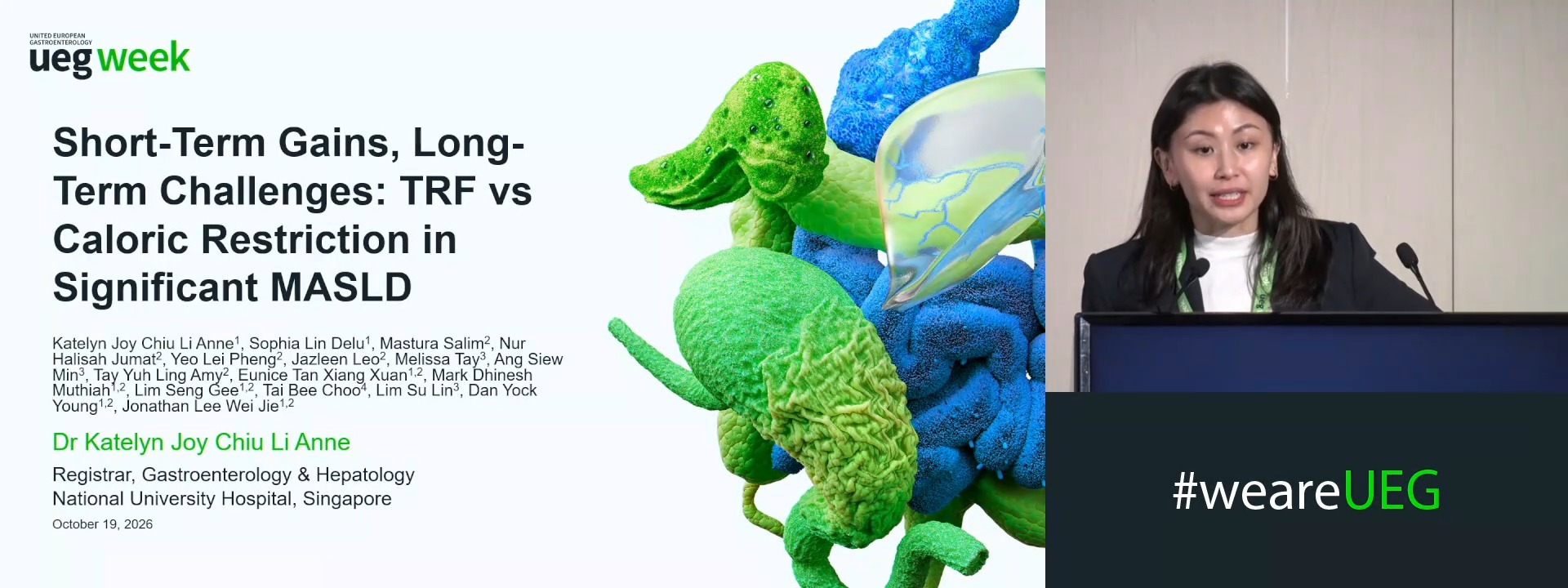
SHORT-TERM GAINS, LONG-TERM CHALLENGES: A PILOT RANDOMIZED CONTROLLED TRIAL FOR TIME-RESTRICTED FEEDING VERSUS CALORIC RESTRICTION IN SIGNIFICANT MASLD
Katelyn Chiu 1, Sophia Lin Delu 1, Jonathan Lee 2, Mastura Binte Salim 3, Nur Halisah Jumat 3, Lei Pheng Yeo 3, Jazleen Leo 3, Melissa Tay 4, Siew Min Ang 4, Amy Tay Yuh Ling 3, Eunice Tan 1, Mark Muthiah 1, Seng Gee Lim 1, Bee Choo Tai 3, Su Lin Lim 4, Dan Yock Young 1
Affiliations
1 National University Hospital, Singapore, Singapore, Singapore
2 National University Health System, Singapore, Singapore, Singapore
3 National University of Singapore, Singapore, Singapore
4 National University Hospital, Singapore, Singapore
Log in to continue.
This content is part of Gutflix. Log in with your myUEG account, or create one free, to watch it.
Not sure what you can access? Learn more about account types.
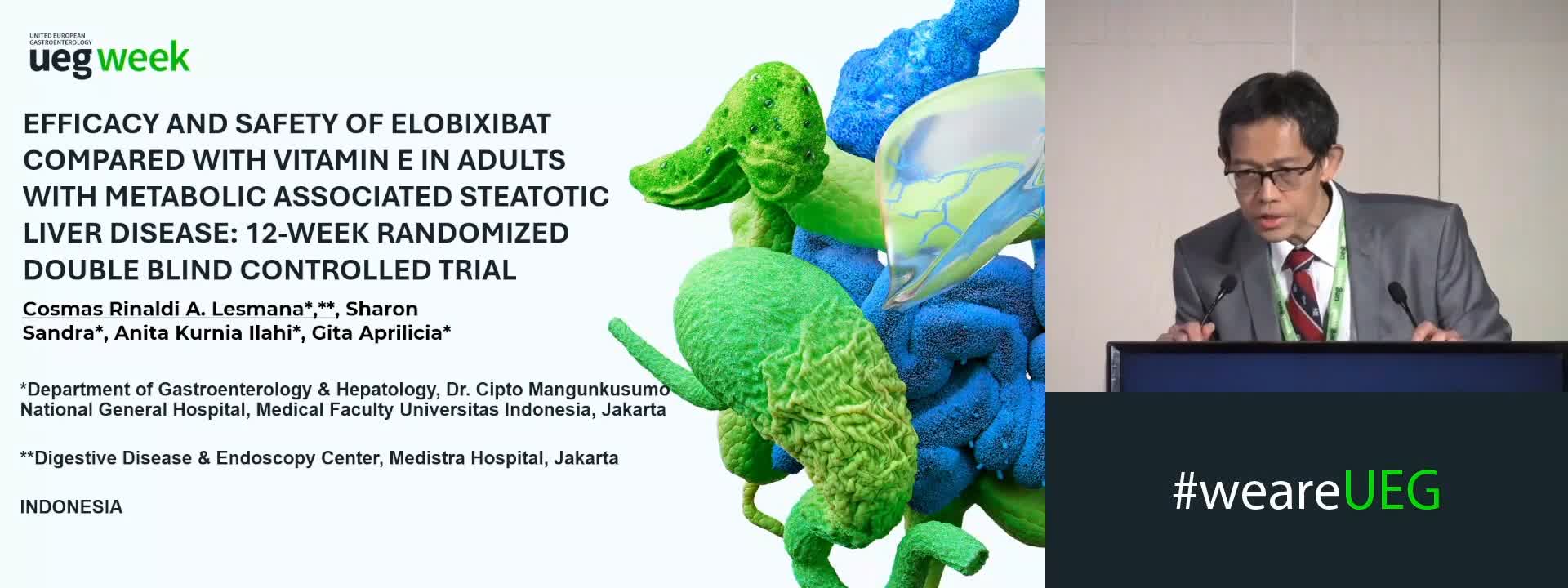
EFFICACY AND SAFETY OF ELOBIXIBAT COMPARED WITH VITAMIN E IN ADULTS WITH METABOLIC ASSOCIATED STEATOTIC LIVER DISEASE: A 12-WEEK RANDOMIZED DOUBLE BLIND CONTROLLED TRIAL
Cosmas Rinaldi A Lesmana 1,2, Sharon Sandra 3, Anita Kurnia Ilahi 3, Gita Aprilicia 3, Irsan Hasan 1
Affiliations
1 Dr. Cipto Mangunkusumo National General Hospital, Medical Faculty Universitas Indonesia, Jakarta, Indonesia
2 Medistra Hospital, Jakarta, Indonesia
3 Dr. Cipto Mangunkusumo National General Hospital, Jakarta, Indonesia
Log in to continue.
This content is part of Gutflix. Log in with your myUEG account, or create one free, to watch it.
Not sure what you can access? Learn more about account types.
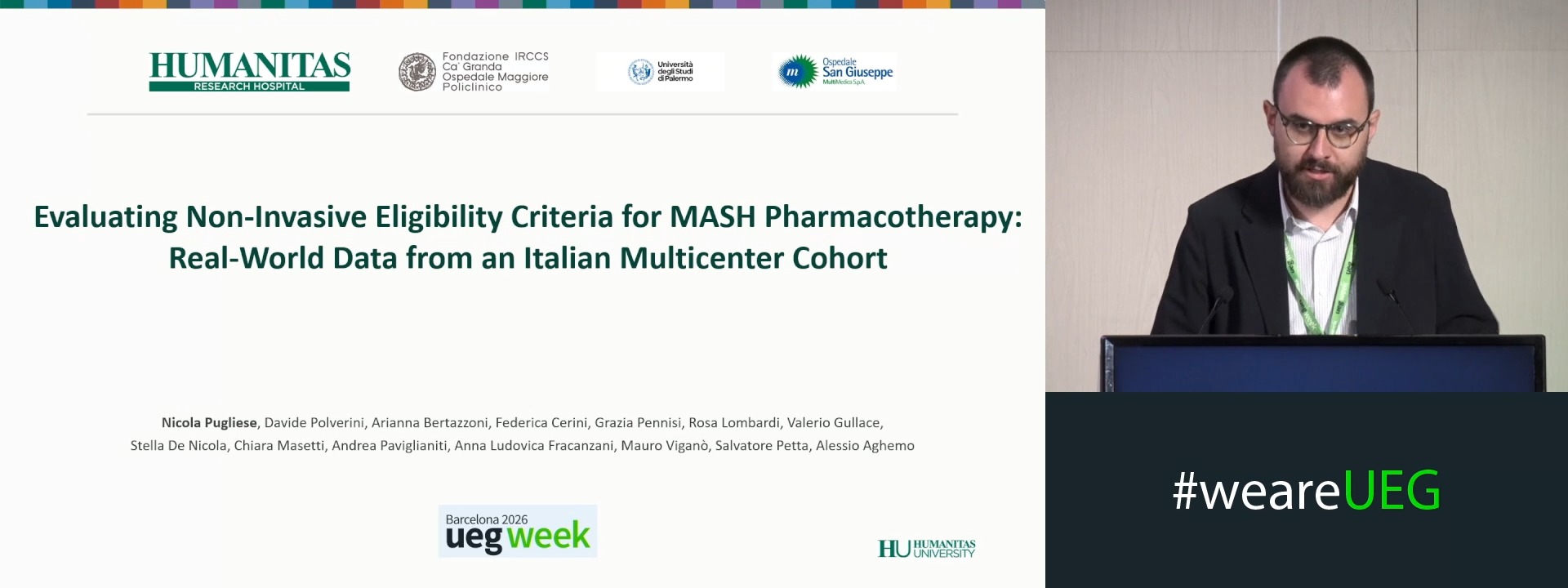
EVALUATING NON-INVASIVE ELIGIBILITY CRITERIA FOR RESMETIROM AND SEMAGLUTIDE IN METABOLIC DYSFUNCTION-ASSOCIATED STEATOTIC LIVER DISEASE: REAL-WORLD DATA FROM AN ITALIAN MULTICENTER COHORT
Nicola Pugliese 1, Davide Polverini 1, Arianna Bertazzoni 1, Federica Cerini 2, Grazie Pennisi 3, Rosa Lombardi 2, Valerio Gullace 1, Stella De Nicola 1, Chiara Masetti 1, Andrea Calogero Paviglianiti 1, Anna Francanzani 2, Mauro Viganò 4, Salvatore Petta 3, Alessio Aghemo 1
Affiliations
1 Humanitas Research Hospital, Rozzano, Italy
2 Università degli Studi di Milano Statale, Milano, Italy
3 Università di Palermo, Palermo, Italy
4 Ospedale Papa Giovanni XXIII, Bergamo, Italy
Log in to continue.
This content is part of Gutflix. Log in with your myUEG account, or create one free, to watch it.
Not sure what you can access? Learn more about account types.
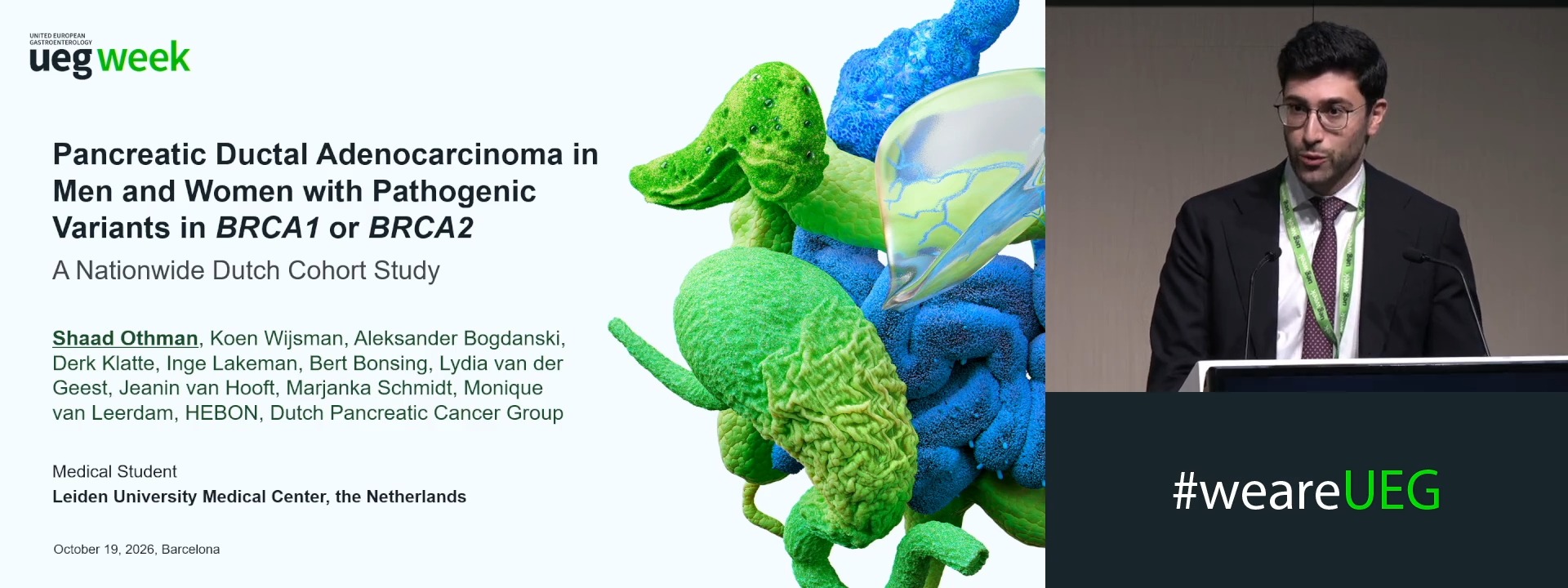
RISK AND SURVIVAL OF PANCREATIC DUCTAL ADENOCARCINOMA IN MEN AND WOMEN WITH PATHOGENIC VARIANTS IN BRCA1 OR BRCA2: A NATIONWIDE DUTCH COHORT STUDY
Shaad Othman 1, Koen Wijsman 1,2, Aleksander Bogdanski 1, Derk Klatte 1, Inge Lakeman 1, Bert Bonsing 1, Lydia G. Van Der Geest 3, Jeanin van Hooft 1, Marjanka Schmidt 1,4, Monique van leerdam 1,4
Affiliations
1 Leiden University Medical Center, Leiden, Netherlands
2 Mayo Clinic, Jacksonville, United States
3 Netherlands Comprehensive Cancer Organisation, Utrecht, Netherlands
4 Netherlands Cancer Institute, Amsterdam, Netherlands