UEG's educational platform for gastroenterology education bringing recordings, courses, guidelines, and more together in one place.
Most popular content
Rate for better recommendations!
Your feedback helps us show you more of what you like and less of what you dislike!
Log in to access this content.
Free for all myUEG account holders. Your access level is set automatically based on your occupation. Medical professionals get full access to all content. If you are a non-medical user, you can only access UEG Week content from congresses you attended.
Not sure what you can access? Learn more about account types.

NOT ALL THAT HURTS IS PANCREAS: A CECAL PLOT TWIST
Concepción García Robledo 1, Adrián Barrajón 1, Guillermo Martínez Fernández 1, Alejandro Ramírez Espejo 1, Elena Aznar Ruiz 1, Manuel Holgado Ayuso 1, Guillermo Carranza Granero 1, Juan Luis Mendoza Hernández 1
1 Hospital Clinico San Carlos, Madrid, Spain
Conference
Topics
Submission format
Session
Published
Log in to access this content.
Free for all myUEG account holders. Your access level is set automatically based on your occupation. Medical professionals get full access to all content. If you are a non-medical user, you can only access UEG Week content from congresses you attended.
Not sure what you can access? Learn more about account types.
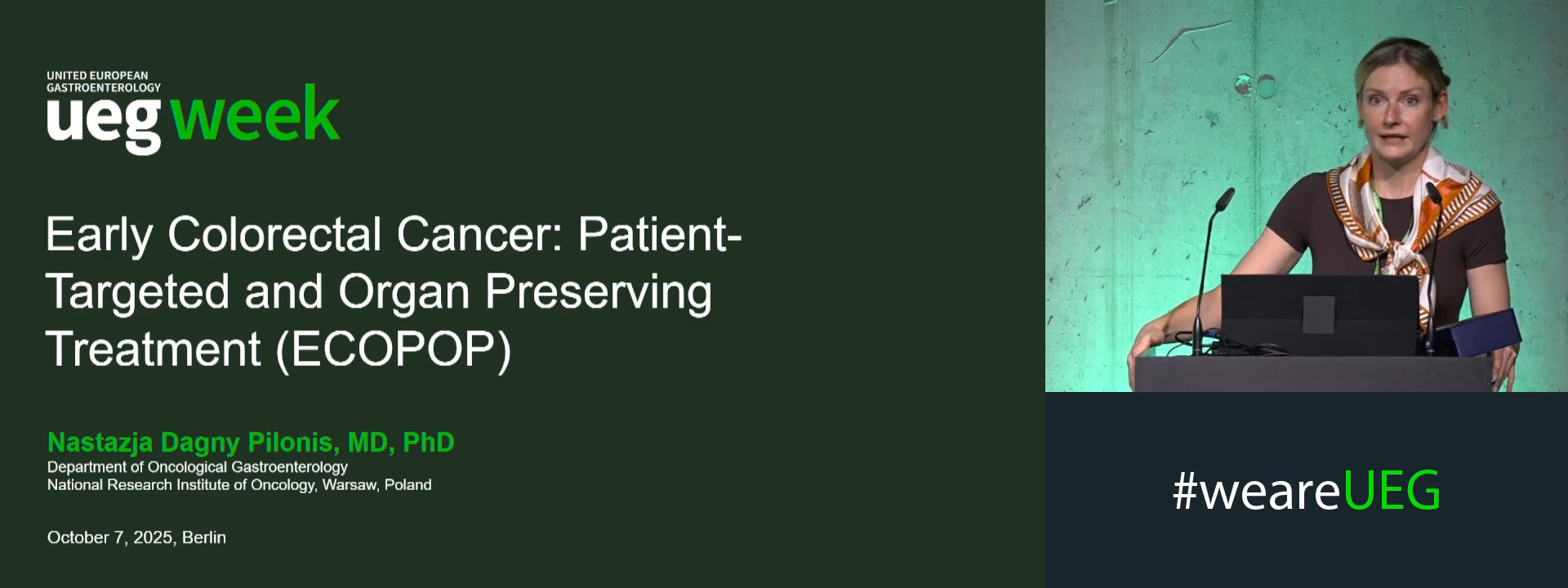
Early colorectal cancer: Patient-targeted and organ preserving treatment (ECOPOP Project)
1 The Maria Sklodowska-Curie Institute - Oncology Institute, Warsaw, Poland
Event
Session
Citation
Published
Log in to access this content.
Free for all myUEG account holders. Your access level is set automatically based on your occupation. Medical professionals get full access to all content. If you are a non-medical user, you can only access UEG Week content from congresses you attended.
Not sure what you can access? Learn more about account types.
HEPATIC HAEMATOMA WITH DUODENAL FISTULISATION FOLLOWING PERCUTANEOUS LIVER BIOPSY: A RARE COMPLICATION
Clara Rodriguez Carrillo 1, María Machín Delgado 1, Yaiza Altuzarra Ranedo 1, Jesús Sánchez César 1, Maria Elena Aznar Ruiz 1, Manuel Holgado Ayuso 1, Guillermo Carranza Granero 1, Clara López Martínez 1, Isabel Cacho Soblechero 1, Micaela Riat Castro Zocchi 1, Alejandro Ventero Borges 1, Maite Maroto 1, Juan Luis Mendoza Hernández 1
1 Hospital Clinico San Carlos, Madrid, Spain
Conference
Topics
Submission format
Session
Published
Log in to access this content.
Free for all myUEG account holders. Your access level is set automatically based on your occupation. Medical professionals get full access to all content. If you are a non-medical user, you can only access UEG Week content from congresses you attended.
Not sure what you can access? Learn more about account types.
POST-ERCP ARTERIO-BILIARY FISTULA: AN UNCOMMON AND POTENTIALLY LETHAL COMPLICATION
Clara Rodriguez Carrillo 1, Marina Montero Blanco 1, Gonzalo Ferreiros Miguel 1, Yaiza Altuzarra Ranedo 1, Jesús Sánchez César 1, María Machín Delgado 1, Maria Elena Aznar Ruiz 1, Manuel Holgado Ayuso 1, Guillermo Carranza Granero 1, Marco Leyva Vásquez Caicedo 1, Javier Armijo Astrain 1, Adrián Barrajón 1, JUAN LUIS MENDOZA 1
1 Hospital Clinico San Carlos, Madrid, Spain
Conference
Topics
Submission format
Session
Published
Log in to access this content.
Free for all myUEG account holders. Your access level is set automatically based on your occupation. Medical professionals get full access to all content. If you are a non-medical user, you can only access UEG Week content from congresses you attended.
Not sure what you can access? Learn more about account types.
PSEUDOACHALASIA SECONDARY TO LUNG ADENOCARCINOMA: A PARANEOPLASTIC MANIFESTATION
Clara Rodriguez Carrillo 1, Marta Aparicio Cabezudo 1, Yaiza Altuzarra Ranedo 1, Jesús Sánchez César 1, Clara López Martínez 1, María Machín Delgado 1, Isabel Cacho Soblechero 1, Maria Elena Aznar Ruiz 1, Manuel Holgado Ayuso 1, Guillermo Carranza Granero 1, Ana Zatarain Valles 1, Constanza Ciriza de Los Rios 1
1 Hospital Clinico San Carlos, Madrid, Spain
Conference
Topics
Submission format
Session
Published
Log in to access this content.
Free for all myUEG account holders. Your access level is set automatically based on your occupation. Medical professionals get full access to all content. If you are a non-medical user, you can only access UEG Week content from congresses you attended.
Not sure what you can access? Learn more about account types.
PATIENTS WITH IRRITABLE BOWEL SYNDROME HAVE GREATER SYMPTOMS BURDEN THAN OTHER BOWEL DISORDERS: ANALYSES FROM THE ROME FOUNDATION GLOBAL
Keren Hod 1, Giovanni Marasco 2, Ami D. Sperber 3, Olafur S. Palsson 4, Shrikant I. Bangdiwala 5, Giovanni Barbara 2
1 Ariel University, Ariel, Israel|||Assuta Medical Centers, Tel-Aviv, Israel
2 University of Bologna, Bologna, Italy|||IRCCS Azienda Ospedaliero-Universitaria di Bologna, Bologna, Italy
3 Ben-Gurion University of the Negev, Beer-Sheva, Israel
4 University of North Carolina, Chapel Hill, Chapel Hill, NC, United States
5 McMaster University, Hamilton, Ontario, Canada|||McMaster University, Hamilton, Ontario, Canada
Conference
Topics
Submission format
Session
Citation
Published
Log in to access this content.
Free for all myUEG account holders. Your access level is set automatically based on your occupation. Medical professionals get full access to all content. If you are a non-medical user, you can only access UEG Week content from congresses you attended.
Not sure what you can access? Learn more about account types.
ALEXITHYMIA IN IBD: A NEW MANAGEMENT TOOL FOR MULTIDISCIPLINARY TARGETED CARE
Simone Di Cola 1, Alice Trombetta 1, Martina Barletta 1, Giulia Scalese 1, Carola Severi 1, Manuela Merli 1, Emanuela Ribichini 1
1 Sapienza University of Rome, Rome, Italy
Conference
Topics
Submission format
Session