UEG's content platform for gastroenterology education bringing recordings, courses, guidelines, and more together in one place.
Trending on Gutflix
Rate for better recommendations!
Your feedback helps us show you more of what you like and less of what you dislike!
Log in to continue.
This content is part of Gutflix. Log in with your myUEG account, or create one free, to watch it.
Not sure what you can access? Learn more about account types.
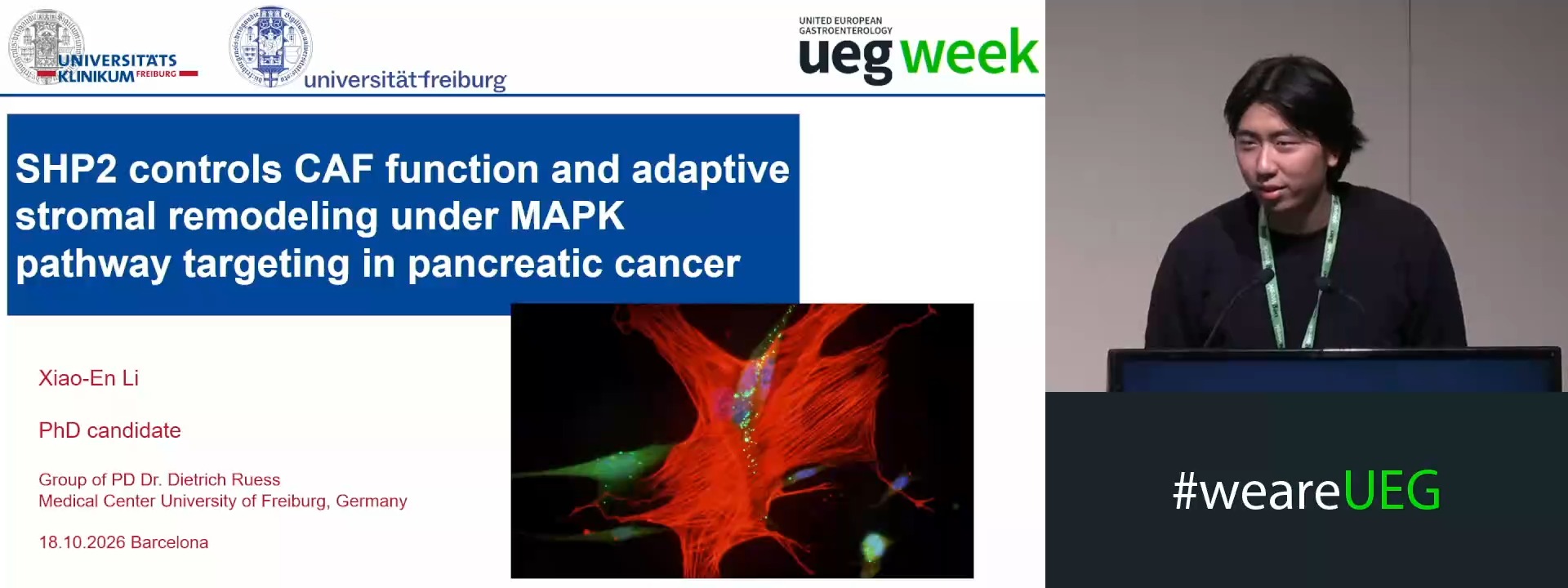
SHP2 REGULATES CAF ACTIVITY AND ADAPTIVE STROMAL REMODELING DURING VERTICAL RAS PATHWAY INHIBITION IN PANCREATIC CANCER
Steffen Keller 1, Xun Chen 1, Tonmoy Das 2, Xiao-En Li 1, Hanna Scheffold 1, Philipp Hafner 1, Asma Alrawashdeh 1, Huda Jumaa 1, Dominik von Elverfeldt 1, Wilfried Reichardt 1, Geoffroy Andrieux 2, Melanie Boerries 2,3, Stefan Fichtner-Feigl 1, Dietrich Alexander Ruess 1,3
Affiliations
1 University Medical Center Freiburg, Freiburg, Germany
2 Institute of Medical Bioinformatics and Systems Medicine, University of Freiburg, Freiburg, Germany
3 German Cancer Consortium (DKTK), Freiburg, Germany
Log in to continue.
This content is part of Gutflix. Log in with your myUEG account, or create one free, to watch it.
Not sure what you can access? Learn more about account types.
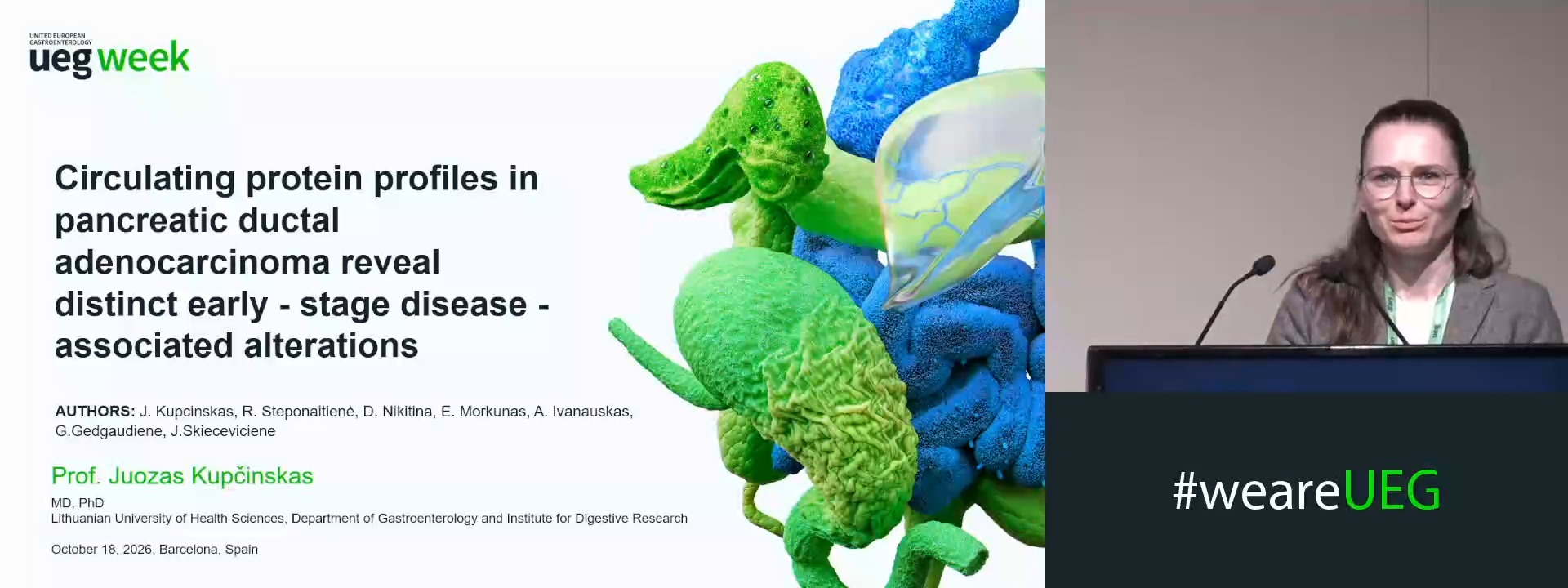
CIRCULATING PROTEIN PROFILES IN PANCREATIC DUCTAL ADENOCARCINOMA REVEAL DISTINCT EARLY-STAGE DISEASE-ASSOCIATED ALTERATIONS
Juozas Kupcinskas 1,2, Rūta Steponaitienė 2, Darja Nikitina 2, Egidijus Morkunas 1, Audrius Ivanauskas 1, Greta Gedgaudiene 2, Jurgita Skieceviciene 2
Affiliations
1 Lithuanian University of Health Sciences, Kaunas, Lithuania
2 Lithuanian University Of Health Sciences, Kaunas, Lithuania
Log in to continue.
This content is part of Gutflix. Log in with your myUEG account, or create one free, to watch it.
Not sure what you can access? Learn more about account types.
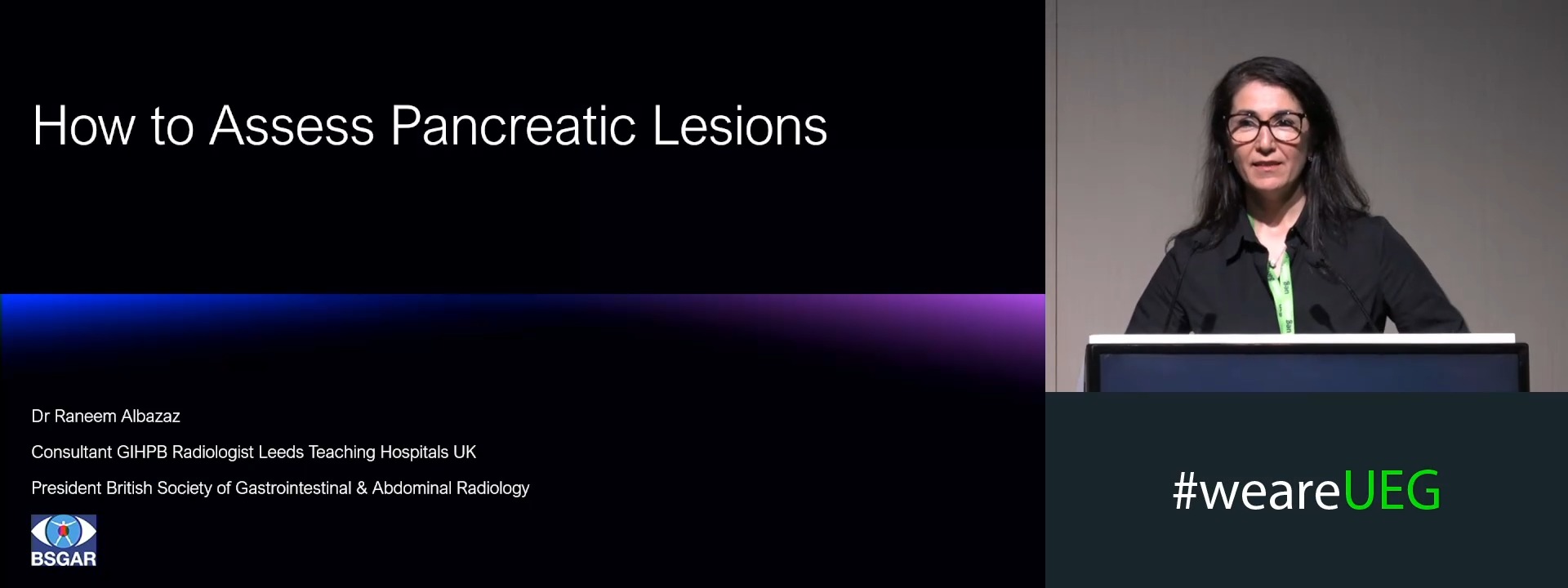
How to assess pancreatic lesions
Affiliations
1 St. James University Hospital, Leeds, United Kingdom
Log in to continue.
This content is part of Gutflix. Log in with your myUEG account, or create one free, to watch it.
Not sure what you can access? Learn more about account types.
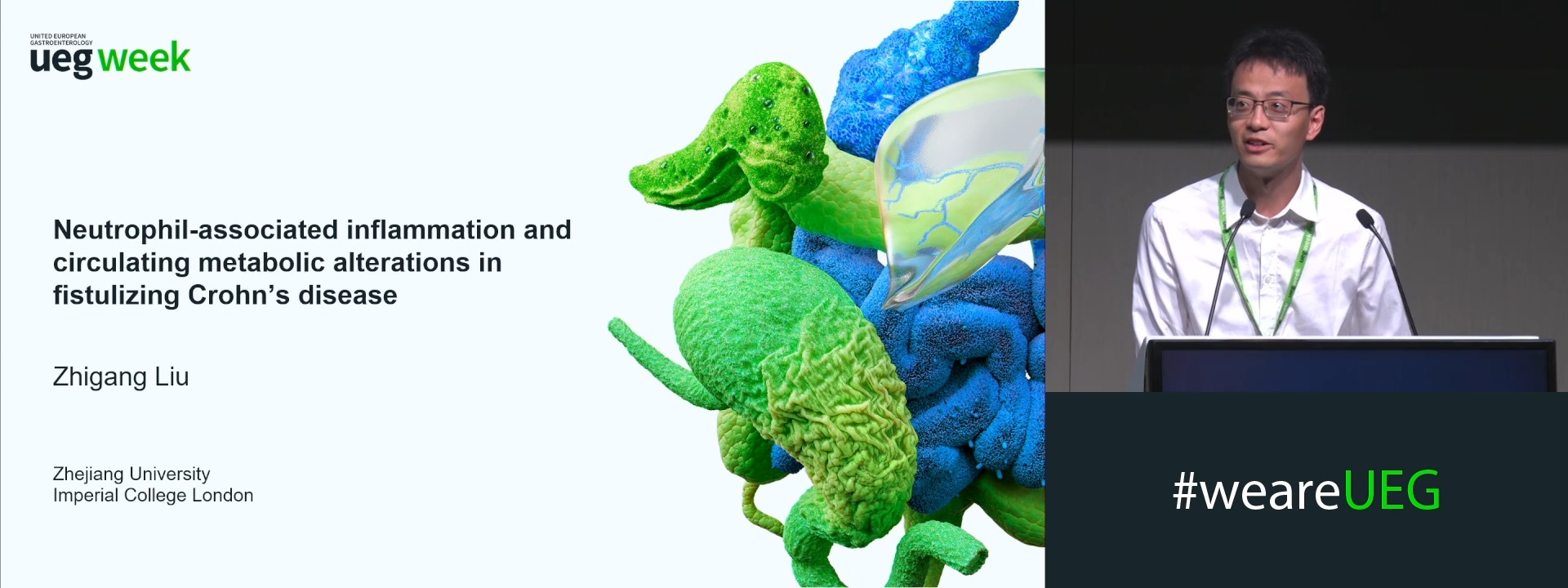
NEUTROPHIL-DRIVEN INFLAMMATION AND METABOLIC REPROGRAMMING CHARACTERIZE FISTULIZING CROHN’S DISEASE: A LARGE-SCALE MULTI-OMIC ANALYSIS
Affiliations
1 Luoyang Central Hospital Affiliated to Zhengzhou University, Luoyang, China
2 Imperial College London, London, United Kingdom
3 Zhejiang University, Hangzhou, China
Log in to continue.
This content is part of Gutflix. Log in with your myUEG account, or create one free, to watch it.
Not sure what you can access? Learn more about account types.
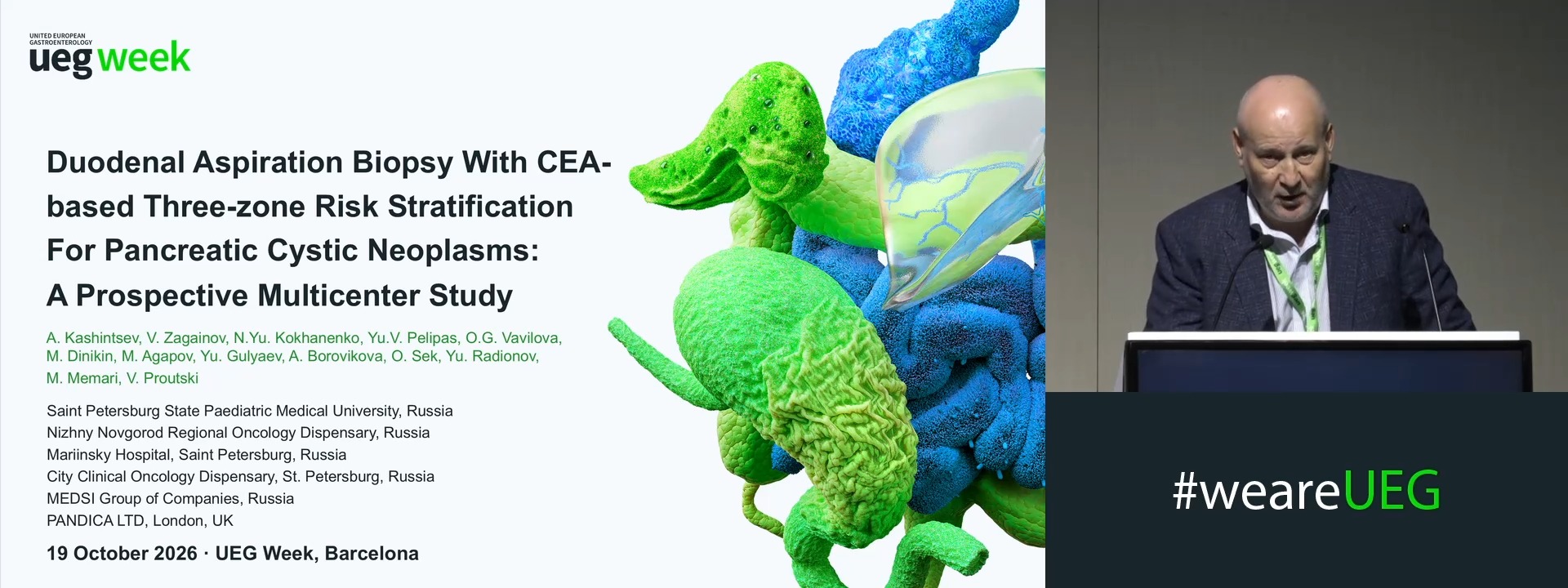
DUODENAL ASPIRATION BIOPSY WITH CEA-BASED THREE-ZONE RISK STRATIFICATION FOR PANCREATIC CYSTIC NEOPLASMS: A PROSPECTIVE MULTICENTER STUDY
Aleksei Kashintsev 1,2, Anna Borovikova 3, Nikolai Kokhanenko 3, Mikhail Dinikin 4, Yuriy Pelipas 4, Olga Vavilova 3, Vladimir Zagainov 5,6, Ok Sek 2, Mikhail Vasilchenko 7, Olga Kolokolnikova 7, Aleksandr Kolbasov 7, Nasipbek Naraliev 5,6, Vitali Proutski 8
Affiliations
1 Pandica LTD/ State Pediatric Medical University, London, United Kingdom
2 Medsi LTD, Saint-Petersburg, Russian Federation
3 State Pediatric Medical University, Saint-Petersburg, Russian Federation
4 Cities oncological hospital, Saint-Petersburg, Russian Federation
5 Privolzhskiy research medical university, Nizhniy Novgorod, Russian Federation
6 Oncology research institute, Nizhniy Novgorod, Russian Federation
7 Medsi, Krasnogorsk, Russian Federation
8 Pandica LTD, London, United Kingdom
Log in to continue.
This content is part of Gutflix. Log in with your myUEG account, or create one free, to watch it.
Not sure what you can access? Learn more about account types.
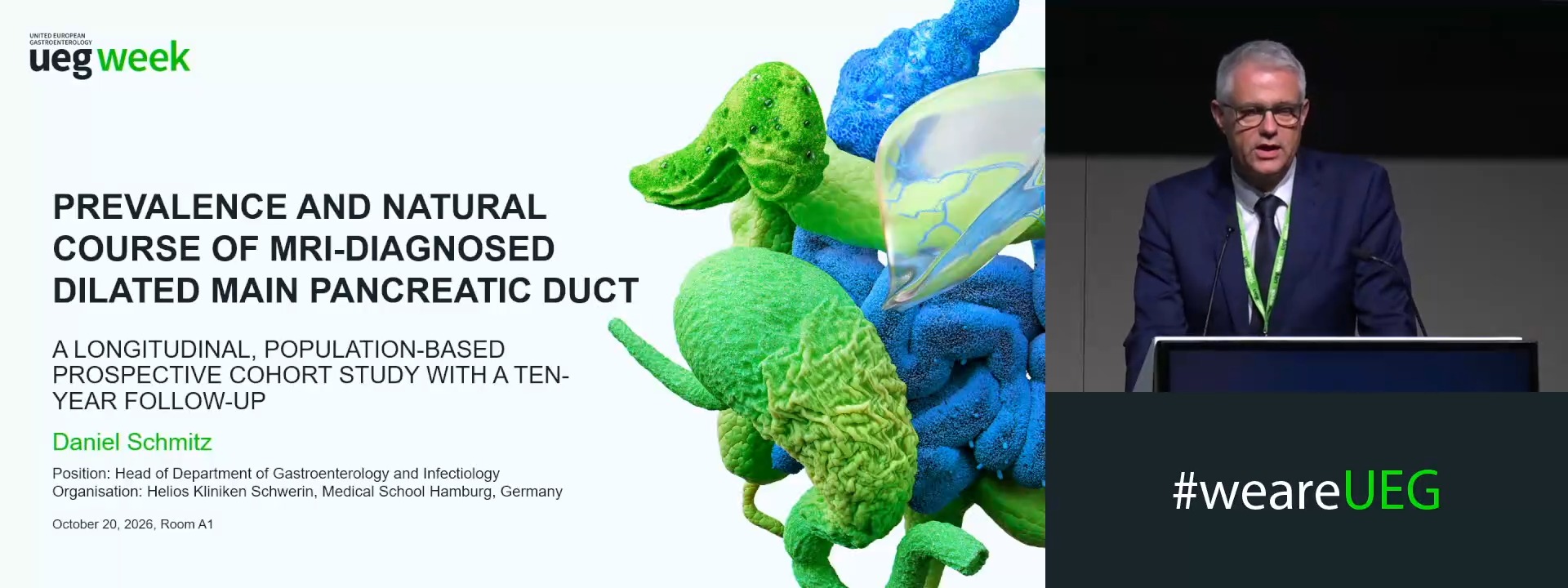
PREVALENCE AND NATURAL COURSE OF MRI-DIAGNOSED DILATED MAIN PANCREATIC DUCT: A LONGITUDINAL, POPULATION-BASED PROSPECTIVE COHORT STUDY WITH A TEN-YEAR FOLLOW-UP
Daniel Schmitz 1, Ali Alexander Aghdassi 2, Mark Wielpütz 3, Henry Völzke 3, Robin Bülow 3, Fabian Yazdi 1
Affiliations
1 Medical School Hamburg-Helios Kliniken Schwerin, Schwerin, Germany
2 Medizin. Universität Greifswald, Greifswald, Germany
3 Universität Greifswald, Greifswald, Germany