UEG's educational platform for gastroenterology education bringing recordings, courses, guidelines, and more together in one place.
Most popular content
Rate for better recommendations!
Your feedback helps us show you more of what you like and less of what you dislike!
Log in to access this content.
Free for all myUEG account holders. Your access level is set automatically based on your occupation. Medical professionals get full access to all content. If you are a non-medical user, you can only access UEG Week content from congresses you attended.
Not sure what you can access? Learn more about account types.

TAK-101 IMMUNOMODULATION OF THE GLIADIN RECALL RESPONSE IN HLA-DQ8 MICE – (SINGLE CELL) TRANSCRIPTOMIC STUDIES
Sazzad Shahrear 1, Eva Krzyżewska-Dudek 1, C.-S. Sam Chang 2, Maria Paraskevopoulou 2, Glennda Smithson 2, Tobias L. Freitag 1
1 University of Helsinki, Helsinki, Finland
2 Takeda Development Center Americas, Inc., Cambridge, United States
Conference
Topics
Submission format
Citation
Published
Log in to access this content.
Free for all myUEG account holders. Your access level is set automatically based on your occupation. Medical professionals get full access to all content. If you are a non-medical user, you can only access UEG Week content from congresses you attended.
Not sure what you can access? Learn more about account types.
ONE IN 10 PATIENTS WITH CELIAC DISEASE SUFFERS FROM JOINT COMPLAINTS: A SYSTEMATIC REVIEW AND META-ANALYSIS
1 College of Health Sciences, VinUniversity, Hanoi, Viet Nam
2 School of Medicine, Nazarbayev University, Astana, Kazakhstan
3 Karolinska Institutet, Stockholm, Sweden|||Karolinska University Hospital, Stockholm, Sweden
Conference
Topics
Submission format
Citation
Published
Log in to access this content.
Free for all myUEG account holders. Your access level is set automatically based on your occupation. Medical professionals get full access to all content. If you are a non-medical user, you can only access UEG Week content from congresses you attended.
Not sure what you can access? Learn more about account types.
GENERAL HEALTH AND LONG-TERM OUTCOMES IN CELIAC DISEASE PATIENTS IDENTIFIED THROUGH SCREENING IN A POPULATION-REPRESENTATIVE COHORT: FINDINGS FROM A PROSPECTIVE STUDY
1 Tampere University, Tampere, Finland
2 Tampere University Hospital, Tampere, Finland|||Tampere University, Tampere, Finland|||Seinäjoki Central Hospital, Seinäjoki, Finland
3 Tampere University, Tampere, Finland|||Tampere University Hospital, Tampere, Finland
4 University of Helsinki and Helsinki University Hospital, Helsinki, Finland|||Tampere University Hospital, Tampere, Finland|||Tampere University, Tampere, Finland
5 Tampere University Hospital, Tampere, Finland|||Tampere University, Tampere, Finland
Conference
Topics
Submission format
Citation
Published
Log in to access this content.
Free for all myUEG account holders. Your access level is set automatically based on your occupation. Medical professionals get full access to all content. If you are a non-medical user, you can only access UEG Week content from congresses you attended.
Not sure what you can access? Learn more about account types.
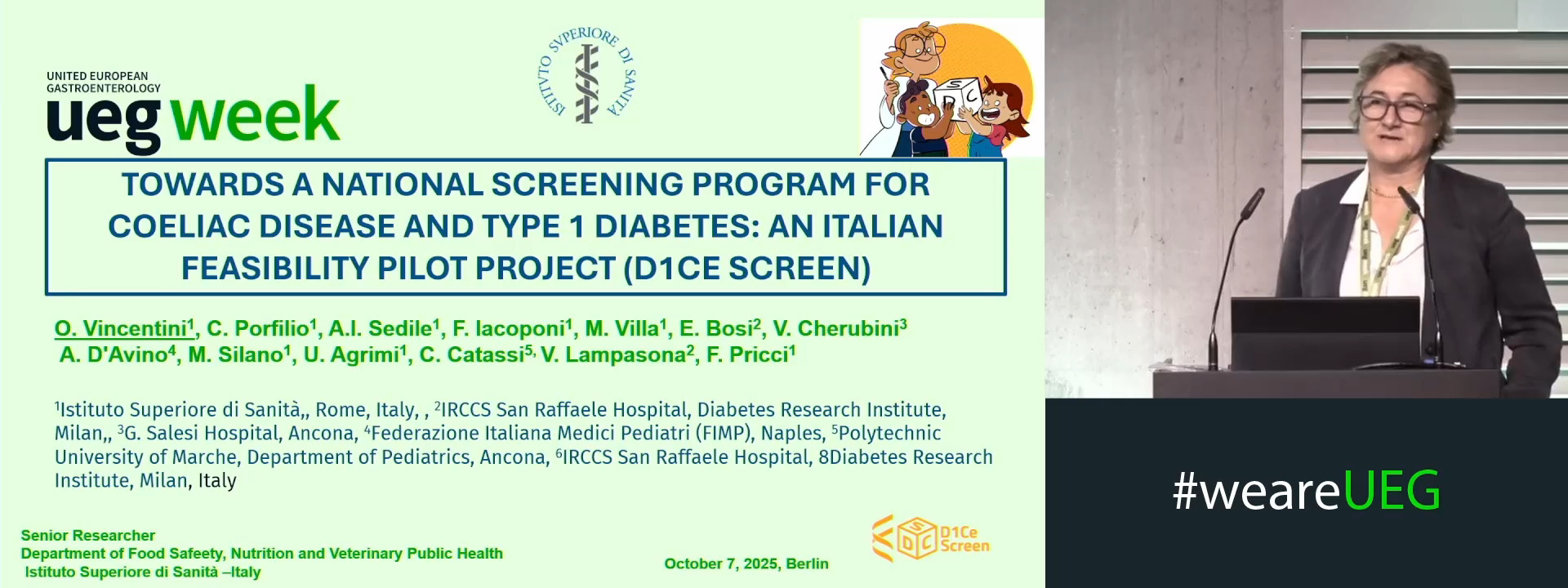
TOWARDS A NATIONAL SCREENING PROGRAM FOR COELIAC DISEASE AND TYPE 1 DIABETES: AN ITALIAN FEASIBILITY PILOT PROJECT (D1CE SCREEN)
Olimpia Vincentini 1, Chiara Porfilio 1, Adalgisa Ilaria Sedile 1, Francesca Iacoponi 1, Marika Villa 1, Emanuele Bosi 2, Valentino Cherubini 3, Antonio D'Avino 4, Marco Silano 1, Umberto Agrimi 1, Carlo Catassi 5, Vito Lampasona 2, Flavia Pricci 1
1 Istituto Superiore di Sanità, Rome, Italy
2 IRCCS San Raffaele Hospital, Milan, Italy
3 Azienda Ospedaliero-Universitaria, Ospedali Riuniti di Ancona, G. Salesi Hospital, Ancona, Italy
4 Federazione Italiana Medici Pediatri (FIMP), Naples, Italy
5 Polytechnic University of Marche, Ancona, Italy
Event
Submission format
Citation
Published
Log in to access this content.
Free for all myUEG account holders. Your access level is set automatically based on your occupation. Medical professionals get full access to all content. If you are a non-medical user, you can only access UEG Week content from congresses you attended.
Not sure what you can access? Learn more about account types.
MEANINGFUL SYMPTOM CHANGE IN CELIAC DISEASE: QUALITATIVE FINDINGS FROM AN EXIT INTERVIEW STUDY FOLLOWING A PHASE 2 CLINICAL TRIAL
1 Takeda Development Center Americas, Inc., Cambridge, United States
2 RTI Health Solutions, North Carolina, United States
Conference
Topics
Submission format
Citation
Published
Log in to access this content.
Free for all myUEG account holders. Your access level is set automatically based on your occupation. Medical professionals get full access to all content. If you are a non-medical user, you can only access UEG Week content from congresses you attended.
Not sure what you can access? Learn more about account types.
GAPS IN DISEASE-SPECIFIC KNOWLEDGE IN INFLAMMATORY BOWEL DISEASE PATIENTS AT A TERTIARY CARE CENTER
Louisa Stechel 1, Thu Giang Le Thi 2, Leandra Koletzko 1, Ralph Wimmer 1, Benjamin Misselwitz 1, Sibylle Koletzko 2, Noortje GM Rossen 3, Helga Török 1
1 LMU University Hospital, Ludwig-Maximilians University, Munich, Munich, Germany
2 Dr. von Hauner Children's Hospital, LMU University Hospital of Munich, Munich, Germany
3 Amsterdam University Medical Centre, Amsterdam, Netherlands
Conference
Topics
Submission format
Session
Citation
Published
Log in to access this content.
Free for all myUEG account holders. Your access level is set automatically based on your occupation. Medical professionals get full access to all content. If you are a non-medical user, you can only access UEG Week content from congresses you attended.
Not sure what you can access? Learn more about account types.
COELIAC DISEASE IN BONE FRACTURE PATIENTS: A 1000 PATIENT PILOT SCREENING STUDY
Frankie Fan 1, Alex Calder 2, Sophie Fox 2, Parizade Raymode 2, Richard Harris 2, Srinivasan Shyamsundar 2, Ajay Verma 2
1 Kettering General Hospital, Kettering, United Kingdom|||University of Leicester, Leicester, United Kingdom
2 Kettering General Hospital, Kettering, United Kingdom
Conference
Topics
Submission format
Session