UEG's content platform for gastroenterology education bringing recordings, courses, guidelines, and more together in one place.
Trending on Gutflix
Rate for better recommendations!
Your feedback helps us show you more of what you like and less of what you dislike!
Log in to continue.
This content is part of Gutflix. Log in with your myUEG account, or create one free, to watch it.
Not sure what you can access? Learn more about account types.
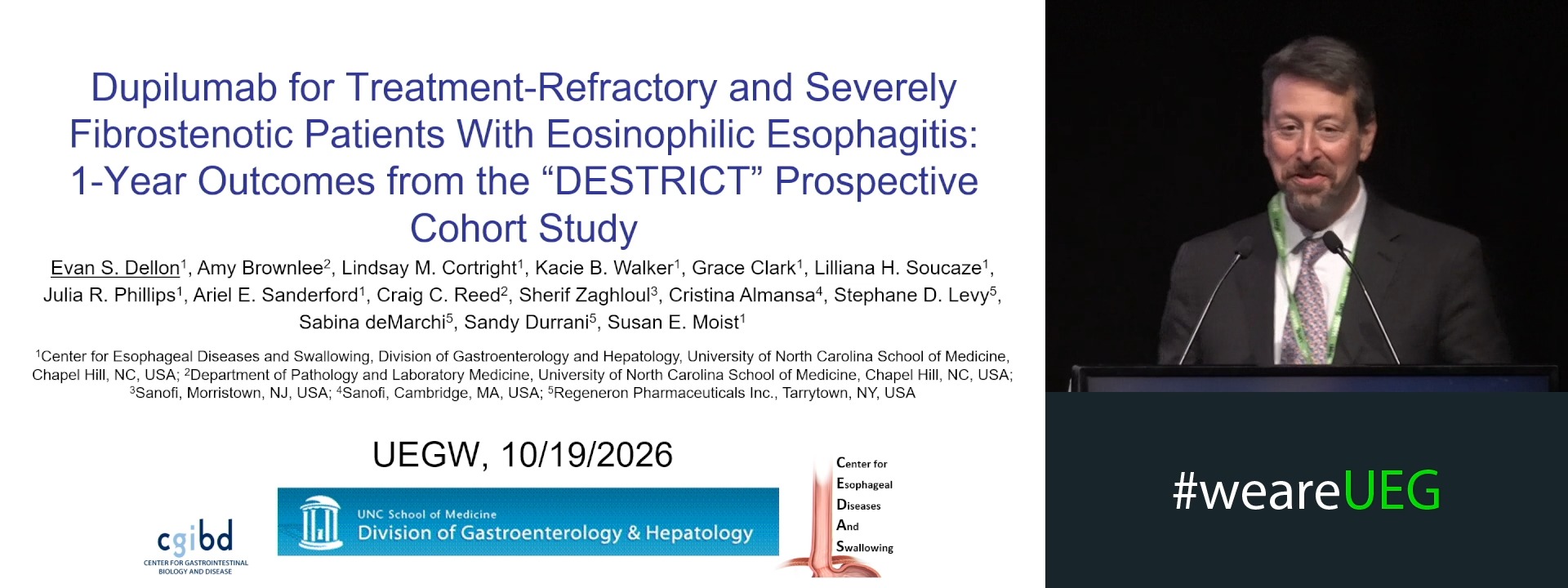
DUPILUMAB FOR TREATMENT-REFRACTORY AND SEVERELY FIBROSTENOTIC PATIENTS WITH EOSINOPHILIC ESOPHAGITIS: 1-YEAR OUTCOMES FROM THE “DESTRICT” PROSPECTIVE COHORT STUDY
Evan S. Dellon 1, Amy Brownlee 1, Lindsay M. Cortright 1, Kacie B. Walker 1, Grace Clark 1, Lilliana H. Soucaze 1, Julia R. Phillips 1, Ariel E. Sanderford 1, Craig C. Reed 1, Sherif Zaghloul 2, Cristina Almansa 3, Amr Radwan 4, Sabina deMarchi 4, Sheharyar Durrani 4, Susan E. Moist 1
Affiliations
1 University of North Carolina School of Medicine, Chapel Hill, NC, United States
2 Sanofi, Morristown, NJ, United States
3 Sanofi, Cambridge, MA, United States
4 Regeneron Pharmaceuticals Inc., Tarrytown, NY, United States
Log in to continue.
This content is part of Gutflix. Log in with your myUEG account, or create one free, to watch it.
Not sure what you can access? Learn more about account types.
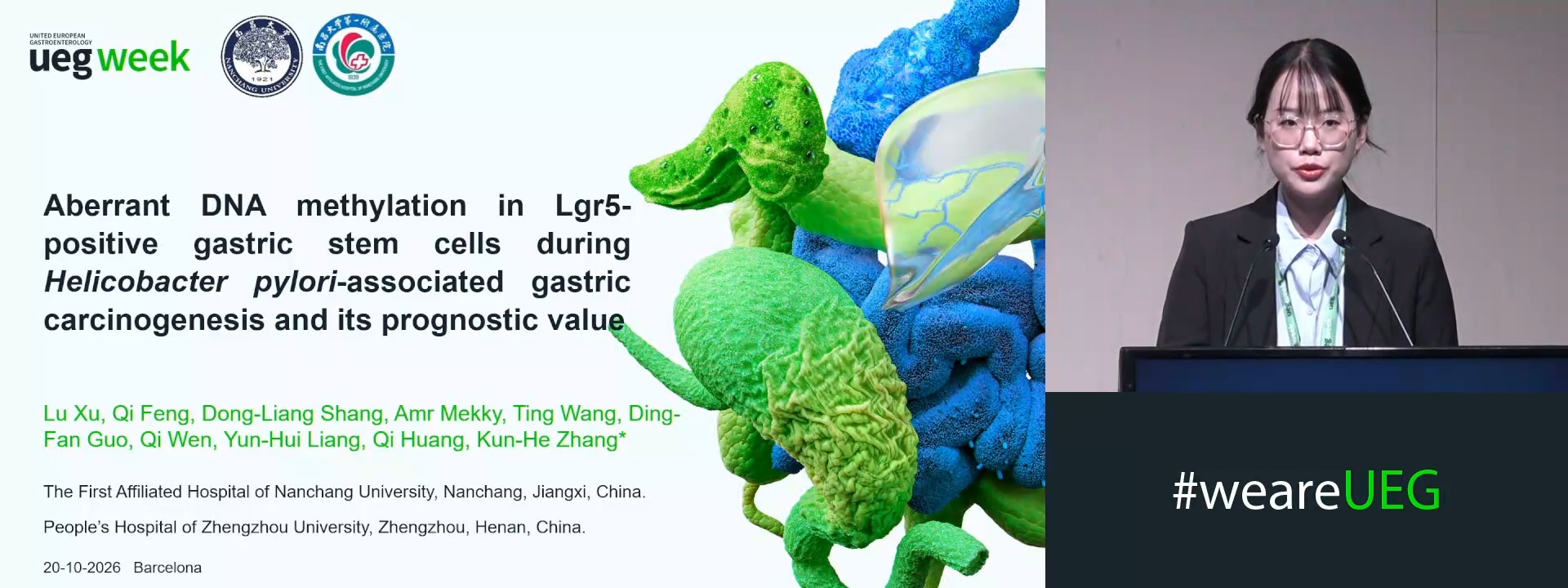
ABERRANT DNA METHYLATION IN LGR5-POSITIVE GASTRIC EPITHELIAL STEM CELLS DURING HELICOBACTER PYLORI-ASSOCIATED GASTRIC CARCINOGENESIS AND ITS PROGNOSTIC VALUE
Lu Xu 1, Qi Feng 1, Dong-Liang Shang 2, Ding-Fan Guo 1, Qi Wen 1, Yun-Hui Liang 1, Qi Huang 1, Ting Wang 1, Kun-He Zhang 1
Affiliations
1 Jiangxi Provincial Key Laboratory of Digestive Diseases, Jiangxi Clinical Research Center for Gastroenterology, Digestive Disease Hospital, The First Affiliated Hospital, Jiangxi Medical College, Nanchang University, Jiangxi, China
2 People’s Hospital of Zhengzhou University, and Henan Provincial People’s Hospital, Zhengzhou, China
Log in to continue.
This content is part of Gutflix. Log in with your myUEG account, or create one free, to watch it.
Not sure what you can access? Learn more about account types.
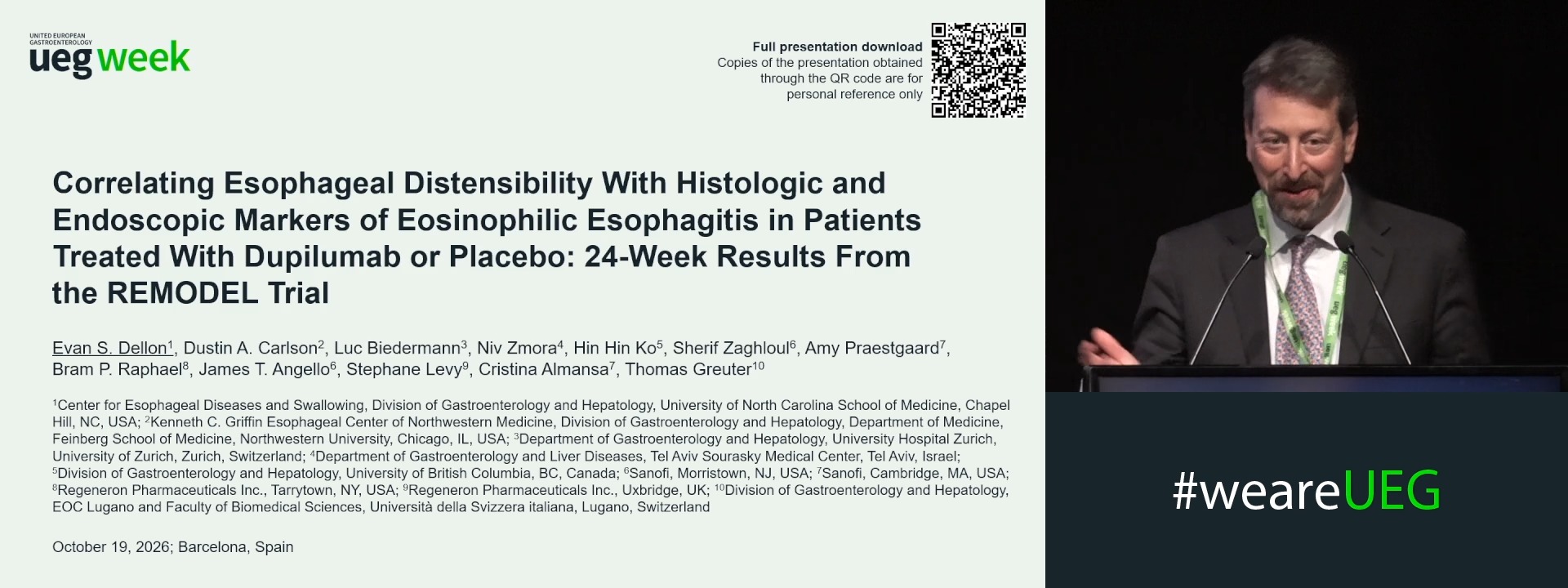
CORRELATING ESOPHAGEAL DISTENSIBILITY WITH HISTOLOGIC AND ENDOSCOPIC MARKERS OF EOSINOPHILIC ESOPHAGITIS IN PATIENTS TREATED WITH DUPILUMAB OR PLACEBO: 24-WEEK RESULTS FROM THE REMODEL TRIAL
Evan S. Dellon 1, Dustin A. Carlson 2, Luc Biedermann 3, Niv Zmora 4, Hin Hin Ko 5, Sherif Zaghloul 6, Amy Praestgaard 7, Bram Raphael 8, James T. Angello 6, Amr Radwan 9, Cristina Almansa 7, Thomas Greuter 10
Affiliations
1 University of North Carolina School of Medicine, Chapel Hill, NC, United States
2 Feinberg School of Medicine, Northwestern University, Chicago, IL, United States
3 University Hospital Zurich, University of Zurich, Zürich, Switzerland
4 Tel Aviv Sourasky Medical Center, Tel Aviv, Israel
5 University of British Columbia, Vancouver, BC, Canada
6 Sanofi, Morristown, NJ, United States
7 Sanofi, Cambridge, MA, United States
8 Regeneron Pharmaceuticals Inc., Tarrytown, NY, United States
9 Regeneron Pharmaceuticals Inc., Uxbridge, United Kingdom
10 Università della Svizzera italiana, Lugano, Switzerland
Log in to continue.
This content is part of Gutflix. Log in with your myUEG account, or create one free, to watch it.
Not sure what you can access? Learn more about account types.
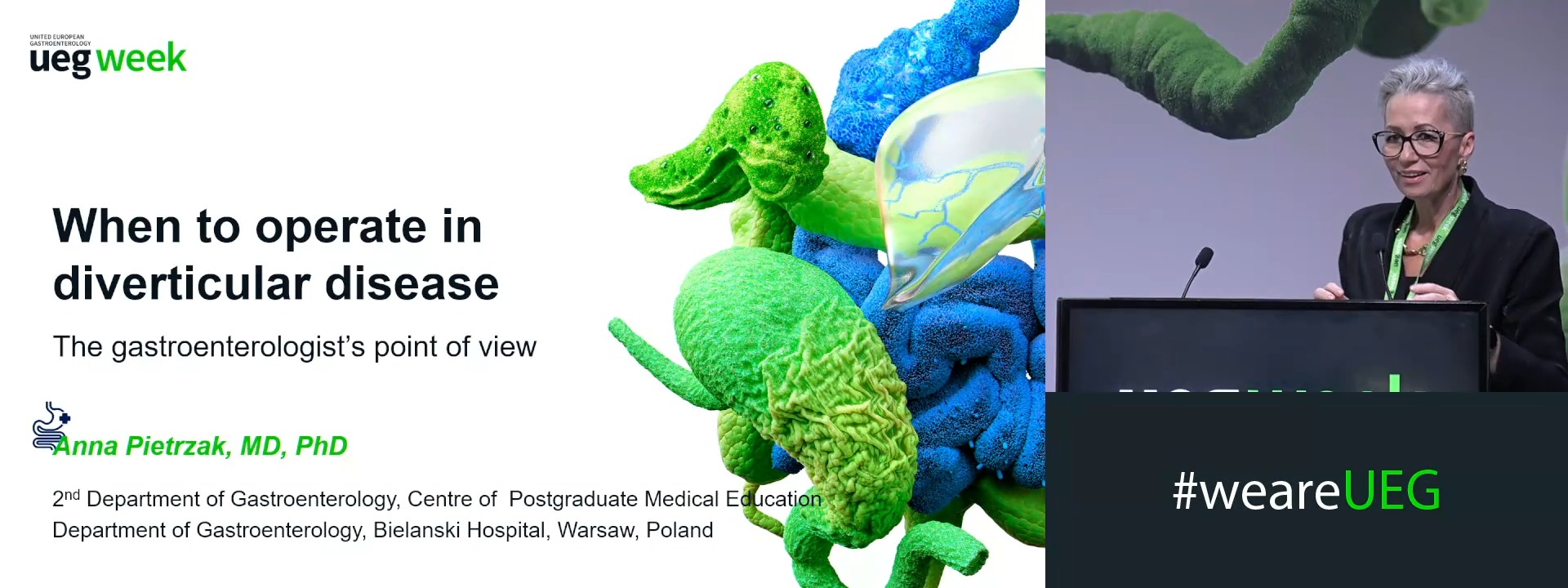
When to operate in diverticular disease: The gastroenterologist's and the surgeon's point of view
Affiliations
1 Medical Centre for Postgraduate Education Gastroenterology and Hepatology, Warsaw, Poland
2 King's College Hospital NHS Foundation Trust, London, United Kingdom
Log in to continue.
This content is part of Gutflix. Log in with your myUEG account, or create one free, to watch it.
Not sure what you can access? Learn more about account types.
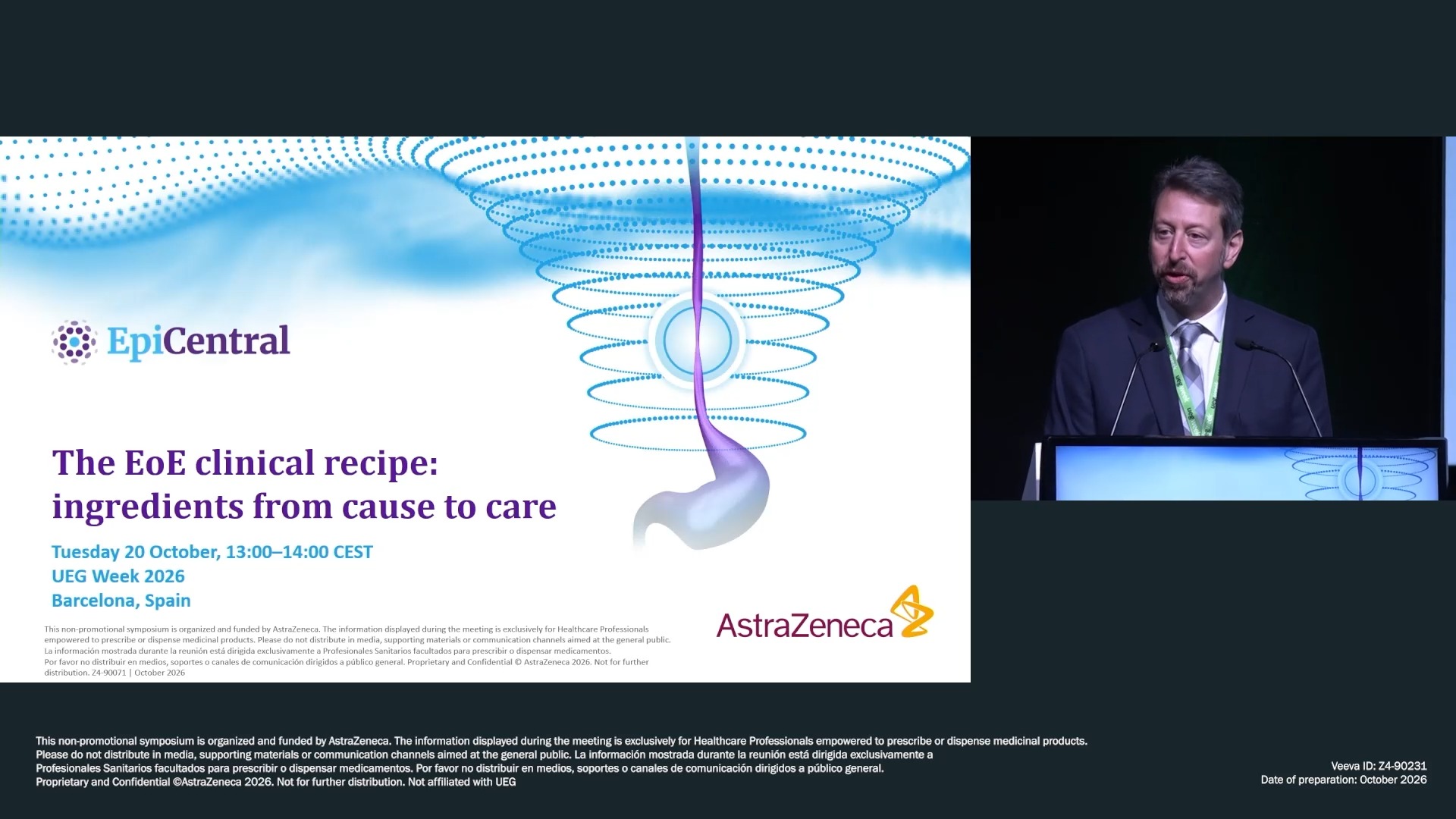
The EoE clinical recipe: ingredients from cause to care (AstraZeneca) (Complete Session)
Affiliations
1 University of North Carolina School of Medicine, Chapel Hill, NC, United States of America
2 USZ Zürich, Zurich, Switzerland
3 Otto-Von Guericke University, Madgeburg, Germany
4 Humanitas Gavazzeni e Castelli, None, Italy
5 Hospital General de Tomelloso, Madrid, Spain