UEG's educational platform for gastroenterology education bringing recordings, courses, guidelines, and more together in one place.
Most popular content
Rate for better recommendations!
Your feedback helps us show you more of what you like and less of what you dislike!
Log in to access this content.
Free for all myUEG account holders. Your access level is set automatically based on your occupation. Medical professionals get full access to all content. If you are a non-medical user, you can only access UEG Week content from congresses you attended.
Not sure what you can access? Learn more about account types.
A HEAD-TO-HEAD COMPARISON OF MASLD WITH MAFLD DIAGNOSTIC CRITERIA IN LONGITUDINALLY ESTIMATING THE LIVER DISEASE PROGRESSION AND ACUTE CARDIOVASCULAR EVENTS’ RISK IN STEATOTIC LIVER DISEASE PATIENTS: A REAL-LIFE EXPERIENCE
Mario Romeo 1, Marcello Dallio 1, Fiammetta Di Nardo 1, Carmine Napolitano 1, Paolo Vaia 1, Giuseppina Martinelli 1, Marco Niosi 1, Alessandro Federico 1
1 University of Campania Luigi Vanvitelli, Naples, Italy
Conference
Topics
Submission format
Session
Citation
Published
Log in to access this content.
Free for all myUEG account holders. Your access level is set automatically based on your occupation. Medical professionals get full access to all content. If you are a non-medical user, you can only access UEG Week content from congresses you attended.
Not sure what you can access? Learn more about account types.
Nurse Programme (Complete Session)
Event
Session
Citation
Published
Log in to access this content.
Free for all myUEG account holders. Your access level is set automatically based on your occupation. Medical professionals get full access to all content. If you are a non-medical user, you can only access UEG Week content from congresses you attended.
Not sure what you can access? Learn more about account types.
A 10-YEAR FOLLOW-UP OF THE NON-RANDOMIZED, SINGLE-ARM, CONFIRMATORY STUDY OF THE EXPANDED INDICATION FOR ENDOSCOPIC SUBMUCOSAL DISSECTION INDICATION IN UNDIFFERENTIATED EARLY GASTRIC CANCER: JAPAN CLINICAL ONCOLOGY GROUP STUDY (JCOG1009/1010)
Shinichiro Hori 1, Kohei Takizawa 2, Hiroyuki Ono 3, Noriaki Hasuike 4, Masanori Terashima 3, Atsuo Takashima 5, Keiko Minashi 6, Narikazu Boku 7, Ryoji Kushima 8, Yusuke Sano 5, Riku Kajiwara 5, Haruhiko Fukuda 5, Yusuke Horiuchi 9, Noboru Kawata 3, Seiichiro Abe 5, Naohiro Yoshida 10, Kingo Hirasawa 11, Yoshinobu Yamamoto 12, Ryu Ishihara 13, Satoshi Tanabe 14, Yasumasa Niwa 15, Masahiro Nakagawa 16, Manabu Muto 17, Takaki Yoshikawa 5, Tomonori Yano 18
1 Japanese Red Cross Society Himeji Hospital, Himeji, Japan|||NHO Shikoku Cancer Center, Matsuyama, Japan
2 Kanagawa Cancer Center, Yokohama, Japan
3 Shizuoka Cancer Center, Shizuoka, Japan
4 Hasuike Clinic, Kobe, Japan
5 National Cancer Center Hospital, Tokyo, Japan
6 Chiba Cancer Center, Chiba, Japan
7 The University of Tokyo, Tokyo, Japan
8 Shiga University of Medica Science, Otsu, Japan
9 Cancer Institute Hospital, Koto, Tokyo, Japan
10 Ishikawa Prefectural Central Hosp., Ishikawa, Japan
11 Yokohama-City Medical Center, Yokohama, Japan
12 Hyogo Cancer Center, Akashi, Japan
13 Osaka International Cancer Institute, Osaka, Japan
14 Ebina general hospital, Ebina, Japan
15 Aichi Cancer Center Hospital, Nagoya, Japan
16 Hiroshima City Hiroshima Citizens Hospital, Hiroshima, Japan
17 Kyoto University Graduate School of Medicine, Kyoto, Japan
18 National Cancer Center Hospital East, Kashiwa, Japan
Conference
Topics
Submission format
Citation
Published
Log in to access this content.
Free for all myUEG account holders. Your access level is set automatically based on your occupation. Medical professionals get full access to all content. If you are a non-medical user, you can only access UEG Week content from congresses you attended.
Not sure what you can access? Learn more about account types.
IMPROVING DOCUMENTED ADVICE REGARDING ANTICOAGULANTS AND ANTIPLATELETS IN PATIENTS UNDERGOING ERCP
Emily Creed 1, Sweekriti Gurung 1, Vanessa Theis 1, Katie Clark 1, Abdullah Motam 1, Gregor FarrellBinns 1
1 Mersey and West Lancs NHS Trust, Liverpool, United Kingdom
Conference
Topics
Submission format
Session
Citation
Published
Log in to access this content.
Free for all myUEG account holders. Your access level is set automatically based on your occupation. Medical professionals get full access to all content. If you are a non-medical user, you can only access UEG Week content from congresses you attended.
Not sure what you can access? Learn more about account types.
SAFETY AND EFFICACY OF COLD VS. HOT SNARE ENDOSCOPIC MUCOSAL RESECTION FOR COLORECTAL POLYPS: A SYSTEMATIC REVIEW AND META-ANALYSIS OF RANDOMIZED CONTROLLED TRIALS
Ahmed Farag 1, Amro Bani-Hani 2, Rihab Kherroubi 3, Alaa Mohamed Elsayed Abbas 4, Ahmed Ayman Shawky 5, Mohamed Hamouda Elkasaby 6
1 Ain Shams University, Cairo, Egypt
2 Faculty of Medicine, The Hashemite University, Zarqa, Jordan
3 Faculty of Medicine, University of Algiers Benyoucef Benkhedda, Algiers, Algeria
4 Faculty of Medicine, Menofia University, Menofia, Egypt
5 Faculty of Medicine, Mansoura University, Mansoura, Egypt
6 Faculty of Medicine, Al-Azhar University, Cairo, Egypt
Conference
Topics
Submission format
Session
Citation
Published
Log in to access this content.
Free for all myUEG account holders. Your access level is set automatically based on your occupation. Medical professionals get full access to all content. If you are a non-medical user, you can only access UEG Week content from congresses you attended.
Not sure what you can access? Learn more about account types.
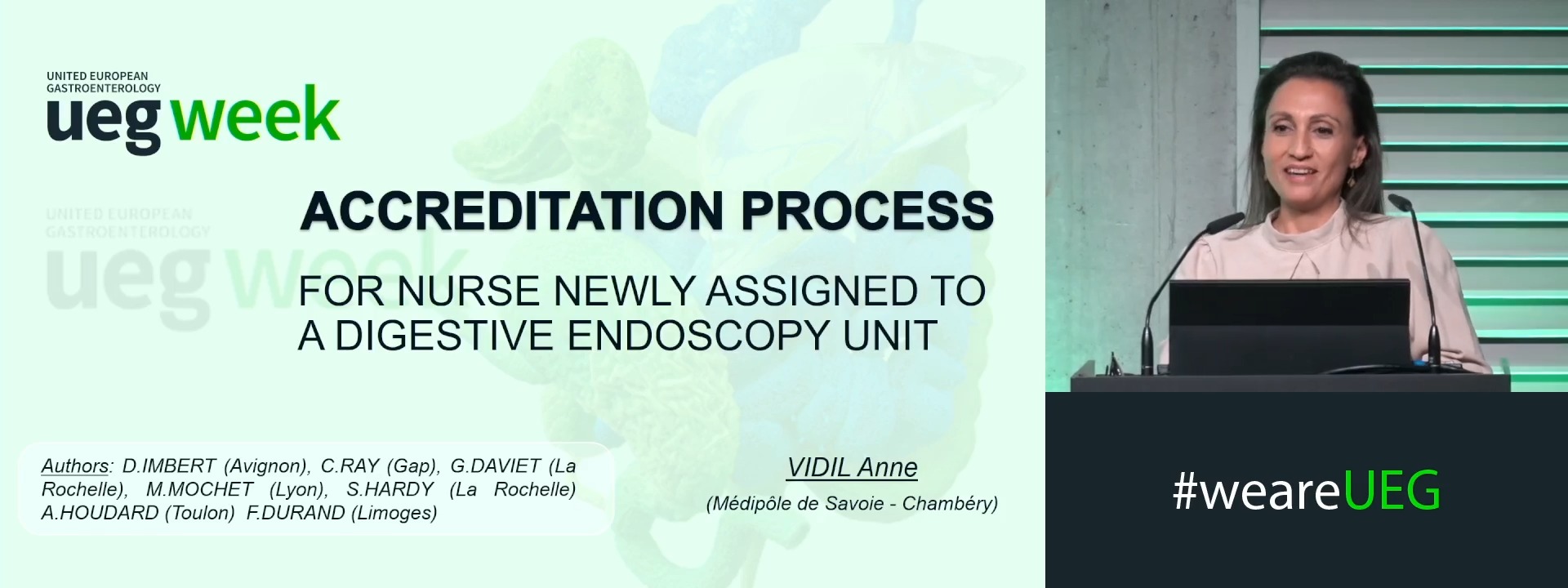
Accreditation for a newly recruited endoscopy nurse
1 None, None, France
Event
Topics
Citation
Published
Log in to access this content.
Free for all myUEG account holders. Your access level is set automatically based on your occupation. Medical professionals get full access to all content. If you are a non-medical user, you can only access UEG Week content from congresses you attended.
Not sure what you can access? Learn more about account types.
ENDOSCOPIC BLEEDING MANAGEMENT IN ALTERED ANATOMY: PRELIMINARY RESULTS OF THE EMBLEMA TRIAL
Cecilia Binda 1, Giulia Gibiino 1, Matteo Secco 1, Marco Balzarini 2, Sergio Segato 3, Camilla Gallo 4, Giuseppe Fierro 4, Germana De Nucci 5, Giovanni Aragona 6, Elena De Cristofaro 7, Giovanna Del Vecchio Blanco 7, Aurelio Mauro 8, Andrea Anderloni 8, Ilaria Tarantino 9, Giacomo Emanuele Maria Rizzo 9, Maria Cristina Conti Bellocchi 10, Milena Di Leo 11, Amedeo Montale 12, Edoardo Forti 13, Marco Marzioni 14, Nicola Olivari 15, Matteo Brunacci 16, Leonardo Frazzoni 1, Carlo Fabbri 1
1 AUSL Romagna, Forlì, Italy
2 ASST dei Sette Laghi Hospital, Varese, Italy
3 Azienda Ospedaliero Universitaria Macchi Varese, Varese, Italy
4 Fondazione IRCCS San Gerardo dei Tintori; University of Milano-Bicocca, Monza, Italy
5 ASST Rhodense, Milano, Italy
6 Gastroenterology unit, Piacenza, Italy
7 University of Rome Tor Vergata, Roma, Italy
8 San Matteo Hospital Foundation, University of Pavia, Pavia, Italy
9 ISMETT - IRCCS, Palermo, Italy
10 AOUI-University of Verona, Verona, Italy
11 ASST Santi Paolo e Carlo - Ospedale San Paolo, Milano, Italy
12 Ospedali Galliera, Genova, Italy
13 Ospedale Niguarda Ca granda, Milano, Italy
14 Università Politecnica delle Marche, Ancona, Italy
15 Fondazione Poliambulanza Istituto Ospedaliero, Brescia, Italy
16 Ospedale Civile S.Andrea, La Spezia, Italy
Conference
Topics