UEG's content platform for gastroenterology education bringing recordings, courses, guidelines, and more together in one place.
Trending on Gutflix
Rate for better recommendations!
Your feedback helps us show you more of what you like and less of what you dislike!
Log in to continue.
This content is part of Gutflix. Log in with your myUEG account, or create one free, to watch it.
Not sure what you can access? Learn more about account types.
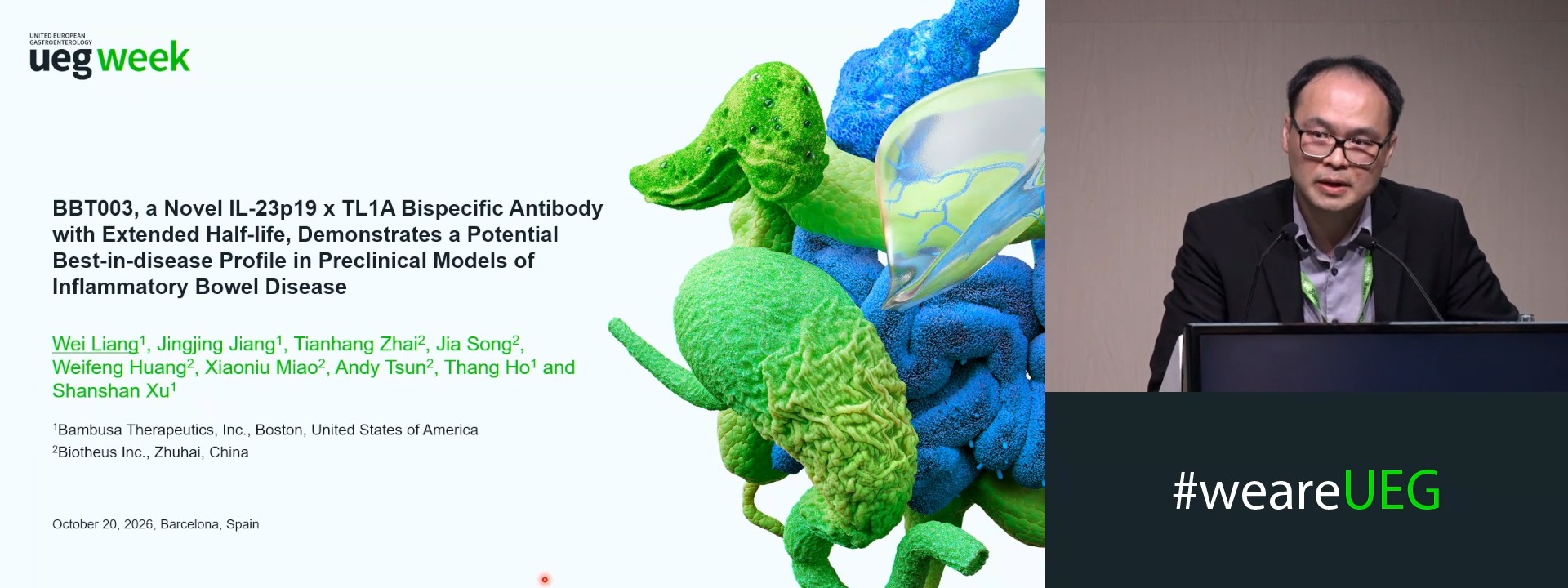
BBT003, A NOVEL IL-23P19 X TL1A BISPECIFIC ANTIBODY WITH EXTENDED HALF-LIFE, DEMONSTRATES A POTENTIAL BEST-IN-DISEASE PROFILE IN PRECLINICAL MODELS OF INFLAMMATORY BOWEL DISEASE
Wei Liang 1, Jingjing Jiang 1, Tianhang Zhai 2, Jia Song 2, Weifeng Huang 2, Xiaoniu Miao 2, Andy Tsun 2, Thang Ho 1, Shanshan Xu 1
Affiliations
1 Bambusa Therapeutics, Boston, United States
2 Biotheus Inc., Zhuhai, China
Log in to continue.
This content is part of Gutflix. Log in with your myUEG account, or create one free, to watch it.
Not sure what you can access? Learn more about account types.
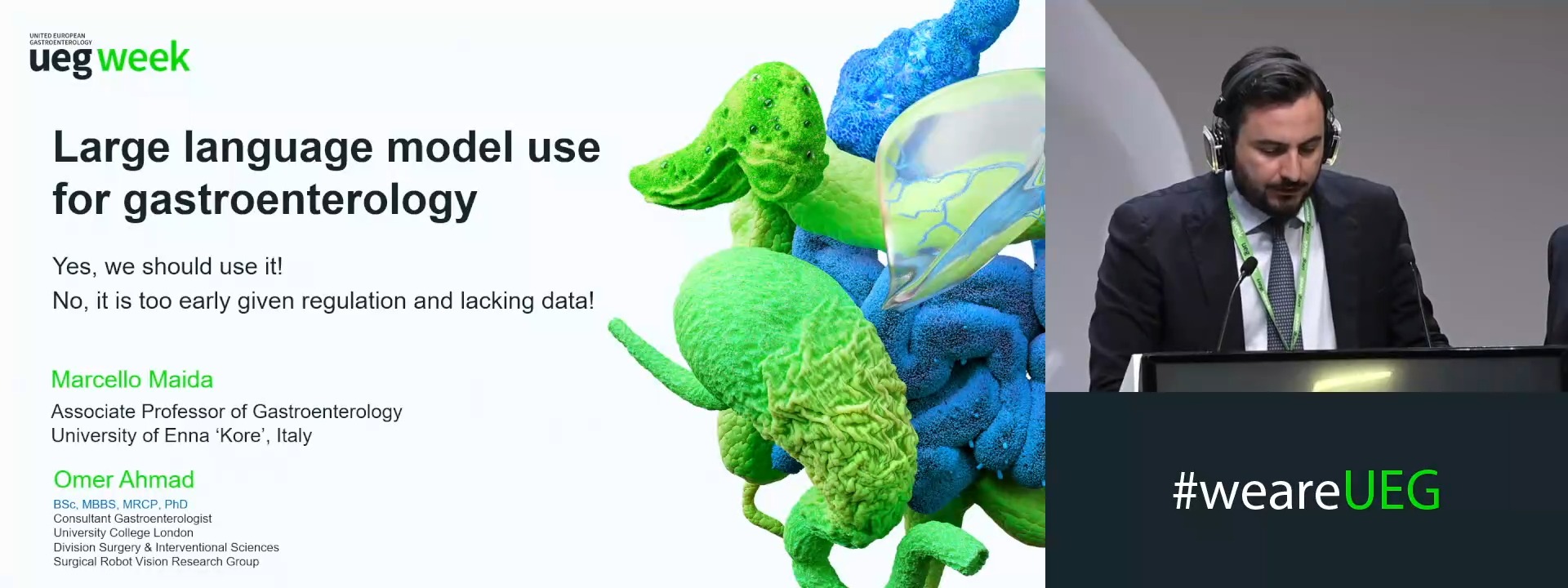
Large language model use for gastroenterology: Should we use it already, or is it too early given regulation and lacking data?
Affiliations
1 Department of Medicine and Surgery, University of Enna ‘Kore’, Enna, Italy
2 University College London, London, United Kingdom
Log in to continue.
This content is part of Gutflix. Log in with your myUEG account, or create one free, to watch it.
Not sure what you can access? Learn more about account types.
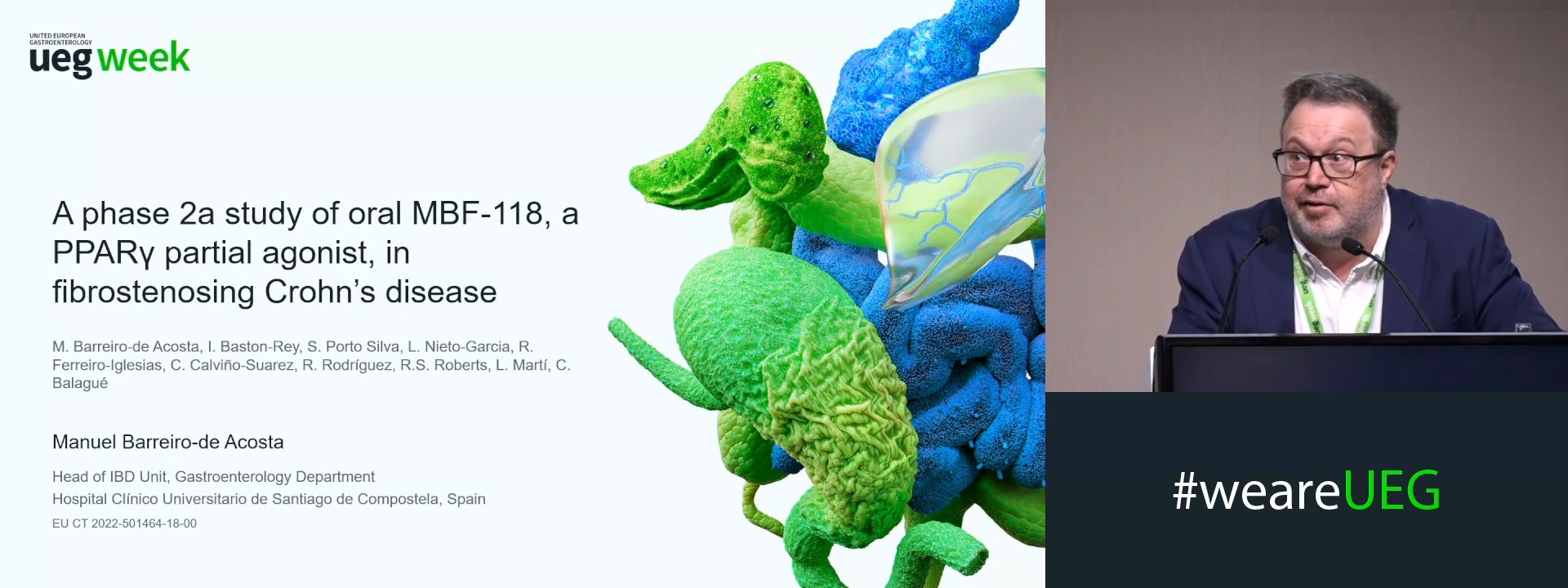
A PHASE 2A STUDY TO EVALUATE SAFETY, PHARMACOKINETICS AND CLINICAL EFFICACY OF ORAL TREATMENT WITH MBF-118 IN PATIENTS WITH FIBROSTENOSING CROHN’S DISEASE
Manuel Barreiro de Acosta 1,2, Iria Bastón-Rey 1,2, María del Sol Porto-Silva 1,2, Laura Nieto-Garcia 1,2, Rocío Ferreiro-Iglesias 1,2, Cristina Calviño Suarez 2,1, Rodolfo Rodríguez 3, Richard Roberts 3, Luc Marti 3, Cristina Balagué 3
Affiliations
1 Health Research Institute of Santiago de Compostela (IDIS), Santiago de Compostela, Spain
2 University Hospital of Santiago de Compostela, Santiago de Compostela, Spain
3 Medibiofarma S.L, Pamplona, Spain
Log in to continue.
This content is part of Gutflix. Log in with your myUEG account, or create one free, to watch it.
Not sure what you can access? Learn more about account types.
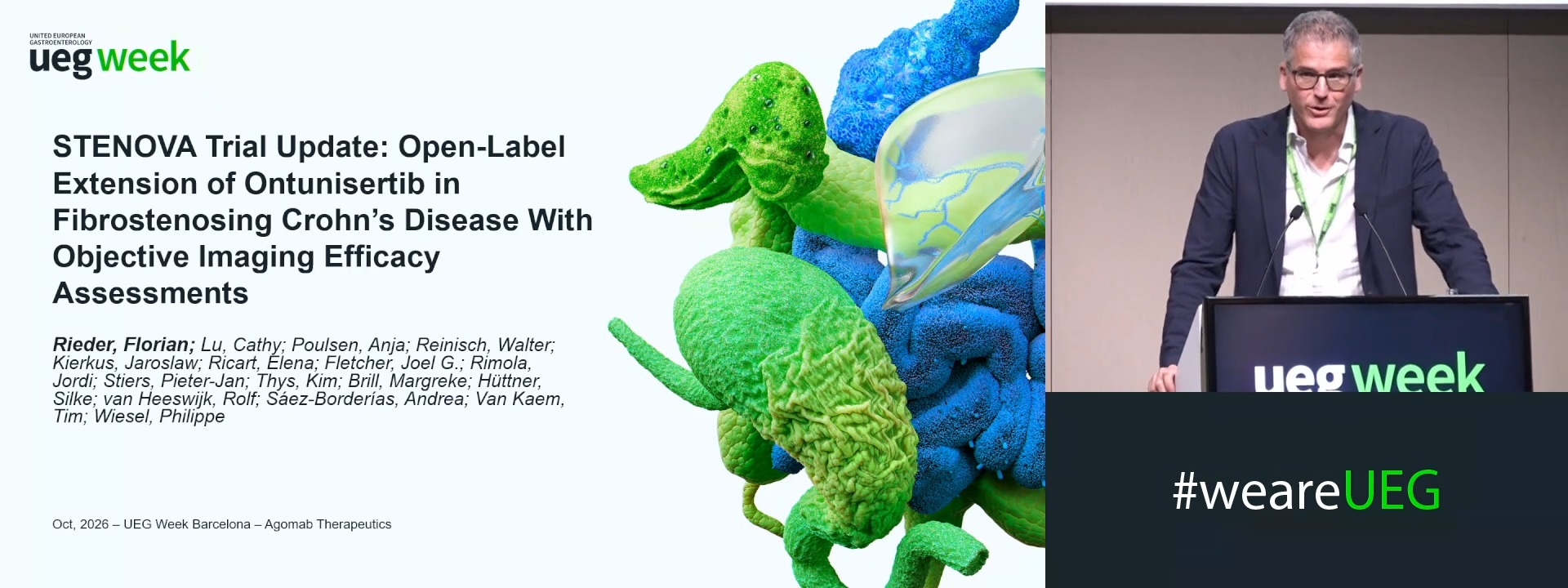
STENOVA TRIAL UPDATE: OPEN-LABEL EXTENSION OF ONTUNISERTIB IN FIBROSTENOSING CROHN’S DISEASE WITH OBJECTIVE IMAGING EFFICACY ASSESSMENTS
Florian Rieder 1, Cathy Lu 2, Anja Poulsen 3, Walter Reinisch 4, Jaroslaw Kierkus 5, Elena Ricart 6, Joel Flechter 7, Jordi Rimola 8, Pieter-Jan Stiers 9, Kim Thys 9, Margreke Brill 9, Silke Hüttner 9, Rolf Van Heeswijk 9, Andrea Saez 10, Tim Van Kaem 9, Philippe Wiesel 11
Affiliations
1 Cleveland Clinic Foundation, Cleveland Heights, United States
2 University Of Calgary, Calgary, Canada
3 Rigshospitalet, Copenhagen Ø, Denmark
4 Medical University of Vienna, Wien, Austria
5 Children’s Memorial Health Institute, Warsaw, Poland
6 Hospital Clinic, Barcelona, Spain
7 Mayo Clinic, Rochester, United States
8 Hospital Clínic Barcelona, Barcelona, Spain
9 Agomab Therapeutics NV, Berchem, Belgium
10 Agomab Spain S.L.U., A Coruña, Spain
11 Agomab US, Cambridge, United States
Log in to continue.
This content is part of Gutflix. Log in with your myUEG account, or create one free, to watch it.
Not sure what you can access? Learn more about account types.
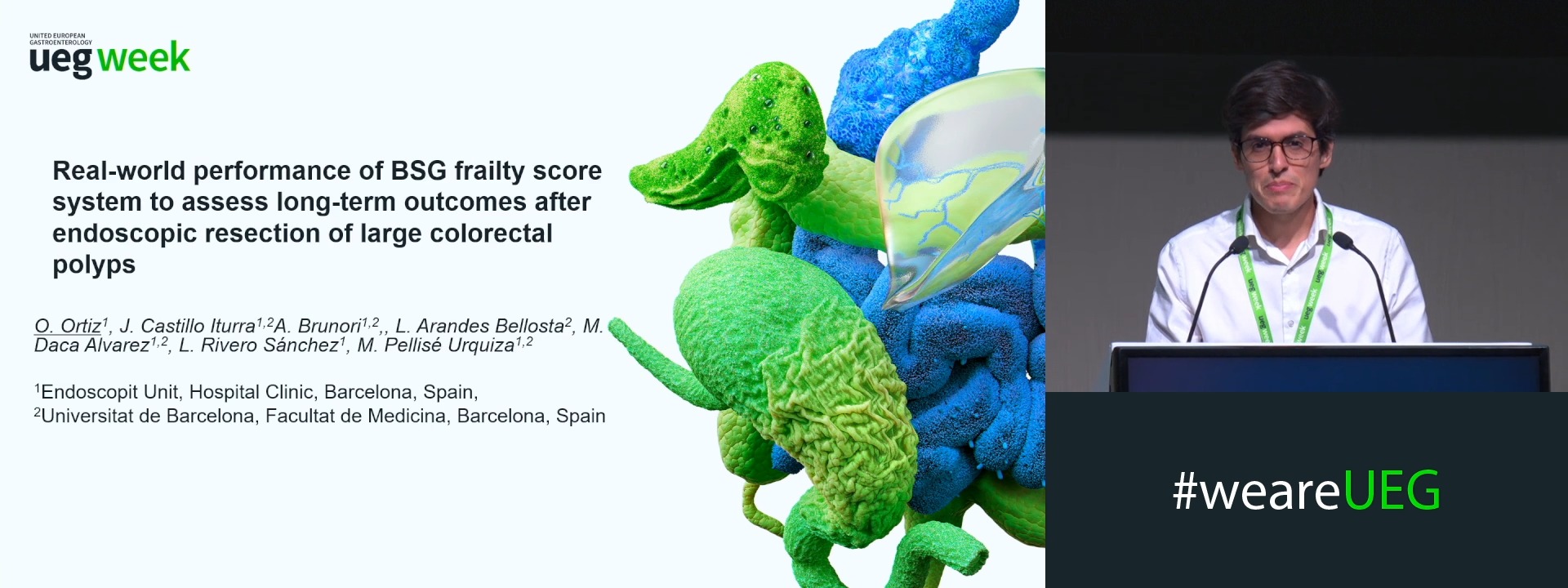
REAL-WORLD PERFORMANCE OF BSG FRAILTY SCORE SYSTEM TO ASSESS LONG-TERM OUTCOMES AFTER ENDOSCOPIC RESECTION OF LARGE COLORECTAL POLYPS
Oswaldo Ortiz 1, Angelo Brunori 1,2, Joaquín Castillo Iturra 1,2, Laura Arandes Bellosta 2, Maria Daca Alvarez 1,2, Liseth Rivero Sánchez 1, Maria Pellisé Urquiza 1,2
Affiliations
1 Hospital Clínic de Barcelona, Barcelona, Spain
2 Universitat de Barcelona, Barcelona, Spain