UEG's educational platform for gastroenterology education bringing recordings, courses, guidelines, and more together in one place.
Most popular content
Rate for better recommendations!
Your feedback helps us show you more of what you like and less of what you dislike!
Log in to access this content.
Free for all myUEG account holders. Your access level is set automatically based on your occupation. Medical professionals get full access to all content. If you are a non-medical user, you can only access UEG Week content from congresses you attended.
Not sure what you can access? Learn more about account types.
The Evolving Landscape of Scientific Publishing: Navigating Trends, Challenges, and Opportunities
1 Bradford Teaching Hospitals NHS trust, Leeds, United Kingdom
2 Amsterdam UMC, Netherlands
Topics
Published
Log in to access this content.
Free for all myUEG account holders. Your access level is set automatically based on your occupation. Medical professionals get full access to all content. If you are a non-medical user, you can only access UEG Week content from congresses you attended.
Not sure what you can access? Learn more about account types.
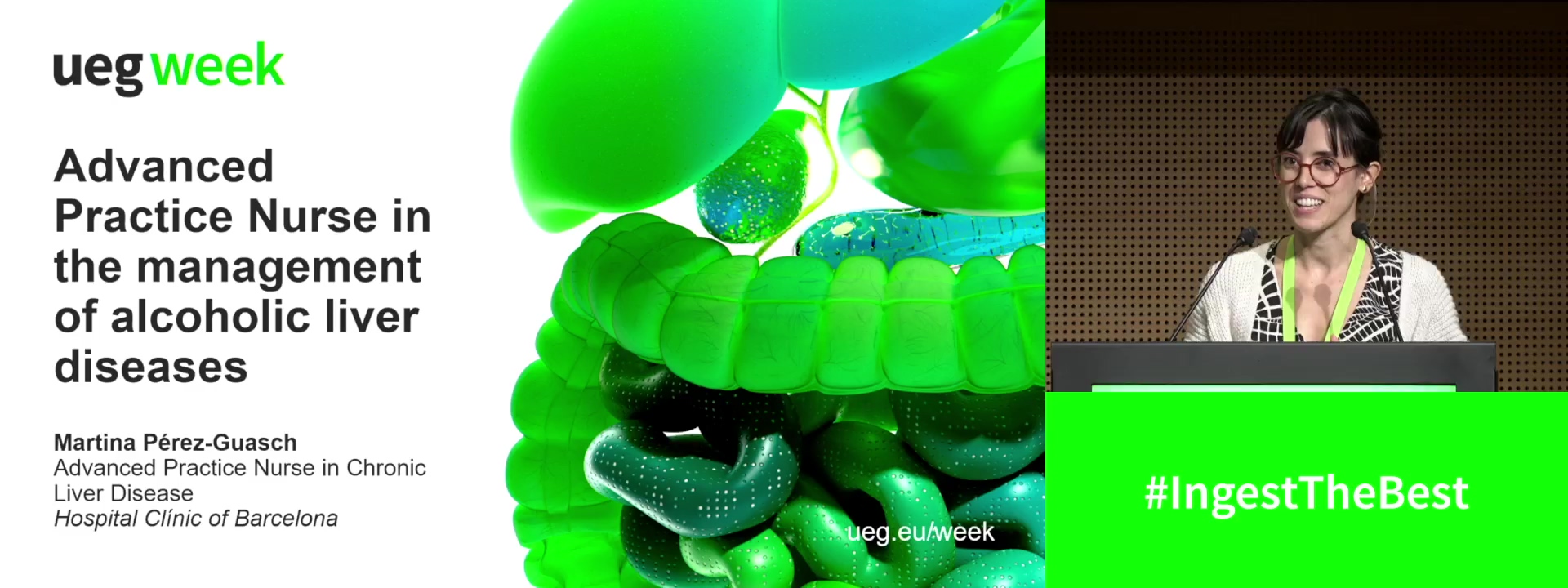
Advanced practice nurses in the management of alcoholic liver disease
1 Hospital Clínic de Barcelona, Barcelona, Spain
Event
Topics
Citation
Published
Log in to access this content.
Free for all myUEG account holders. Your access level is set automatically based on your occupation. Medical professionals get full access to all content. If you are a non-medical user, you can only access UEG Week content from congresses you attended.
Not sure what you can access? Learn more about account types.
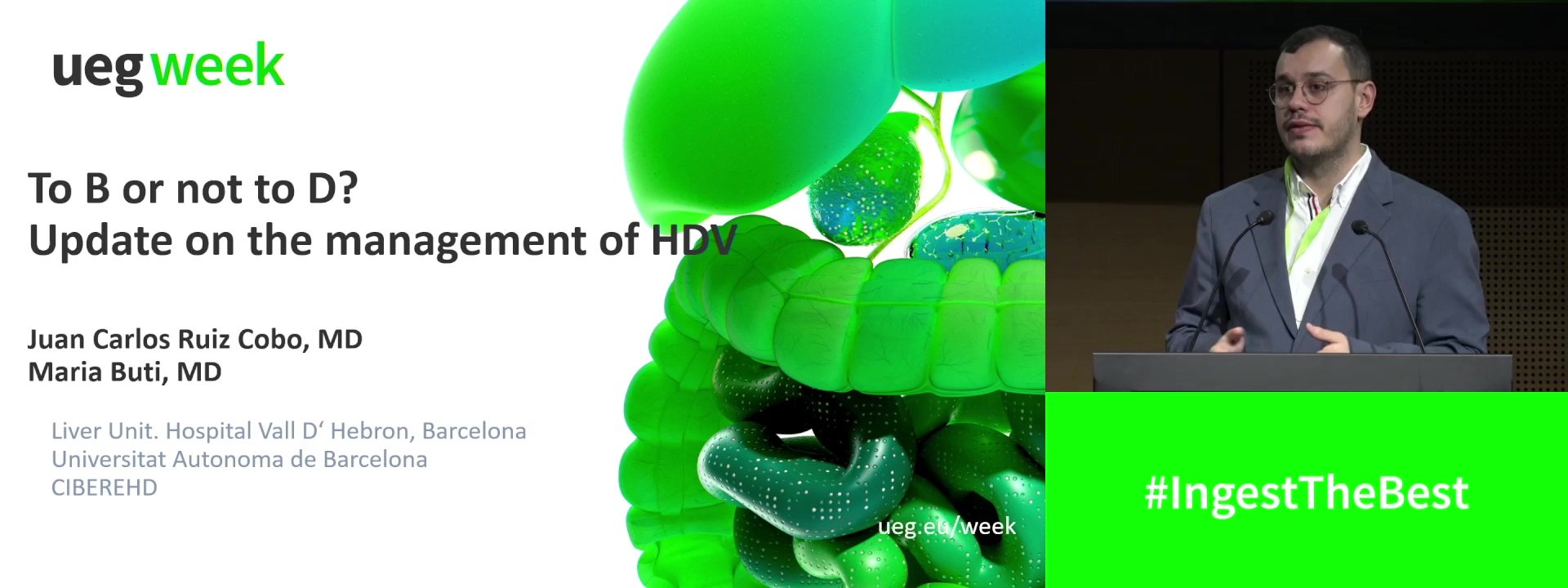
To B or not to D? Update on the management of HDV
1 Hospital General Universitari Vall d'Hebron, Barcelona, Spain
2 Vall d'Hebron Barcelona Hospital, Barcelona, Spain
Event
Citation
Published
Log in to access this content.
Free for all myUEG account holders. Your access level is set automatically based on your occupation. Medical professionals get full access to all content. If you are a non-medical user, you can only access UEG Week content from congresses you attended.
Not sure what you can access? Learn more about account types.
Summary: Diagnosis and treatment of malnutrition
1 North Estonia Medical Centre Foundation, Tallinn, Estonia
Event
Citation
Published
Log in to access this content.
Free for all myUEG account holders. Your access level is set automatically based on your occupation. Medical professionals get full access to all content. If you are a non-medical user, you can only access UEG Week content from congresses you attended.
Not sure what you can access? Learn more about account types.

COMPARATIVE EFFECTS OF METABOLIC DYSFUNCTION-ASSOCIATED STEATOTIC LIVER DISEASE AND METABOLIC AND ALCOHOL-ASSOCIATED STEATOTIC LIVER DISEASE (METALD) ON RISK OF HEPATIC AND EXTRA-HEPATIC OUTCOMES: A META-ANALYSIS
Ciro Celsa 1, Grazia Pennisi 2, Adele Tulone 1, Giacinta Ciancimino 1, Marco Vaccaro 1, Fabiana Pecorella 1, Gabriele Di Maria 1, Marco Enea 1, Calogero Camma 1, Salvatore Petta 1
1 University of Palermo, Palermo, Italy
2 Policlinico Paolo Giaccone, Palermo, Italy
Conference
Topics
Submission format
Citation
Published
Log in to access this content.
Free for all myUEG account holders. Your access level is set automatically based on your occupation. Medical professionals get full access to all content. If you are a non-medical user, you can only access UEG Week content from congresses you attended.
Not sure what you can access? Learn more about account types.
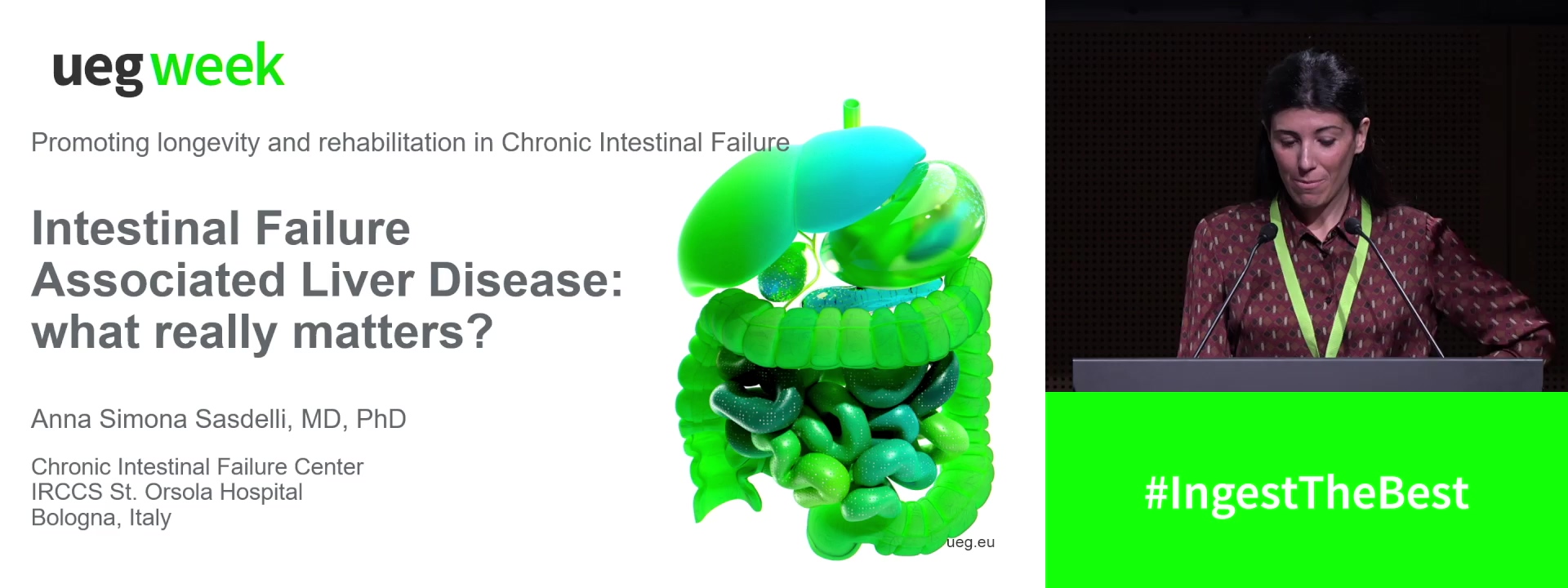
Intestinal-failure-associated liver disease: What really matters?
1 University of Bologna S. Orsola-Malpighi Hospital, Bologna, Italy
Event
Citation
Published
Log in to access this content.
Free for all myUEG account holders. Your access level is set automatically based on your occupation. Medical professionals get full access to all content. If you are a non-medical user, you can only access UEG Week content from congresses you attended.
Not sure what you can access? Learn more about account types.
MANAGEMENT OF COMPLICATIONS IN PATIENTS WITH AN ILEOSTOMY: AN UMBRELLA REVIEW OF SYSTEMATIC REVIEWS FOR THE ENDOTRIAL CONSORTIUM
VIRGINIA SOLITANO 1, Sudheer K. Vuyyuru 2, Yuhong Yuan 3, Siddarth Singh 4, Neeraj Narula 5, Christopher Ma 6, Megan Hutton 7, Julie Ann Van Koughnett 8, Florian Rieder 9, Vipul Jairath 10
1 Universita Vita-Salute San Raffaele, Milan, Italy|||Western University, London, Ontario, Canada
2 Alimentiv Inc., London, Canada
3 Lawson Health Research Institute,, London, Canada
4 5Division of Gastroenterology, Department of Medicine, University of California, San Diego, La Jolla, United States
5 McMaster University, Hamilton, Canada
6 University of Caglary, Calgary, Canada
7 Nursing Practice Excellence and Innovation, London Health Sciences Centre, London, Canada
8 Division of General Surgery, Department of Surgery, University of Western Ontario, London, Canada
9 Cleveland Clinic Foundation, Cleveland Heights, United States
10 Division of Gastroenterology, Western University, London, Ontario, Canada, London, Canada
Conference
Topics
Submission format
Session