UEG's educational platform for gastroenterology education bringing recordings, courses, guidelines, and more together in one place.
Most popular content
Rate for better recommendations!
Your feedback helps us show you more of what you like and less of what you dislike!
Log in to access this content.
Free for all myUEG account holders. Your access level is set automatically based on your occupation. Medical professionals get full access to all content. If you are a non-medical user, you can only access UEG Week content from congresses you attended.
Not sure what you can access? Learn more about account types.
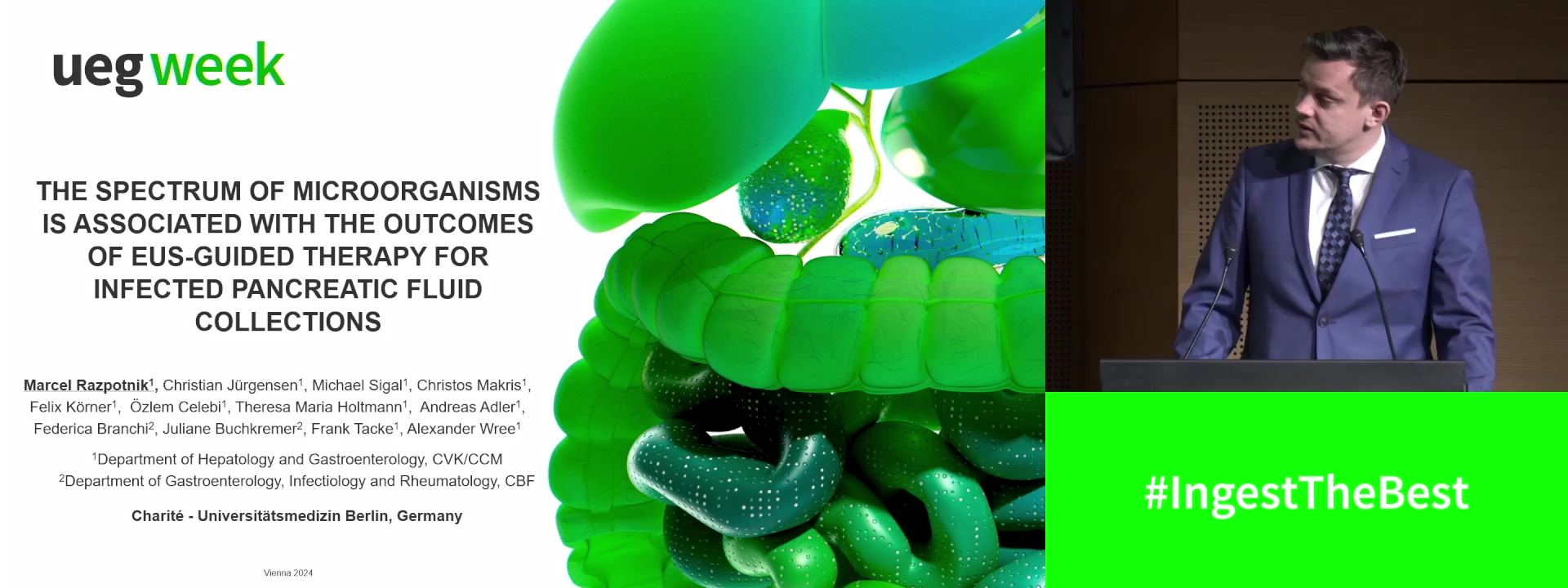
THE SPECTRUM OF MICROORGANISMS IS ASSOCIATED WITH THE OUTCOMES OF ENDOSONOGRAPHY-GUIDED THERAPY FOR INFECTED PANCREATIC FLUID COLLECTIONS
Marcel Razpotnik 1, Christian Jürgensen 1, Michael Sigal 1, Christos Makris 1, Felix Johannes Körner 1, Theresa Maria Holtmann 1, Özlem Celebi 1, Andreas Adler 1, Federica Branchi 1, Juliane Buchkremer 1, Frank Tacke 1, Alexander Wree 1
1 Charité - Universitätsmedizin Berlin, Berlin, Germany
Event
Topics
Submission format
Session
Citation
Published
Log in to access this content.
Free for all myUEG account holders. Your access level is set automatically based on your occupation. Medical professionals get full access to all content. If you are a non-medical user, you can only access UEG Week content from congresses you attended.
Not sure what you can access? Learn more about account types.
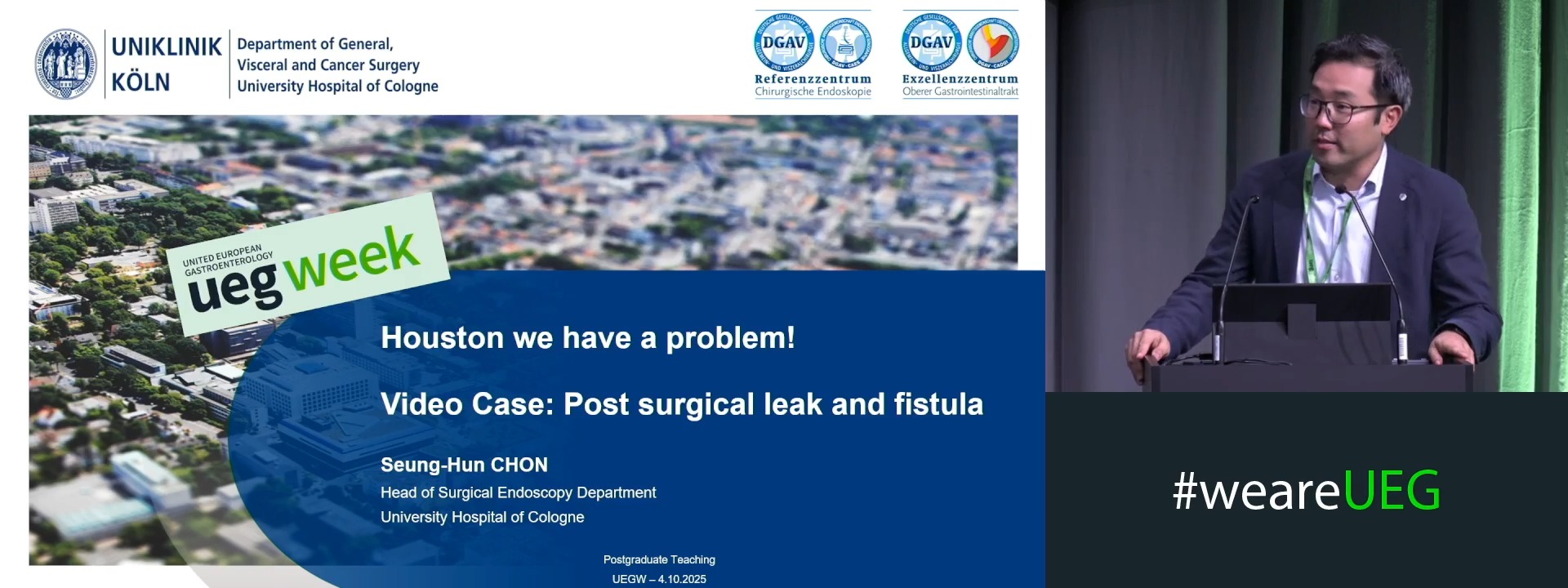
Video Case: Post surgical leak and fistula
1 University Hospital of Cologne, Cologne, Germany
Event
Citation
Published
Log in to access this content.
Free for all myUEG account holders. Your access level is set automatically based on your occupation. Medical professionals get full access to all content. If you are a non-medical user, you can only access UEG Week content from congresses you attended.
Not sure what you can access? Learn more about account types.

DEVELOPMENT AND VALIDATION OF A NOVEL PATIENT-REPORTED OUTCOME FOR MICROSCOPIC COLITIS – MICROSCOPIC COLITIS SCORE (MCS)
Katarina Pihl Lesnovska 1, Samuel Schäfer 2, Yamile Zabana 3, Ingrid Fajardo 3, Danila Guagnozzi 4, Emese Mihály 5, Stephan Miehlke 6, Ahmed Madisch 7, Beatrice Marioni 8, Giovanni Latella 9, Andreas Münch 10, Henrik Hjortswang 11
1 University Hospital of Linköping, Linköping, Sweden|||Linköping University, Linköping, Sweden
2 University Hospital Linköping, Linköping, Sweden|||Linköping University, Linköping, Sweden
3 Hospital Universitari Mútua Terrassa, Terrassa, Spain
4 University Hospital Vall de Hebron, Barcelona, Spain
5 SE II.sz. Int.Med. Clinic, Budapest, Hungary
6 Facharztzentrum Eppendorf, CED-Schwerpunkt, Magen-Darm-Zentrumpraxis,, Hamburg, Germany
7 CRH Clinic Hannover, Hannover, Germany
8 University of Milan, Milan, Italy
9 University of LAquila Gastroenterology Unit, Rome, Italy
10 University Hospital Linköping, Linköping, Sweden
11 Linköping university hospital, Linköping, Sweden
Conference
Topics
Submission format
Session
Citation
Published
Log in to access this content.
Free for all myUEG account holders. Your access level is set automatically based on your occupation. Medical professionals get full access to all content. If you are a non-medical user, you can only access UEG Week content from congresses you attended.
Not sure what you can access? Learn more about account types.
MICROSCOPIC COLITIS: A COMPARATIVE STUDY OF CLINICAL SYMPTOMS AND HISTOPATHOLOGICAL FEATURES
Chaimae Haddad Hachimi 1, Mariam Konso 2, Chaimae Hiji 1, Hayat Ennoufous Krami 3, Mouna Tamzaourte 1
1 Mohamed V Military Training Hospital, Rabat, Morocco
2 Faculty of Medicine and Pharmacy of Rabat, Rabat, Morocco
3 Private Practice, Rabat, Morocco
Conference
Topics
Submission format
Session
Citation
Published
Log in to access this content.
Free for all myUEG account holders. Your access level is set automatically based on your occupation. Medical professionals get full access to all content. If you are a non-medical user, you can only access UEG Week content from congresses you attended.
Not sure what you can access? Learn more about account types.
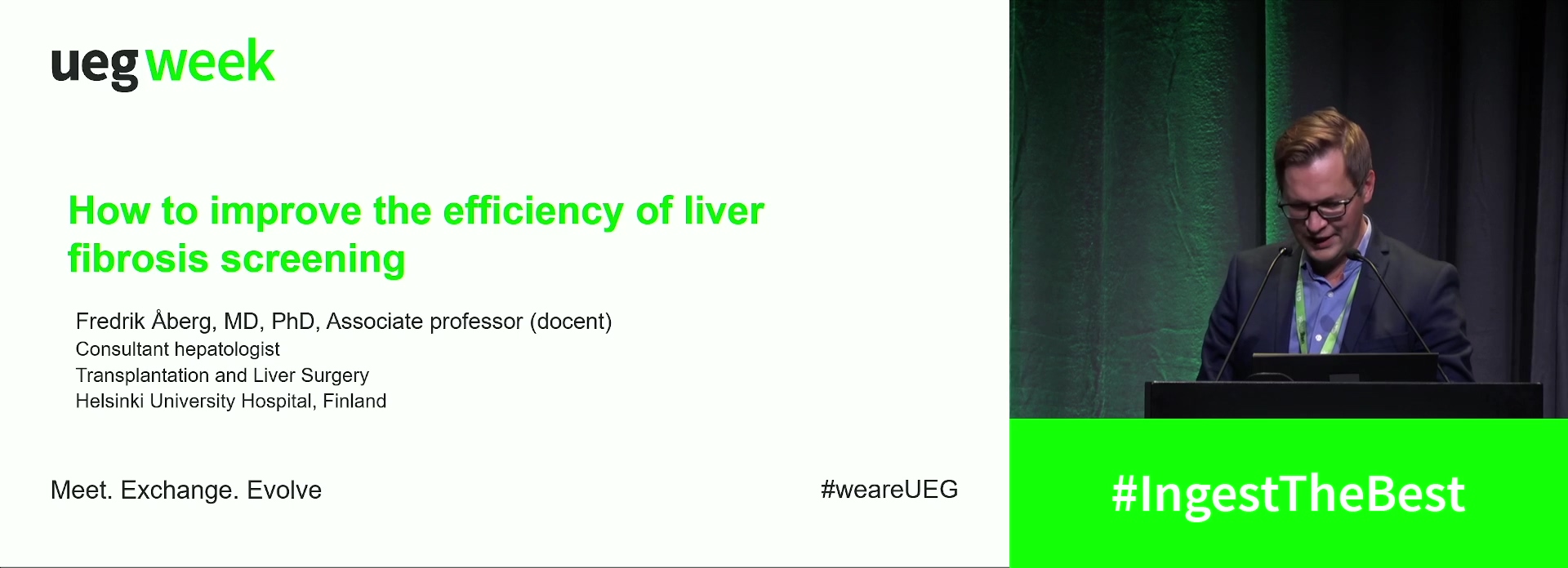
How to improve the efficiency of liver fibrosis screening
1 Helsinki University Hospital, Helsinki, Finland
Event
Topics
Published
Log in to access this content.
Free for all myUEG account holders. Your access level is set automatically based on your occupation. Medical professionals get full access to all content. If you are a non-medical user, you can only access UEG Week content from congresses you attended.
Not sure what you can access? Learn more about account types.
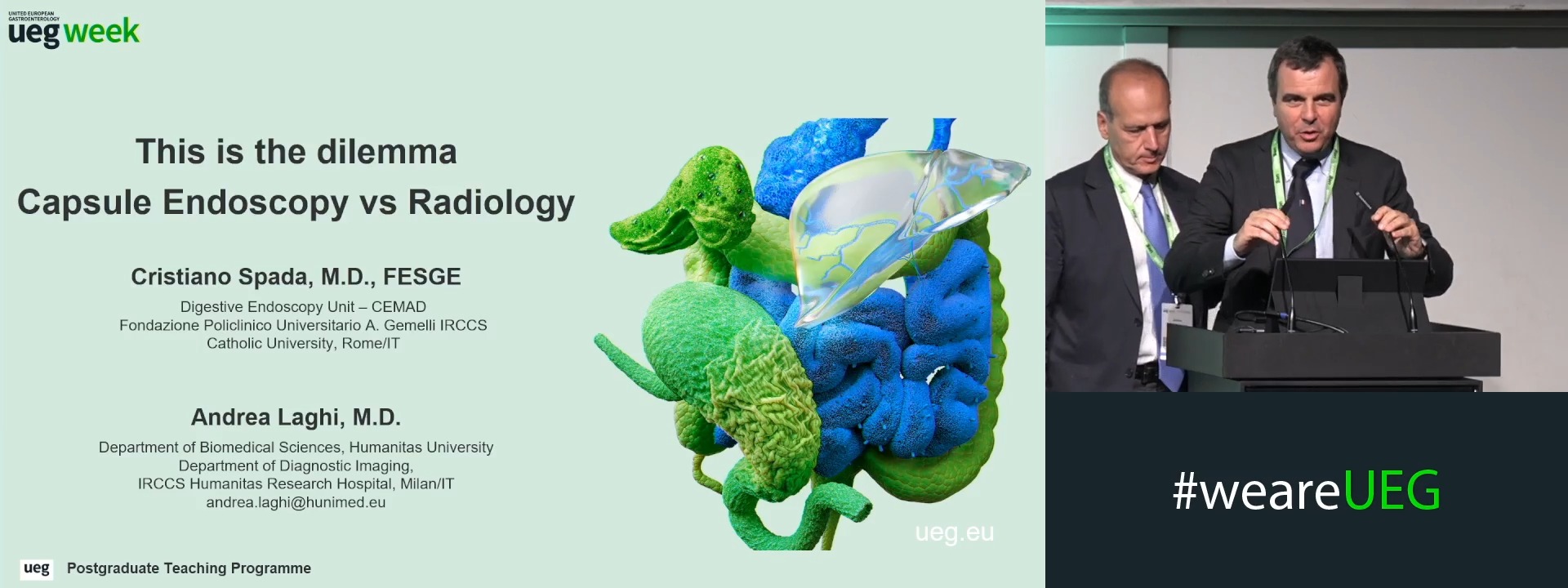
This is the dilemma: Capsule endoscopy and radiology
1 Sapienza - University of Rome, Rome, Italy
2 Catholic University Rome - Digestive Endoscopy unit, Catholic University Rome; Rome/IT, Rome, Italy
Event
Citation
Published
Log in to access this content.
Free for all myUEG account holders. Your access level is set automatically based on your occupation. Medical professionals get full access to all content. If you are a non-medical user, you can only access UEG Week content from congresses you attended.
Not sure what you can access? Learn more about account types.
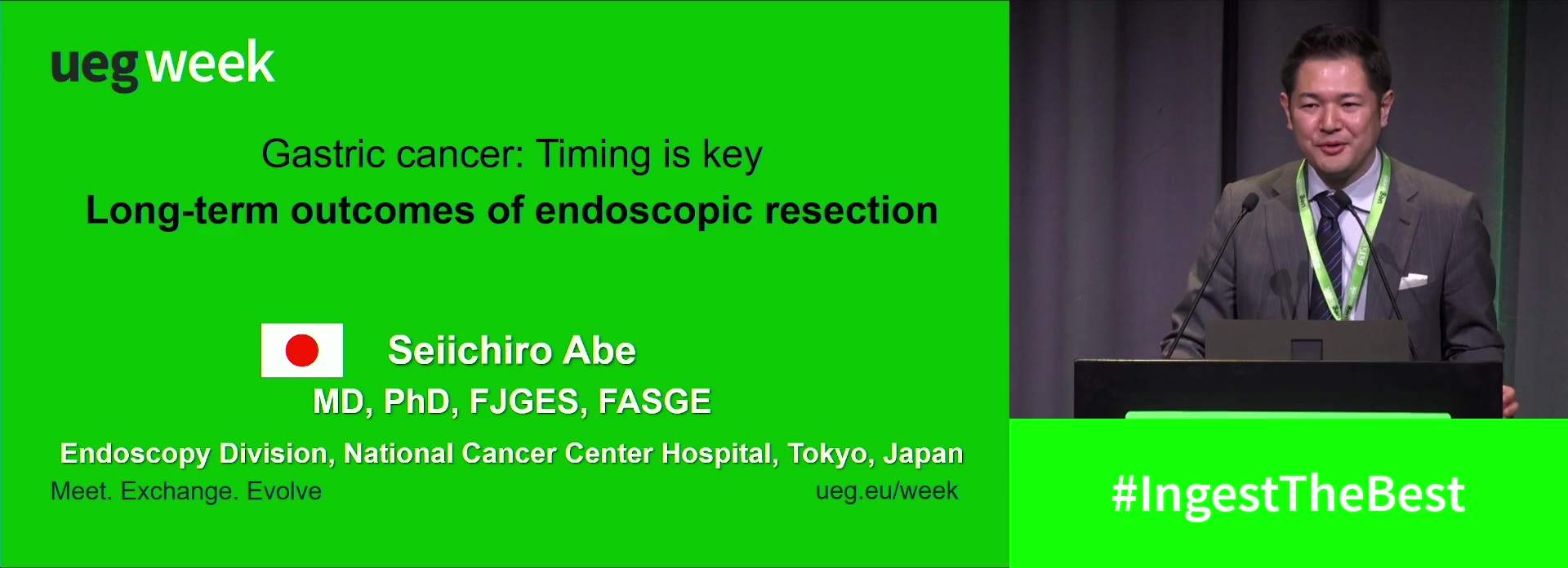
Long-term outcomes of endoscopic resection
1 National Cancer Center Hospital, Tokyo, Japan
Event
Session