UEG's educational platform for gastroenterology education bringing recordings, courses, guidelines, and more together in one place.
Most popular content
Rate for better recommendations!
Your feedback helps us show you more of what you like and less of what you dislike!
Log in to access this content.
Free for all myUEG account holders. Your access level is set automatically based on your occupation. Medical professionals get full access to all content. If you are a non-medical user, you can only access UEG Week content from congresses you attended.
Not sure what you can access? Learn more about account types.
What can we learn from monogenic IBD
1 SickKids Research Institute, Toronto, Canada
Event
Citation
Published
Log in to access this content.
Free for all myUEG account holders. Your access level is set automatically based on your occupation. Medical professionals get full access to all content. If you are a non-medical user, you can only access UEG Week content from congresses you attended.
Not sure what you can access? Learn more about account types.
AYA: Adolescents and young adults
1 Erasmus Medical Center, Rotterdam, Netherlands
Event
Topics
Session
Citation
Published
Log in to access this content.
Free for all myUEG account holders. Your access level is set automatically based on your occupation. Medical professionals get full access to all content. If you are a non-medical user, you can only access UEG Week content from congresses you attended.
Not sure what you can access? Learn more about account types.
... for medical therapy in colorectal cancer
1 University Medical Center Mainz, Mainz, Germany
Event
Topics
Session
Citation
Published
Log in to access this content.
Free for all myUEG account holders. Your access level is set automatically based on your occupation. Medical professionals get full access to all content. If you are a non-medical user, you can only access UEG Week content from congresses you attended.
Not sure what you can access? Learn more about account types.
IL-23
1 Inserm NGERE and University of Lorraine, Vandœuvre-lès-Nancy, France
Event
Citation
Published
Log in to access this content.
Free for all myUEG account holders. Your access level is set automatically based on your occupation. Medical professionals get full access to all content. If you are a non-medical user, you can only access UEG Week content from congresses you attended.
Not sure what you can access? Learn more about account types.
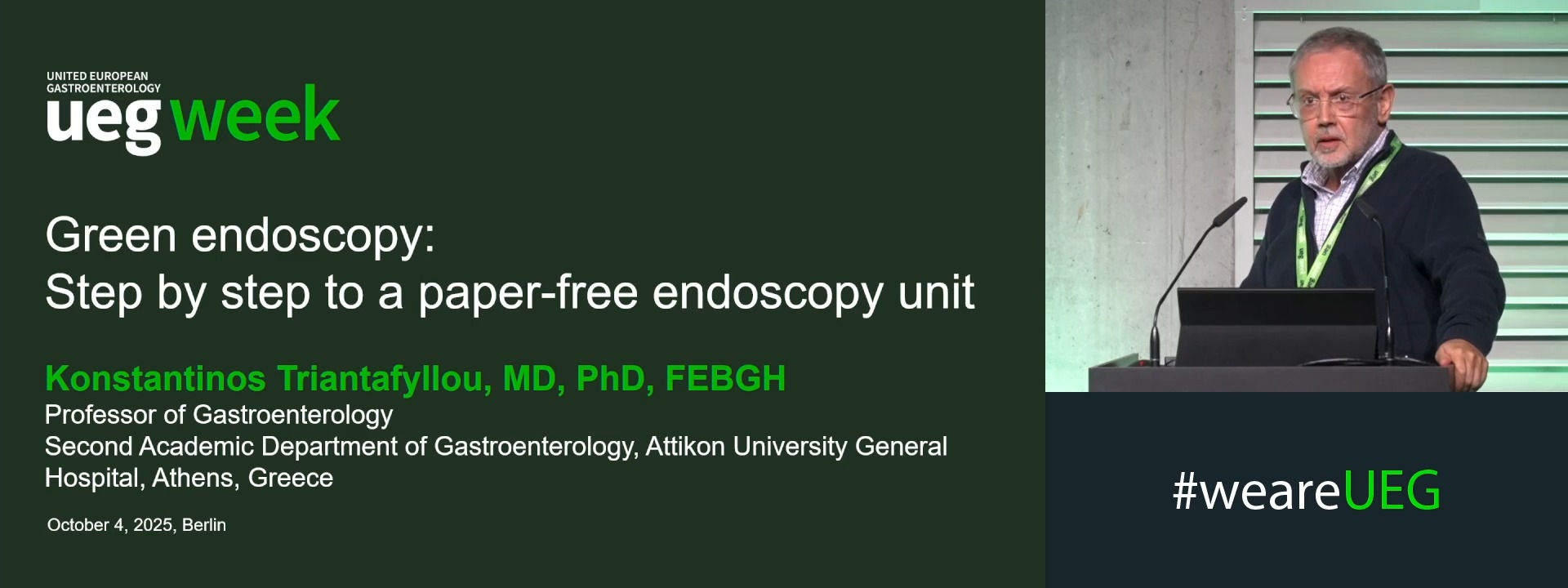
Green endoscopy: Step by step to a paper free endoscopy unit
1 Attikon University General Hospital, Athens, Greece
Event
Topics
Citation
Published
Log in to access this content.
Free for all myUEG account holders. Your access level is set automatically based on your occupation. Medical professionals get full access to all content. If you are a non-medical user, you can only access UEG Week content from congresses you attended.
Not sure what you can access? Learn more about account types.
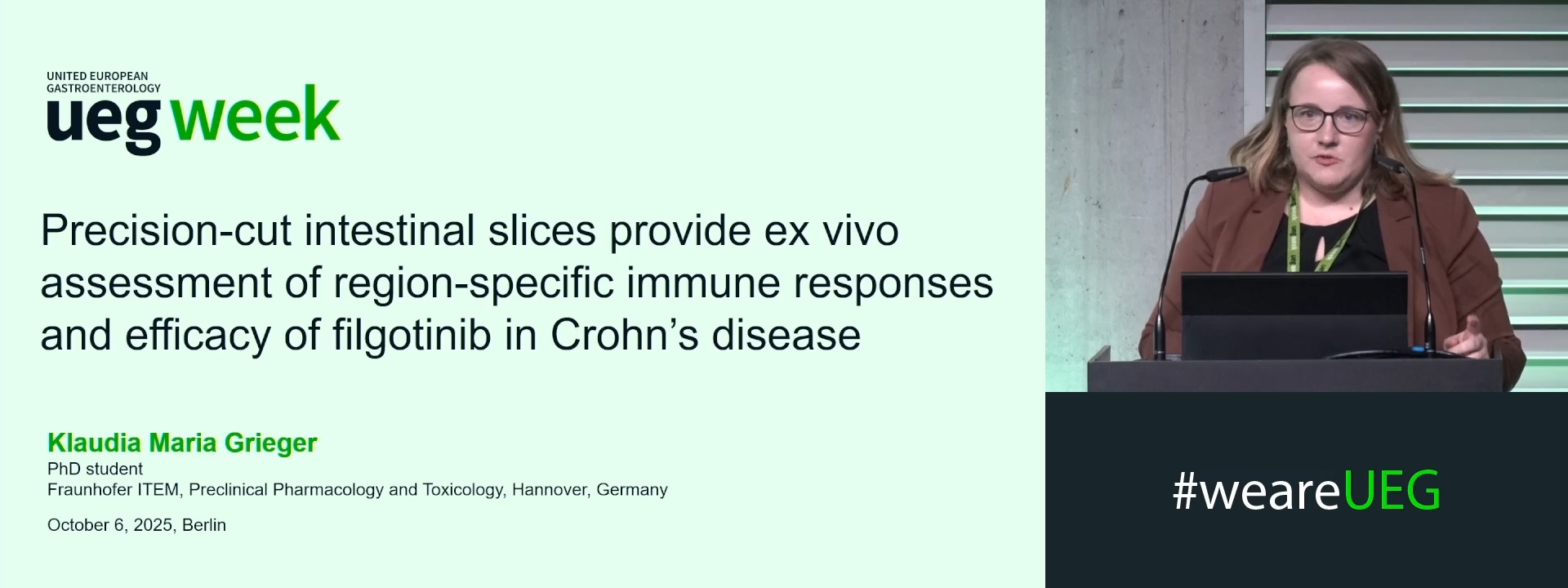
PRECISION-CUT INTESTINAL SLICES PROVIDE EX VIVO ASSESSMENT OF REGION-SPECIFIC IMMUNE RESPONSES AND EFFICACY OF FILGOTINIB IN CROHN'S DISEASE
Klaudia Maria Grieger 1, Valerie Beneke 1, Vanessa Neuhaus 1, Ulf Kulik 2, Heiko Aselmann 3, Benjamin Gundert 3, Armin Braun 1, Christina Hesse 1, Susann Dehmel 1, Katherina Sewald 1
1 Fraunhofer Institute for Toxicology and Experimental Medicine, Hannover, Germany
2 Hannover Medical school (MHH), Hannover, Germany
3 KRH Klinikum Region Hannover, Hannover, Germany
Event
Submission format
Citation
Published
Log in to access this content.
Free for all myUEG account holders. Your access level is set automatically based on your occupation. Medical professionals get full access to all content. If you are a non-medical user, you can only access UEG Week content from congresses you attended.
Not sure what you can access? Learn more about account types.
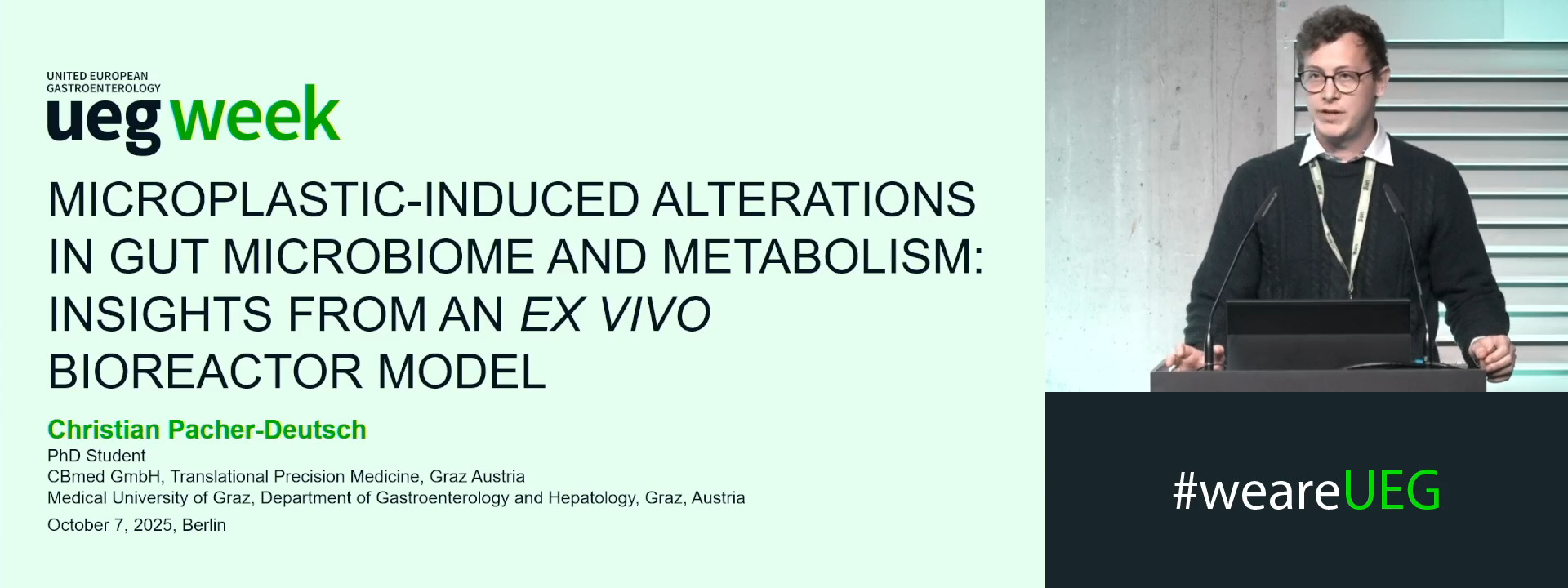
MICROPLASTIC-INDUCED ALTERATIONS IN GUT MICROBIOME AND METABOLISM: INSIGHTS FROM AN EX VIVO BIOREACTOR MODEL
Christian Pacher-Deutsch 1, Kristina Žukauskaitė 1, Cigdem Akar 2, Maximilian Nepel 2, Lukas Kogler 3, Hansjörg Habisch 2, Serena Ducoli 4, Stefania Federici 4, Tobias Madl 5, Verena Pichler 6, Angela Horvath 1, Vanessa Stadlbauer 7
1 Center for Biomarker Research in Medicine (CBmed), Graz, Austria|||Medical University of Graz, Graz, Austria
2 Medical University of Graz, Graz, Austria
3 Center for Biomarker Research in Medicine (CBmed), Graz, Austria|||University of Vienna, Vienna, Austria|||Medical University of Vienna, Vienna, Austria
4 University of Brescia, Brescia, Italy
5 Medical University of Graz, Graz, Austria|||BioTechMed-Graz, Graz, Austria
6 Center for Biomarker Research in Medicine (CBmed), Graz, Austria|||University of Vienna, Vienna, Austria
7 Center for Biomarker Research in Medicine (CBmed), Graz, Austria|||Medical University of Graz, Graz, Austria|||BioTechMed-Graz, Graz, Austria
Event
Topics