UEG's educational platform for gastroenterology education bringing recordings, courses, guidelines, and more together in one place.
Most popular content
Rate for better recommendations!
Your feedback helps us show you more of what you like and less of what you dislike!
Log in to access this content.
Free for all myUEG account holders. Your access level is set automatically based on your occupation. Medical professionals get full access to all content. If you are a non-medical user, you can only access UEG Week content from congresses you attended.
Not sure what you can access? Learn more about account types.
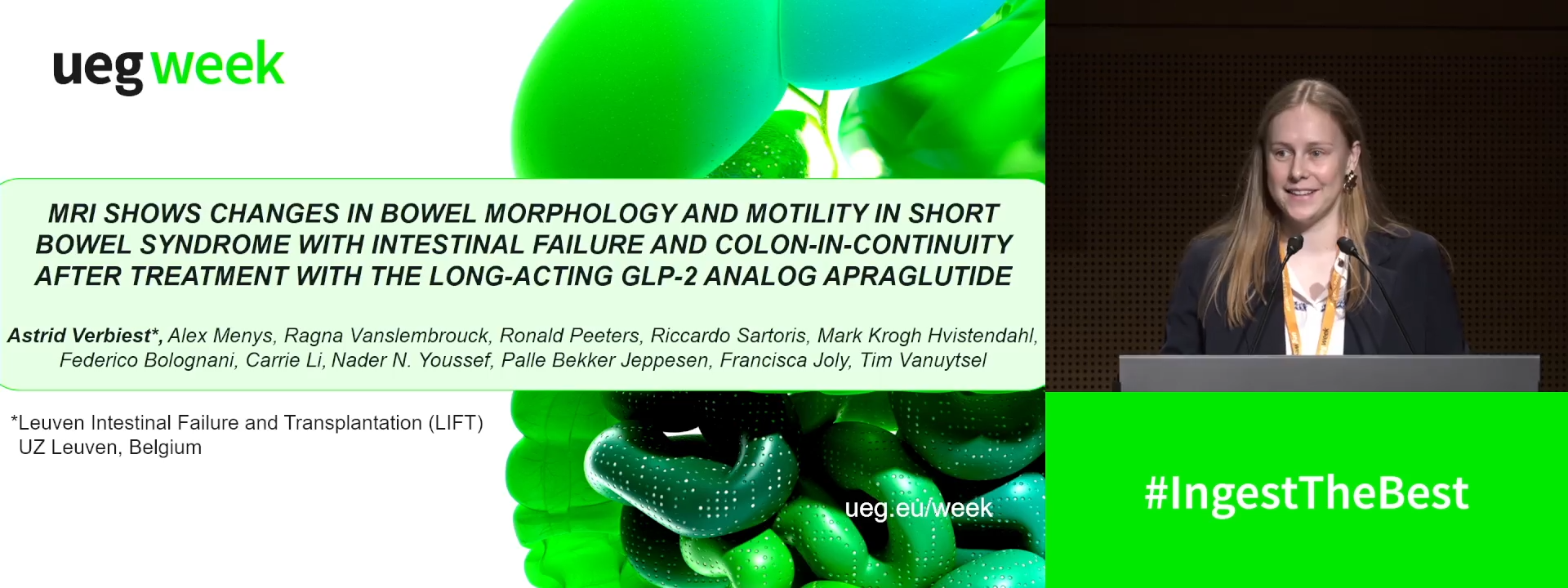
MAGNETIC RESONANCE IMAGING (MRI) SHOWS CHANGES IN BOWEL MORPHOLOGY AND MOTILITY IN SHORT BOWEL SYNDROME WITH INTESTINAL FAILURE (SBS-IF) AND COLON-IN-CONTINUITY (CIC) AFTER TREATMENT WITH THE LONG-ACTING GLUCAGON-LIKE PEPTIDE-2 (GLP-2) ANALOG APRAGLUTIDE
Astrid Verbiest 1, Alex Menys 2, Ragna Vanslembrouck 3, Ronald Peeters 3, Riccardo Sartoris 4, Mark Krogh Hvistendahl 5, Federico Bolognani 6, Carrie Li 6, Nader N. Youssef 6, Palle Bekker Jeppesen 5, Francisca Joly 4, Tim Vanuytsel 1
1 University of Leuven, Leuven, Belgium|||University Hospitals Leuven, Leuven, Belgium
2 Motilent, London, United Kingdom
3 University Hospitals Leuven, Leuven, Belgium
4 Hôpital Beaujon, Clichy, France
5 Rigshospitalet, Copenhagen University Hospital, Copenhagen, Denmark
6 VectivBio/Ironwood, Basel, Switzerland
Event
Topics
Submission format
Session
Citation
Published
Log in to access this content.
Free for all myUEG account holders. Your access level is set automatically based on your occupation. Medical professionals get full access to all content. If you are a non-medical user, you can only access UEG Week content from congresses you attended.
Not sure what you can access? Learn more about account types.
Best of UEG Week - Endoscopy with Manmeet Matharoo
Topics
Published
Log in to access this content.
Free for all myUEG account holders. Your access level is set automatically based on your occupation. Medical professionals get full access to all content. If you are a non-medical user, you can only access UEG Week content from congresses you attended.
Not sure what you can access? Learn more about account types.
Panel discussion: Liver and pregnancy - Beware of dangerous liaisons
Event
Topics
Citation
Published
Log in to access this content.
Free for all myUEG account holders. Your access level is set automatically based on your occupation. Medical professionals get full access to all content. If you are a non-medical user, you can only access UEG Week content from congresses you attended.
Not sure what you can access? Learn more about account types.

Self-expandable metal stents for obstructing colonic and extracolonic cancer: European Society of Gastrointestinal Endoscopy (ESGE) Guideline – Update 2020
Publisher
Guideline
Topics
Citation
Published
Log in to access this content.
Free for all myUEG account holders. Your access level is set automatically based on your occupation. Medical professionals get full access to all content. If you are a non-medical user, you can only access UEG Week content from congresses you attended.
Not sure what you can access? Learn more about account types.

COMPARATIVE EFFECTS OF METABOLIC DYSFUNCTION-ASSOCIATED STEATOTIC LIVER DISEASE AND METABOLIC AND ALCOHOL-ASSOCIATED STEATOTIC LIVER DISEASE (METALD) ON RISK OF HEPATIC AND EXTRA-HEPATIC OUTCOMES: A META-ANALYSIS
Ciro Celsa 1, Grazia Pennisi 2, Adele Tulone 1, Giacinta Ciancimino 1, Marco Vaccaro 1, Fabiana Pecorella 1, Gabriele Di Maria 1, Marco Enea 1, Calogero Camma 1, Salvatore Petta 1
1 University of Palermo, Palermo, Italy
2 Policlinico Paolo Giaccone, Palermo, Italy
Conference
Topics
Submission format
Citation
Published
Log in to access this content.
Free for all myUEG account holders. Your access level is set automatically based on your occupation. Medical professionals get full access to all content. If you are a non-medical user, you can only access UEG Week content from congresses you attended.
Not sure what you can access? Learn more about account types.
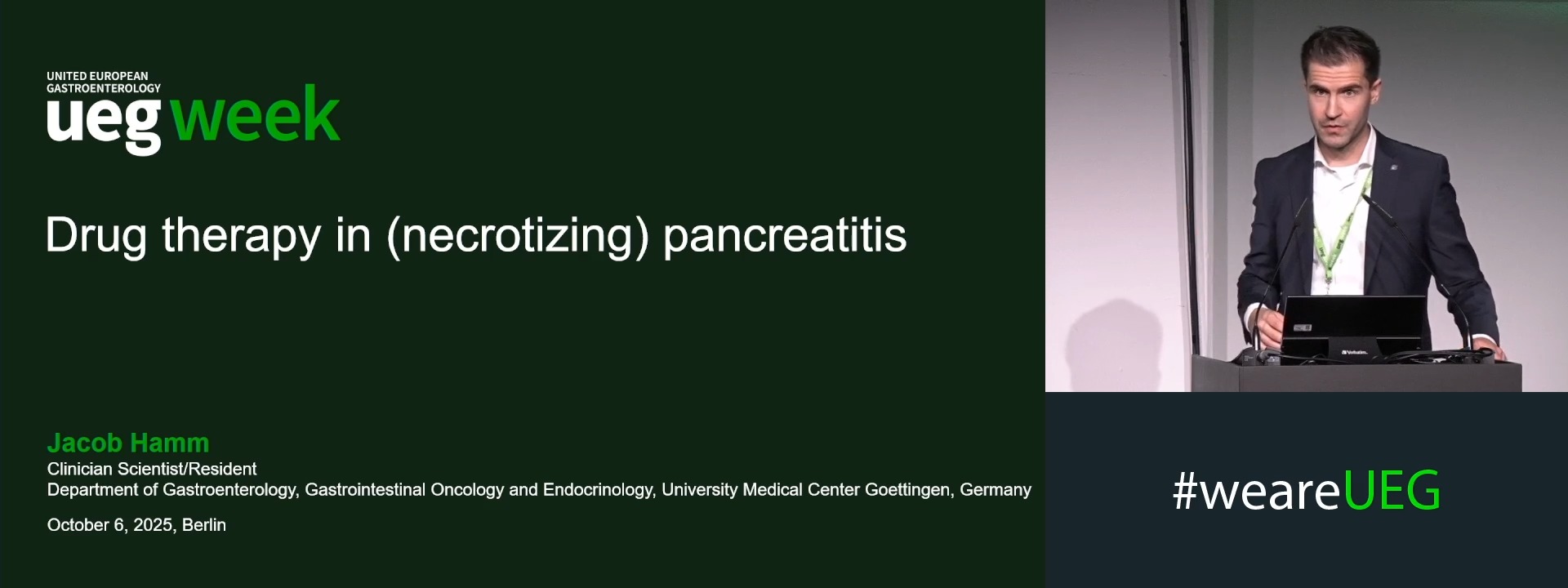
Drug management in necrotising pancreatitis
1 University Medical Center Goettingen, Goettingen, Germany
Event
Citation
Published
Log in to access this content.
Free for all myUEG account holders. Your access level is set automatically based on your occupation. Medical professionals get full access to all content. If you are a non-medical user, you can only access UEG Week content from congresses you attended.
Not sure what you can access? Learn more about account types.
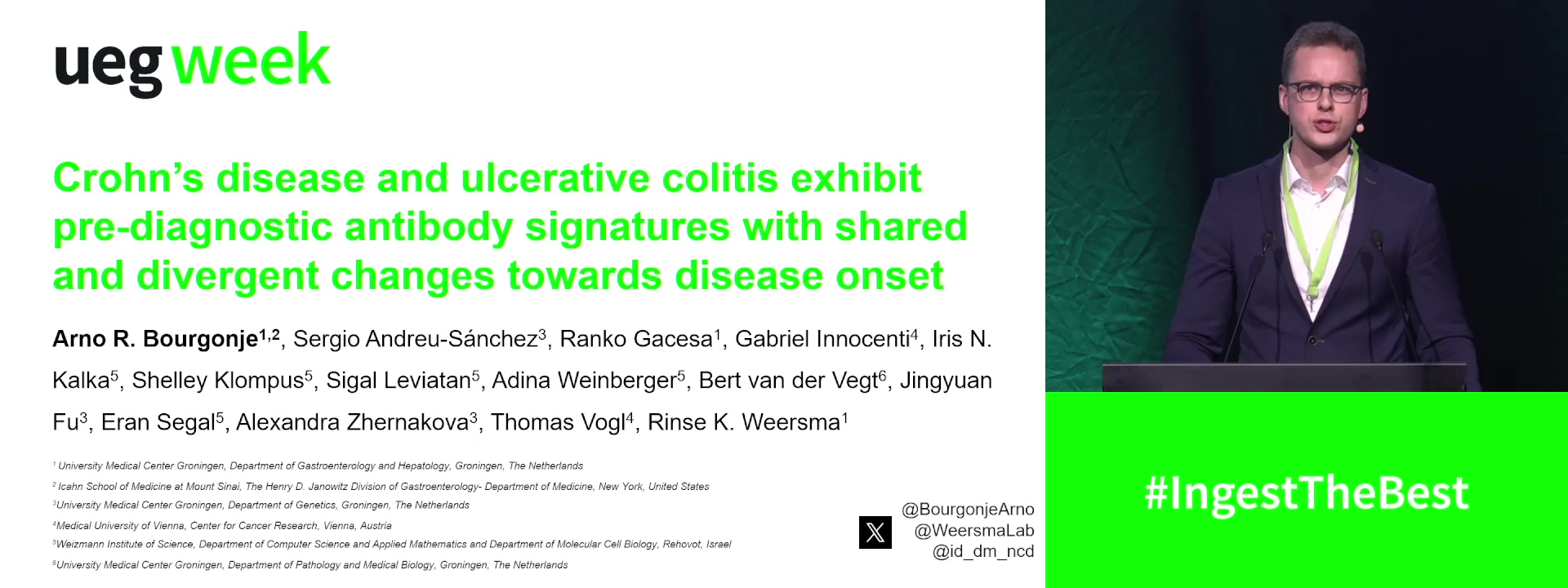
CROHN'S DISEASE AND ULCERATIVE COLITIS EXHIBIT PRE-DIAGNOSTIC ANTIBODY SIGNATURES WITH SHARED AND DIVERGENT CHANGES TOWARDS DISEASE ONSET
Arno R. Bourgonje 1, Sergio Andreu-Sánchez 2, Ranko Gacesa 2, Gabriel Innocenti 3, Iris N. Kalka 4, Shelley Klompus 4, Sigal Leviatan 4, Adina Weinberger 4, Bert van der Vegt 2, Jingyuan Fu 2, Eran Segal 4, Alexandra Petrovna Zhernakova 2, Thomas Vogl 3, Rinse K. Weersma 2
1 University Medical Center Groningen, Groningen, Netherlands|||Icahn School of Medicine at Mount Sinai, New York, United States
2 University Medical Center Groningen, Groningen, Netherlands
3 Medical University of Vienna, Vienna, Austria
4 Weizmann Institute of Science, Rehovot, Israel
Event
Topics
Submission format
Session