UEG's educational platform for gastroenterology education bringing recordings, courses, guidelines, and more together in one place.
Most popular content
Rate for better recommendations!
Your feedback helps us show you more of what you like and less of what you dislike!
Log in to access this content.
Free for all myUEG account holders. Your access level is set automatically based on your occupation. Medical professionals get full access to all content. If you are a non-medical user, you can only access UEG Week content from congresses you attended.
Not sure what you can access? Learn more about account types.

CLINICOPATHOLOGICAL CHARACTERISTICS OF OTHER NEW NEOPLASTIC LESIONS MISSED BY IMAGE ENHANCED ENDOSCOPY AT SURVEILLANCE FOR PATIENTS WITH ESOPHAGEAL SQUAMOUS CELL CARCINOMA
Haruki Yamamoto 1, Tomohiro Kadota 1, Hiroki Yamashita 1, Atsushi Inaba 1, Hironori Sunakawa 1, Keiichiro Nakajo 1, Kensuke Shinmura 1, Tomonori Yano 1
1 National Cancer Center Hospital East, Kashiwa, Japan
Conference
Topics
Submission format
Citation
Published
Log in to access this content.
Free for all myUEG account holders. Your access level is set automatically based on your occupation. Medical professionals get full access to all content. If you are a non-medical user, you can only access UEG Week content from congresses you attended.
Not sure what you can access? Learn more about account types.
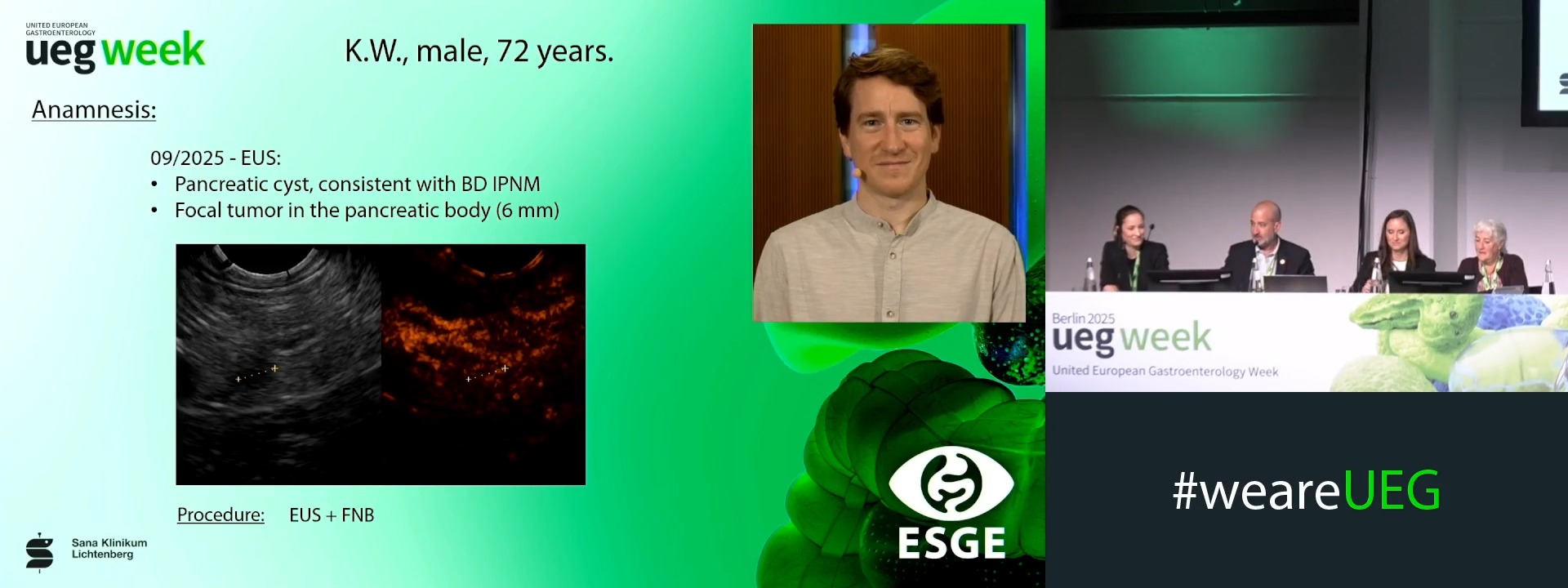
ESGE Live Endoscopy II (Complete Session)
Event
Session
Citation
Published
Log in to access this content.
Free for all myUEG account holders. Your access level is set automatically based on your occupation. Medical professionals get full access to all content. If you are a non-medical user, you can only access UEG Week content from congresses you attended.
Not sure what you can access? Learn more about account types.
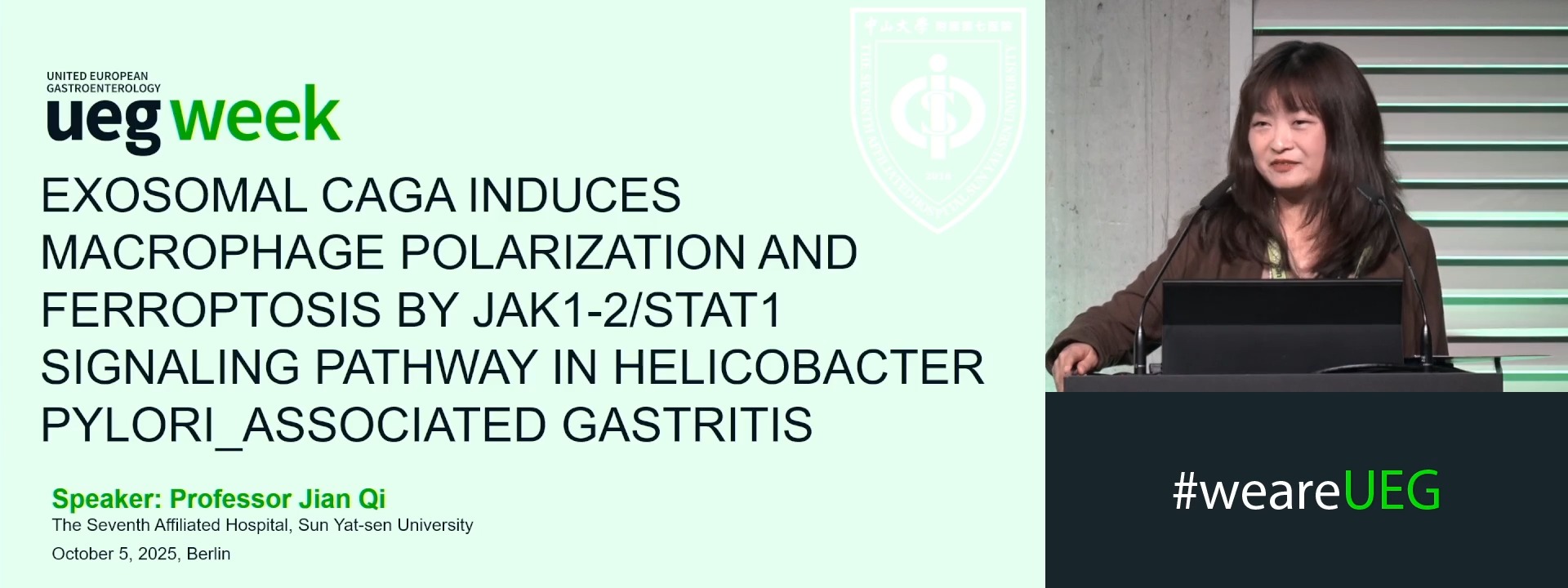
EXOSOMAL CAGA INDUCES MACROPHAGE POLARIZATION AND FERROPTOSIS BY JAK1-2/STAT1 SIGNALING PATHWAY IN HELICOBACTER PYLORI-ASSOCIATED GASTRITIS
1 The Seventh Affiliated Hospital, Sun Yat-Sen University, Shenzhen, China
Event
Submission format
Citation
Published
Log in to access this content.
Free for all myUEG account holders. Your access level is set automatically based on your occupation. Medical professionals get full access to all content. If you are a non-medical user, you can only access UEG Week content from congresses you attended.
Not sure what you can access? Learn more about account types.
CORRELATION BETWEEN KUDO’S PIT PATTERN AND FINAL HISTOLOGY IN CASE OF SCREEN-DETECTED COLORECTAL POLYPS – RESULTS FROM A NATIONWIDE COHORT STUDY
Anna Fabian 1, Dániel Magyar 1, Renáta Bor 1, Zsofia Bosze 1, Flora Szanto 1, Béla Vasas 1, Anita Balint 1, Péter Bacsur 1, Bernadett Farkas 1, Klaudia Farkas 1, Emese Ivány 1, Mariann Rutka 1, Tamás Molnár 1, Zoltán Szepes 1
1 University of Szeged, Szeged, Hungary
Conference
Topics
Submission format
Session
Citation
Published
Log in to access this content.
Free for all myUEG account holders. Your access level is set automatically based on your occupation. Medical professionals get full access to all content. If you are a non-medical user, you can only access UEG Week content from congresses you attended.
Not sure what you can access? Learn more about account types.
EFFICACY AND SAFETY OF ETRASIMOD IN PATIENTS WITH ULCERATIVE COLITIS ACCORDING TO SEX IN THE ELEVATE UC CLINICAL PROGRAMME
Joana Torres 1, Robert Battat 2, Andres Yarur 3, Martina Goestch 4, Eugenia Kunina 4, Linxi Han 5, Alexis B. Dalam 6, Karolina Wosik 7, Irina Blumenstein 8
1 Division of Gastroenterology, Hospital Beatriz Ângelo, Loures, Portugal|||Division of Gastroenterology, Hospital da Luz, Lisbon, Portugal
2 Division of Gastroenterology, Centre Hospitalier de l'Université de Montreal, Montreal, QC, Canada
3 Inflammatory Bowel Disease Center and Division of Gastroenterology and Hepatology, Cedars-Sinai Medical Center, Los Angeles, CA, United States
4 Pfizer AG, Zürich, Switzerland
5 Pfizer R&D UK Ltd, Walton Oaks, United Kingdom
6 Pfizer Inc, Manilla, Philippines
7 Pfizer Canada, Kirkland, QC, Canada
8 Goethe University Frankfurt, Frankfurt University Hospital, Medical Clinic 1, Frankfurt am Main, Germany
Conference
Topics
Submission format
Session
Citation
Published
Log in to access this content.
Free for all myUEG account holders. Your access level is set automatically based on your occupation. Medical professionals get full access to all content. If you are a non-medical user, you can only access UEG Week content from congresses you attended.
Not sure what you can access? Learn more about account types.
UNDERSTANDING THE DRIVERS BEHIND WHAT MATTERS WHEN TREATING GASTRO-OESOPHAGEAL REFLUX DISEASE – AN INTERIM ANALYSIS OF A DISCRETE-CHOICE EXPERIMENT
1 Reckitt Benckiser Healthcare Ltd, Hull, United Kingdom
2 Reckitt Benckiser, Slough, United Kingdom
3 Visfo, Lindley, Huddersfield, United Kingdom
Conference
Topics
Submission format
Citation
Published
Log in to access this content.
Free for all myUEG account holders. Your access level is set automatically based on your occupation. Medical professionals get full access to all content. If you are a non-medical user, you can only access UEG Week content from congresses you attended.
Not sure what you can access? Learn more about account types.
Panel discussion: The ultimate guide to colorectal cancer staging surgery adjuvant treatment
Event
Topics