UEG's educational platform for gastroenterology education bringing recordings, courses, guidelines, and more together in one place.
Most popular content
Rate for better recommendations!
Your feedback helps us show you more of what you like and less of what you dislike!
Log in to access this content.
Free for all myUEG account holders. Your access level is set automatically based on your occupation. Medical professionals get full access to all content. If you are a non-medical user, you can only access UEG Week content from congresses you attended.
Not sure what you can access? Learn more about account types.
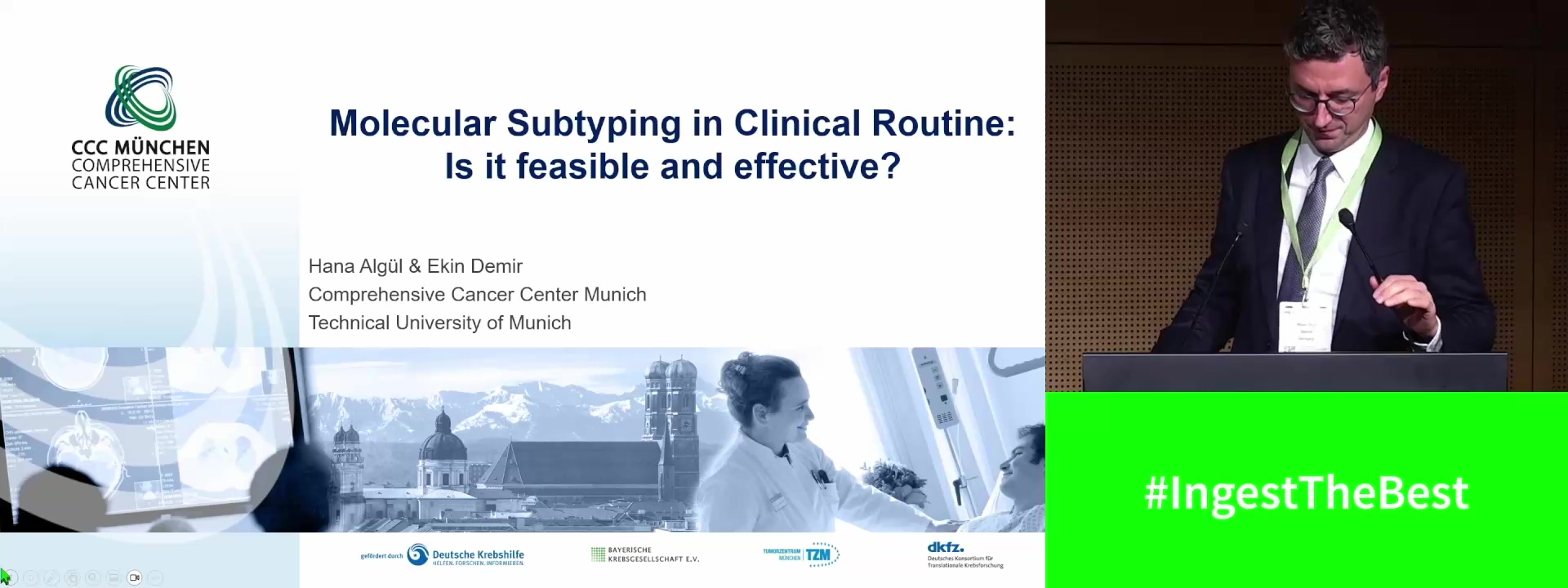
Molecular subgroups in pancreatic cancer for treatment selection
1 Klinikum Rechts Der Isar, Technical University of Munich, Muenchen, Germany
Event
Citation
Published
Log in to access this content.
Free for all myUEG account holders. Your access level is set automatically based on your occupation. Medical professionals get full access to all content. If you are a non-medical user, you can only access UEG Week content from congresses you attended.
Not sure what you can access? Learn more about account types.
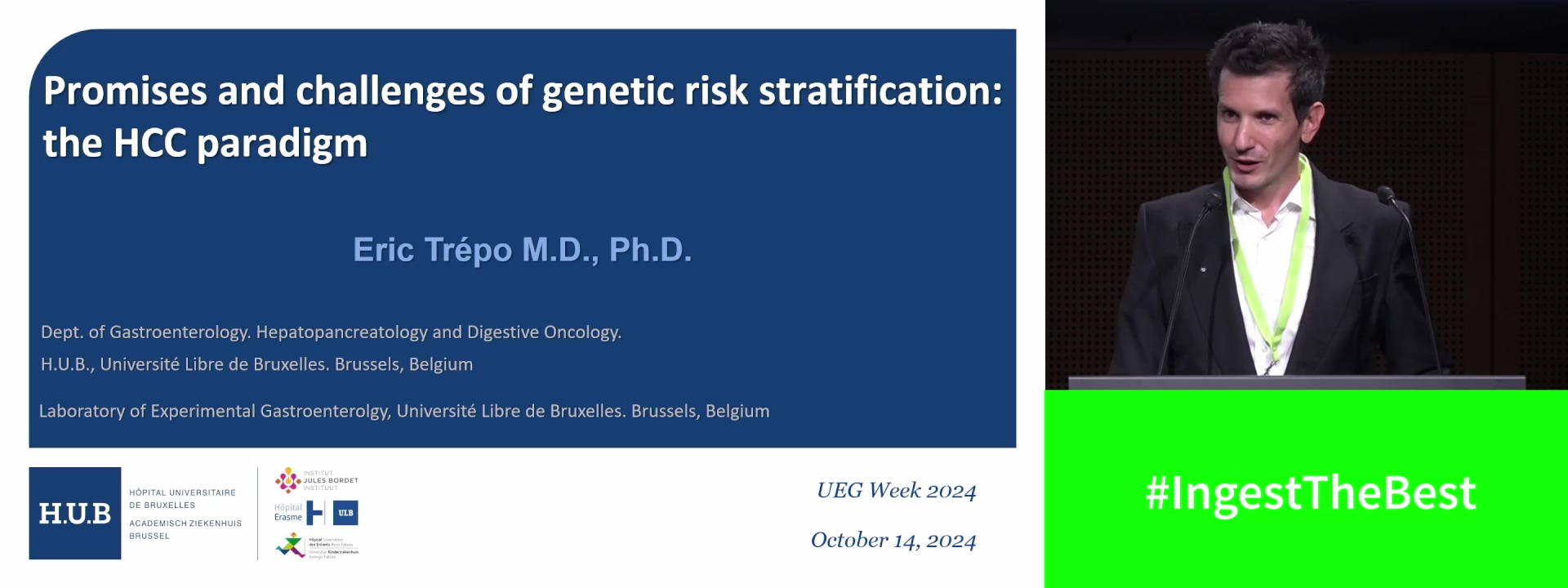
Promises and challenges of genetic risk stratification: The HCC paradigm
1 Hopital Universitaire de Bruxelles, Brussels, Belgium
Event
Citation
Published
Log in to access this content.
Free for all myUEG account holders. Your access level is set automatically based on your occupation. Medical professionals get full access to all content. If you are a non-medical user, you can only access UEG Week content from congresses you attended.
Not sure what you can access? Learn more about account types.

ENDOSCOPIC BAND LIGATION VERSUS CLIPPING FOR DIVERTICULAR BLEEDING: A SYSTEMATIC REVIEW WITH META-ANALYSIS
1 University of Bari, Bari, Italy
Conference
Topics
Submission format
Citation
Published
Log in to access this content.
Free for all myUEG account holders. Your access level is set automatically based on your occupation. Medical professionals get full access to all content. If you are a non-medical user, you can only access UEG Week content from congresses you attended.
Not sure what you can access? Learn more about account types.
EARLY SYMPTOMATIC IMPROVEMENT WITH GUSELKUMAB INDUCTION TREATMENT IN MODERATELY TO SEVERELY ACTIVE ULCERATIVE COLITIS: RESULTS FROM THE PHASE 3 QUASAR INDUCTION STUDY
Gary R. Lichtenstein 1, Axel Dignass 2, David T. Rubin 3, Shadi Yarandi 4, Gary KH Huang 4, Matthew Germinaro 4, Ye Miao 4, Hongyan Zhang 4, Jaroslaw Kierkus 5, Ursula Seidler 6, Atsuo Maemoto 7, Jessica Allegretti 8, Brian Bressler 9, Laurent Peyrin-Biroulet 10
1 University of Pennsylvania, Philadelphia, United States
2 Agaplesion Markus Hospital, Goethe University, Frankfurt, Germany
3 University of Chicago Medicine Inflammatory Bowel Disease Center, Chicago, United States
4 Janssen Research & Development, LLC, Spring House, United States
5 WIP Warsaw IBD Point, Warsaw, Poland
6 Medizinische Hochschule Klinik f. Gastroenterlogie, Hannover, Germany
7 Sapporo Higashi Tokushukai Hospital IBD Center, Sapporo, Japan
8 Brigham and Women´s Hospital, Boston, United States
9 University of British Columbia, Vancouver, Canada
10 Nancy University Hospital, Université de Lorraine, Nancy, France
Conference
Topics
Submission format
Citation
Published
Log in to access this content.
Free for all myUEG account holders. Your access level is set automatically based on your occupation. Medical professionals get full access to all content. If you are a non-medical user, you can only access UEG Week content from congresses you attended.
Not sure what you can access? Learn more about account types.
EFFECTIVENESS OF ERGONOMICS PROGRAM BASED ON MOVEMENT ANALYSIS FOR EXPERIENCED ENDOSCOPISTS: A PILOT STUDY
1 Yonsei Univ. Wonju College of Medicine, Wonju, Korea, Republic of
2 Yonsei University, Wonju, Korea, Republic of
Conference
Submission format
Citation
Published
Log in to access this content.
Free for all myUEG account holders. Your access level is set automatically based on your occupation. Medical professionals get full access to all content. If you are a non-medical user, you can only access UEG Week content from congresses you attended.
Not sure what you can access? Learn more about account types.
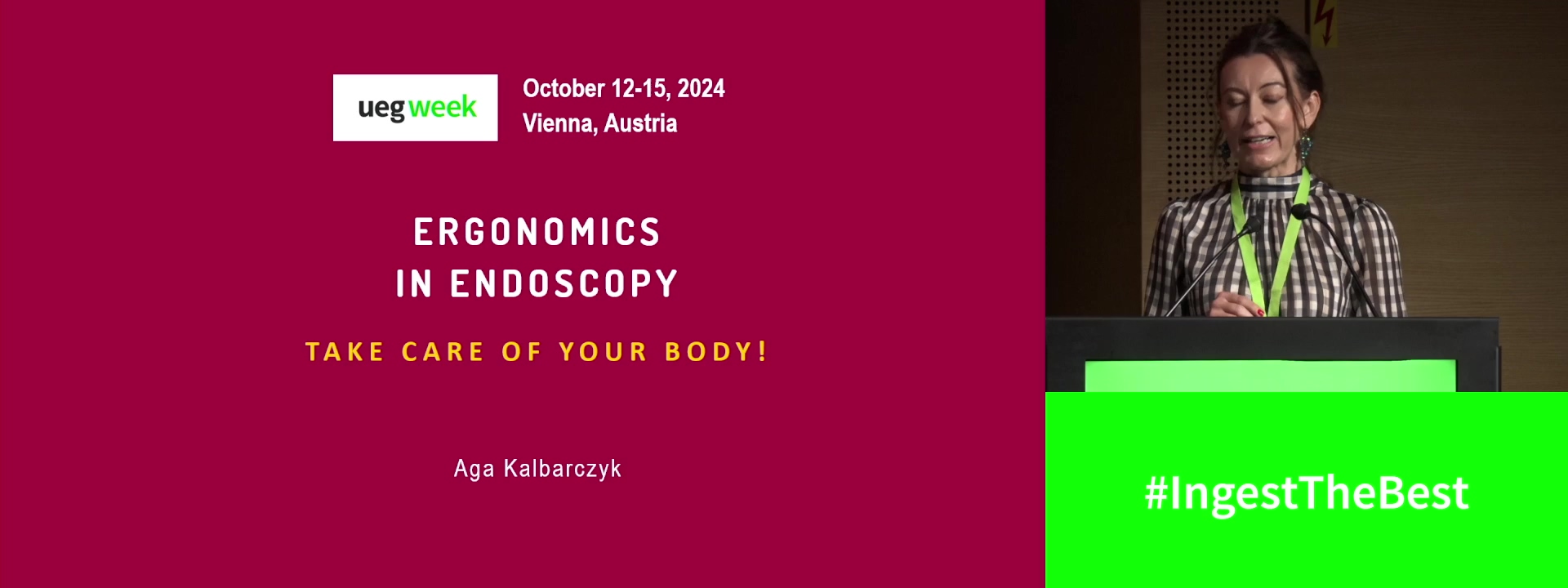
Ergonomics in endoscopy: Take care of your body
1 University Hospital, Medical University of Warsaw, Warsaw, Poland
Event
Topics
Citation
Published
Log in to access this content.
Free for all myUEG account holders. Your access level is set automatically based on your occupation. Medical professionals get full access to all content. If you are a non-medical user, you can only access UEG Week content from congresses you attended.
Not sure what you can access? Learn more about account types.
MIMICS OF INFLAMMATORY BOWEL DISEASE IN CLINICAL PRACTICE
Andreia Guimarães 1, Tania Carvalho 1, José Damasceno 1, Ana Rebelo 1, Ângela Rodrigues 1, Raquel Gonçalves 1
1 Hospital de Braga, Braga, Portugal
Conference
Topics
Submission format
Session