UEG Week Recordings UEG Week Posters Online courses Guidelines Mistakes in... Podcasts Webinars
new
Gut Guide online
Visit ueg.eu Create myUEG account Log In

Filters:

UEG Online Course
accredited
Share via Email Share on Facebook Share on X Share on LinkedIn Share on Bluesky

Log in to access this content.

Free for all myUEG account holders. Your access level is set automatically based on your occupation. Medical professionals get full access to all content. If you are a non-medical user, you can only access UEG Week content from congresses you attended.

Log In Create a free account

Not sure what you can access? Learn more about account types.

Intestinal failure is the rarest organ failure, but its prevalence across Europe is increasing. Patients have complex conditions and requirements, and optimal care involves multiple specialties and disciplines. Home parenteral nutrition — the first-line treatment for chronic intestinal failure — can significantly impact patients’ lives.

This online course provides in-depth coverage of all aspects of intestinal failure and parenteral nutrition. Authors Shameer Mehta and Sarah Williams discuss the aetiology and management of short bowel syndrome, followed by the causes, classification and management of intestinal failure.

Learning objectives

  • To understand how to reach a conclusive diagnosis of GORD
  • To know how to reach a conclusive diagnosis of no GORD
  • To understand how to deal with an inconclusive diagnosis

Target audience

This course is suitable for gastroenterologists in training, colorectal surgeons, nutrition nurses, dietitians, intensivists, and other healthcare professionals looking after patients receiving parenteral nutrition.

Intestinal failure and parenteral nutrition

Intestinal failure and parenteral nutrition

Shameer Mehta, Sarah Williams

Event

Intestinal failure and parenteral nutrition

Topics

Small Intestine & Nutrition

Accreditation status

accredited

Duration

1 hour

Published

2021
Login to access
UEG Online Course
accredited
Share via Email Share on Facebook Share on X Share on LinkedIn Share on Bluesky

Log in to access this content.

Free for all myUEG account holders. Your access level is set automatically based on your occupation. Medical professionals get full access to all content. If you are a non-medical user, you can only access UEG Week content from congresses you attended.

Log In Create a free account

Not sure what you can access? Learn more about account types.

About this online course

Stem cells are primitive and undifferentiated cells in human tissues (foetal and adult) with self-renewal, multipotency and longevity properties. They are responsible for cellular regeneration within the gastrointestinal tract but also play an essential role in different GI pathologies (e.g., Barrett’s oesophagus).

A gastroenterologist’s guide to stem cells, by Simon Leedham and Stuart McDonalds, covers the basic definitions of stem cells and their different locations in the gastrointestinal tract, homeostasis, the role of stem cells in intestinal regeneration, metaplasia, and tumour heterogeneity. The course includes comprehensive PPT slides, and bespoke video presentations filmed in London in December 2022. Figures, schemes, and further readings are included for consideration. The combined material has a total duration of approximately 60 minutes. The estimated time needed to complete the course, including the final assessment, is 60 minutes.

Target audience

This course is suitable for gastroenterologists in training, but is also appropriate for nurses, basic scientist in gastroenterology, medical students with interest in gastroenterology as well as other physicians (oncology, regenerative medicine, research).

Gastroenterologist's guide to stem cells

Gastroenterologist's guide to stem cells

Simon Leedham, Stuart McDonald

Event

Gastroenterologist's guide to stem cells

Accreditation status

accredited

Duration

1 hour

Published

2024
Login to access
UEG Online Course
not accredited
Share via Email Share on Facebook Share on X Share on LinkedIn Share on Bluesky

Log in to access this content.

Free for all myUEG account holders. Your access level is set automatically based on your occupation. Medical professionals get full access to all content. If you are a non-medical user, you can only access UEG Week content from congresses you attended.

Log In Create a free account

Not sure what you can access? Learn more about account types.

Nonalcoholic fatty liver disease (NAFLD) is a highly prevalent but largely asymptomatic disease that poses a major challenge to healthcare systems worldwide. Disease severity and outcome vary considerably and those at greatest risk of progression from steatosis and steatohepatitis to cirrhosis and hepatocellular carcinoma need to be identified.

This online course, from the multidisciplinary team of Quentin M. Anstee, Stuart McPherson, Kate Hallsworth and Laura Haigh, provides a comprehensive update on all aspects of NAFLD. After introducing the epidemiology and natural history of NAFLD, the course turns its attention to biomarkers, patient identification and care pathways, dietary and lifestyle interventions, and pharmacotherapy.

The course includes detailed PPT slides and bespoke video presentations, which were filmed in May 2022. The estimated time needed to complete the course, including the final assessment, is 120 minutes.

Target audience

This course is designed for gastroenterologists and/or hepatologists in training, liver pathologists, endocrinologists/diabetologists, primary care physicians, nurses, allied health professionals, basic scientists working in translational biomedicine, and medical students.
Metabolic Dysfunction-Associated Steatotic Liver Disease

Metabolic Dysfunction-Associated Steatotic Liver Disease

Quentin Anstee, Stuart McPherson, Kate Hallsworth, Laura Haigh

Event

Metabolic Dysfunction-Associated Steatotic Liver Disease

Topics

Hepatobiliary

Accreditation status

not accredited

Duration

2 hours

Published

2022
Login to access
UEG Online Course
accredited
Share via Email Share on Facebook Share on X Share on LinkedIn Share on Bluesky

Log in to access this content.

Free for all myUEG account holders. Your access level is set automatically based on your occupation. Medical professionals get full access to all content. If you are a non-medical user, you can only access UEG Week content from congresses you attended.

Log In Create a free account

Not sure what you can access? Learn more about account types.

Oesophageal adenocarcinoma is one of the most rapidly increasing cancers in the Western world and is associated with a high mortality rate. The most important risk factor for development of this type of cancer is presence of a Barrett oesophagus, of which the incidence is also increasing around the world. Patients known with Barrett oesophagus undergo regular endoscopic surveillance to detect cancer at an early and curable stage. The possibilities for endoscopic treatment of Barrett related neoplasia have enhanced significantly over the last years and this therapy has proven to be highly effective. Therefore, diagnosing and performing correct surveillance of Barrett oesophagus is becoming increasingly important.

This course includes recorded PowerPoint slides with real-time images and videos, and multiple self-assessments. The presentation is filmed  in June 2022. The course has a duration of approximately 60 minutes, including the assessments. The course was developed in collaboration with the UEG.

Target audience

The target audience for this course are gastroenterologists and fellows in training, who want to gain more knowledge on Barrett oesophagus to become more experienced with this condition. Also, this course could be beneficial for all those interested in achieving better understanding of the disease and the treatment possibilities for their patients.

Barrett Oesophagus - pathophysiology, diagnosis, surveillance and treatment

Barrett Oesophagus - pathophysiology, diagnosis, surveillance and treatment

Roos E. Pouw, Eva Verheij

Event

Barrett Oesophagus - pathophysiology, diagnosis, surveillance and treatment

Topics

Endoscopy Oesophagus

Accreditation status

accredited

Duration

50 minutes

Published

2022
Login to access
UEG Mistakes In Articles
Share via Email Share on Facebook Share on X Share on LinkedIn Share on Bluesky

Log in to access this content.

Free for all myUEG account holders. Your access level is set automatically based on your occupation. Medical professionals get full access to all content. If you are a non-medical user, you can only access UEG Week content from congresses you attended.

Log In Create a free account

Not sure what you can access? Learn more about account types.

Parenteral nutrition (PN) is the intravenous delivery of nutrients, commonly used to treat intestinal failure (IF). IF occurs when gut function is insufficient to absorb macronutrients, water, or electrolytes, requiring IV supplementation to maintain health. The European Society for Clinical Nutrition and Metabolism (ESPEN) classifies IF into acute (type 1) and chronic (types 2 and 3), with chronic cases often needing long-term home parenteral nutrition (HPN). Although IF is rare, its prevalence in Europe is rising. PN formulations are complex, requiring skilled management by a specialized multi-disciplinary team to avoid complications.

Mistakes in intestinal failure and parenteral nutrition

Mistakes in intestinal failure and parenteral nutrition

Samreen Malik, Sarah Williams, Shameer Mehta

Topics

Small Intestine & Nutrition

Citation

Williams S, Malik S and Mehta S. Mistakes in intestinal failure and parenteral nutrition and how to avoid them. UEG Education 2024; 24: 18-23.

Published

2024
UEG Presentation
Share via Email Share on Facebook Share on X Share on LinkedIn Share on Bluesky
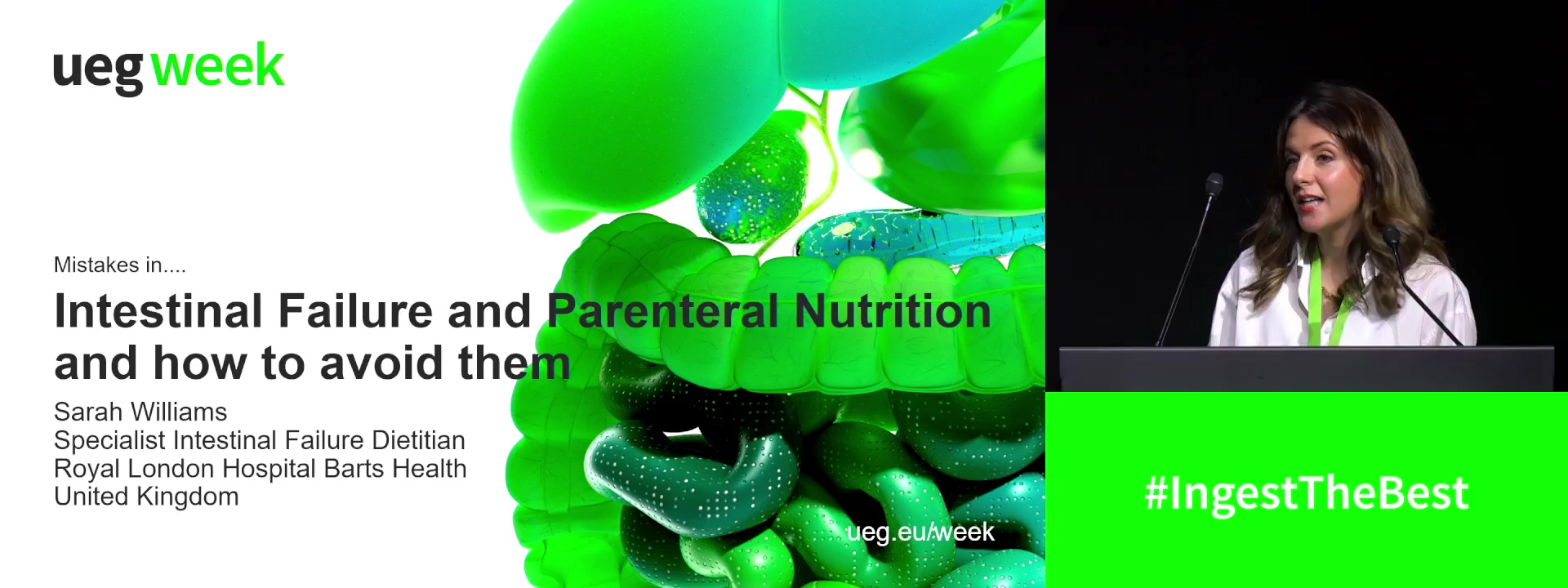
Intestinal failure and parenteral nutrition

Log in to access this content.

Free for all myUEG account holders. Your access level is set automatically based on your occupation. Medical professionals get full access to all content. If you are a non-medical user, you can only access UEG Week content from congresses you attended.

Log In Create a free account

Not sure what you can access? Learn more about account types.

Intestinal failure and parenteral nutrition

Sarah Williams 1

1 None, None, United Kingdom

Event

UEG Week Vienna 2024

Topics

Endoscopy Radiology & Imaging Small Intestine & Nutrition Stomach & H. Pylori Surgery

Session

Mistakes in...: Upper GI

Citation

United European Gastroenterology Journal 2024; 12 (Supplement 8)

Published

2024
UEG Online Course
accredited
Share via Email Share on Facebook Share on X Share on LinkedIn Share on Bluesky

Log in to access this content.

Free for all myUEG account holders. Your access level is set automatically based on your occupation. Medical professionals get full access to all content. If you are a non-medical user, you can only access UEG Week content from congresses you attended.

Log In Create a free account

Not sure what you can access? Learn more about account types.

Proctologic disorders are a widespread problem—their high incidence means that many different healthcare professionals (e.g. gastroenterologists, surgeons, dermatologists, nurses, young residents, etc.) will be confronted by patients complaining about a proctologic disease.

This course by European Society of Coloproctology (ESCP) experts Harald Rosen, Janindra Warusavitarne and Nuha Yassin provides the most recent state-of-the-art information on the common proctologic disorders of haemorrhoids and perianal skin conditions.

Learning objectives

  • To understand how to reach a conclusive diagnosis of GORD
  • To know how to reach a conclusive diagnosis of no GORD
  • To understand how to deal with an inconclusive diagnosis

Target audience

This course is suitable for gastroenterologists and surgeons in training, but is also appropriate for other physicians, as well as nurses, biotechnicians and medical students who have an interest in coloproctology.

Proctology — haemorrhoids and perianal skin conditions

Proctology — haemorrhoids and perianal skin conditions

Harald Rosen, Janindra Warusavitarne, Nuha Yassin

Event

Proctology — haemorrhoids and perianal skin conditions

Topics

Surgery

Accreditation status

accredited

Duration

1 hour

Published

2021
Login to access

The global reference point for the digestive health community

Platform Publisher

United European Gastroenterology

Wickenburggasse 1 1080 Vienna, Austria

Contact us

support@ueg.eu

ueg.eu

T: +43 1 997 1639

Legal

Terms & Conditions

Imprint

Privacy Policy

Explore

My Bookmarks

My recommendations

My fields of interest

© 2026 United European Gastroenterology

Change fields of interest

These fields are selected based on the interests in your myUEG profile.
Click the item to unselect it. You can select multiple items.