Introduction
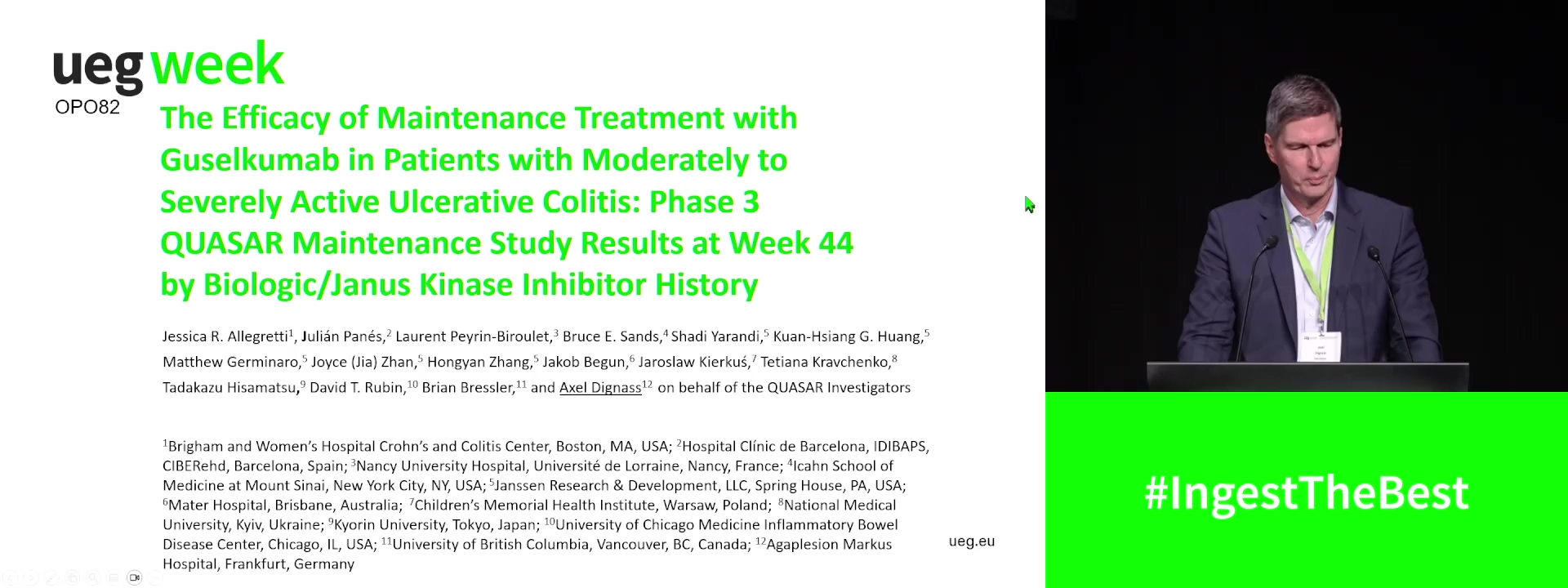
The Phase 3 QUASAR Maintenance Study evaluated the efficacy of maintenance treatment with subcutaneous (SC) guselkumab (GUS), a dual-acting IL-23p19 subunit inhibitor, in patients (pts) with ulcerative colitis (UC) who achieved clinical response following IV GUS induction treatment. Here, we report Week(Wk) 44 efficacy and safety results for GUS treatment compared with withdrawal (placebo) and by history of treatment with biologics/Janus kinase (JAK) inhibitors.
Aims & Methods
At maintenance baseline, clinical responders to 12 weeks of GUS IV induction from QUASAR Phase 2b and Phase 3 induction studies (NCT04033445) were randomized 1:1:1 to GUS 200 mg SC q4w, GUS 100 mg SC q8w, or PBO (GUS withdrawal). The primary analysis population included randomized and treated pts in the Maintenance Study with a modified Mayo score of 5-9 at induction baseline. Key clinical, symptomatic, histologic, and endoscopic efficacy endpoints and safety events were evaluated through Wk 44.
Results
Of the 568 pts included, 240 (42.3%) had a history of inadequate response or intolerance to biologics/JAK inhibitors, 309 (54.4%) were biologic/JAK inhibitor naïve, and 19 (3.3%) were biologic/JAK inhibitor experienced without documented inadequate response or intolerance. Among pts with inadequate response or intolerance to biologics/JAK inhibitors (anti-TNFs [87.9%], vedolizumab [49.2%], or tofacitinib [20.0%]), 48.3% had inadequate response or intolerance to two or more biologic/JAK inhibitor therapies. At induction baseline, pts with a history of inadequate response or intolerance to biologics/JAK inhibitors had longer disease duration (mean 9.94 vs 6.25 yrs) and more severe endoscopic disease (Mayo endoscopy subscore=3, 79.6% vs 56.7%) compared with pts with no such history.
Results for key efficacy endpoints are included in Table 1. At Wk 44, clinical remission was achieved by 40.0% of GUS-treated pts (vs 8.0% of withdrawal pts, nominal p<0.001) who had inadequate response or intolerance to biologics/JAK inhibitors, and 54.2% of biologic/JAK inhibitor naïve pts who were treated with GUS (vs 25.9% of withdrawal pts, nominal p<0.001). The proportions of pts who met the key endpoints were generally higher in the biologic/JAK inhibitor naïve subpopulation compared with the subpopulation of pts with prior inadequate response or intolerance to biologics/JAK inhibitors across treatment groups, however, the treatment differences were generally greater in pts with prior inadequate response or intolerance to biologics/JAK inhibitors. Through Wk 44, adverse events for these subpopulations were consistent with the overall population, and no new safety concerns were identified.
Table 1. Endpoints at maintenance Week 44 by history of biologic/JAK inhibitor therapy: Primary analysis population
|
History of Inadequate Response/Intolerance to Biologics/JAK Inhibitors | Biologic/JAK Inhibitor Naïve
|
| GUS Withdrawal (Placebo)
(N=75)
| GUS 100mg SC q8w
(N=77)
| GUS 200 mg SC q4w
(N=88)
| GUS Withdrawal (Placebo)
(N=108)
| GUS 100mg SC q8w
(N=105)
| GUS 200mg SC q4w
(N=96)
|
Clinical remission, a1,b n (%)
Adjusted treatment difference (95%CI)
| 6 (8.0%)
| 31 (40.3%)
30.4% (18.7%, 42.1%)
P<0.001
| 35 (39.8%)
32.4% (21.1%, 43.7%)
P<0.001
| 28 (25.9%)
| 53 (50.5%)
24.3% (12.0%, 36.5%)
P<0.001
| 56 (58.3%)
28.8% (16.5%, 41.1%)
P<0.001
|
Maintenance of clinical remission, a2,b n/N (%)
Treatment difference (95%CI)
| 4/15 (26.7%)
| 12/20 (60.0%)
33.3% (-0.9%, 62.1%)
P=0.087
| 10/18 (55.6%)
28.9% (-5.9%, 59.0%)
P=0.158
| 14/41 (34.1%)
| 28/43 (65.1%)
31.0% (9.3%, 50.6%)
P=0.008
| 38/48 (79.2%)
45.0% (24.9%, 62.2%)
P<0.001
|
Maintenance of clinical response, a3,b n (%)
Adjusted treatment difference (95%CI)
| 21 (28.0%)
| 54 (70.1%)
40.8% (27.4%, 54.2%)
P<0.001
| 59 (67.0%)
39.4% (25.8%, 53.0%)
P<0.001 | 58 (53.7%) | 87 (82.9%)
29.0% (17.2%, 40.8%)
P<0.001 | 78 (81.3%)
26.3% (14.0%, 38.6%)
P<0.001
|
Symptomatic remission,a4,b n (%)
Adjusted treatment difference (95%CI)
| 18 (24.0%)
| 50 (64.9%)
39.1% (25.9%, 52.2%)
P<0.001
| 53 (60.2%)
36.8% (23.4%, 50.2%)
P<0.001
| 50 (46.3%)
| 78 (74.3%)
27.6% (15.1%, 40.1%)
P<0.001
| 73 (76.0%)
28.2% (15.4%, 41.0%)
<0.001
|
Endoscopic improvement,a5,b n (%)
Adjusted treatment difference (95%CI)
| 6 (8.0%)
| 35 (45.5%)
35.8% (23.8%, 47.8%)
P<0.001
| 37 (42.0%)
34.6% (23.1%, 46.0%)
P<0.001
| 28 (25.9%)
| 56 (53.3%)
27.2% (15.0%, 39.5%)
P<0.001
| 57 (59.4%)
30.0% (17.6%, 42.4%)
P<0.001
|
Histo-endoscopic mucosal improvement,a6,b n (%)
Adjusted treatment difference (95%CI)
| 6 (8.0%)
| 29 (37.7%)
27.7% (16.0%, 39.5%)
P<0.001
| 34 (38.6%)
31.2% (19.8%, 42.5%)
P<0.001
| 25 (23.1%)
| 52 (49.5%)
26.1% (14.0%, 38.2%)
P<0.001
| 54 (56.3%)
29.5% (17.3%, 41.7%)
P<0.001
|
Endoscopic normalization (remission)a7,b n (%)
Adjusted treatment difference (95%CI)
| 6 (8.0%)
| 24 (31.2%)
21.4% (10.0%, 32.7%)
P<0.001
| 21 (23.9%)
16.3% (6.4%, 26.1%)
P=0.005
| 22 (20.4%)
| 40 (38.1%)
17.3% (5.6%, 29.1%)
P=0.005
| 40 (41.7%)
17.5% (6.0%, 29.0%)
P=0.004
|
| Biologic/JAK inhibitor experienced without documented inadequate response or intolerance to biologics/JAK inhibitors: placebo, n=7 ; GUS 100 mg, n=6; GUS 200 mg, n=6. All p-values were nominal. P-values were based on the CMH test, stratified by clinical remission status at maintenance baseline and induction treatment, except for the maintenance of clinical remission, which was based on the Fisher’s exact test . Adjusted treatment difference was based on the Wald statistic with CMH weight. a1 Clinical remission: A Mayo stool frequency subscore of 0 or 1 and not increased from induction baseline, a Mayo rectal bleeding subscore of 0, and a Mayo endoscopy subscore of 0 or 1 with no friability. a2 Maintenance of clinical remission: Clinical remission at Wk 44 among pts in clinical remission at maintenance baseline. a3 Maintenance of clinical response: Clinical response at Wk 44 among pts in clinical response at maintenance baseline. a4 Symptomatic remission: A stool frequency subscore of 0 or 1 and not increased from induction baseline, and a rectal bleeding subscore of 0. a5 Endoscopic improvement: An endoscopy subscore of 0 or 1 with no friability present on the endoscopy. a6 Histo-endoscopic mucosal improvement: Achieving a combination of histologic improvement (neutrophil infiltration in <5% of crypts, no crypt destruction, and no erosions, ulcerations or granulation tissue per Geboes grading system) and endoscopic improvement. a7 Endoscopic normalization: An endoscopy subscore of 0. b Pts who had a prohibited change in UC medication, an ostomy or colectomy, a dose adjustment (including a sham dose adjustment) , or discontinued study agent due to lack of efficacy or an adverse event of worsening of UC or other reasons except for COVID-19 related reasons (excluding COVID-19 infection) or regional crisis in Russia and Ukraine prior to the Wk 44 visit were considered not to have achieved the endpoint. Pts who were missing one or more components pertaining to a specified endpoint at Wk 44 were considered not to have achieved the endpoint. |
Conclusion
Maintenance treatment with both GUS dosing regimens resulted in greater improvements compared with placebo withdrawal across key clinical, symptomatic, endoscopic, and histologic endpoints at Wk 44 regardless of prior history with biologics/JAK inhibitors. Safety results for both GUS maintenance dose regimens were comparable across subpopulations by treatment history and consistent with the known safety profile of GUS.
Disclosure
JRA: consultant for Finch Therapeutics, Artugen, Pfizer, Takeda, Janssen, and Iterative Scopes; research support from Merck; consultant and speaker for BMS.
JP: received consultancy fees/honorarium from AbbVie, Alimentiv, Athos, Atomwise, Boehringer Ingelheim, Celsius, Ferring, Galapagos, Genentech/Roche, GlaxoSmithKline, Janssen, Mirum, Nimbus, Pfizer, Progenity, Prometheus, Protagonist, Revolo, Sanofi, Sorriso, Surrozen, Takeda, and Wasserman, and has served on a data safety monitoring board for Alimentiv, Mirum, Sorriso, Sanofi, and Surrozen.
LPB: personal fees from AbbVie, Allergan, Alma, Amgen, Applied Molecular Transport, Arena, Biogen, Boehringer Ingelheim, BMS, Celgene, Celltrion, Enterome, Enthera, Ferring, Fresenius, Genentech, Gilead, Hikma, Index Pharmaceuticals, Janssen, Lilly, MSD, Mylan, Nestlé, Norgine, Oppilan Pharma, OSE Immunotherapeutics, Pfizer, Pharmacosmos, Roche, Samsung Bioepis, Sandoz, Sterna, Sublimity Therapeutics, Takeda, Tillots and Vifor; grants from AbbVie, MSD and Takeda; stock options from CTMA.
BES: consulting fees from Abbvie, Alimentiv, Amgen, Arena Pharmaceuticals, Artugen Therapeutics, Astra Zeneca, Boehringer Ingelheim, Boston Pharmaceuticals, Calibr, Celgene, Celltrion, ClostraBio, Equillium, Enthera, Evommune, Fresenius Kabi, Galapagos, Genentech (Roche), Gilead Sciences, GlaxoSmithKline, Gossamer Bio, Index Pharmaceuticals, Innovation Pharmaceuticals, Inotrem, Kaleido, Kallyope, Merck, Morphic Therapeutics, MRM Health, Progenity, Prometheus Biosciences, Prometheus Laboratories, Protagonist Therapeutics, Q32 Bio, Sun Pharma, Surrozen, Target RWE,Teva, TLL Pharmaceutical, Ventyx Biosciences; consulting and speaking fees from Abivax; consulting and speaking fees and other support from Lilly; research grants, consulting and speaking fees and other support from Bristol Myers Squibb, Janssen, Pfizer, Takeda; research grants and consulting fees from Theravance Biopharma; and stock options from Ventyx Biopharma.
SY, KGH, MG, JZ and HZ: employees of Johnson & Johnson and own company stock/stock options.
JB received grant support from AbbVie, Janssen, Pfizer and Ferring. Consulting fees from Janssen, Pfizer, Abbvie, Takeda, Ferring, Microba, Anatara, DrFalk, Bristol Meyers Squibb, Glaxo Smith Klein and Chieisi, and lecture fees from AbbVie, Janssen, Pfizer, Takeda, and Ferring.
JK reports personal fees from Bristol-Myers Squibb, Celltrion, Ferring, Fresenius, Janssen, Lilly, Nestlé.
TK served as an investigator for Janssen.
TH: grant support from AbbVie, Daiichi-Sankyo, EA Pharma Co, Ltd. JIMRO, Mitsubishi Tanabe Pharma Corporation, Mochida Pharmacuetical Co., Ltd., Nippon Kayaku Co., Ltd., Pfizer Inc., Takeda Pharmaceutical Co., Ltd., consulting fees from EA Pharma Co, Ltd., Janssen Research & Development, LLC., and lecture fees from AbbVie, EA Pharma Co, Ltd, Mitsubishi Tanabe Pharma Corporation, Takeda Pharmaceutical Co., Ltd.
DTR: research funding from Takeda, and has served as a consultant to AbbVie, Altrubio, Allergan, Inc., Arena Pharmaceuticals, Aslan Pharmaceuticals, Athos Therapeutics, Bellatrix Pharmaceuticals, Boehringer Ingelheim, Ltd., Bristol Myers Squibb, Celgene Corp/Syneos, Connect BioPharma, GalenPharma/Atlantica, Genentech/Roche, InDex Pharmaceuticals, Ironwood Pharmaceuticals, Iterative Scopes, Janssen Pharmaceuticals, Eli Lilly, Materia Prima, Pfizer, Prometheus Biosciences, Reistone, Takeda, Techlab, Inc and is a co-founder of Cornerstones Health, Inc.
BB: advisor/speaker for Abbvie, BMS, Ferring, Janssen, Merck, Novartis, Organon, Pfizer, Sandoz, Takeda; advisor for Alimentiv, Allergan, AMT, Bausch Health, BMS, Celgene, Celltrion Healthcare, Eupraxia, Fresenius Kabi, Genentech, Gilead, Iterative Scopes, Jamp Pharma, Merck Amgen, Microbiome Insights, Mylan, Pendopharm, Protagonist, Viatris; received research support from Abbvie, Amgen, BI, BMS, Genentech, GSK, Janssen, Merck, Qu Biologic; and reports stock options for Qu Biologic.
AD: fees for clinical trials, data monitoring boards, statistical analysis and end point committees from Abivax, AbbVie, BMS, Dr Falk Foundation, Galapagos, Gilead, Janssen, and Pfizer; consultancy fees from AbbVie, Amgen, Arena Pharmaceuticals, Biogen, Boehringer Ingelheim, BMS, Celltrion, Dr Falk Foundation, Ferring Pharmaceuticals, Fresenius Kabi, Galapagos, Janssen, Lilly, MSD, Pfizer, Pharmacosmos, Roche, Sandoz,; Stada, Takeda, Tillotts, and Vifor Pharma; payment for lectures from AbbVie, Biogen, CED Service GmbH, Celltrion, Falk Foundation, Ferring, Galapagos, Gilead, High5MD, Janssen, Materia Prima, MedToday, MSD, Pfizer, Sandoz, Takeda, Tillotts, and Vifor Pharma; payment for manuscript preparation from Abbvie, Falk Foundation, Janssen, Takeda, Thieme, and UniMed Verlag.