UEG's educational platform for gastroenterology education bringing recordings, courses, guidelines, and more together in one place.
Most popular content
Rate for better recommendations!
Your feedback helps us show you more of what you like and less of what you dislike!
Log in to access this content.
Free for all myUEG account holders. Your access level is set automatically based on your occupation. Medical professionals get full access to all content. If you are a non-medical user, you can only access UEG Week content from congresses you attended.
Not sure what you can access? Learn more about account types.
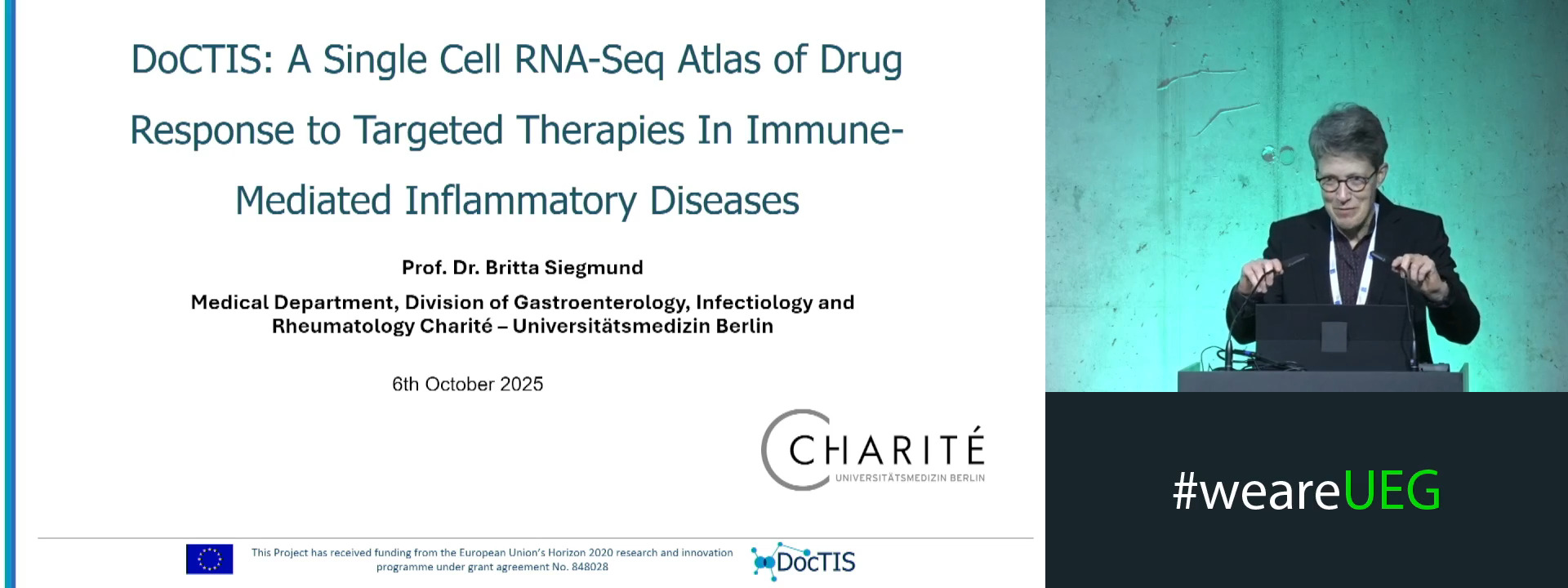
DOCTIS: A SINGLE CELL RNA-SEQ ATLAS OF DRUG RESPONSE TO TARGETED THERAPIES IN IMMUNE-MEDIATED INFLAMMATORY DISEASES
Britta Siegmund 1, Antonio Julià 2, Yolanda Guillén 3, Eugeni Domenech Morral 4, Javier Gisbert 5, Paloma Vela Casasempere 6, Antonio Fernández Nebro 7, Carlos Marras 8, Santos Castañeda 9, Jaime Calvo Alén 10, Jesús Tornero Molina 11, Juan Cañete Crespillo 12, Jose Manuel Carrascosa 13, Eduardo Fonseca 14, Luis Bujanda Fernández de Piérola 15, Valle García 16, Giampiero Girolomoni 17, Holger Heyn 18, Laura Jiménez Gracia 18, Pere SantaMaria 19, Edgar Angelats 19, Sergio Hilario Martínez Mateu 3, Rick Myers 20, Juan Ángel Patiño Galindo 3, Ernest Choy 21, Sara Marsal 2
1 Charité - Universitätsmedizin Berlin, Berlin, Germany
2 Vall d'Hebron Research Institute (VHIR), Barcelona, Spain
3 IMIDomics, Inc, Barcelona, Spain
4 Hospital Germans Trias i pujol, Badalona, Barcelona, Spain
5 Hospital Universitario de La Princesa, Instituto de Investigación Sanitaria Princesa and CIBEREHD, Madrid, Spain
6 Hospital General Universitario de Alicante, Alicante, Spain
7 Hospital Regional Universitario Carlos Haya, Málaga, Spain
8 Hospital Clínico Universitario Virgen de la Arrixaca, Murcia, Spain
9 Hospital Universitario La Princesa, Madrid, Spain
10 Hospital Universitario Araba, Álava, Spain
11 Hospital Universitario Guadalajara, Guadalajara, Spain
12 Hospital Clínic de Barcelona, Barcelona, Spain
13 Hospital Germans Trias i Pujol, Badalona, Spain
14 Complejo Hospitalario Juan Canalejo, A Coruña, Spain
15 Instituto Biodonostia, San Sebastián, Spain
16 Hospital Reina Sofia, Córdoba, Spain
17 Univeristà di Verona, Verona, Italy
18 Centre Nacional d'Anàlisi Genòmica (CNAG), Barcelona, Spain
19 IDIBAPS, Barcelona, Spain
20 Hudson Alpha Institute for Biotechnology, Huntsville, United States
21 Cardiff University, Cardiff, United Kingdom
Event
Submission format
Citation
Published
Log in to access this content.
Free for all myUEG account holders. Your access level is set automatically based on your occupation. Medical professionals get full access to all content. If you are a non-medical user, you can only access UEG Week content from congresses you attended.
Not sure what you can access? Learn more about account types.
How to handle the frail
1 Örebro University, Örebro, Sweden
Event
Topics
Session
Citation
Published
Log in to access this content.
Free for all myUEG account holders. Your access level is set automatically based on your occupation. Medical professionals get full access to all content. If you are a non-medical user, you can only access UEG Week content from congresses you attended.
Not sure what you can access? Learn more about account types.
Who is at risk?
1 University Hospital North Tees NHS Dept. of Gastroenterology - Gastroenterology, University Hospital, Stockton-on-Tees, United Kingdom
Event
Topics
Session
Citation
Published
Log in to access this content.
Free for all myUEG account holders. Your access level is set automatically based on your occupation. Medical professionals get full access to all content. If you are a non-medical user, you can only access UEG Week content from congresses you attended.
Not sure what you can access? Learn more about account types.
"I am a little better, doctor": When is 'better' enough in ASUC
1 Fondazione Policlinico Universitario "A. Gemelli" IRCCS, Università Cattolica del Sacro Cuore, Roma, Italy
Event
Citation
Published
Log in to access this content.
Free for all myUEG account holders. Your access level is set automatically based on your occupation. Medical professionals get full access to all content. If you are a non-medical user, you can only access UEG Week content from congresses you attended.
Not sure what you can access? Learn more about account types.
From H. pylori to cancer:Optimising current antibiotic therapy and exploring future targeted treatments
1 Trinity College Dublin, Dublin, Ireland
2 UZ Leuven, Leuven, Belgium
Event
Citation
Published
Log in to access this content.
Free for all myUEG account holders. Your access level is set automatically based on your occupation. Medical professionals get full access to all content. If you are a non-medical user, you can only access UEG Week content from congresses you attended.
Not sure what you can access? Learn more about account types.
EFFICACY AND SAFETY OF MORF-057 THERAPY IN ADULTS WITH MODERATELY TO SEVERELY ACTIVE ULCERATIVE COLITIS: PHASE 2B EMERALD-2 STUDY RESULTS THROUGH WEEK 12
Bruce E. Sands 1, Brian G. Feagan 2, Stefan Schreiber 3, Brihad Abhyankar 4, Michael Choi 5, Yujun Wu 5, Sun Ku Lee 5, Maloy Mangada 5, Andrew Wey 5, Xin Zhang 5, Nadezhda Mincheva Eberhart 5, Laurent Peyrin-Biroulet 6, Silvio Danese 7
1 Icahn School of Medicine at Mount Sinai, New York, United States
2 Alimentiv Inc., London, Canada
3 University Hospital Schleswig-Holstein, Kiel, Germany
4 Eli Lilly and Company Limited, Basingstoke, United Kingdom
5 Eli Lilly and Company, Indianapolis, United States
6 Centre Hospitalier Régional Universitaire de Nancy, Nancy, France
7 Vita-Salute San Raffaele University - IRCCS Ospedale San Raffaele, Milan, Italy
Event
Submission format
Citation
Published
Log in to access this content.
Free for all myUEG account holders. Your access level is set automatically based on your occupation. Medical professionals get full access to all content. If you are a non-medical user, you can only access UEG Week content from congresses you attended.
Not sure what you can access? Learn more about account types.
Panel discussion: Cancer and IBD - Mitigating risk among uncertainty
Event
Topics