UEG's content platform for gastroenterology education bringing recordings, courses, guidelines, and more together in one place.
Trending on Gutflix
Rate for better recommendations!
Your feedback helps us show you more of what you like and less of what you dislike!
Log in to continue.
This content is part of Gutflix. Log in with your myUEG account, or create one free, to watch it.
Not sure what you can access? Learn more about account types.
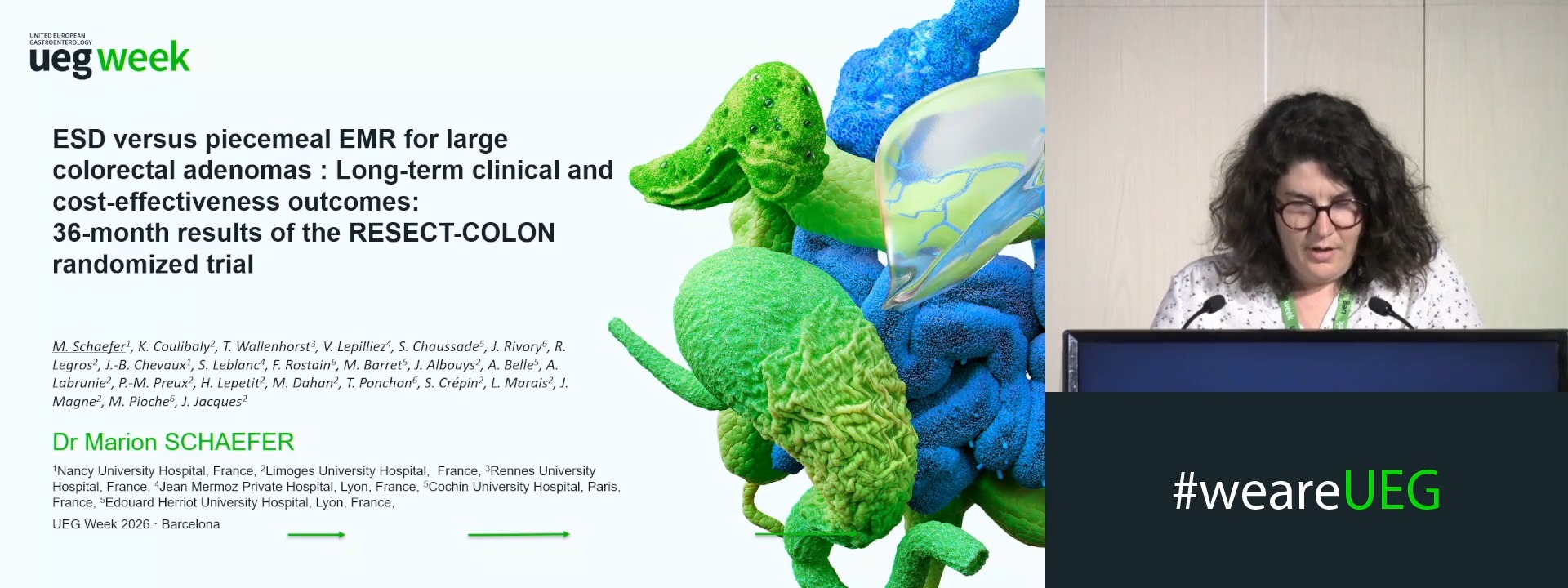
LONG-TERM CLINICAL AND COST-EFFECTIVENESS OUTCOMES OF ESD VERSUS PIECEMEAL EMR FOR LARGE COLORECTAL ADENOMAS: 36-MONTH RESULTS FROM THE RESECT-COLON RANDOMIZED TRIAL
Marion Schaefer 1, Kiyali Coulibaly 2, Timothee Wallenhorst 3, Vincent Lepilliez 4, Stanislas Chaussade 5, Jerome Rivory 6, Romain Legros 7, Jean-Baptiste Chevaux 1, Sarah Leblanc 4, Florian Rostain 6, Maximilien Barret 5, Jeremie Albouys 7, Arthur Belle 5, Anais Labrunie 7, Pierre-Marie Preux 8, Hugo Lepetit 7, Martin Dahan 7, Thierry Ponchon 9, Sabrina Crépin 7, Loic Marais 7, Julien Magne 7, Mathieu Pioche 6, Jérémie Jacques 10
Affiliations
1 Nancy Regional University Hospital, Nancy, France
2 Poitiers University Hospital, Poitiers, France
3 CHU Pontchaillou, Rennes, France
4 Jean Mermoz Private Hospital, Lyon, France
5 Aphp - Paris University, Paris, France
6 Hopital Edouard Herriot, Lyon, France
7 Limoges University Hospital, Limoges, France
8 University of Limoges, Limoges, France
9 Centre Léon Berard, Lyon, France
10 CHU Limoges - Hepato-Gastro-Enterology, CHU Limoges, Limoges, France
Log in to continue.
This content is part of Gutflix. Log in with your myUEG account, or create one free, to watch it.
Not sure what you can access? Learn more about account types.
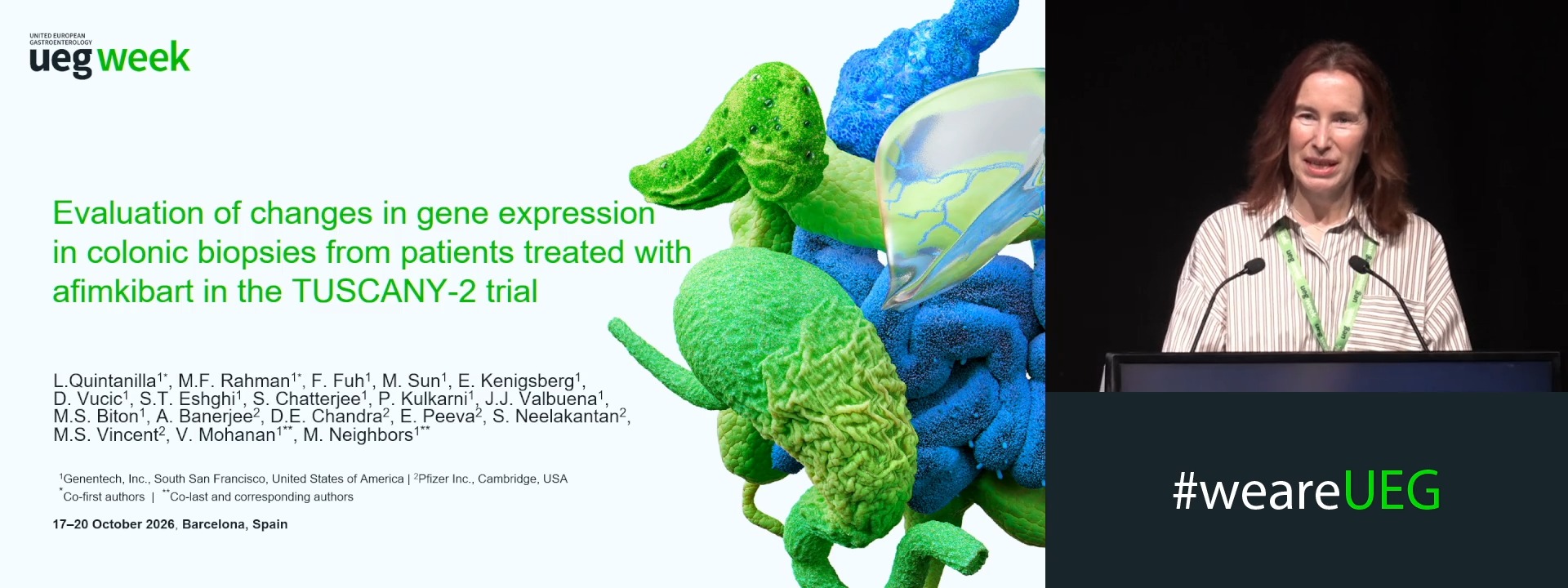
EVALUATION OF CHANGES IN GENE EXPRESSION IN COLONIC BIOPSY SAMPLES FROM PATIENTS TREATED WITH AFIMKIBART IN THE TUSCANY-2 TRIAL
Luis Quintanilla 1, Mouly Rahman 2, Franklin Fuh 1, Meng Sun 1, Ephraim Kenigsberg 1, Domagoj Vucic 1, Shadi Toghi Eshghi 1, Sharmila Chatterjee 1, Priyanka Kulkarni 1, Judit Jané Valbuena 1, Michal Slyper Biton 1, Anindita Banerjee 3, Deepa E. Chandra 3, Elena Peeva 3, Srividya Neelakantan 3, Michael S. Vincent 3, Vishnu Mohanan 2, Margaret Neighbors 1
Affiliations
1 Genentech, Inc., South San Francisco, United States
2 F. Hoffmann‑La Roche Ltd., Basel, Switzerland
3 Pfizer Inc., Cambridge, United States
Log in to continue.
This content is part of Gutflix. Log in with your myUEG account, or create one free, to watch it.
Not sure what you can access? Learn more about account types.
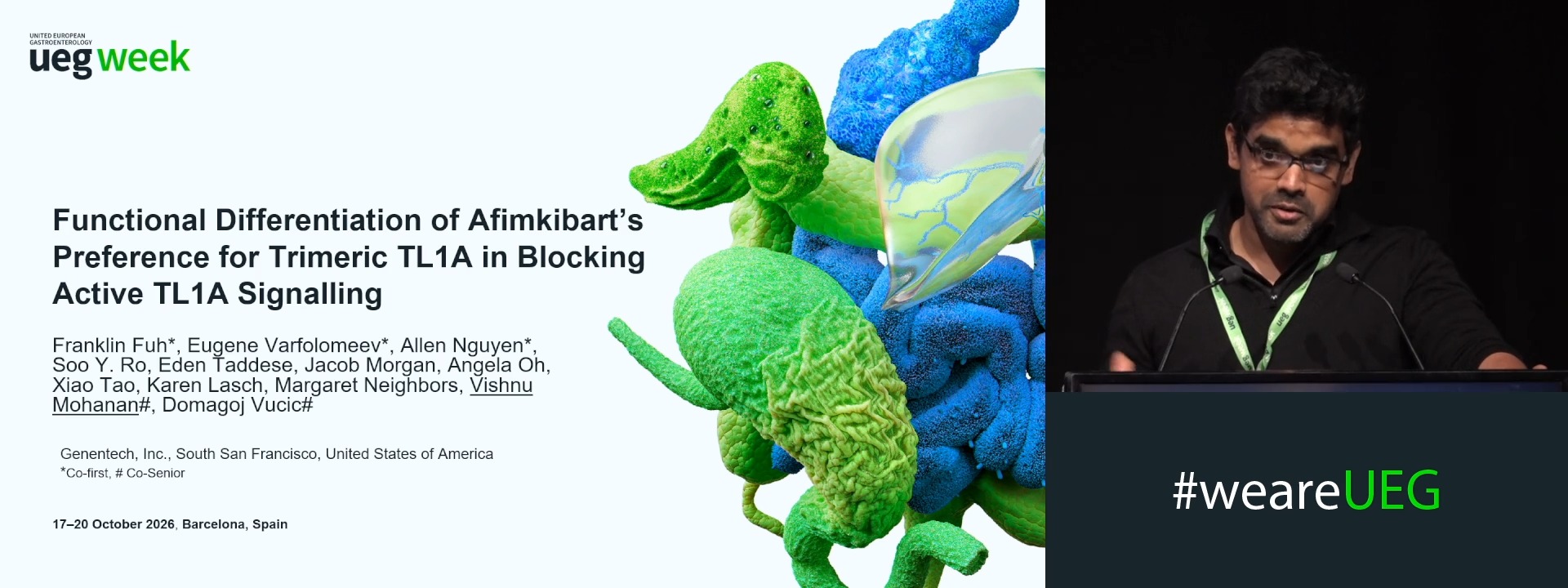
FUNCTIONAL DIFFERENTIATION OF AFIMKIBART’S PREFERENCE FOR TRIMERIC TL1A IN BLOCKING ACTIVE TL1A SIGNALING
Franklin Fuh 1, Eugene Varfolomeev 1, Allen Nguyen 1, Angela Oh 1, Geil Merana 1, Xiao Tao 1, Karen Lasch 1, Maggie Neighbors 1, Vishnu Mohanan 1, Domagoj Vucic 1
Affiliations
1 Genentech Inc., South San Francisco, United States
Log in to continue.
This content is part of Gutflix. Log in with your myUEG account, or create one free, to watch it.
Not sure what you can access? Learn more about account types.
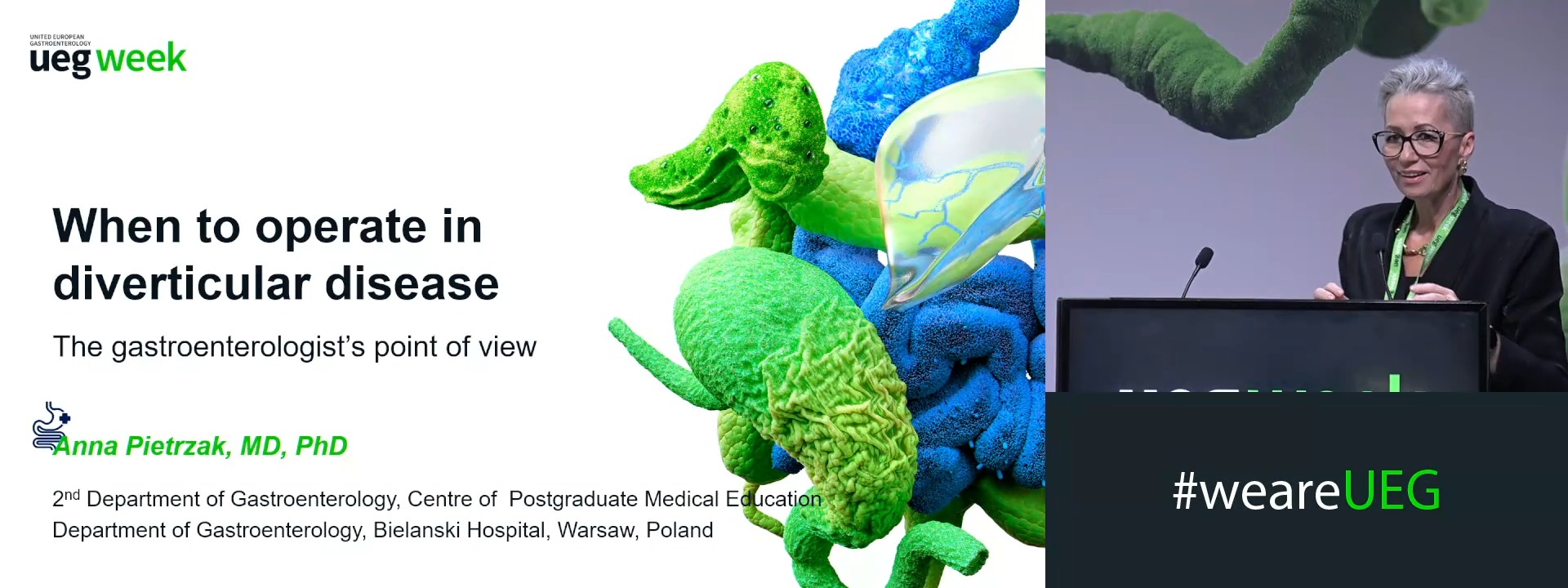
When to operate in diverticular disease: The gastroenterologist's and the surgeon's point of view
Affiliations
1 Medical Centre for Postgraduate Education Gastroenterology and Hepatology, Warsaw, Poland
2 King's College Hospital NHS Foundation Trust, London, United Kingdom