UEG's educational platform for gastroenterology education bringing recordings, courses, guidelines, and more together in one place.
Most popular content
Rate for better recommendations!
Your feedback helps us show you more of what you like and less of what you dislike!
Log in to access this content.
Free for all myUEG account holders. Your access level is set automatically based on your occupation. Medical professionals get full access to all content. If you are a non-medical user, you can only access UEG Week content from congresses you attended.
Not sure what you can access? Learn more about account types.

DIAGNOSIS OF EOSINOPHILIC ENTERITIS USING DOUBLE-BALLOON ENTEROSCOPY
1 Kansai Medical University Medical Center, Moriguchi, Japan
2 Kansai Medical University 3rd Dept. of Internal Medicine, Hirakata, Japan
Conference
Topics
Submission format
Citation
Published
Log in to access this content.
Free for all myUEG account holders. Your access level is set automatically based on your occupation. Medical professionals get full access to all content. If you are a non-medical user, you can only access UEG Week content from congresses you attended.
Not sure what you can access? Learn more about account types.
Pediatric emergencies
1 Al Jalila Children's Specialty Hospital, DUBAI, United Arab Emirates
Event
Topics
Session
Citation
Published
Log in to access this content.
Free for all myUEG account holders. Your access level is set automatically based on your occupation. Medical professionals get full access to all content. If you are a non-medical user, you can only access UEG Week content from congresses you attended.
Not sure what you can access? Learn more about account types.
Nutritional management of small intestinal enteropathies
1 Beaujon Hospital, Assistance Publique-Hôpitaux de Paris, Clichy, France
Event
Citation
Published
Log in to access this content.
Free for all myUEG account holders. Your access level is set automatically based on your occupation. Medical professionals get full access to all content. If you are a non-medical user, you can only access UEG Week content from congresses you attended.
Not sure what you can access? Learn more about account types.
Barrett’s oesophagus: Epidemiology and risk factors
1 The Maria Sklodowska-Curie Institute - Oncology Institute, Warsaw, Poland
Event
Session
Citation
Published
Log in to access this content.
Free for all myUEG account holders. Your access level is set automatically based on your occupation. Medical professionals get full access to all content. If you are a non-medical user, you can only access UEG Week content from congresses you attended.
Not sure what you can access? Learn more about account types.
GP: First line diagnosis and treatment
1 European Society for Primary Care Gastroenterology (ESPCG), Sant Adrià de Besòs ( Barcelona), Spain
Event
Session
Citation
Published
Log in to access this content.
Free for all myUEG account holders. Your access level is set automatically based on your occupation. Medical professionals get full access to all content. If you are a non-medical user, you can only access UEG Week content from congresses you attended.
Not sure what you can access? Learn more about account types.
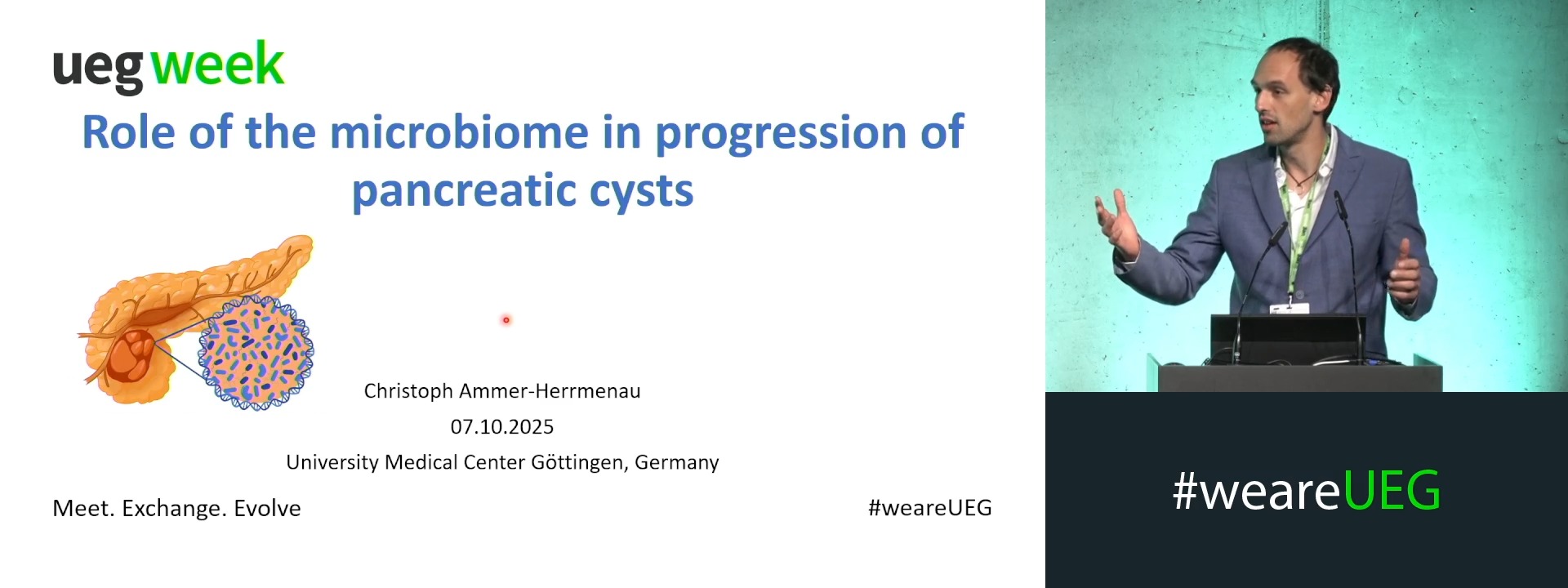
Role of microbiome in development and progression of pancreatic cysts
1 University Medical Centre Goettingen, Goettingen, Germany
Event
Session
Citation
Published
Log in to access this content.
Free for all myUEG account holders. Your access level is set automatically based on your occupation. Medical professionals get full access to all content. If you are a non-medical user, you can only access UEG Week content from congresses you attended.
Not sure what you can access? Learn more about account types.
GUT HEALTH AND LIPID METABOLISM: THE ROLE OF SIBO THERAPY
1 Danylo Halytsky Lviv National Medical University, Lviv, Ukraine
2 Shupyk National Healthcare University of Ukraine, Kyiv, Ukraine
Conference
Topics
Submission format
Session