UEG's educational platform for gastroenterology education bringing recordings, courses, guidelines, and more together in one place.
Most popular content
Rate for better recommendations!
Your feedback helps us show you more of what you like and less of what you dislike!
Log in to access this content.
Free for all myUEG account holders. Your access level is set automatically based on your occupation. Medical professionals get full access to all content. If you are a non-medical user, you can only access UEG Week content from congresses you attended.
Not sure what you can access? Learn more about account types.

BETWEEN RISK AND NECESSITY: URGENT COLECTOMY IN ASUC AFTER RECENT NSTEMI ON DAPT
1 Clinical Center of Montenegro, Podgorica, Montenegro
2 Clinical Center of Montenegro, Podgorica, Montenegro|||Faculty of Medicine, University of Montenegro, Podgorica, Montenegro
Conference
Topics
Submission format
Session
Published
Log in to access this content.
Free for all myUEG account holders. Your access level is set automatically based on your occupation. Medical professionals get full access to all content. If you are a non-medical user, you can only access UEG Week content from congresses you attended.
Not sure what you can access? Learn more about account types.
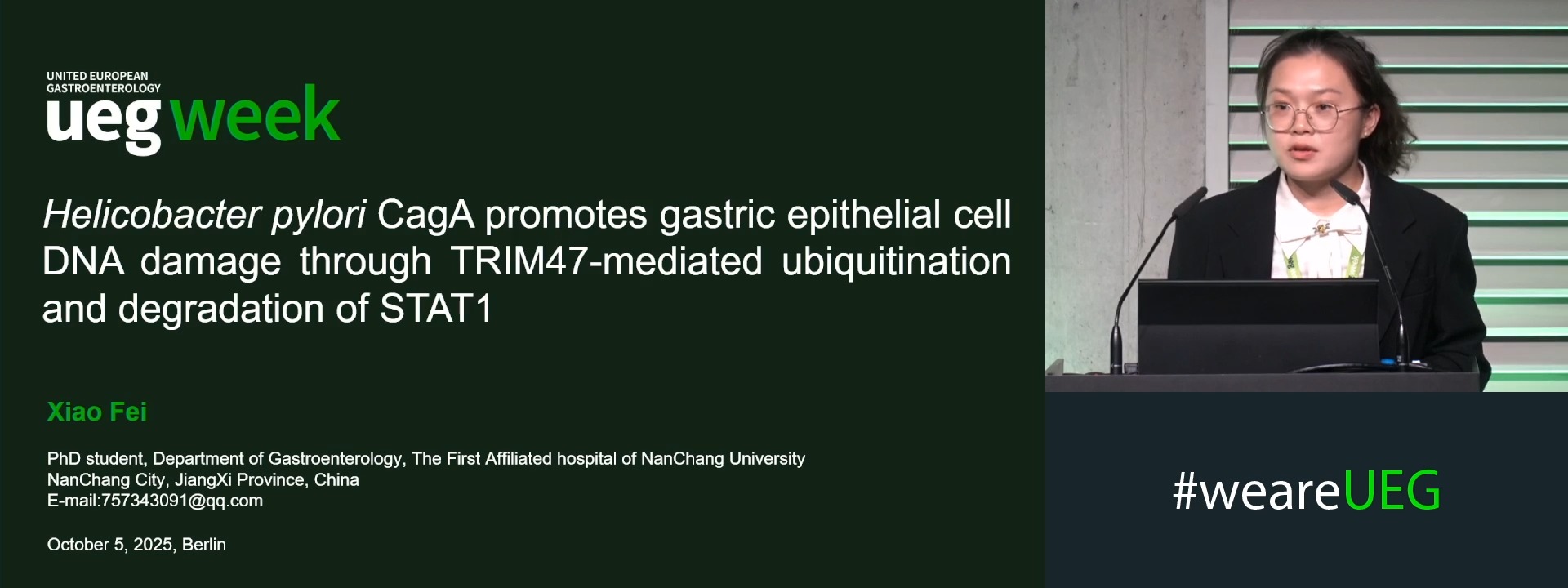
HELICOBACTER PYLORI CAGA PROMOTES GASTRIC EPITHELIAL CELL DNA DAMAGE THROUGH TRIM47-MEDIATED UBIQUITINATION AND DEGRADATION OF STAT1
1 The First Affiliated Hospital, Jiangxi Medical College, Nanchang University, Nanchang, China
Event
Submission format
Citation
Published
Log in to access this content.
Free for all myUEG account holders. Your access level is set automatically based on your occupation. Medical professionals get full access to all content. If you are a non-medical user, you can only access UEG Week content from congresses you attended.
Not sure what you can access? Learn more about account types.
REQUIRED WITHDRAWAL TIMES TO MEET ADENOMA DETECTION TARGETS DURING COLONOSCOPY
Mahsa Taghiakbari 1, Sara-Ivana Calce 1, Douglas Kevin Rex 2, Roupen Djinbachian 1, Alan N. Barkun 3, Victoire Michal 4, Claire Gefflot 4, Mickael Bouin 1, Simon Bouchard 1, Benoit Panzini 1, Erik Deslandres 1, Dane Christina Daoud 1, Robert Battat 1, Katarzyna Orlicka 1, Edmond-Jean Bernard 1, Jeremy Liu Chen Kiow 1, Daniel von Renteln 1
1 University of Montreal Hospital Center (CHUM), Montreal, Canada
2 Indiana University School of Medicine, Indianapolis, United States
3 McGill University Health Centre and McGill University, Montreal, Canada
4 University of Montreal Hospital Research Center (CRCHUM), Montreal, Canada
Conference
Topics
Submission format
Citation
Published
Log in to access this content.
Free for all myUEG account holders. Your access level is set automatically based on your occupation. Medical professionals get full access to all content. If you are a non-medical user, you can only access UEG Week content from congresses you attended.
Not sure what you can access? Learn more about account types.
BEYOND COLONOSCOPY: FAECAL DNA MUTATION SCREENING AS A POTENTIAL AND VIABLE PATH TO EARLY COLORECTAL CANCER DETECTION
Alonzo Alfaro-Núñez 1, Stina Christensen 2, Jette Ellehauge 2, Jens Ole Eriksen 2, Gitte Andersen 2, Tine Jess 1, Esther Agnete Jensen 2
1 Aalborg University Copenhagen, Copenhagen, Denmark
2 Naestved Hospital, Naestved, Denmark
Conference
Topics
Submission format
Citation
Published
Log in to access this content.
Free for all myUEG account holders. Your access level is set automatically based on your occupation. Medical professionals get full access to all content. If you are a non-medical user, you can only access UEG Week content from congresses you attended.
Not sure what you can access? Learn more about account types.
MORTALITY AND NEED FOR INTERVENTION IN PATIENTS WITH MASSIVE GASTROINTESTINAL BLEEDING. PRELIMINARY RESULTS OF A MULTICENTER STUDY
Eduardo Redondo-Cerezo 1, José Antonio Velarde-Ruiz Velasco 2, Javier Tejedor-Tejada 3, FRANCISCO JOSE SANCHEZ RONCERO 4, Raquel Dominguez-Gomez 5, MARIA VEGA CATALINA RODRIGUEZ 6, Adrian Huergo 7, Itxaso Jimenez 8, Adelina García Robles 9, Elena Cozar 10, Jaysoom Willem Abraca-Ruiz 11, Lorena Carballo-Folgoso 12, Rafael Martinez-Garcia 13, Rita Jiménez-Rosales 1
1 Hospital Universitario Virgen de las Nieves, Granada, Spain
2 Hospital Civil de Guadalajara Fray Antonio Alcalde., Guadalajara, Mexico
3 Hospital Universitario de Cabueñes, Gijon, Spain
4 Hospital Universitario Virgen de la Arrixaca, Murcia, Spain
5 Complejo Asistencial Universitario de Salamanca, Salamanca, Spain
6 Hospital General Universitario Gregorio Marañón, Madrid, Spain
7 Hospital Alvarez Buylla, Mieres, Spain
8 Hospital de Galdakao, Galdakao, Spain
9 Hospital Universitario San Cecilio Campus de la Salud, Granada, Spain
10 Hospital Universitario Virgen de la Victoria, Malaga, Spain
11 Hospital Eugenio Espejo, Quito, Ecuador
12 Hospital Universitario Central de Asturias, Oviedo, Spain
13 Complejo Hospitalario de Jaen, Jaen, Spain
Conference
Topics
Submission format
Citation
Published
Log in to access this content.
Free for all myUEG account holders. Your access level is set automatically based on your occupation. Medical professionals get full access to all content. If you are a non-medical user, you can only access UEG Week content from congresses you attended.
Not sure what you can access? Learn more about account types.
PERIPHERAL ARTERIAL COMPLICATION ASSOCIATED WITH UPADACITINIB AND SEVERE ULCERATIVE PANCOLITIS: A CASE REPORT
1 University Medical Center Maribor, Maribor, Slovenia
Conference
Topics
Submission format
Session
Published
Log in to access this content.
Free for all myUEG account holders. Your access level is set automatically based on your occupation. Medical professionals get full access to all content. If you are a non-medical user, you can only access UEG Week content from congresses you attended.
Not sure what you can access? Learn more about account types.
ADENOMA DETECTION RATE AND SUBSEQUENT RISK OF COLORECTAL CANCER: AN END TO THE RACE? A SYSTEMATIC REVIEW AND META-ANALYSIS
Leonardo Frazzoni 1, Giulio Antonelli 2, Nastazja Pilonis 3, Pieter Henk Abraham Wisse 4, Antonio Facciorusso 5, Manon C.W. Spaander 6, Mario Dinis-Ribeiro 7, Giovanni Barbara 8, Federico Orlandini 8, Marco Di Marco 1, Angelo De Padova 1, Cristiano Spada 9, Evelien Dekker 10, Michael Bretthauer 11, Michal Filip Kaminski 12, Cesare Hassan 13, Lorenzo Fuccio 8
1 AUSL Romagna, Rimini, Italy
2 Ospedale dei Castelli, Rome, Italy
3 The Maria Sklodowska-Curie Institute - Oncology Institute Warsaw, Poland, Warsaw, Poland
4 Erasmus MC Rotterdam, Rotterdam, Netherlands
5 University of Salento, Lecce, Italy
6 Erasmus Medical Center Rotterdam, Rotterdam, Netherlands
7 IPO Porto, Porto, Portugal
8 University of Bologna, Bologna, Italy
9 Catholic University Rome - Digestive Endoscopy unit, Catholic University Rome; Rome/IT, Rome, Italy
10 AMC, Amsterdam, Netherlands
11 University of Oslo, Oslo, Norway
12 Maria Sklodowska-Curie Memorial Center and Institute of Oncology, Warsaw, Poland
13 Humanitas University, Pieve Emanuele MI, Italy
Conference
Topics