Introduction
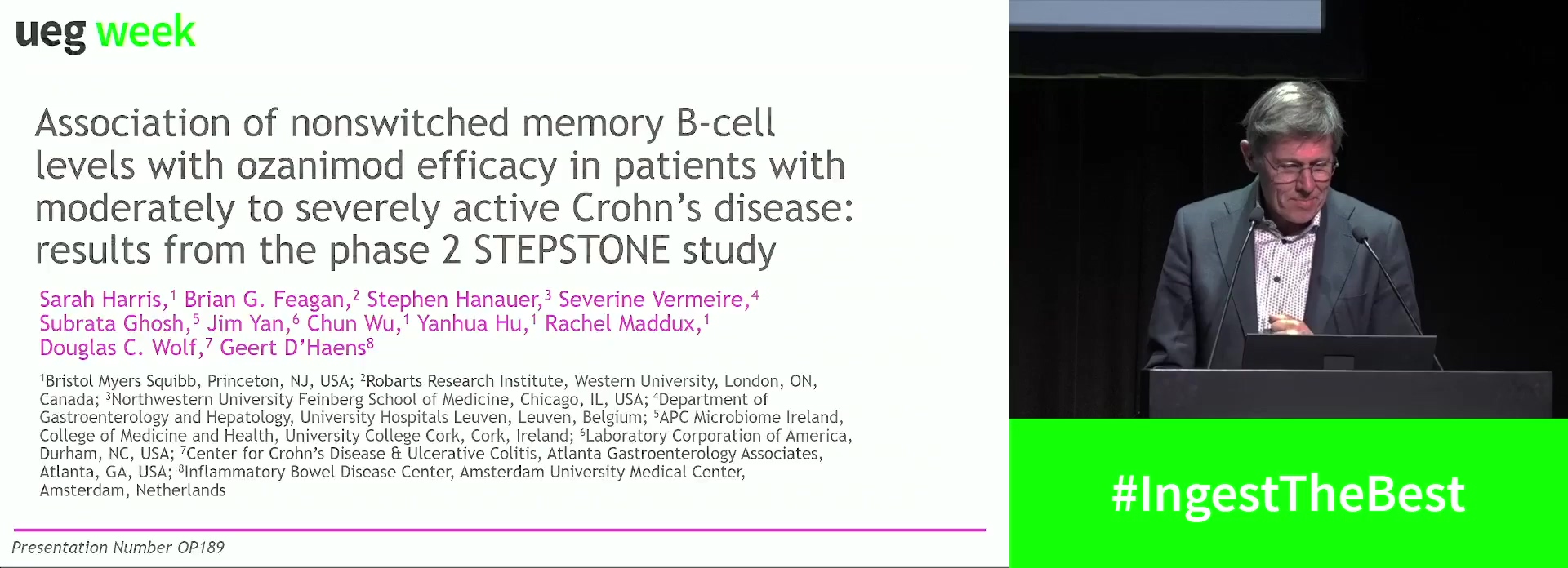
OZA, an oral selective sphingosine 1-phosphate receptor modulator, is approved for the treatment of moderately to severely active ulcerative colitis and is under investigation for CD. Clinical, endoscopic, and histologic improvements were observed after 12 wk of treatment with OZA in pts with moderately to severely active CD in the phase 2 STEPSTONE study. Differential decreases in circulating lymphocytes were observed in STEPSTONE, with reductions in T and B cells; however, natural killer cells and monocytes were unaffected. Circulating MBCs have not been widely studied in CD.
Aims & Methods
This exploratory analysis of STEPSTONE assessed the association between levels of circulating lymphocyte subsets and OZA efficacy. Pts received OZA 0.92 mg for 12 wk. Lymphocyte subsets were evaluated using multicolor flow analysis on blood samples collected before treatment and at Week (W) 12; differences between Day 1 and W12 were analyzed by Wilcoxon signed-rank tests. Change in disease activity from baseline to W12 was determined for Simple Endoscopic Score for Crohn’s Disease, size of ulcers, extent of ulcerated surface, extent of affected surface, presence of narrowing, Crohn’s Disease Activity Index (CDAI), Robart’s Histopathology Index (RHI), Geboes Histology Activity Score (GHAS), and stool frequency. Efficacy outcomes (ie, clinical response, clinical remission, endoscopic response, endoscopic remission, global GHAS remission, RHI remission, and RHI mucosal healing) were evaluated at W12. Associations of lymphocyte subset levels with disease activity changes and efficacy outcomes were assessed using Spearman’s correlation and logistic regression, respectively.
Results
Of the 69 pts enrolled, 52 had disease activity, efficacy outcome, and flow cytometry data at baseline and W12 and were included in this analysis. Most lymphocyte subsets assessed were significantly associated with 1 or 2 efficacy outcomes, whereas nonswitched MBCs were significantly associated with most outcomes, including endoscopic response-25, endoscopic response-50, endoscopic remission, global GHAS remission, and RHI mucosal healing (Table). Baseline levels of nonswitched MBCs were significantly correlated with change from baseline to W12 in extent of affected surface (Spearman’s rho = –0.44, P<0.05), RHI (Spearman’s rho = –0.34, P<0.05), and GHAS (Spearman’s rho = –0.47, P<0.05). Changes in levels of nonswitched MBCs were significantly correlated with change from baseline to W12 in CDAI (Spearman’s rho = 0.38, P<0.05), RHI (Spearman’s rho = 0.37, P<0.05), GHAS (Spearman’s rho = 0.43, P<0.05), and stool frequency (Spearman’s rho = 0.43, P<0.05).
Association of baseline lymphocytes with W12 efficacy
| Clinical responsea | Clinical remissionb
| Endoscopic response-25c | Endoscopic response-50d
| Endoscopic remissione | Global GHAS remissionf
| RHI
remissiong
| RHI mucosal
healingh
|
| CD4 EM T cell; CD8 CM T cell | NS; NS
| NS; NS
| NS; NS
| NS; NS
| NS; NS
| 0.0350
(–0.69); 0.0233
(–0.87)
| NS; NS
| NS; NS
|
CD8 skin-homing CCR4 EM cell
| NS
| NS
| NS
| NS
| NS
| NS
| 0.0155 (0.15)
| NS
|
CD8 TEMRA (fully differentiated)
| NS
| NS
| NS | NS
| 0.0484 (0.61)
| 0.0138 (0.95)
| NS
| NS
|
| Naive CD8+ T cell; CD8 EM T cell | NS; NS | NS; NS
| NS; NS
| 0.0449 (0.55); NS
| NS; NS | NS; 0.0344 (0.79)
| NS; NS
| NS; NS
|
B cell
| NS
| NS
| NS
| 0.0404 (0.68) | NS
| NS
| NS
| NS
|
| Nonswitched MBC | NS
| NS
| 0.0368 (0.52)
| 0.0046 (0.86) | 0.0163 (0.84)
| 0.0036 (1.20) | NS
| 0.0136 (0.95)
|
IgD-CD27 MBC
| NS
| NS
| NS
| NS
| NS
| 0.0159 (0.88)
| NS
| NS
|
MBC
| NS
| NS
| NS
| NS
| NS
| 0.0403 (0.76)
| NS
| NS
|
All lymphocyte subsets were measured in cells/µl. The values in each cell represent the P-value with logistic regression coefficient beta in parentheses. aCDAI reduction from baseline of ≥100 points. bCDAI score of <150. cDecrease of ≥25% in SES-CD from baseline. dDecrease of ≥50% in SES-CD from baseline. eSES-CD ≤4 points and SES-CD decrease ≥2 points with no SES-CD subscore >1 point. fNo active inflammation in any measured segment based on the GHAS. gNo active inflammation in any measured segment based on the RHI. hEndoscopic remission plus RHI remission.
CM, central memory; EM, effector memory; NS, not specified; SES-CD, Simple Endoscopic Score for Crohn’s Disease; TEMRA, terminally differentiated effector memory. |
Conclusion
After 12 wk of OZA treatment, higher levels of nonswitched MBCs at baseline were associated with endoscopic and histologic improvement, and reductions in nonswitched MBCs were associated with decreases in clinical and histologic disease activity. These data implicate nonswitched MBCs, which are involved in T cell–dependent immune responses and some inflammatory diseases, as a marker associated with OZA response in CD.
Disclosure
The study was funded by Bristol Myers Squibb, Princeton, NJ, USA.
SHar, CW, YH, and RM: employees and/or shareholders of Bristol Myers Squibb.
BGF: consulted for AbbVie, ActoGeniX, Albireo, Amgen, AstraZeneca, Avaxia Biologics, Baxter, Biogen Idec, Boehringer Ingelheim, Bristol Myers Squibb, Calypso, Celgene, Elan, Eli Lilly, enGene, Ferring Pharmaceuticals, Roche/Genentech, gIcare Pharma, Gilead, Given Imaging, GlaxoSmithKline, Ironwood, Janssen, Johnson & Johnson, Lexicon, Merck, Millennium, Nektar, Novo Nordisk, Pfizer, Prometheus Laboratories, Protagonist, Sanofi, and UCB; director at Robarts Clinical Trials.
SHan: consulted for AbbVie, Actavis, Boehringer Ingelheim, Bristol Myers Squibb, Caremark, Celgene, Ferring Pharmaceuticals, Janssen, Merck, Pfizer, Salix, Sanofi-Aventis, Shire, and UCB.
SV: received research funding from AbbVie, Galapagos, Johnson & Johnson, Pfizer, and Takeda; received consulting and/or speaking fees from AbbVie, Abivax, AbolerIS, AgomAb, Alimentiv, Arena, AstraZeneca, Avaxia, Bristol Myers Squibb, Boehringer Ingelheim, Celgene, CVasThera, Cytoki Pharma, Eli Lilly, Falk Pharma, Ferring, Galapagos, Genentech/Roche, Gilead, GlaxoSmithKline, Hospira, IMIDomics, Janssen, Johnson & Johnson, Materia Prima, MiroBio, Morphic Therapeutic, MRM Health, MSD, Mundipharma, Pfizer, ProDigest, Progenity, Prometheus, Robarts Clinical Trials, Second Genome, Shire, Surrozen, Takeda, Theravance, Tillotts Pharma AG, and Zealand.
SG: received research funding from AbbVie and GlaxoSmithKline; served as a lecturer for AbbVie, Celgene, Eli Lilly, Ferring, Galapagos, Gilead, Janssen, MSD, Pfizer, and Takeda; served as a consultant for AbbVie, Bristol Myers Squibb, Janssen, Novo Nordisk, Pfizer, Roche, and Takeda.
JY: employee and shareholder of Laboratory Corporation of America Holdings.
DCW: received honoraria as a speaker, consultant, and/or advisory board member from AbbVie, Arena, Celgene/Bristol Myers Squibb, Janssen, Pfizer, Prometheus, Takeda, and UCB.
GD: served as an advisor for AbbVie, Agomab Therapeutics, Alimentiv, Applied Molecular Therapeutics, AstraZeneca, Bristol Myers Squibb, Boehringer Ingelheim, Celltrion, Cytoki, Eli Lilly, Exeliom, Ferring, Galapagos, GlaxoSmithKline, Gossamer Bio, Immunic, Johnson & Johnson, Pfizer, Polpharma, ProciseDx, Progenity, Prometheus Biosciences, Prometheus Laboratories, Protagonist Therapeutics, Seres, Takeda, Tillotts, and Versant; received speaker fees from AbbVie, Bristol Myers Squibb, Eli Lilly, Galapagos, Johnson & Johnson, Pfizer, Takeda, and Tillotts.