Introduction
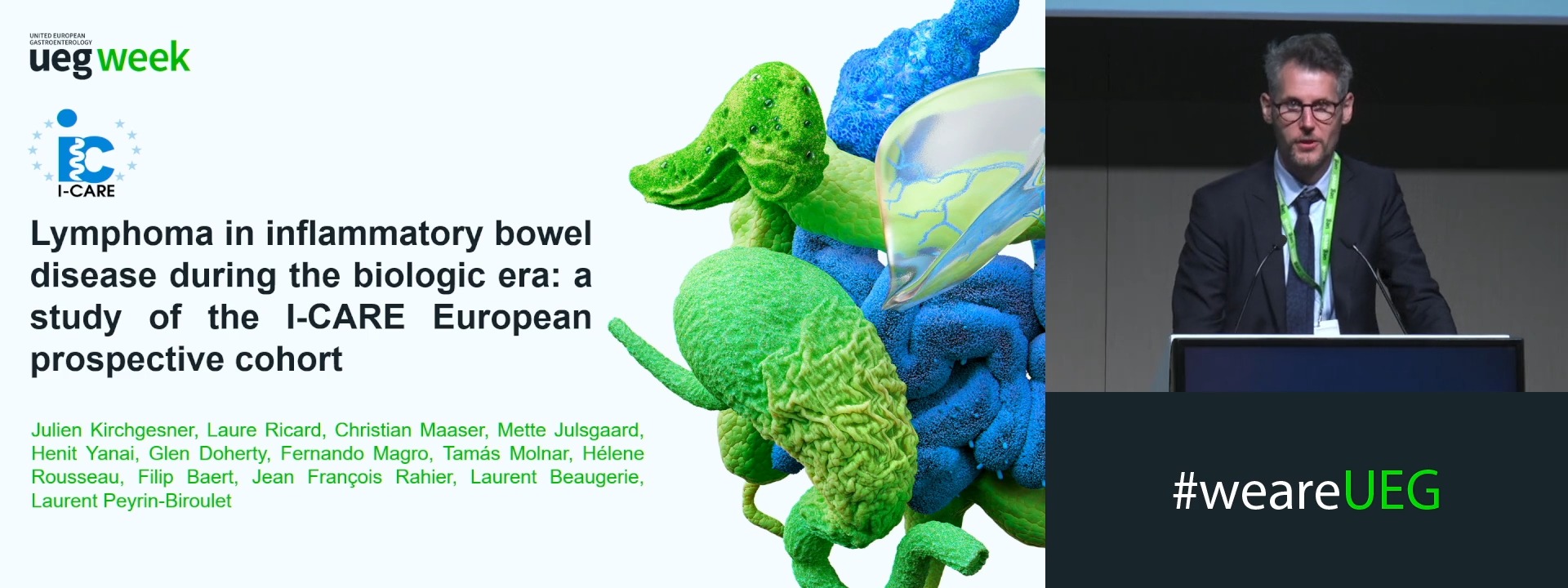
The risk of lymphoma in patients with inflammatory bowel disease (IBD) has been poorly assessed in the recent biologic era. No large-scale study has collected data on lymphoma-specific risk factors or extensive IBD disease characteristics and history. We assessed the risk of lymphoma and their characteristics in IBD compared to the general population in the European setting based on the I-CARE cohort.
Aims & Methods
The I-CARE cohort is a prospective cohort including IBD patients enrolled by 508 gastroenterologists from 15 countries between 2016 and 2019 (1). Patients provided monthly reports for up to six years including details of IBD treatment, clinical disease activity based on validated scores, colonoscopy procedures, and lymphoma diagnoses. Physicians yearly confirmed/completed patient’s information including disease status and therapies. Lymphoma diagnoses were confirmed based on pathological reports reviewed by an expert hematologist. For this analysis, patients with a previous history of lymphoma were excluded. Incidence of lymphoma in patients with IBD and expected incidence for each country, sex-, and 5-year age-specific stratum based on observed incidence from 2022 IARC estimates (2) were calculated.
Results
A total of 10 171 individuals with IBD (Crohn’s disease [CD], n=6149, 60.5%; ulcerative colitis [UC] and IBD unclassified [IBDu], n=4022, 39.5%) were included, among whom 5367 (52.8%) were females. During 31 152 person-years of follow-up, 13 patients with IBD were diagnosed with incident lymphoma, including 3 follicular, 3 Hodgkin, and 3 diffuse large B-cell lymphomas. Gastrointestinal involvement was observed at diagnosis in one follicular and one Hodgkin lymphoma. Two lymphomas were EBV positive. The overall incidence rate of lymphoma was of 0.42 cases per 1000 person-years. Patients with IBD (Standardized incidence ratio (SIR), 2.41; 95% confidence interval [95% CI] 1.28-4.12) had an increased risk of lymphoma overall (Table). Higher values of SIR were observed in patients aged less than 29 years (SIR, 5.41; 95% CI 0.61-19.55), male (SIR, 2.70; 95% CI, 1.23-5.13), and CD (SIR, 2.73; 95% CI, 1.18-5.39).
| Person-years
| Reported cases
| Expected cases
| SIR (95% CI)
| P value
|
|---|
IBD
| 31 152
| 13 | 5.40 | 2.41 (1.28-4.12)
| 0.008 |
UC/ IBDu
| 12 306
| 5 | 2.47 | 2.02 (0.65-4.72)
| 0.209 |
| CD | 18 846
| 8 | 2.93 | 2.73 (1.18-5.39)
| 0.022 |
Sex - Male
| 14 731
| 9 | 3.33 | 2.70 (1.23-5.13)
| 0.015 |
Sex - Female
| 16 421
| 4 | 2.07 | 1.93 (0.52-4.95)
| 0.309 |
Age - 15-29
| 6 217
| 2 | 0.37 | 5.41 (0.61-19.55)
| 0.112 |
Age - 30-44
| 12 726
| 3 | 1.15 | 2.62 (0.53-7.54)
| 0.227 |
Age - 45-59
| 8 908
| 5 | 1.79 | 2.79 (0.90-6.52)
| 0.072 |
Age - 60-74
| 3 050
| 3 | 1.82 | 1.65 (0.33-4.81)
| 0.546 |
Conclusion
In the biologic era, patients with IBD have a two-fold increased risk of lymphoma compared to the general population. Patients less than 29 years, males, and those with CD may represent a high-risk population. The determinants of this risk, including IBD disease activity and treatment exposure, are being investigated.
References
1. Peyrin-Biroulet L, Rahier JF, Kirchgesner J, Abitbol V, Shaji S, Armuzzi A, et al. Clin Gastroenterol Hepatol 2023;21(3):771-788.e10.
2. International Agency for research on Cancer. 2022 estimates of the incidence of 36 specific cancer types in 185 countries. https://gco.iarc.fr/today/en/about#about-cancer-today.
Disclosure
Julien Kirchgesner received consulting and/or speaker fees from Abbvie, Amgen, Alfasigma, Biosynex, Celltrion, Ferring, Galapagos, Janssen, Johnson & Johnson, Lilly, MSD, Takeda, Theradiag, Tillots, Pfizer, and Resilience. Christian Maaser declares consulting/speaker fees from AbbVie, Alfasigma, Biogen, Bristol Myers Squibb, Eli Lilly, Falk Foundation, Ferring, Galapagos, Gilead, Lilly, J&J, Pfizer, Samsung and Takeda. Mette Julsgaard declares consulting/speaker fees from Ferring, Takeda, MSD, Janssen, AbbVie, PharmaCosmos, Eli Lilly and Tillots Pharma. Henit Yanai declares consulting/speaker fees from Abbvie, Janssen, Pfizer, Takeda, Bristol Myers Squibb, and Eli Lilly. Glen Doherty declares consulting/speaker fees from Abbvie, Alfasigma, Celltrion, Lilly, Pfizer, and Takeda. Fernando Magro declares consulting/speaker fees from AbbVie, Arena, Biogen, Bristol Myers Squibb, Falk, Ferring, Hospira, Janssen, Laboratórios Vitoria, Pfizer, Eli Lilly, Merck Sharp & Dohme, Sandoz, Takeda, UCB and Vifo. Tamás Molnar declares consulting/speaker fees from MSD, AbbVie, Egis, Goodwill Pharma, Takeda, Pfizer, Janssen, Sandoz, MundiPharma, Phytotec, Roche, Fresenius, and Teva. Filip Baert declares consulting/speaker fees from AbbVie, Amgen, Arena Pharmaceuticals, Celgene, Ferring, Fresenius Kabi, Galapagos, Janssen, Merck, Pfizer, and Takeda. Jean-Francois Rahier declares consulting/speaker fees from Abbvie, Takeda, Hospira, Mundipharma, MSD, Pfizer, GlaxoSK, Janssen, Takeda, Galapagos, Ferring, Falk, Biogen, Amgen, Celltrion, and Lilly. Laurent Beaugerie declares consulting/speaker fees from Takeda, Janssen, Nordic Pharma, and Viatris. Laurent Peyrin-Biroulet declares consulting/speaker fees from Protagonist, Roche, Samsung, Sandoz, Sanofi, Satisfay, Takeda, Telavant, Theravance, Thermo Fischer, Tigenix, Tillots, Viatris, Vectivbio, Ventyx, Ysopia. Other authors have no conflicts of interest to disclose.
The I-CARE cohort was supported by following partners: Abbvie; Amgen; Ferring; Pfizer; Janssen; MSD; Takeda.