UEG's educational platform for gastroenterology education bringing recordings, courses, guidelines, and more together in one place.
Most popular content
Rate for better recommendations!
Your feedback helps us show you more of what you like and less of what you dislike!
Log in to access this content.
Free for all myUEG account holders. Your access level is set automatically based on your occupation. Medical professionals get full access to all content. If you are a non-medical user, you can only access UEG Week content from congresses you attended.
Not sure what you can access? Learn more about account types.

SHOULD GASTROINTESTINAL BLEEDING AND IMPAIRED MENTAL STATUS BE CONSIDERED ORGAN FAILURE IN PATIENTS WITH ACUTE PANCREATITIS?
Lucía Guilabert 1, Karina Cárdenas-Jaén 1, Lorena Bernal 1, Jose Alberto Andreu Viseras 1, Sara Pérez-Brotons 1, Alicia Vaillo-Rocamora 1, Laura Sempere Robles 1, Enrique de-Madaria 2
1 Dr. Balmis General University Hospital, ISABIAL, Alicante, Spain
2 Dr. Balmis General University Hospital, ISABIAL, Alicante, Spain|||Miguel Hernández University, Elche, Spain
Conference
Topics
Submission format
Session
Citation
Published
Log in to access this content.
Free for all myUEG account holders. Your access level is set automatically based on your occupation. Medical professionals get full access to all content. If you are a non-medical user, you can only access UEG Week content from congresses you attended.
Not sure what you can access? Learn more about account types.
THE ROLE AND UPTAKE OF DRUG AND ALCOHOL SERVICES AMONG PATIENTS WITH ALCOHOL-ASSOCIATED ACUTE PANCREATITIS ADMITTED TO A TERTIARY HEALTH SERVICE
Cindy Ho 1, Alexander Mitropoulos 1, Jeremy Tse 1, Bowen Xia 1, Blake McLeod 1, Olivia Slifirski 1, David Jacka 1, Simon Hew 1
1 Monash Health, Melbourne, Australia
Conference
Topics
Submission format
Session
Citation
Published
Log in to access this content.
Free for all myUEG account holders. Your access level is set automatically based on your occupation. Medical professionals get full access to all content. If you are a non-medical user, you can only access UEG Week content from congresses you attended.
Not sure what you can access? Learn more about account types.
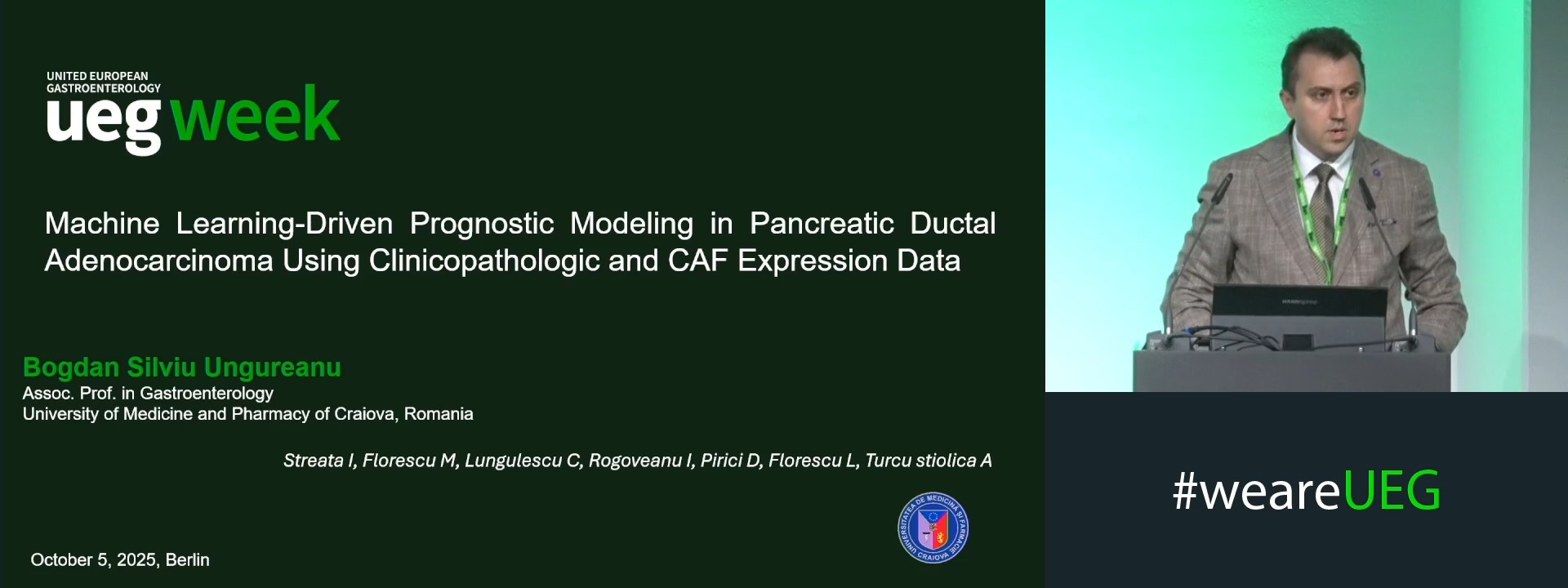
MACHINE LEARNING-DRIVEN PROGNOSTIC MODELING IN PANCREATIC DUCTAL ADENOCARCINOMA USING CLINICOPATHOLOGIC AND CAF EXPRESSION DATA
Bogdan Ungureanu 1, Ioana Streata 2, Mirela Florescu 2, Cristian Lungulescu 2, ION ROGOVEANU 2, Daniel Pirici 2, Lucian Florescu 2, Adina Turcu-Stiolica 2
1 University of Medicine and Pharmacy of Craiova, Craiova, Romania
2 University of Medicine and Pharmacy of Craiova Romania, Craiova, Romania
Event
Topics
Submission format
Citation
Published
Log in to access this content.
Free for all myUEG account holders. Your access level is set automatically based on your occupation. Medical professionals get full access to all content. If you are a non-medical user, you can only access UEG Week content from congresses you attended.
Not sure what you can access? Learn more about account types.
COMPACT PANCREATIC ACINI-SPECIFIC ENHANCER-PROMOTER FOR PANCREATIC GENE THERAPY
1 Changhai Hospital, Shanghai, China
Conference
Topics
Submission format
Session
Citation
Published
Log in to access this content.
Free for all myUEG account holders. Your access level is set automatically based on your occupation. Medical professionals get full access to all content. If you are a non-medical user, you can only access UEG Week content from congresses you attended.
Not sure what you can access? Learn more about account types.
PREDICTING EUS-FNB ADEQUACY WITH VISUAL ON-SITE EVALUATION (VOSE): TOWARD SMARTER PANCREATIC BIOPSIES
Oussama Nacir 1, Fatima Ezzahra Lairani 1, Adil Ait Errami 1, Sofia Oubaha 1, Zouhour Samlani 2, Khadija Krati 1
1 Mohammed VI University Hospital, Marrakech, Morocco|||Faculty of Medicine and Pharmacy, Cadi Ayyad University, Marrakech, Morocco
2 Mohammed VI University Hospital, Marrakech, Morocco
Conference
Topics
Submission format
Session
Citation
Published
Log in to access this content.
Free for all myUEG account holders. Your access level is set automatically based on your occupation. Medical professionals get full access to all content. If you are a non-medical user, you can only access UEG Week content from congresses you attended.
Not sure what you can access? Learn more about account types.
MODELING PRESSURE-TRIGGERED PANCREATIC INFLAMMATION USING HUMAN POLARITY-SWITCHED ORGANOIDS
Aletta Kata Kiss 1, Arpad Varga 1, György Lázár 2, Gergely Groma 3, Ferenc Kagan 4, Petra Pallagi 1, József Maléth 1
1 University of Szeged, Szeged, Hungary|||University of Szeged, Szeged, Hungary|||University of Szeged, Szeged, Hungary
2 University of Szeged, Szeged, Hungary
3 University of Szeged, Szeged, Hungary|||University of Szeged, Szeged, Hungary
4 Max Planck Institute for Multidisciplinary Sciences, Göttingen, Germany
Conference
Topics
Submission format
Session
Citation
Published
Log in to access this content.
Free for all myUEG account holders. Your access level is set automatically based on your occupation. Medical professionals get full access to all content. If you are a non-medical user, you can only access UEG Week content from congresses you attended.
Not sure what you can access? Learn more about account types.
IMPACT OF MACROSCOPIC ON-SITE EVALUATION (MOSE) ON ACCURACY OF ENDOSCOPIC ULTRASOUND-GUIDED FINE-NEEDLE BIOPSY (EUS-FNB) OF SOLID LESIONS: A RANDOMISED CONTROLLED TRIAL.
1 HCA, Algiers, Algeria
Conference
Topics
Submission format
Session