UEG's content platform for gastroenterology education bringing recordings, courses, guidelines, and more together in one place.
Trending on Gutflix
Rate for better recommendations!
Your feedback helps us show you more of what you like and less of what you dislike!
Log in to continue.
This content is part of Gutflix. Log in with your myUEG account, or create one free, to watch it.
Not sure what you can access? Learn more about account types.
PREVENTION OF DELAYED POST-POLYPECTOMY HEMORRHAGE BY DOPPLER ENDOSCOPIC PROBE MONITORING AND FOCAL BLOOD FLOW ABLATION IN A RANDOMIZED CONTROLLED TRIAL
Affiliations
1 University of California Los Angeles, Santa Monica, United States
2 Harbor-UCLA Medical Center, Torrance, United States
3 Kaiser Permanente, Downey, United States
4 West Los Angeles Veterans Administration Medical Center, Los Angeles, United States
5 University of California Los Angeles, Los Angeles, United States
Log in to continue.
This content is part of Gutflix. Log in with your myUEG account, or create one free, to watch it.
Not sure what you can access? Learn more about account types.
Exocrine pancreatic insufficiency: is there a pancreas-liver axis?
Affiliations
1 Mayo Clinic, Rochester, United States of America
Log in to continue.
This content is part of Gutflix. Log in with your myUEG account, or create one free, to watch it.
Not sure what you can access? Learn more about account types.
DETERMINANTS OF NEOPLASIA YIELD AT THE FIRST SURVEILLANCE COLONOSCOPY: THE IMPACT OF ENDOSCOPIST'S ADR
Stefano Rousset 1,2, Gianluigi Ferrante 1, Marco Silvani 1, Marco Calcagno 1, Cristiano Piccinelli 1, Annalisa Castella 3, Dario Mazzucco 4, Arrigo Arrigoni 5, Fabiana Venezia 6, Lorenzo Marcello Orione 7, Vittoria Grammatico 8, Paola Cassoni 9, Maria Caterina Maconi 10, Cesare Hassan 11, Carlo Senore 1
Affiliations
1 University Hospital Città della Salute e della Scienza, Torino, Italy
2 School of Specialization in Statistics and Biometry, University of Turin, Torino, Italy
3 ASL TO3 Piedmont, Collegno (To), Italy
4 Ospedale di Rivoli, Rivoli (To), Italy
5 IRCCS Candiolo, Candiolo (To), Italy
6 ASL TO4 Piedmont, Chivasso (To), Italy
7 ASL CN1 Piedmont, Cuneo, Italy
8 ASL TO5 Piedmont, Chieri (To), Italy
9 University of Turin, Torino, Italy
10 ASL AL Piedmont, Alessandria, Italy
11 Humanitas University, Pieve Emanuele MI, Italy
Log in to continue.
This content is part of Gutflix. Log in with your myUEG account, or create one free, to watch it.
Not sure what you can access? Learn more about account types.
TEXTBOOK OUTCOMES OF EUS-GUIDED HEPATICOGASTROSTOMY ACCORDING TO INDICATION AND PRESENTING ANATOMY: A PROSPECTIVE COHORT STUDY
Giuseppe Vanella 1,2, Rosa Claudia Stasio 1,3, Rukaia Barà 1,2, Giuseppe Marzocca 1,2, Diego Palumbo 2,1, Francesco Frigo 1,3, Andrea Casadei-Gardini 2,1, Francesco De Cobelli 2,1, Michele Reni 2,1, Massimo Falconi 2,1, Paolo Giorgio Arcidiacono 1,2
Affiliations
1 IRCCS San Raffaele Scientific Institute, Milan, Italy
2 Vita-Salute San Raffaele University, Milan, Italy
3 University of Turin, Turin, Italy
Log in to continue.
This content is part of Gutflix. Log in with your myUEG account, or create one free, to watch it.
Not sure what you can access? Learn more about account types.
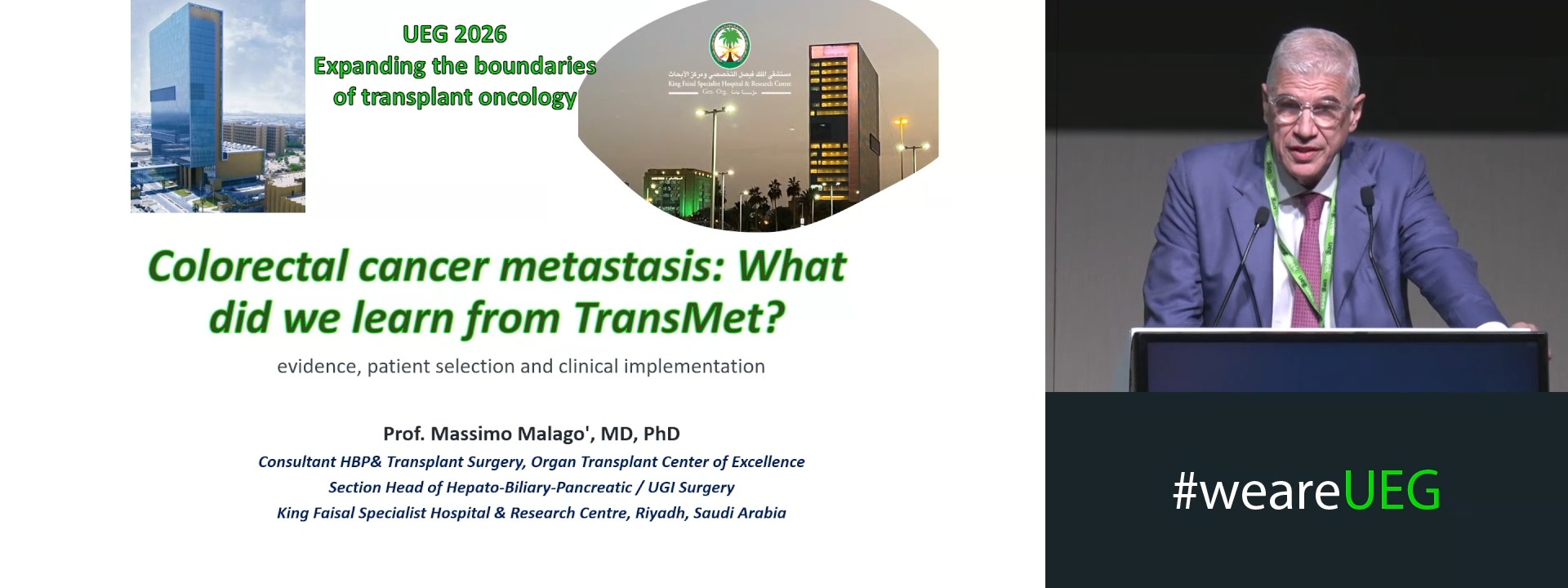
Colorectal cancer metastasis: What did we learn from TransMet?
Log in to continue.
This content is part of Gutflix. Log in with your myUEG account, or create one free, to watch it.
Not sure what you can access? Learn more about account types.
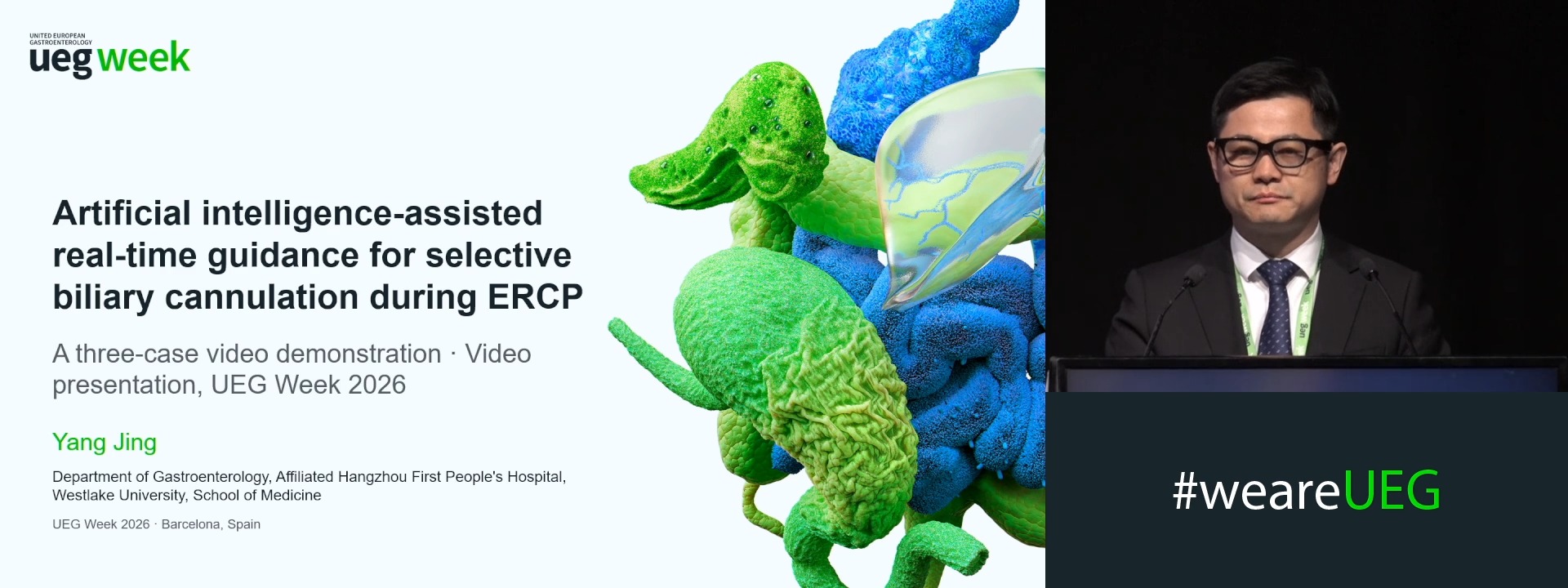
ARTIFICIAL INTELLIGENCE FOR PROCEDURAL GUIDANCE IN ERCP: A VIDEO DEMONSTRATION STUDY
Affiliations
1 Hangzhou First People's Hospital, Hangzhou, China
2 Affiliated Hangzhou First People's Hospital, School of Medicine, Westlake University, Hangzhou, China