UEG's content platform for gastroenterology education bringing recordings, courses, guidelines, and more together in one place.
Trending on Gutflix
Rate for better recommendations!
Your feedback helps us show you more of what you like and less of what you dislike!
Log in to continue.
This content is part of Gutflix. Log in with your myUEG account, or create one free, to watch it.
Not sure what you can access? Learn more about account types.
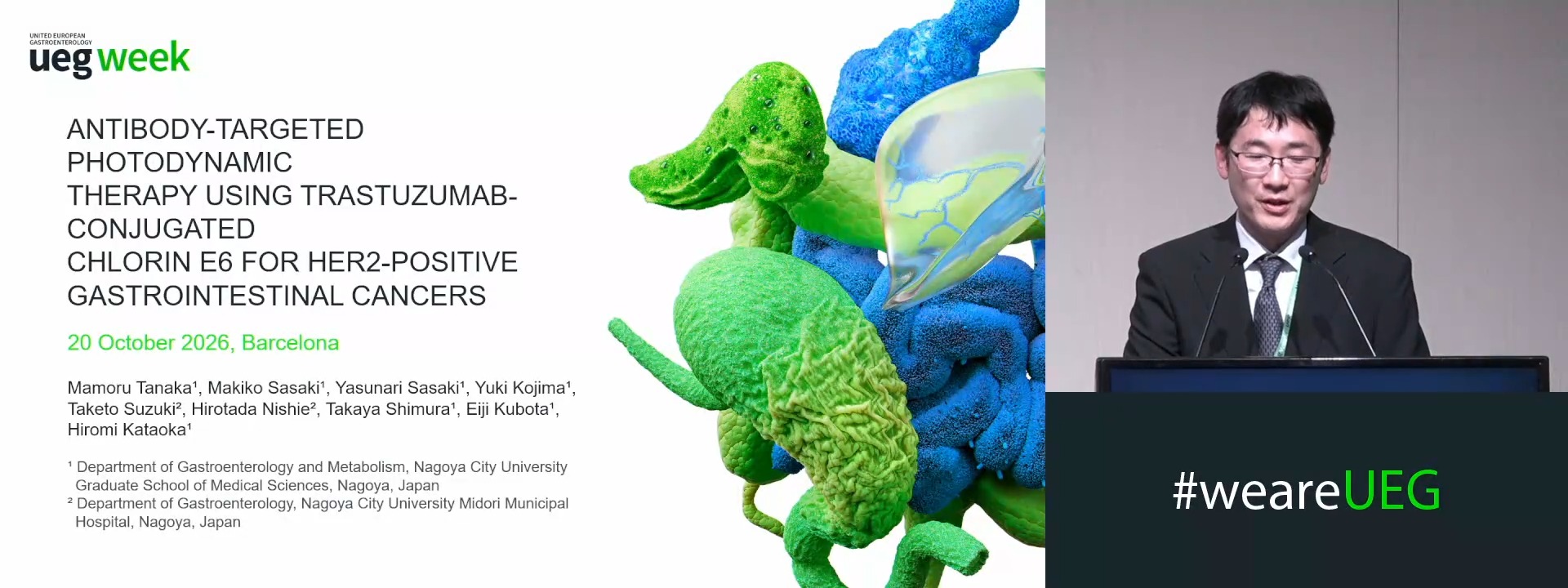
ANTIBODY-TARGETED PHOTODYNAMIC THERAPY USING TRASTUZUMAB-CONJUGATED CHLORIN E6 FOR HER2-POSITIVE GASTROINTESTINAL CANCERS
Mamoru Tanaka 1, Makiko Sasaki 1, Yasunari Sasaki 1, Yuki Kojima 1, Taketo Suzuki 2, Hirotada Nishie 2, Takaya Shimura 1, Eiji Kubota 1, Hiromi Kataoka 1
Affiliations
1 Nagoya City University Graduate School of Medical Sciences, Nagoya, Japan
2 Nagoya City University Midori Municipal Hospital, Nagoya, Japan
Log in to continue.
This content is part of Gutflix. Log in with your myUEG account, or create one free, to watch it.
Not sure what you can access? Learn more about account types.
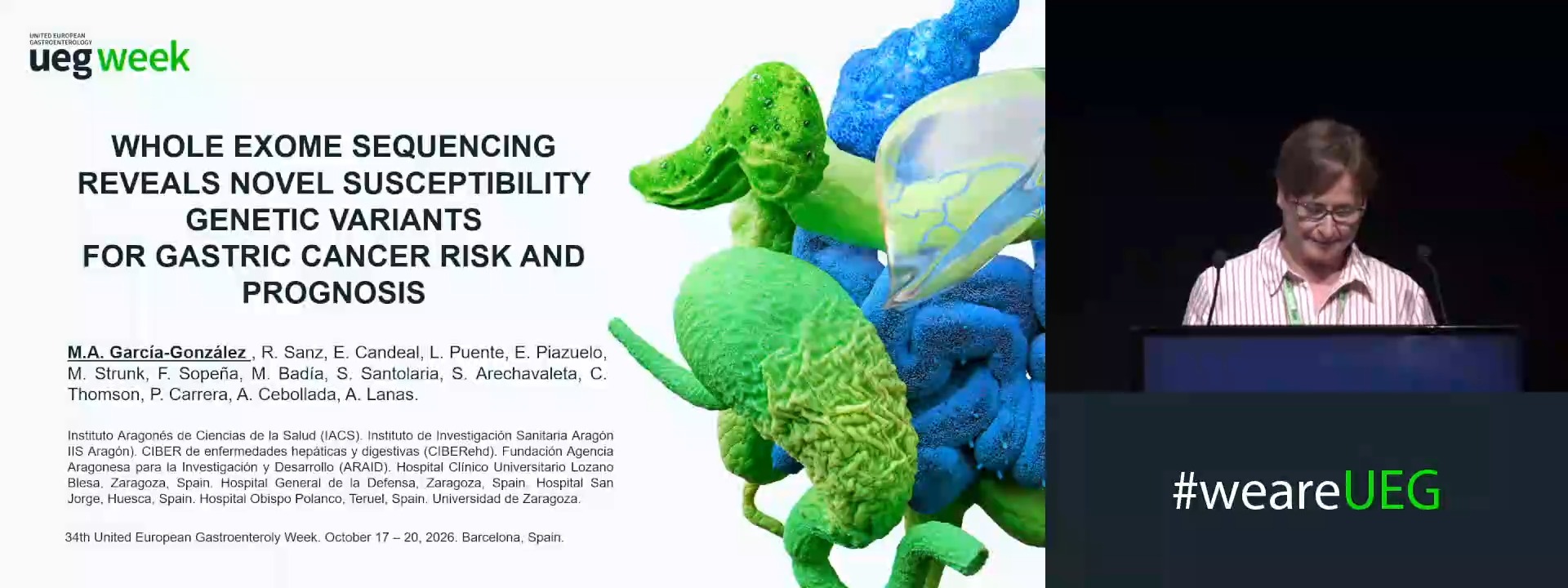
WHOLE EXOME SEQUENCING REVEALS NOVEL SUSCEPTIBILITY GENETIC VARIANTS FOR GASTRIC CANCER RISK AND PROGNOSIS
María Asunción García-González 1,2,3, Rebeca Sanz Pamplona 2,4, Eduardo Candeal Núñez 2, Laura Puente Santamaría 1, Elena Piazuelo Ortega 1,2,3, Mark Strunk 1, Federico Sopena 2,5,3, MARIA BADIA 6, Santos Santolaria Piedrafita 7, Samanta Arechavaleta 3,2, Concha Thomson Llisterri 8, Patricia Carrera-Lasfuentes 3, Alberto Cebollada 1, Angel Lanas 2,3,9
Affiliations
1 Instituto Aragonés de Ciencias de la Salud, Zaragoza, Spain
2 Instituto de Investigación Sanitaria Aragón, Zaragoza, Spain
3 CIBER de enfermedades hepáticas y digestivas (CIBERehd), Zaragoza, Spain
4 Fundación Agencia Aragonesa para la Investigación y Desarrollo (ARAID), Zaragoza, Spain
5 Hospital Clínico Universitario Lozano Blesa, Zaragoza, Spain
6 Hospital General de la Defensa, Zaragoza, Spain
7 Hospital San Jorge, Huesca, Spain
8 Hospital Obispo Polanco, Teruel, Spain
9 Universidad de Zaragoza, Zaragoza, Spain
Log in to continue.
This content is part of Gutflix. Log in with your myUEG account, or create one free, to watch it.
Not sure what you can access? Learn more about account types.
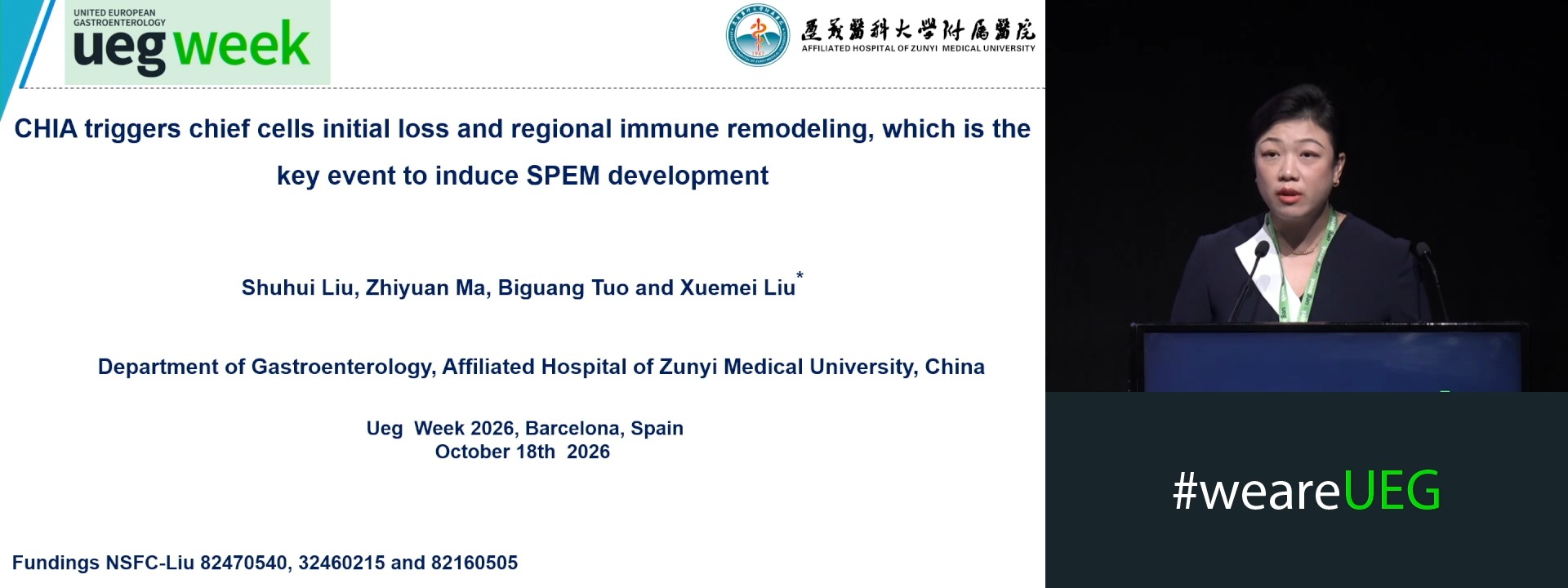
NON-ENZYMATIC ACTIVITY OF CHIA TRIGGERS CHIEF CELL INITIAL LOSS AND REGIONAL IMMUNE REMODELING, WHICH IS THE KEY EVENT TO INDUCE SPEM DEVELOPMENT
Affiliations
1 Department of Gastroenterology, Digestive Disease Hospital, Affiliated Hospital of Zunyi Medical University, Zunyi, China
2 Department of General Surgery, Department of Thyroid and Breast Surgery, Affiliated Hospital of Zunyi Medical University, Zunyi, China