UEG's educational platform for gastroenterology education bringing recordings, courses, guidelines, and more together in one place.
Most popular content
Rate for better recommendations!
Your feedback helps us show you more of what you like and less of what you dislike!
Log in to access this content.
Free for all myUEG account holders. Your access level is set automatically based on your occupation. Medical professionals get full access to all content. If you are a non-medical user, you can only access UEG Week content from congresses you attended.
Not sure what you can access? Learn more about account types.

WHEN ONE DISEASE ISN’T ENOUGH: A RARE COMBINATION OF REFRACTORY ULCERATIVE COLITIS, PRIMARY SCLEROSING CHOLANGITIS CIRRHOSIS, AND UNEXPECTED GASTROINTESTINAL POLYPOSIS IN AN ADOLESCENT
Imane Zouaki 1, Saliath Assani 1, AIT ERRAMI ADIL 1, Oussama Nacir 1, Fatima Ezzahra Lairani 1, Zouhour Samlani 1, Sofia Oubaha 1, Khadija Krati 1
1 Mohammed VI University Hospital, Marrakech, Morocco
Conference
Topics
Submission format
Session
Published
Log in to access this content.
Free for all myUEG account holders. Your access level is set automatically based on your occupation. Medical professionals get full access to all content. If you are a non-medical user, you can only access UEG Week content from congresses you attended.
Not sure what you can access? Learn more about account types.
Summary: Autoimmune disease of liver and bile ducts
1 Klinikum rechts der Isar, München, Germany
Event
Topics
Citation
Published
Log in to access this content.
Free for all myUEG account holders. Your access level is set automatically based on your occupation. Medical professionals get full access to all content. If you are a non-medical user, you can only access UEG Week content from congresses you attended.
Not sure what you can access? Learn more about account types.
Difficult stones: Is it the stone or the endoscopist?
1 San Matteo Hospital, Pavia, Italy
Event
Topics
Citation
Published
Log in to access this content.
Free for all myUEG account holders. Your access level is set automatically based on your occupation. Medical professionals get full access to all content. If you are a non-medical user, you can only access UEG Week content from congresses you attended.
Not sure what you can access? Learn more about account types.
BILE LIQUID BIOPSY IN PANCREATOBILIARY TUMORS: A NOVEL APPROACH TO DETECT ACTIONABLE MUTATIONS
Javier Rández-Garbayo 1, Maria Rullan Iriarte 2, Diary Fall 3, Silvia Pinto Martínez 2, Patricia de Miguel 2, David Ruiz-Clavijo Garcia 2, Belen GONZÁLEZ DE LA HIGUERA CARNICER 2, Federico Bolado Concejo 2, Daniel Oyón 4, Irene Amat 2, David Guerrero-Setas 2, Ana Purroy 1, Juan Carrascosa Gil 2, Vanesa Jusué Irurita 2, Ignacio Fernández-Urién Sainz 2, María Arechederra 5, Carmen Berasain 5, Juan Jose Vila 2, Matias A. Avila 5, Jesús M. Urman 2
1 Navarrabiomed, Pamplona, Spain|||Navarra Institute for Health Research, IdiSNA, Pamplona, Spain
2 Navarra University Hospital, Pamplona, Spain|||Navarra Institute for Health Research, IdiSNA, Pamplona, Spain
3 Navarra University Hospital, Pamplona, Spain
4 Hospital General Universitario Gregorio Marañón, Madrid, Spain|||Navarra Institute for Health Research, IdiSNA, Pamplona, Spain
5 Center of Applied Medicine (CIMA) / University of Navarra, Pamplona, Spain|||Navarra Institute for Health Research, IdiSNA, Pamplona, Spain
Event
Submission format
Citation
Published
Log in to access this content.
Free for all myUEG account holders. Your access level is set automatically based on your occupation. Medical professionals get full access to all content. If you are a non-medical user, you can only access UEG Week content from congresses you attended.
Not sure what you can access? Learn more about account types.
INNOVATIVE ERCP TRAINING: BRIDGING EDUCATIONAL GAPS WITH NEXT-GENERATION 3D-PRINTED SIMULATORS
Oguz Ozturk 1, Mucahit Ergul 1, Yavuz Çağır 2, Ali Atay 1, Muhammed bahaddin Durak 3, ilhami yuksel 4
1 Ankara Bilkent City Hospital, Ankara, Türkiye
2 Ankara Yildirim Beyazit University Yenimahalle Training and Research Hospital, Ankara, Türkiye
3 Ankara Hacettepe University, Ankara, Türkiye
4 Ankara Bilkent City Hospital, Ankara, Türkiye|||Ankara Yildirim Beyazit University School of Medicine, Ankara, Türkiye
Conference
Topics
Submission format
Session
Citation
Published
Log in to access this content.
Free for all myUEG account holders. Your access level is set automatically based on your occupation. Medical professionals get full access to all content. If you are a non-medical user, you can only access UEG Week content from congresses you attended.
Not sure what you can access? Learn more about account types.
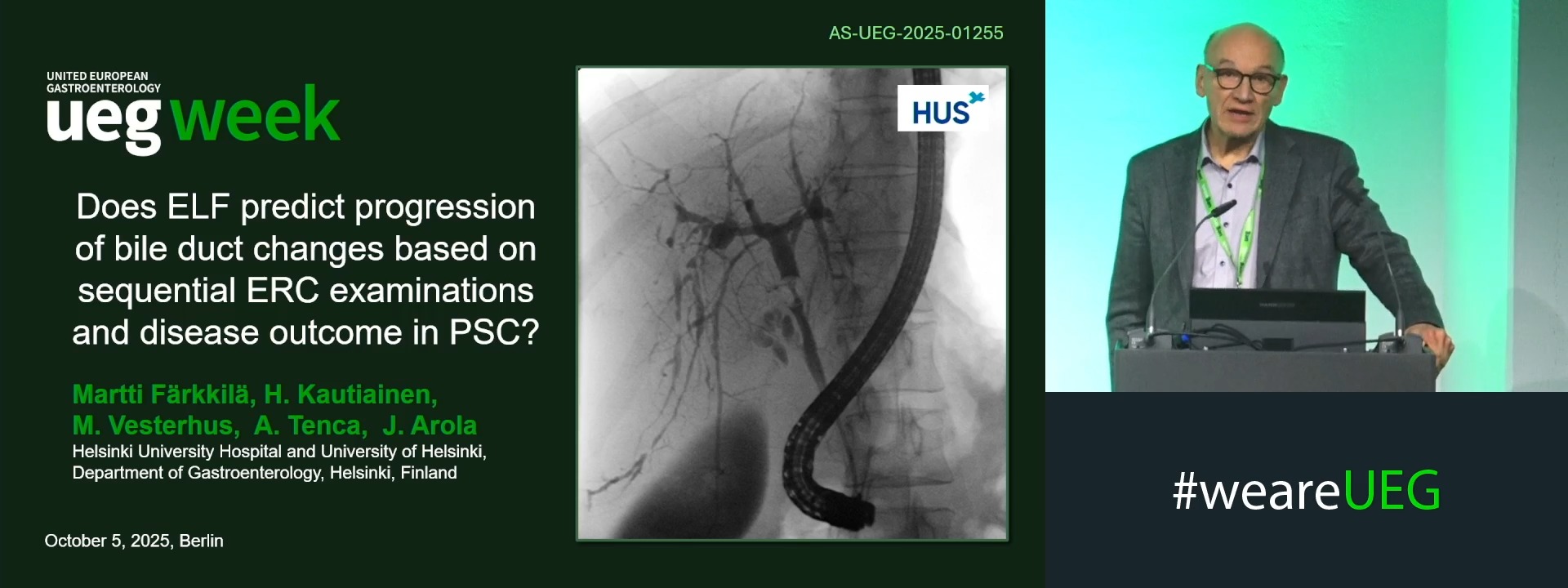
DOES ELF PREDICT PROGRESSION BILE DUCT CHANGES BASED ON SEQUENTIAL ERC EXAMINATIONS AND DISEASE OUTCOME IN PSC?
1 Helsinki University Hospital, Helsinki, Finland
2 University of Eastern Finland, Kuopio, Finland
3 Haraldsplass Deaconess Hospital, Bergen, Norway
4 Clinic of Gastroenterology - Helsinki University Hospital, Helsinki, Finland
5 University of Helsinki, Helsinki, Finland
Event
Submission format
Citation
Published
Log in to access this content.
Free for all myUEG account holders. Your access level is set automatically based on your occupation. Medical professionals get full access to all content. If you are a non-medical user, you can only access UEG Week content from congresses you attended.
Not sure what you can access? Learn more about account types.
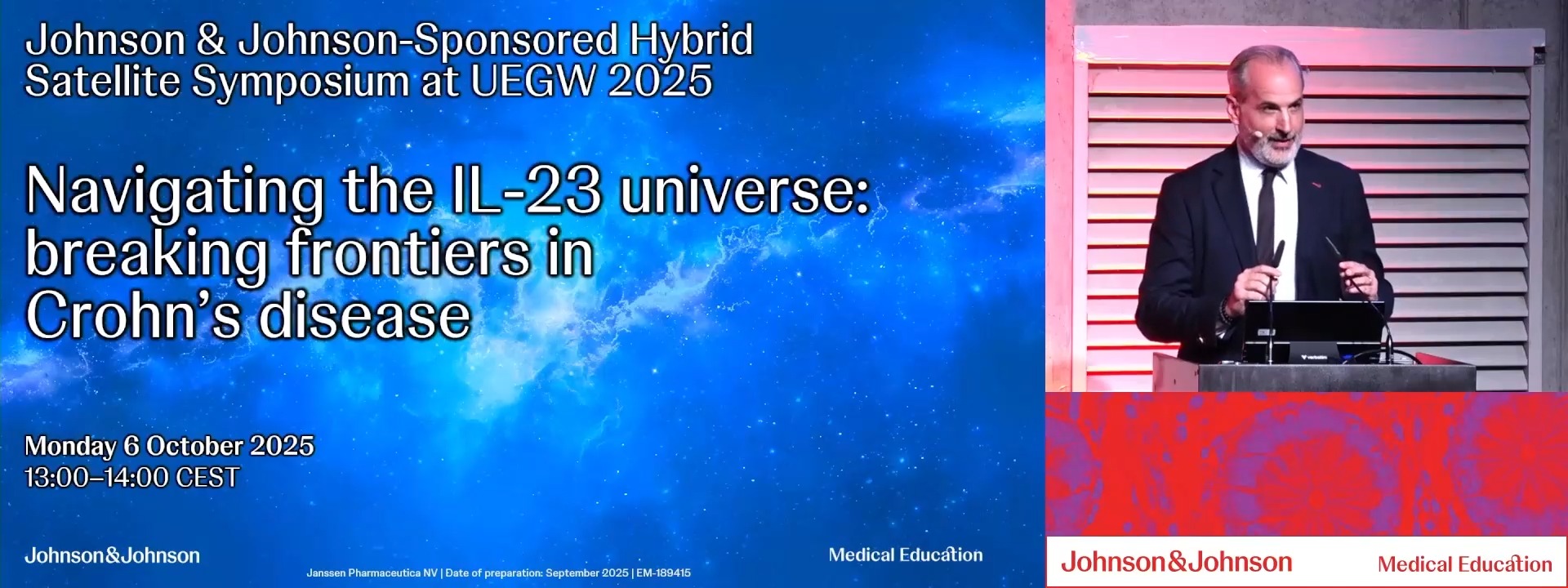
Navigating the IL-23 universe: breaking frontiers in Crohn’s disease (Johnson and Johnson) (Complete Session)
Alessandro Armuzzi 1, Laurent Peyrin-Biroulet 2, David T. Rubin 3, Yamile Zabana 4, Sebastian Zeissig 5
1 IRCCS Humanitas Research Hospital, Rozzano, Italy
2 Inserm NGERE and University of Lorraine, Vandœuvre-lès-Nancy, France
3 The University of Chicago Medicine, Chicago, United States of America
4 Hospital Universitari Mútua Terrassa, Terrassa, Spain
5 Inselspital - Bern University Hospital, Bern, Switzerland