UEG's content platform for gastroenterology education bringing recordings, courses, guidelines, and more together in one place.
Trending on Gutflix
Rate for better recommendations!
Your feedback helps us show you more of what you like and less of what you dislike!
Log in to continue.
This content is part of Gutflix. Log in with your myUEG account, or create one free, to watch it.
Not sure what you can access? Learn more about account types.
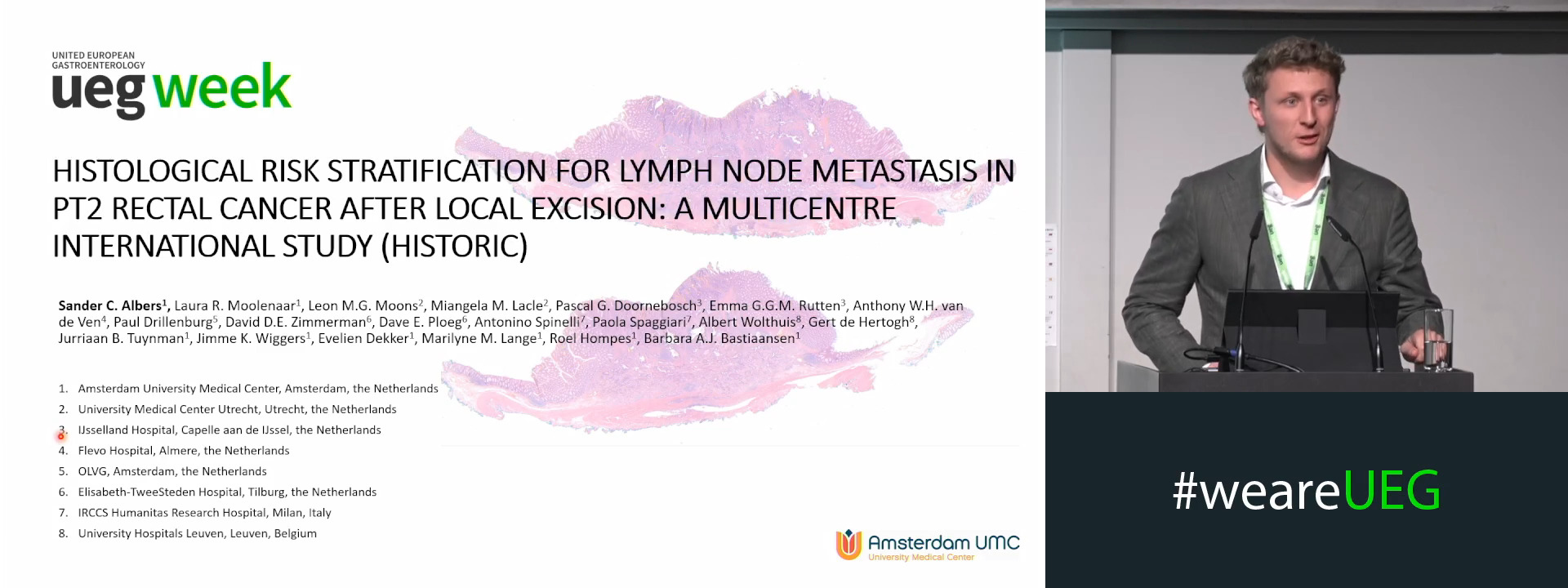
HISTOLOGICAL RISK STRATIFICATION FOR LYMPH NODE METASTASIS IN PT2 RECTAL CANCER AFTER LOCAL EXCISION: A MULTICENTRE INTERNATIONAL STUDY
Sander C. Albers 1, Laura Moolenaar 1, Leon M.G. Moons 2, Miangela M. Lacle 2, Pascal G. Doornebosch 3, Emma G.G.M. Rutten 3, Anthony W.H. van de Ven 4, Paul Drillenburg 5, David D.E. Zimmerman 6, Dave E. Ploeg 6, Antonino Spinelli 7, Paola Spaggiari 7, Albert Wolthuis 8, Gert De Hertogh 8, Jurriaan Tuynman 1, Jimme Wiggers 1, Evelien Dekker 1, Marilyne M. Lange 1, Roel Hompes 1, Barbara A.J. Bastiaansen 1
Affiliations
1 Amsterdam University Medical Center, Amsterdam, Netherlands
2 University Medical Center Utrecht, Utrecht, Netherlands
3 IJsselland Hospital, Capelle aan de IJssel, Netherlands
4 Flevo Hospital, Almere, Netherlands
5 OLVG, Amsterdam, Netherlands
6 Elisabeth-TweeSteden Hospital, Tilburg, Netherlands
7 IRCCS Humanitas Research Hospital, Milan, Italy
8 University Hospital Leuven, Leuven, Belgium

Log in to continue.
This content is part of Gutflix. Log in with your myUEG account, or create one free, to watch it.
Not sure what you can access? Learn more about account types.
RISK OF OCCULT LYMPH NODE METASTASIS IN PT2 RECTAL CANCER: A NATIONWIDE RETROSPECTIVE ANALYSIS
Sander C. Albers 1, Ritch Geitenbeek 2, Eline G M van Geffen 1, Tania C Sluckin 1, Sanne-Marije Hazen 1, Miranda Kusters 1, Pieter J. Tanis 3, Esther C.J. Consten 4, Evelien Dekker 1, Barbara A.J. Bastiaansen 1, Jimme Klaas Wiggers 1, Roel Hompes 1
Affiliations
1 Amsterdam University Medical Centers, Amsterdam, Netherlands
2 University Medical Center Groningen, Haren, Netherlands
3 Leiden University Medical Center, Leiden, Netherlands
4 Meander Medisch Centrum, Amersfoort, Netherlands