Introduction
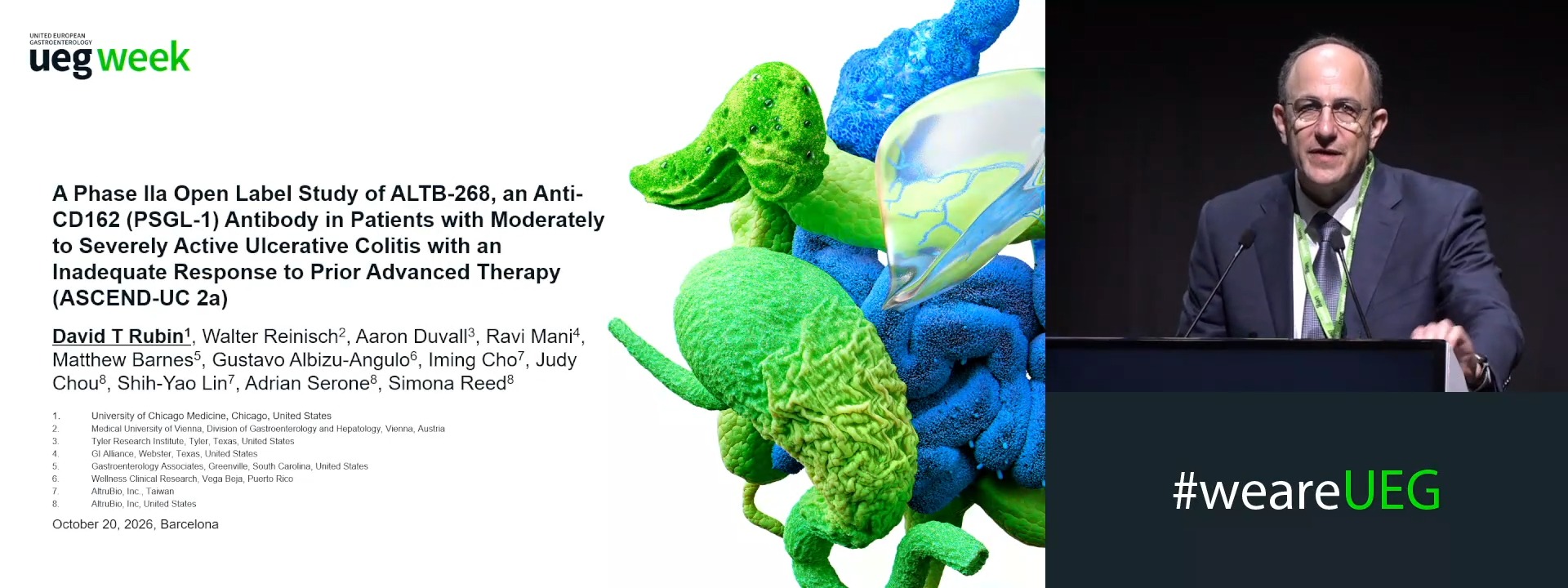
ALTB-268 is a novel immune modulatory agonistic antibody targeting human CD162 (P-selectin glycoprotein ligand‑1 [PSGL-1]), leading to downregulation of effector functions in activated T cells. Early phase clinical studies of PSGL-1 agonism have suggested therapeutic potential in immune-mediated diseases[1, 2]. Here, we report the efficacy, safety, tolerability and pharmacokinetic results of a Phase IIa trial (NCT06109441) evaluating ALTB‑268 in patients with moderately to severely active ulcerative colitis (UC) who had an inadequate response to at least one advanced therapy (AT).
Aims & Methods
Patients must have failed ≥ 1 AT and presented at screening with moderately to severely active disease, defined by a modified Mayo Score (mMS) of 5-9, inclusive, with a modified endoscopic subscore (mMES) of ≥ 2 (from central reading), and a rectal bleeding subscore (RBS) of ≥ 1. Eligible participants received subcutaneous ALTB-268 at either 500 mg followed by 250 mg weekly (Cohort 1), or 675 mg followed by 500 mg weekly (Cohort 2), for a total treatment duration of 12 weeks. Efficacy endpoints assessed at Week 12 included proportion of patients achieving i) clinical remission by mMS, ii) endoscopic improvement, iii) mMS clinical response, and iv) Inflammatory Bowel Disease Questionnaire (IBDQ) response. Safety, tolerability and pharmacokinetics were also evaluated.
Results
Thirty-five subjects were enrolled in Cohort 1, and 13 subjects were enrolled in Cohort 2. Baseline demographics and disease characteristics were similar between cohorts. Baseline disease characteristics and clinical efficacy outcomes at Week 12 are shown in Table 1. Treatment with ALTB-268 demonstrated a dose-response for induction of clinical remission, endoscopic improvement, and clinical response at Week 12. Based on preliminary exposure-response (ER) analysis, Day 29 Ctrough levels showed a statistically significant relationship with Week 12 clinical remission and identified a Ctrough threshold for efficacy (Target Ctrough). In the subset of subjects who achieved Day 29 trough concentrations above the target threshold established from the ER analysis, meaningful improvement in efficacy was observed. ALTB-268 was generally well tolerated, with injection site reactions being the most frequently reported adverse event. In Cohort 1, a maximum of 26% (9/35) of participants reported an ISR within the first 2 weeks of dosing, decreasing to < 5% (1/25) by the end of induction. In Cohort 2, a maximum of 23% (3/13) of participants reported an ISR within the first 2 weeks of dosing, decreasing to 0% (0/9) by the end of induction.
Table 1: Summary of Baseline Disease Characteristics and Induction (Week 12) Efficacy Outcomes
| Dx Characteristic | >1 Prior AT-IR % (n/N) | Mean
mMS ± SD | MES=3
% (n/N) | Pancolitis
% (n/N) |
| Cohort 1 | 57.1% (20/35) | 7.0 ± 1.15 | 54.3% (19/35) | 45.7% (16/35) |
| Cohort 2 | 53.8% (7/13) | 6.9 ± 1.26 | 69.2% (9/13) | 53.8% (7/13) |
| Efficacy Outcome | Clinical Remission
% (n/N) | Endoscopic Improvement % (n/N) | Clinical Response
% (n/N) | IBDQ Response
% (n/N) |
| Cohort 1 | 11.4% (4/35) | 17.1% (6/35) | 34.3% (12/35) | 51.4% (18/35) |
| Cohort 2 | 23.1% (3/13) | 23.1% (3/13) | 53.4% (7/13) | 53.4% (7/13) |
| Ctrough Subset1 | 38.9% (7/18) | 38.9% (7/18) | 55.5% (10/18) | 55.5% (10/18) |
- Subset of Cohort 1 & 2 subjects (combined) with Day 29 Ctrough ≥ target, as determined from ER analysis
Dx, disease; SD, standard deviation
Clinical Remission = mMS ≤ 2 points, stool frequency subscore (SFS) ≤ 1 point, a RBS = 0, and mMES ≤ 1 point; Endoscopic Improvement = mMES ≤ 1; Clinical Response = decrease from baseline in mMS ≥ 2-points and ≥ 30%, accompanied by ≥ 1-point decrease in RBS or an absolute RBS ≤ 1; IBDQ Response = increase from Baseline ≥ 16-points |
Conclusion
In this Phase IIa study, ALTB-268 demonstrated dose- and exposure-dependent clinical activity and a favorable safety profile in patients with moderately to severely active UC with an inadequate response to prior AT, supporting further clinical development.
References
1. Rubin, D.T., Lee, S.D., Flores, L., Albizu-Angulo, G., Scherl, E., Saini, S., Cho, I., Lin, SY., Reed, S., Hall, J., A phase II, open abel study of neihulizumab, an anti-CD162 (PSGL-1) antibody, in patients with moderate to severe active, anti-TNFa and/or anti-integrin refractory ulcerative colitis. Inflammatory Bowel Disease, 2023. 29: p. S77.
2. Abedin, S.H., M.; Holtan, SG.; Gary, JS.; Gallogly, M.; Waller, EK.; Kosuri, S.; Abhyankar, SH.; Anand, SM.; Gooptu, M.; Cho, I.; Reed, S.; Lin, SY.; Hall, JW.; Martin, PJ., Neihulizumab (ALTB-168) in Patients with Steroid-Refractory Acute Graft-Versus-Host-Disease (SR-aGVHD) or Treatment-Refractory Acute Graft-Versus-Host Disease (TR-aGVHD). Blood, 2022. 140: p. 10495-10497.
Disclosure
This study was funded by AltruBio, Inc. The authors had full access to the study data and take full responsibility for the content of this manuscript.