UEG's content platform for gastroenterology education bringing recordings, courses, guidelines, and more together in one place.
Trending on Gutflix
Rate for better recommendations!
Your feedback helps us show you more of what you like and less of what you dislike!
Log in to continue.
This content is part of Gutflix. Log in with your myUEG account, or create one free, to watch it.
Not sure what you can access? Learn more about account types.
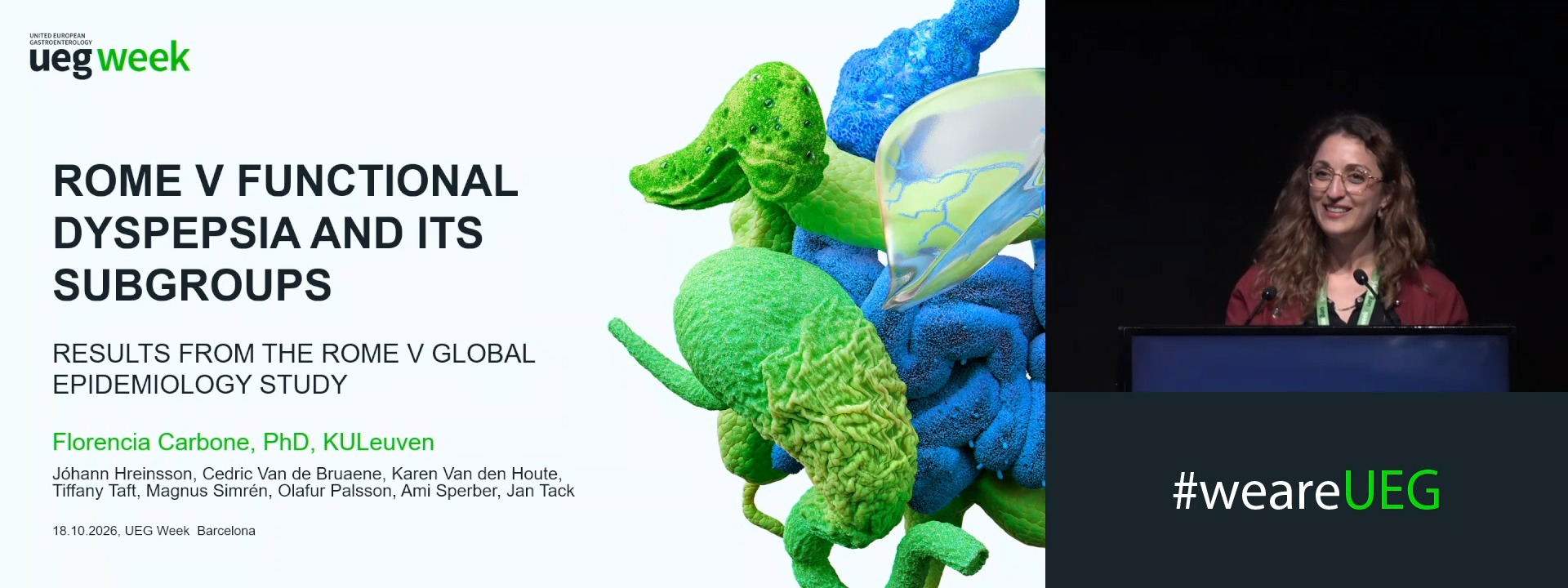
ROME V FUNCTIONAL DYSPEPSIA AND ITS SUBGROUPS: RESULTS FROM THE ROME V GLOBAL EPIDEMIOLOGY STUDY
Florencia Carbone 1, Jóhann Hreinsson 2, Cedric Van de Bruaene 1, Karen Van den Houte 1, Tiffany Taft 3,4, Olafur S. Palsson 3,5, Ami D. Sperber 3,6, Jan Tack 3,1
Affiliations
1 KULeuven, UZLeuven, Leuven, Belgium
2 University of Gothenburg, Gothenburg, Sweden
3 Rome Foundation Research Institute, North Carolina, United States
4 Northwestern University Feinberg School of Medicine, Chicago, Illinois, United States
5 University of North Carolina at Chapel Hill, Chapel Hill, North Carolina, United States
6 Ben-Gurion University of the Negev, Farod, Israel
Log in to continue.
This content is part of Gutflix. Log in with your myUEG account, or create one free, to watch it.
Not sure what you can access? Learn more about account types.
Dysbiosis vs microbiome testing
Affiliations
1 Università Cattolica del Sacro Cuore, Rome, Italy
Log in to continue.
This content is part of Gutflix. Log in with your myUEG account, or create one free, to watch it.
Not sure what you can access? Learn more about account types.
THE DUODENAL MICROENVIRONMENT IN FUNCTIONAL DYSPEPSIA SHOWS MINIMAL MOLECULAR AND FUNCTIONAL IMPACT ON THE INTESTINAL BARRIER AND MAST CELL BIOLOGY
Pauline Huyghe 1, Matthias Ceulemans 2, Theo Thijs 1, Joran Toth 1, Mona Farhadipour 3, Lorenzo Giorio 1, Kaline Arnauts 1, Åsa V. Keita 4, Bram Verstockt 5, Lucas Wauters 5, Inge Depoortere 1, Jan Tack 5, Tim Vanuytsel 5
Affiliations
1 KU Leuven, Translational Research Center for Gastrointestinal Disorders (TARGID), Leuven, Belgium
2 Precision Immunology Institute, Icahn School of Medicine at Mount Sinai, New York, United States
3 Division of Gastroenterology and Hepatology, Mayo Clinic, Rochester, United States
4 Linköping University Clinical and Exper. Medicine Faculty of Health Sciences, Linköping, Sweden
5 University Hospitals Leuven and KU Leuven, Translational Research in Gastrointestinal Disorders, Leuven, Belgium
Log in to continue.
This content is part of Gutflix. Log in with your myUEG account, or create one free, to watch it.
Not sure what you can access? Learn more about account types.
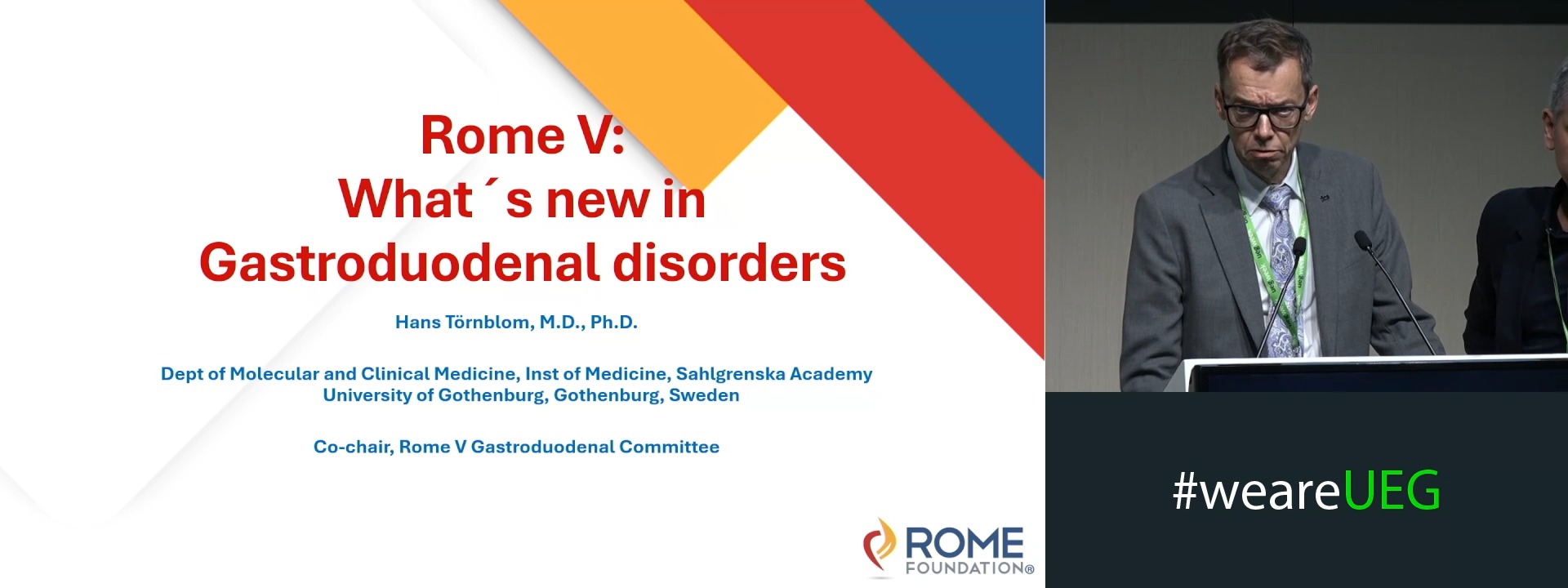
Upper GI disorders
Affiliations
1 Inst of medicine, Gothenburg, Sweden
Log in to continue.
This content is part of Gutflix. Log in with your myUEG account, or create one free, to watch it.
Not sure what you can access? Learn more about account types.
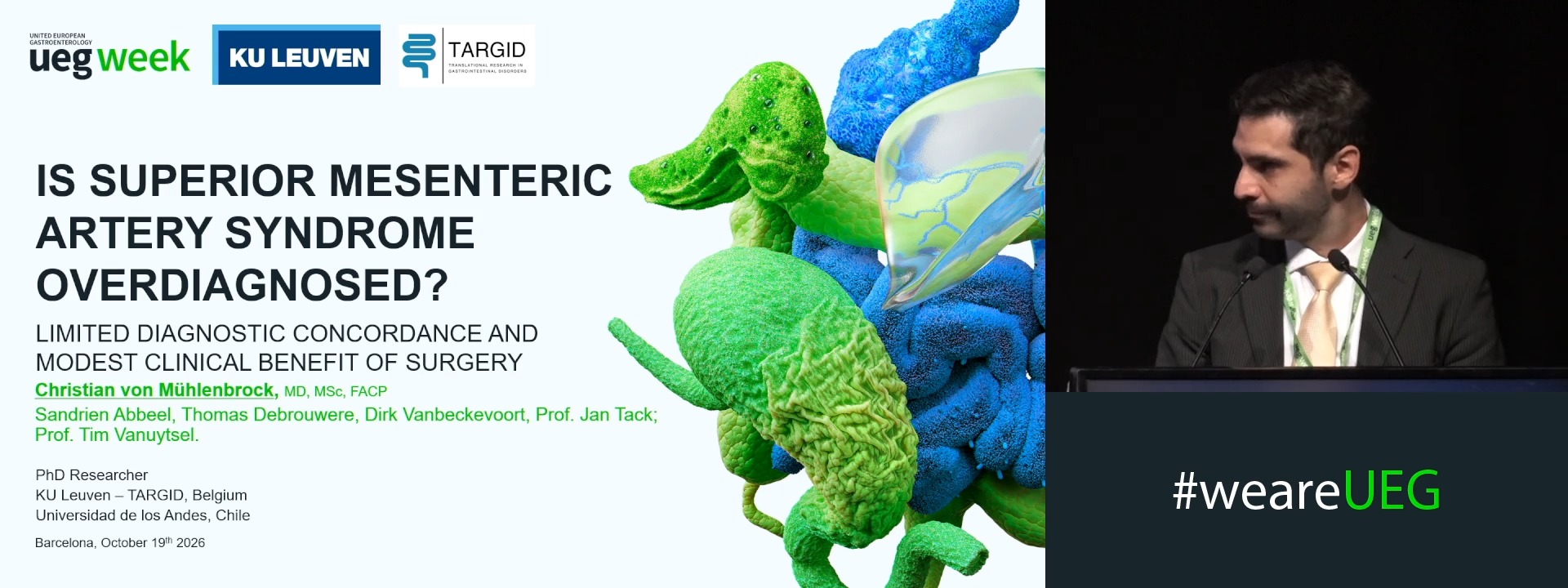
OVERDIAGNOSIS OF SUPERIOR MESENTERIC ARTERY SYNDROME: LIMITED DIAGNOSTIC CONCORDANCE BETWEEN IMAGING MODALITIES AND LIMITED BENEFIT OF SURGERY
Christian von Muhlenbrock 1,2,3, Sandrien Abbeel 4, Thomas Debrouwere 1, Dirk Vanbeckevoort 1, Jan Tack 1, Tim Vanuytsel 1
Affiliations
1 KU Leuven, Leuven, Belgium
2 Universidad de Chile, Santiago, Chile
3 Universidad de los Andes, Santiago, Chile
4 KU Leuven, Eppegem, Belgium
Log in to continue.
This content is part of Gutflix. Log in with your myUEG account, or create one free, to watch it.
Not sure what you can access? Learn more about account types.
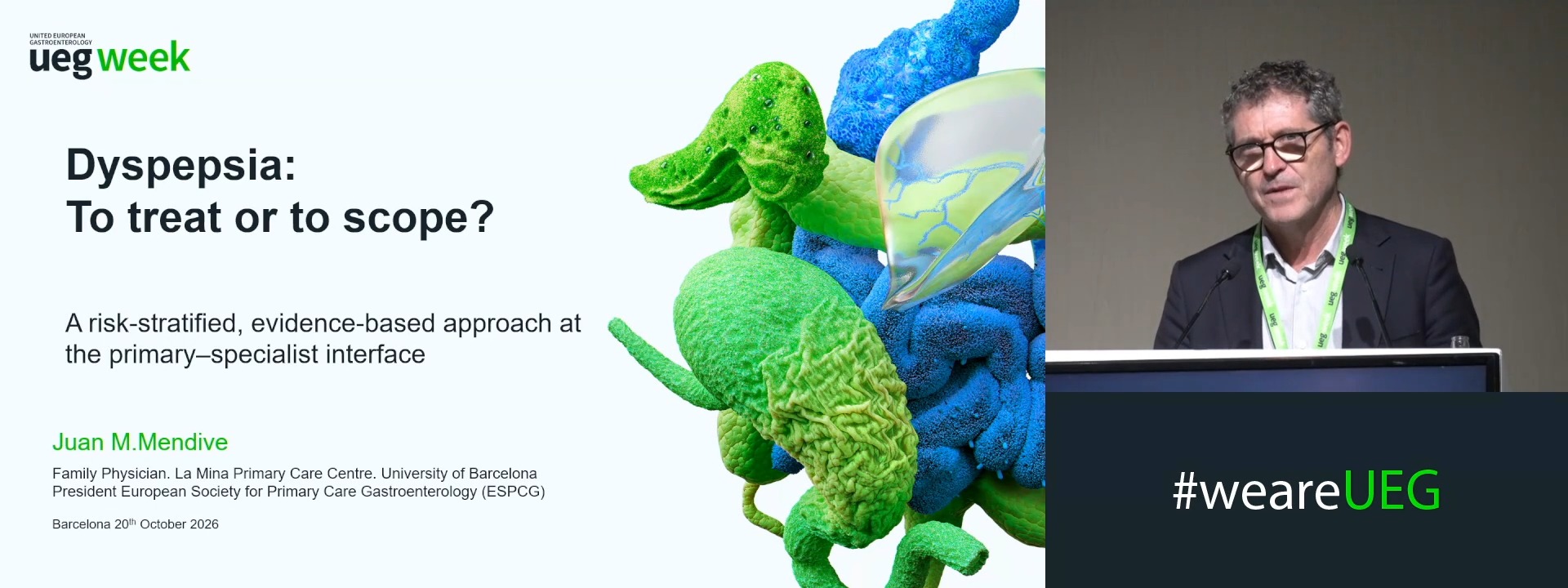
Dyspepsia: To treat or to scope
Affiliations
1 European Society for Primary Care Gastroenterology (ESPCG), Sant Adrià de Besòs ( Barcelona), Spain