UEG's content platform for gastroenterology education bringing recordings, courses, guidelines, and more together in one place.
Trending on Gutflix
Rate for better recommendations!
Your feedback helps us show you more of what you like and less of what you dislike!
Log in to continue.
This content is part of Gutflix. Log in with your myUEG account, or create one free, to watch it.
Not sure what you can access? Learn more about account types.
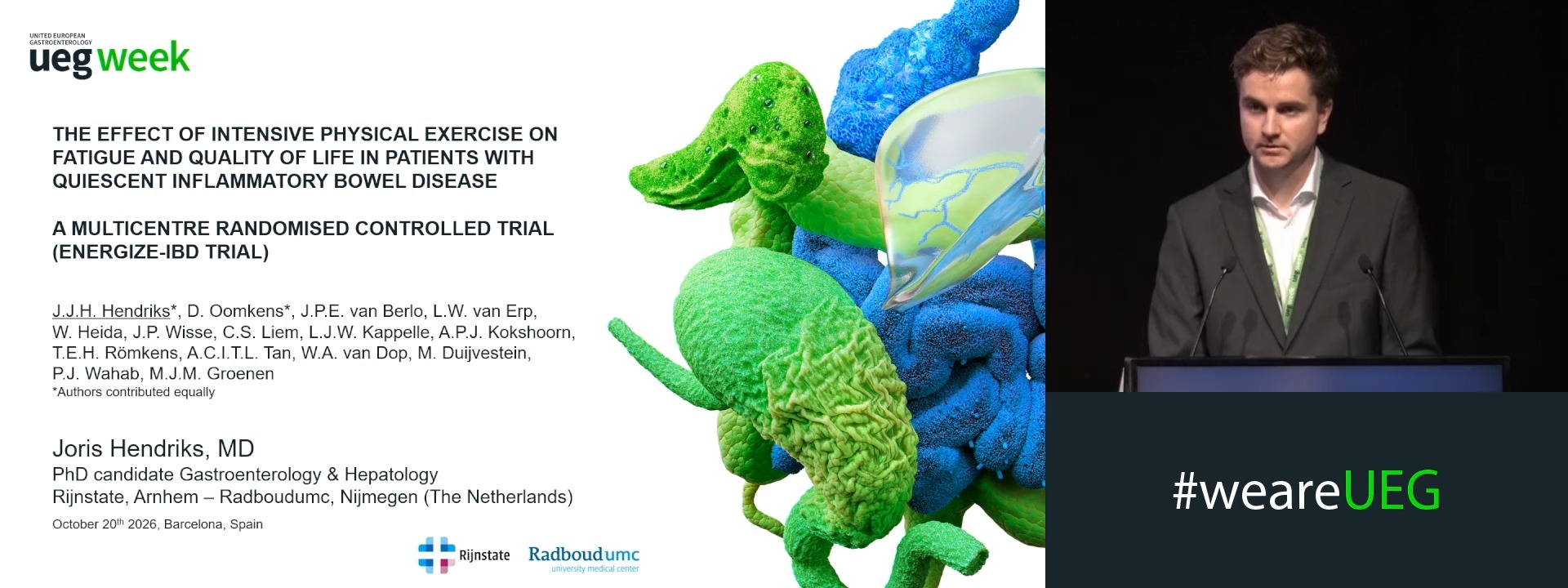
THE EFFECT OF INTENSIVE PHYSICAL EXERCISE ON FATIGUE AND QUALITY OF LIFE IN PATIENTS WITH QUIESCENT INFLAMMATORY BOWEL DISEASE: FOLLOW-UP RESULTS OF A MULTICENTRE RANDOMISED CONTROLLED TRIAL (ENERGIZE-IBD TRIAL)
Joris J H Hendriks 1,2, Dorien Oomkens 1,2, Jole P. E. van Berlo 1, Liselot van Erp 1, Wendy Heida 1, Jolien P. Wisse 1, Camilo S. Liem 3, Laurens J. W. Kappelle 4, Robert E. H. van Cingel 4,2, Arjan P. J. Kokshoorn 5, Tessa E.H. Römkens 5, Adriaan Tan 6, Willemijn Van Dop 2, Marjolijn Duijvestein 2, Peter J Wahab 1, Marcel J.M. Groenen 1
Affiliations
1 Rijnstate, Arnhem, Netherlands
2 Radboud University Medical Centre, Nijmegen, Netherlands
3 Formupgrade Sports Centre, Arnhem, Netherlands
4 Sport Medisch Centrum Papendal, Arnhem, Netherlands
5 Jeroen Bosch Hospital, 's-Hertogenbosch, Netherlands
6 Canisius Wilhelmina Hospital, Nijmegen, Netherlands
Log in to continue.
This content is part of Gutflix. Log in with your myUEG account, or create one free, to watch it.
Not sure what you can access? Learn more about account types.
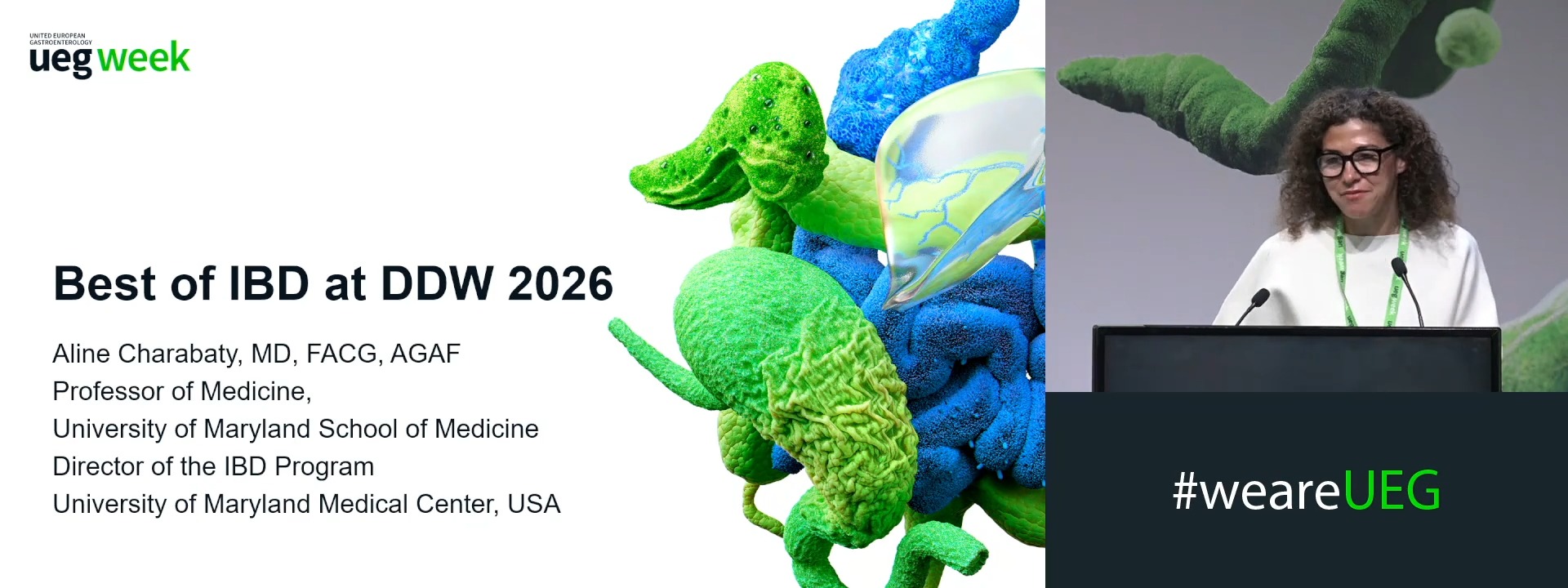
IBD
Affiliations
1 Johns Hopkins University School of Medicine, Baltimore, United States of America
Log in to continue.
This content is part of Gutflix. Log in with your myUEG account, or create one free, to watch it.
Not sure what you can access? Learn more about account types.
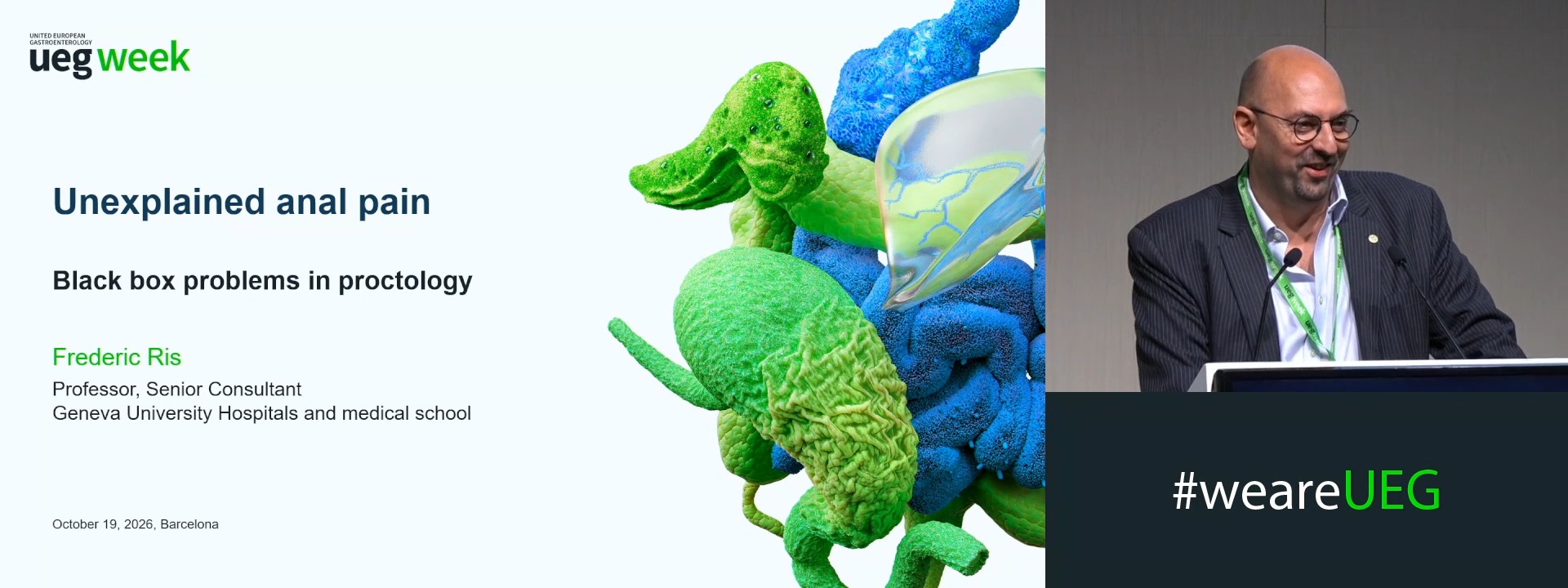
Unexplained anal pain
Affiliations
1 Geneva University Hospitals, Geneva, Switzerland
Log in to continue.
This content is part of Gutflix. Log in with your myUEG account, or create one free, to watch it.
Not sure what you can access? Learn more about account types.
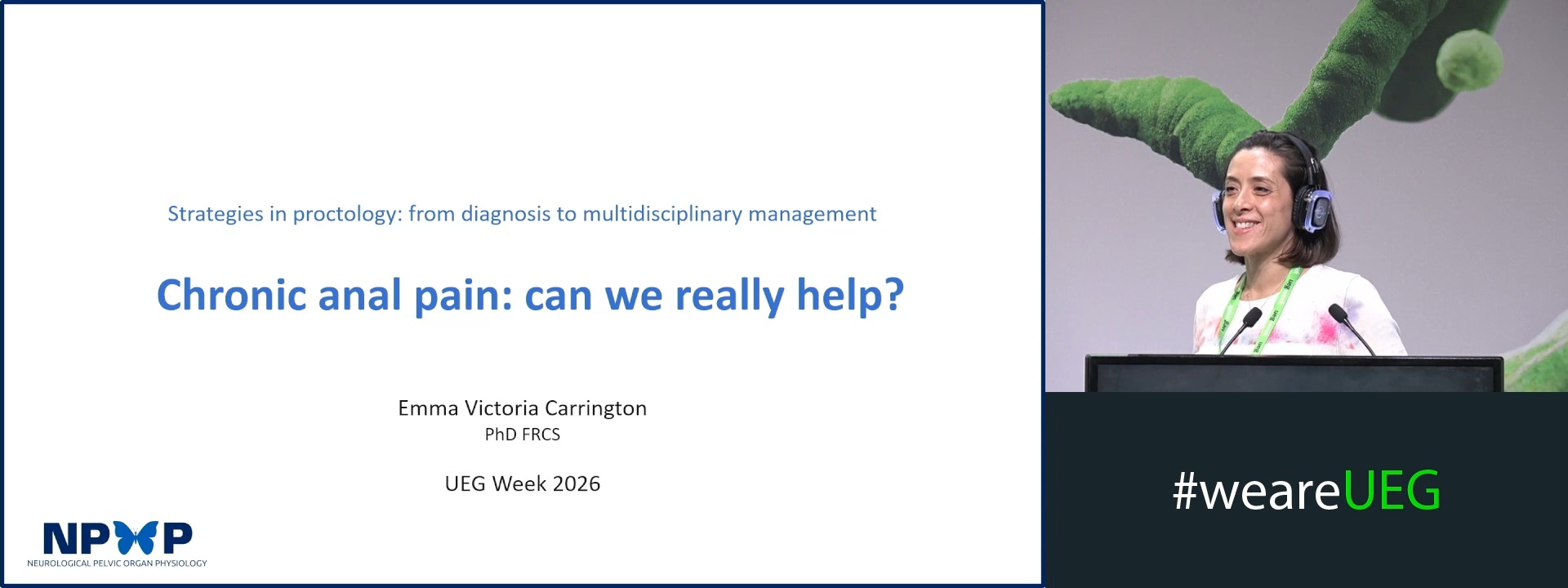
Chronic anal pain: Can we really help?
Affiliations
1 University of North Carolina / NCRBSI, London, United Kingdom

Log in to continue.
This content is part of Gutflix. Log in with your myUEG account, or create one free, to watch it.
Not sure what you can access? Learn more about account types.
What is the approach to malabsorption
Affiliations
1 Charité Berlin, Berlin, Germany