UEG's content platform for gastroenterology education bringing recordings, courses, guidelines, and more together in one place.
Trending on Gutflix
Rate for better recommendations!
Your feedback helps us show you more of what you like and less of what you dislike!
Log in to continue.
This content is part of Gutflix. Log in with your myUEG account, or create one free, to watch it.
Not sure what you can access? Learn more about account types.
Panel discussion: Beyond calories: Managing complications and refeeding syndrome in clinical nutrition support
Log in to continue.
This content is part of Gutflix. Log in with your myUEG account, or create one free, to watch it.
Not sure what you can access? Learn more about account types.
A is for alcohol-related liver disease
Affiliations
1 Hospital Clínic of Barcelona - IDIBAPS, Barcelona, Spain
Log in to continue.
This content is part of Gutflix. Log in with your myUEG account, or create one free, to watch it.
Not sure what you can access? Learn more about account types.
Can I trust elastography and blood-based non-invasive tests in case of ongoing drinking or active inflammation? Yes or no?
Affiliations
1 Fondazione IRCCS Ca' Granda Ospedale Maggiore Policlinico, Milan, Italy
2 University Medical Centre Hamburg-Eppendorf, Hamburg, Germany
Log in to continue.
This content is part of Gutflix. Log in with your myUEG account, or create one free, to watch it.
Not sure what you can access? Learn more about account types.
Liver nurses & allied health professions in Europe – the EASL Nurses and AHP Taskforce
Log in to continue.
This content is part of Gutflix. Log in with your myUEG account, or create one free, to watch it.
Not sure what you can access? Learn more about account types.
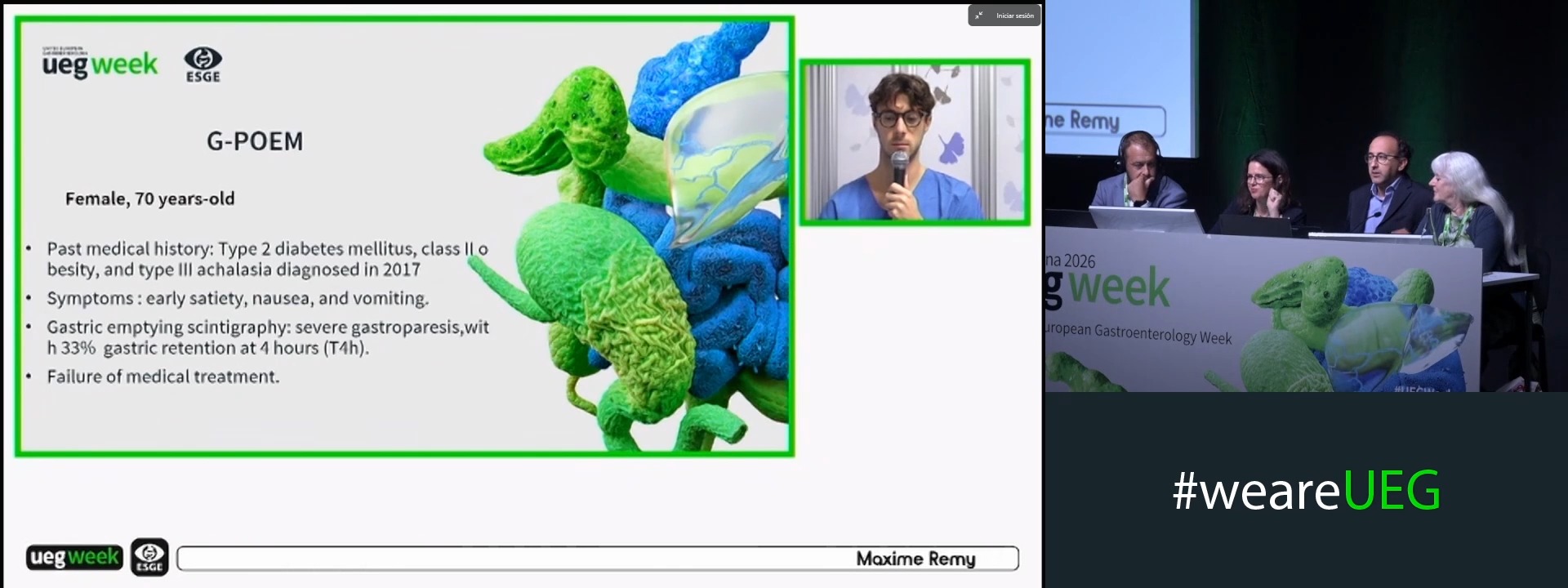
THE DOMINANCE OF HOST COMORBIDITIES OVER CYSTIC MORPHOLOGY IN MANAGEMENT OF INTRADUCTAL PAPILLARY MUCINOUS NEOPLASMS: A COMPETING RISK ANALYSIS IN HIGH-RISK HOST POPULATIONS
Affiliations
1 Peking Union Medical College Hospital, Beijing, China
Log in to continue.
This content is part of Gutflix. Log in with your myUEG account, or create one free, to watch it.
Not sure what you can access? Learn more about account types.
ESGE live endoscopy I (Complete Session)
Log in to continue.
This content is part of Gutflix. Log in with your myUEG account, or create one free, to watch it.
Not sure what you can access? Learn more about account types.
ESGE live endoscopy III (Complete Session)