UEG's educational platform for gastroenterology education bringing recordings, courses, guidelines, and more together in one place.
Most popular content
Rate for better recommendations!
Your feedback helps us show you more of what you like and less of what you dislike!
Log in to access this content.
Free for all myUEG account holders. Your access level is set automatically based on your occupation. Medical professionals get full access to all content. If you are a non-medical user, you can only access UEG Week content from congresses you attended.
Not sure what you can access? Learn more about account types.

INTERNATIONAL CONSENSUS STATEMENTS ON THE USE OF TOPICAL ENDOSCOPIC HAEMOSTATIC AGENTS IN THE TREATMENT OF ACUTE GASTROINTESTINAL BLEEDING
mohamed hussein 1, Apostolis Papaefthymiou 2, Sachin Wani 3, Joseph Sung 4, Amit Rastogi 5, Paul Bassett 6, Benjamin Norton 2, Andrea Telese 2, Allan John Morris 7, Mostafa Ibrahim 8, Krish Ragunath 9, James Y. Lau 10, John Anderson 11, Andy Tau 12, Lawrence Hookey 13, Seth A. Gross 14, Alan N. Barkun 15, Martin Goetz 16, Vivek Kaul 17, Rehan Haidry 2
1 Guy's and St Thomas' Hospital, London, United Kingdom
2 Cleveland Clinic London, London, United Kingdom
3 University of Colorado, Aurora, United States
4 4. Nanyang Technological University, Singapore, Singapore
5 The University of Kansas Hospital, Kansas, United States
6 Stats consultancy Ltd, Amersham, United Kingdom
7 Glasgow Royal Infirmary, Glasgow, United Kingdom
8 Theodor Bilharz Research Institute, Giza, Egypt
9 Royal Perth Hospital, Perth, Australia
10 The Chinese University Of Hong Kong, Hong Kong, Hong Kong
11 Gloucestershire Hospitals NHS Foundation Trust, Gloucestershire, United Kingdom
12 Austin Gastroenterology, Texas, United States
13 Queen's University, Ontario, Canada
14 Nyu Medical School, New York, NY, United States
15 McGill University, Montreal, Canada
16 Böblingen Clinic, Böblingen, Germany
17 University of Rochester, Medical Center, Rochester, United States
Conference
Topics
Submission format
Session
Citation
Published
Log in to access this content.
Free for all myUEG account holders. Your access level is set automatically based on your occupation. Medical professionals get full access to all content. If you are a non-medical user, you can only access UEG Week content from congresses you attended.
Not sure what you can access? Learn more about account types.
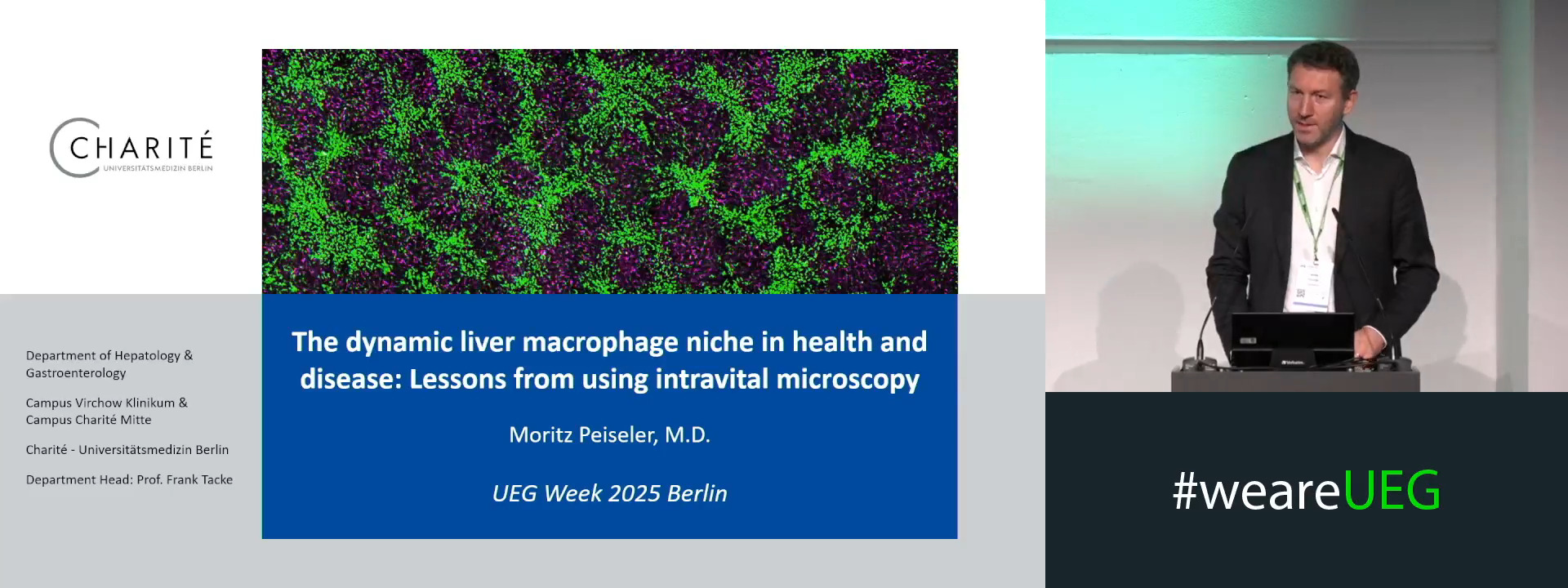
The dynamic liver macrophage niche in health and disease: Lessons from using intravital microscopy
1 Charité University Medicine Berlin, Berlin, Germany
Event
Citation
Published
Log in to access this content.
Free for all myUEG account holders. Your access level is set automatically based on your occupation. Medical professionals get full access to all content. If you are a non-medical user, you can only access UEG Week content from congresses you attended.
Not sure what you can access? Learn more about account types.
RED PACK CELL TRANSFUSIONS BEFORE OR AFTER ENDOSCOPY IN PATIENTS WITH ACUTE UPPER GASTROINTESTINAL BLEEDING. A MULTICENTRE PROSPECTIVE COHORT STUDY
1 Fondazione Policlinico Universitario Agostino Gemelli, IRCCS, Università Cattolica del Sacro Cuore, Rome, Italy
2 Cristina Bucci, Naples, Italy
3 A. Manzoni Hospital, Lecco, Italy
4 Hospital L. Curto, Polla (Salerno), Italy
Conference
Topics
Submission format
Citation
Published
Log in to access this content.
Free for all myUEG account holders. Your access level is set automatically based on your occupation. Medical professionals get full access to all content. If you are a non-medical user, you can only access UEG Week content from congresses you attended.
Not sure what you can access? Learn more about account types.
GASTRIC AND DUODENAL CANCER IN LYNCH SYNDROME: INCIDENCE AND YIELD OF UPPER ENDOSCOPY SURVEILLANCE
1 Hospital General Universitario Dr Balmis de Alicante, Alicante, Spain
Conference
Topics
Submission format
Citation
Published
Log in to access this content.
Free for all myUEG account holders. Your access level is set automatically based on your occupation. Medical professionals get full access to all content. If you are a non-medical user, you can only access UEG Week content from congresses you attended.
Not sure what you can access? Learn more about account types.
NOT ALWAYS MECKEL’S: THE ROLE OF GASTRIC HETEROTOPIA IN GASTROINTESTINAL BLEEDING
Joana Camões Neves 1, José Damasceno 2, Andreia Guimarães 3, Patrícia Vaz Conde 4, Bruno Arroja 4, Raquel Gonçalves 4, Dalila Costa 5
1 Braga Hospital, Porto, Portugal
2 Braga Hospital, Vila Nova de Gaia, Portugal
3 Hospital Braga, Guimarães, Portugal
4 Braga Hospital, Braga, Portugal
5 Hospital de Braga, Braga, Portugal
Conference
Topics
Submission format
Session
Published
Log in to access this content.
Free for all myUEG account holders. Your access level is set automatically based on your occupation. Medical professionals get full access to all content. If you are a non-medical user, you can only access UEG Week content from congresses you attended.
Not sure what you can access? Learn more about account types.
THE PROGNOSTIC VALUE OF NEUTROPHIL-LYMPHOCYTE RATIO IN PATIENTS WITH ALCOHOLIC HEPATITIS
Moises Coutiño Flores 1, Lucia Amairani Robles Casanova 1, Gabriela Breton 1, Katy Alejandra Sanchez Pozos 1, Jesus Ignacio Mazadiego Cid. 1, Antonio Coutiño Flores 1, Scherezada Mejia 1, Eumir Israel Juárez Valdés 1, Maria del Rosario Herrero Maceda 1
1 Juarez Hospital of Mexico, Mexico City, Mexico
Conference
Topics
Submission format
Citation
Published
Log in to access this content.
Free for all myUEG account holders. Your access level is set automatically based on your occupation. Medical professionals get full access to all content. If you are a non-medical user, you can only access UEG Week content from congresses you attended.
Not sure what you can access? Learn more about account types.
SEVERE PERFORATED DIVERTICULITIS IN A YOUNG ADULT UNMASKING ASCARIS INFESTATION: A MULTIDIMENSIONAL SURGICAL AND INFECTIOUS CHALLENGE
1 Emirates Health Services, Sharjah, United Arab Emirates
2 Emirates Health Services, Ras Al-Khiemah, United Arab Emirates
Conference
Topics
Submission format
Session