UEG's educational platform for gastroenterology education bringing recordings, courses, guidelines, and more together in one place.
Most popular content
Rate for better recommendations!
Your feedback helps us show you more of what you like and less of what you dislike!
Log in to access this content.
Free for all myUEG account holders. Your access level is set automatically based on your occupation. Medical professionals get full access to all content. If you are a non-medical user, you can only access UEG Week content from congresses you attended.
Not sure what you can access? Learn more about account types.
The effectiveness of an extended bowel preparation regimen in capsule endoscopy
1 Mater Dei Hospital, Zabbar, Malta
Event
Topics
Citation
Published
Log in to access this content.
Free for all myUEG account holders. Your access level is set automatically based on your occupation. Medical professionals get full access to all content. If you are a non-medical user, you can only access UEG Week content from congresses you attended.
Not sure what you can access? Learn more about account types.
How to classify: Remove or discard?
1 Southampton University Hospital NHS Trust, Southampton, United Kingdom
Event
Topics
Session
Citation
Published
Log in to access this content.
Free for all myUEG account holders. Your access level is set automatically based on your occupation. Medical professionals get full access to all content. If you are a non-medical user, you can only access UEG Week content from congresses you attended.
Not sure what you can access? Learn more about account types.
Colonoscopy
1 Wolfson Unit St Marks, London, United Kingdom
Event
Topics
Session
Citation
Published
Log in to access this content.
Free for all myUEG account holders. Your access level is set automatically based on your occupation. Medical professionals get full access to all content. If you are a non-medical user, you can only access UEG Week content from congresses you attended.
Not sure what you can access? Learn more about account types.
Building an endoscopy department: Looking at the workflow after the first year
1 AMC Amsterdam Dept. of Endoscopy, Amsterdam, Netherlands
Event
Topics
Citation
Published
Log in to access this content.
Free for all myUEG account holders. Your access level is set automatically based on your occupation. Medical professionals get full access to all content. If you are a non-medical user, you can only access UEG Week content from congresses you attended.
Not sure what you can access? Learn more about account types.
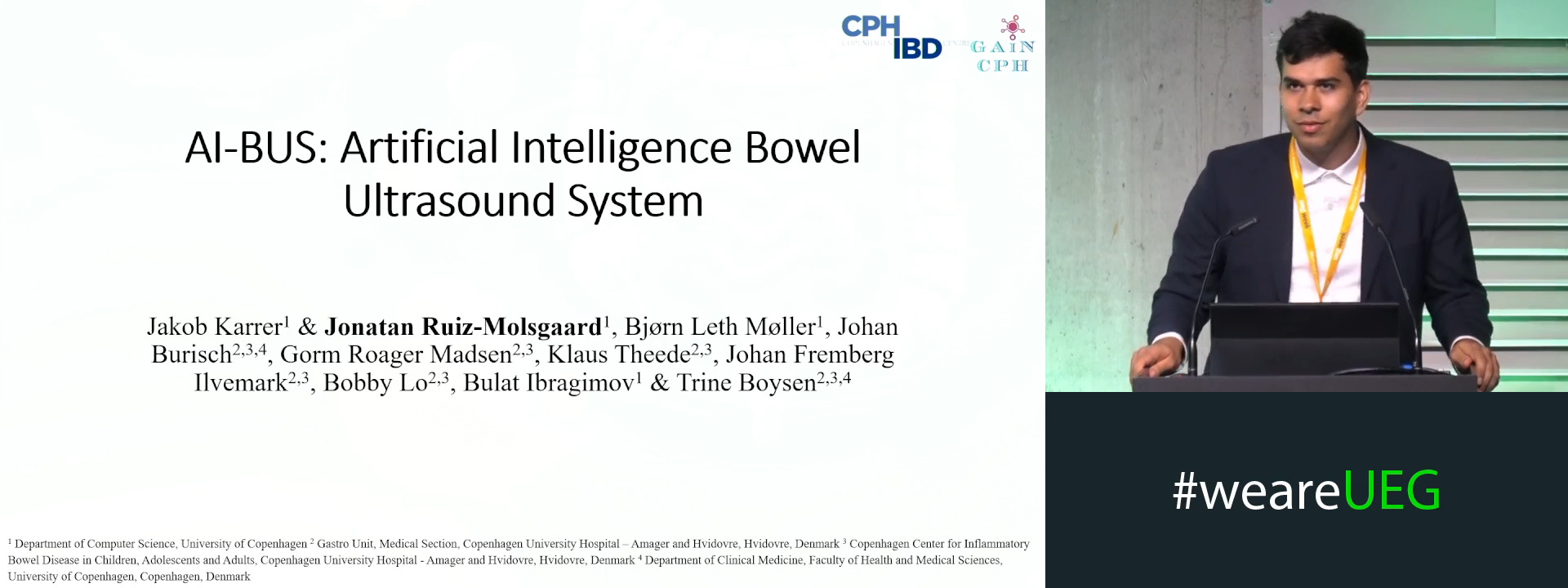
AI-BUS: ARTIFICIAL INTELLIGENCE BOWEL ULTRASOUND SYSTEM
Jonatan Ruiz-Molsgaard 1, Jakob Karrer 1, Bobby Lo 2, Bjørn Leth Møller 3, Gorm Roager Madsen 2, Johan Fremberg Ilvemark 4, Klaus Theede 2, Johan Burisch 2, Bulat Ibragimov 3, Trine Boysen 2
1 University of copenhagen, Copenhagen, Denmark|||Hvidovre Hospital, Hvidovre, Denmark
2 Hvidovre Hospital, Hvidovre, Denmark
3 University of copenhagen, Copenhagen, Denmark
4 Herlev University Hospital, Hvidovre, Denmark
Event
Topics
Submission format
Session
Citation
Published
Log in to access this content.
Free for all myUEG account holders. Your access level is set automatically based on your occupation. Medical professionals get full access to all content. If you are a non-medical user, you can only access UEG Week content from congresses you attended.
Not sure what you can access? Learn more about account types.
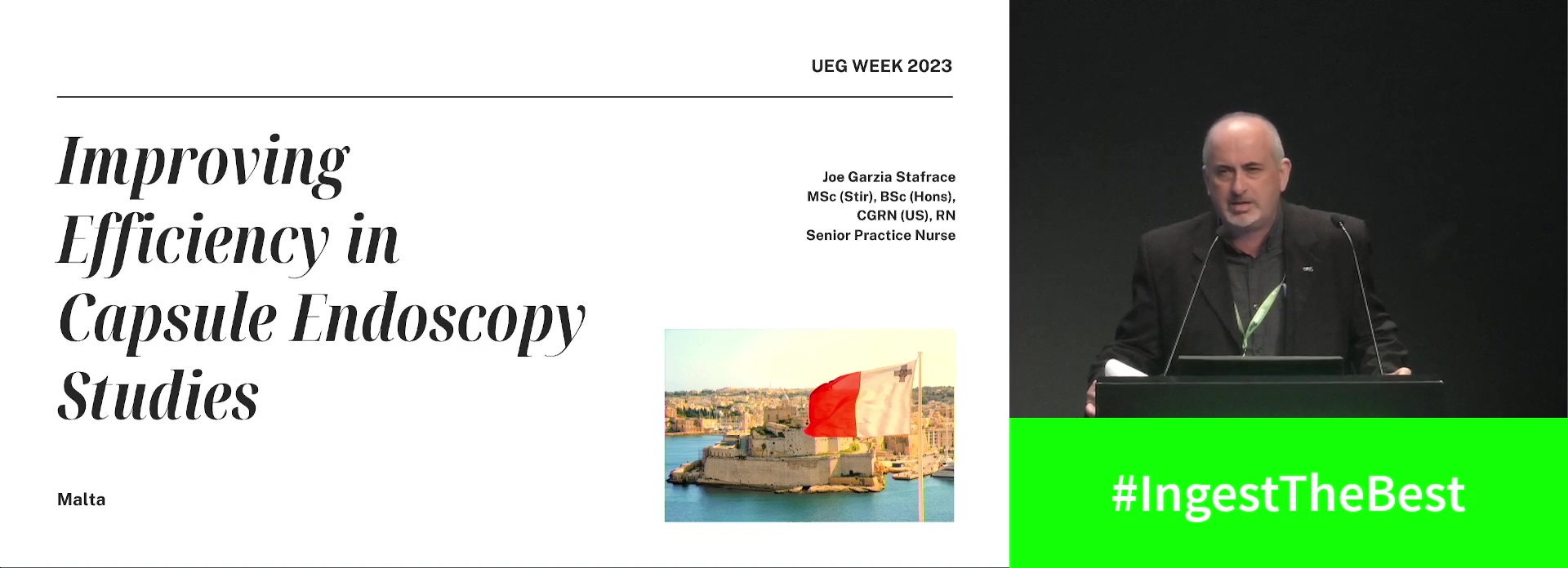
The effectiveness of an extended bowel preparation regimen in capsule endoscopy
1 Mater Dei Hospital, Zabbar, Malta
Event
Published
Log in to access this content.
Free for all myUEG account holders. Your access level is set automatically based on your occupation. Medical professionals get full access to all content. If you are a non-medical user, you can only access UEG Week content from congresses you attended.
Not sure what you can access? Learn more about account types.
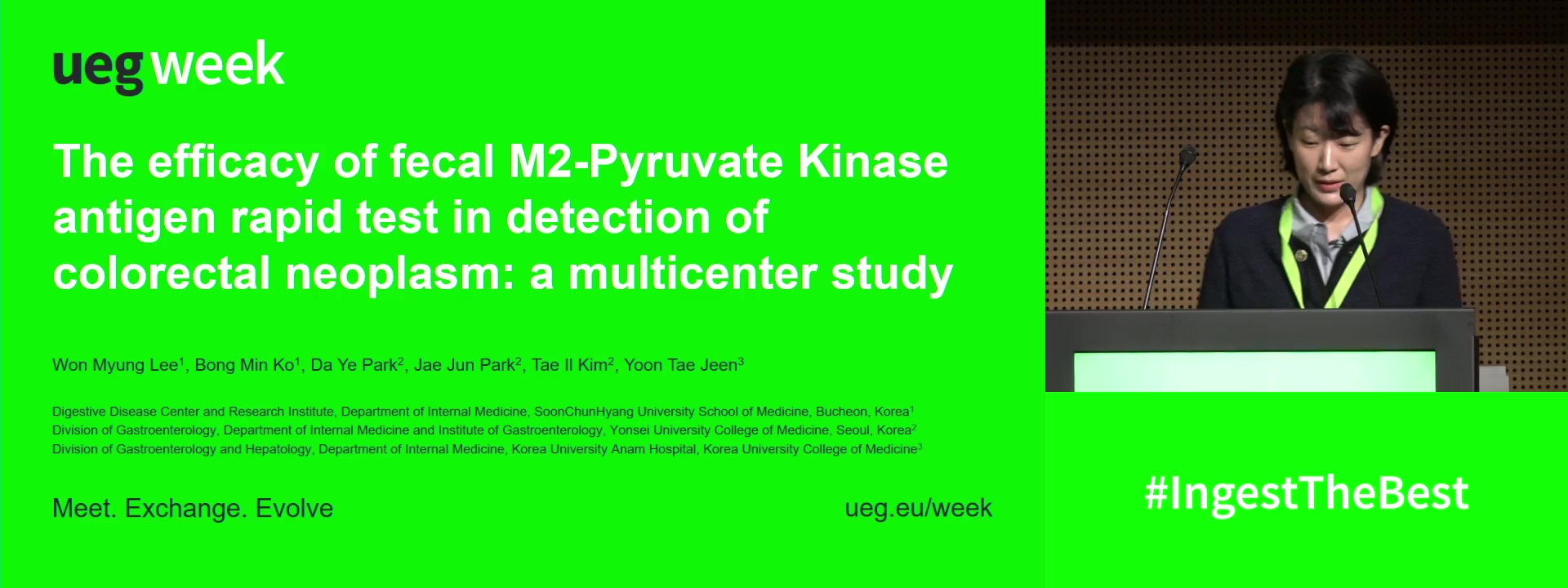
THE EFFICACY OF FECAL M2-PYRUVATE KINASE ANTIGEN RAPID TEST IN DETECTION OF COLORECTAL NEOPLASM: A MULTICENTER STUDY
1 SoonChunHyang University School of Medicine, Korea, Bucheon, Korea, Republic of
2 Yonsei University College of Medicine, Seoul, Korea, Republic of
3 Severance Hospital, Yonsei University College of Medicine, Seoul, Korea, Republic of
4 Institute of Digestive Disease and Nutrition, Korea University College of Medicine, Seoul, Korea, Republic of
Event
Submission format
Session