UEG's content platform for gastroenterology education bringing recordings, courses, guidelines, and more together in one place.
Trending on Gutflix
Rate for better recommendations!
Your feedback helps us show you more of what you like and less of what you dislike!
Log in to continue.
This content is part of Gutflix. Log in with your myUEG account, or create one free, to watch it.
Not sure what you can access? Learn more about account types.
Q&A: Chronic constipation: How to diagnose and treat this frequent condition in clinical practice
Log in to continue.
This content is part of Gutflix. Log in with your myUEG account, or create one free, to watch it.
Not sure what you can access? Learn more about account types.
Summary: H. pylori and precancerous conditions
Affiliations
1 University of Latvia, Riga, Latvia
Log in to continue.
This content is part of Gutflix. Log in with your myUEG account, or create one free, to watch it.
Not sure what you can access? Learn more about account types.
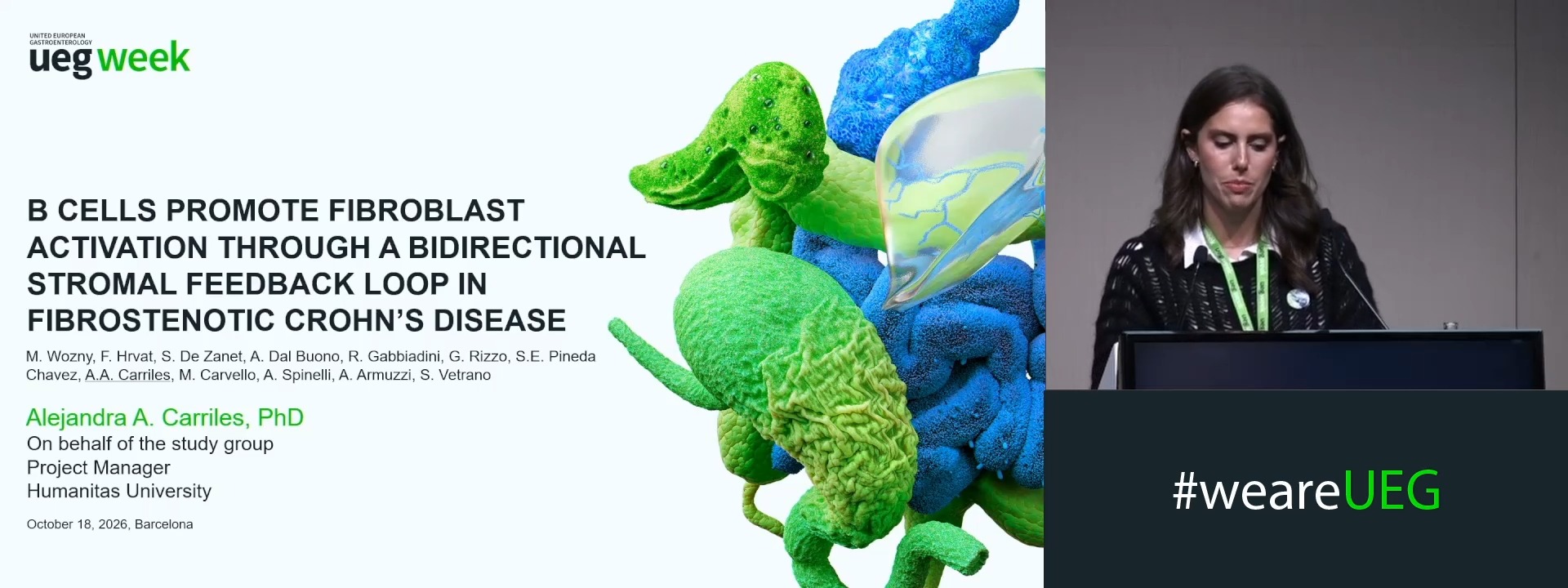
B CELLS PROMOTE FIBROBLAST ACTIVATION THROUGH A BIDIRECTIONAL STROMAL FEEDBACK LOOP IN FIBROSTENOTIC CROHN’S DISEASE
Marek Wozny 1, Faris Hrvat 1, Stefano De Zanet 2, Arianna Dal Buono 3, Roberto Gabbiadini 3, Giulia Rizzo 4, Samuel Elias Pineda Chavez 5, Alejandra Angela Carriles Linares 1, Michele Carvello 2, Antonino Spinelli 6, Alessandro Armuzzi 7, Stefania Vetrano 8
Affiliations
1 Humanitas University, Pieve Emanuele, Italy
2 IRCCS Humanitas Research Hospital, Rozzano, Italy
3 Humanitas University, Milan, Italy
4 Humanitas Research Hospital, Rozzano, Italy
5 Humanitas University, Rozzano, Italy
6 Humanitas University, Rozzano Milano, Italy
7 IBD Center, IRCCS Humanitas Research Hospital, Rozzano, Milan, Italy
8 Istituto Clinico Humanitas Dept. of Gastroenterology, Rozzano, Italy
Log in to continue.
This content is part of Gutflix. Log in with your myUEG account, or create one free, to watch it.
Not sure what you can access? Learn more about account types.
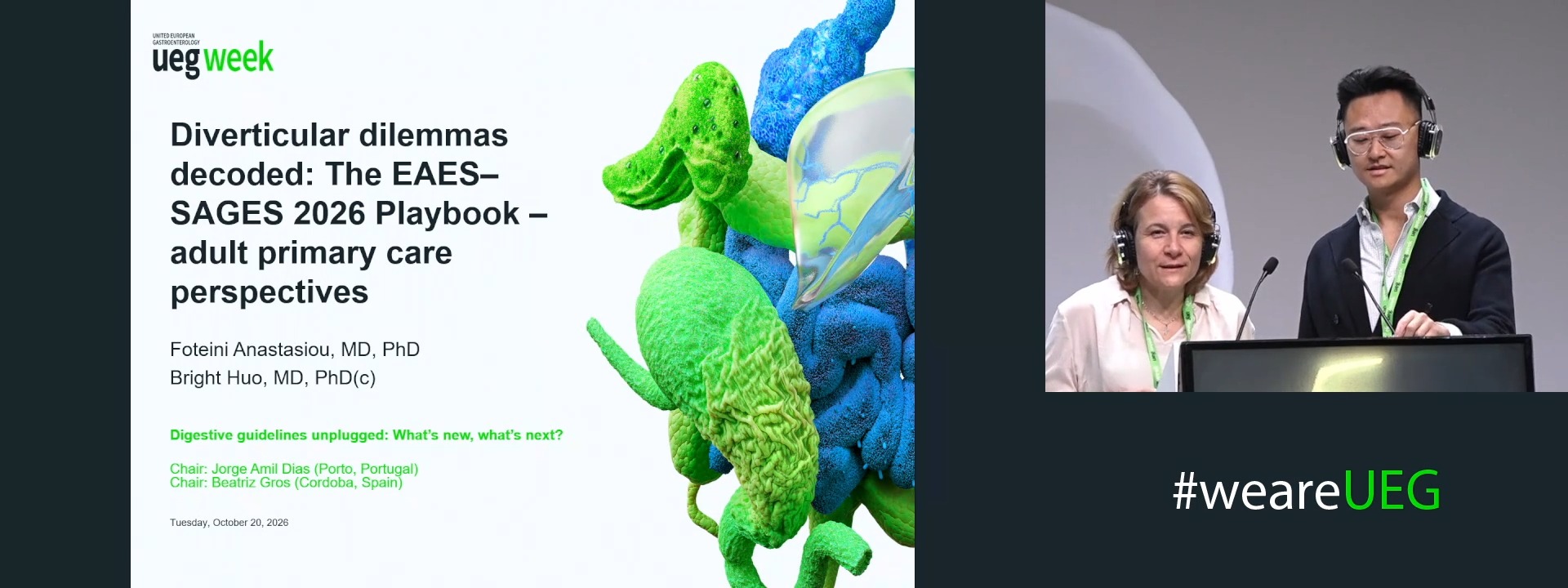
Diverticular dilemmas decoded: The EAES–SAGES 2026 Playbook – adult and primary care perspectives
Affiliations
1 4rth Local Primary Health Care Team (TOMY) - Municipality Practice-Academic Practice of Heraklion, Crete, Heraklion, Crete, Greece
2 McMaster University, Hamilton, Canada
Log in to continue.
This content is part of Gutflix. Log in with your myUEG account, or create one free, to watch it.
Not sure what you can access? Learn more about account types.
Immunodeficiency-associated enteropathy
Affiliations
1 Vrije Universiteit Medical Center, Amsterdam, Netherlands
Log in to continue.
This content is part of Gutflix. Log in with your myUEG account, or create one free, to watch it.
Not sure what you can access? Learn more about account types.
Anal rejuvenation
Affiliations
1 ProctoDUO Clinic, Porto Alegre, Brazil
Log in to continue.
This content is part of Gutflix. Log in with your myUEG account, or create one free, to watch it.
Not sure what you can access? Learn more about account types.
Intrarectal botox: A game changer?
Affiliations
1 Rouen University Hospital, Rouen, France